


Most new traders think their account balance is their money.

David van der Merwe
Emerging Markets Trader ·  South Africa
☕ 10 min read
What you'll learn:
- 1Balance, Equity, and Free Margin: The Holy Trinity
- 2How Equity Dictates Your Survival
- 3Calculating Equity: Real Examples with Rands
- 4The Top 3 Equity Mistakes South African Traders Make
- 5Practical Strategies to Manage Your Equity
- 6Equity Considerations for Scalpers, Swing Traders, and Prop Traders
- 7Tools and Mental Models to Keep Equity Front of Mind

Most new traders think their account balance is their money. They're wrong, and that mistake blows accounts. Your balance is just a history book. Your equity is your real, live net worth in the market right now, and if you don't watch it like a hawk, you're finished. I've seen too many guys in Joburg and Cape Town get a margin call because they confused the two. Let's set the record straight on the equity definition in forex, why it's the only number that matters when you're in a trade, and how to use it to survive.
If you don't understand these three numbers on your MT4/MT5 platform, you're driving blindfolded. Here's the blunt breakdown.
Balance: This is your cash-in-hand from closed trades. It only changes when you close a position for a profit or loss. Think of it as your bank statement from yesterday. It tells you nothing about the live battle happening right now.
Equity: This is your current net worth. It's your Balance plus or minus the floating Profit/Loss of all your open trades. This number updates in real-time with every tick of the market. If you have one trade open and it's down R500, your Equity is your Balance minus R500. This is the equity definition in forex you must burn into your brain. It's what your broker uses to decide if you're still solvent enough to keep trading.
Free Margin: This is your available ammunition. It's your Equity minus the Margin currently being used to hold your open positions. This is the money you have left to open new trades. When Free Margin hits zero, you can't open any more positions. You're maxed out.

Warning: A common rookie error is seeing a positive Balance and thinking you have money to trade. If your open trades are deep in the red, your Equity (and thus your Free Margin) could be almost zero, putting you seconds from a margin call.

💡 Winston's Tip
Your balance is a rear-view mirror. Your equity is the windshield. You drive by looking forward, not backward.

“Your equity is your real, live net worth in the market right now, and if you don't watch it like a hawk, you're finished.”
Your equity isn't just a number, it's your lifeline. It directly controls two critical broker functions that can end your trading day.
The Margin Call and Stop Out Levels
South African brokers (and all regulated ones) have strict rules. When your Equity falls to a certain percentage of your used Margin, you get a Margin Call. This is usually a warning. If your Equity drops further to the Stop Out Level, the broker starts automatically closing your losing positions, biggest loser first, until your Equity is back above the required level. For many brokers, this sequence is:
- Margin Call at 100% Equity/Margin (you're using 100% of your equity as margin).
- Stop Out at 50% Equity/Margin (your equity is now half your used margin).
Let me give you a real example from my early days. I deposited $1,000 (about R18,000 at the time). I opened a few gold (XAU/USD) positions, using $800 as margin. My Balance was $1,000. My Equity started at $1,000. The trade went against me. My floating loss hit -$300. My Equity dropped to $700. My Free Margin was now negative because my Equity ($700) was less than my Used Margin ($800). Boom. Margin Call. I didn't act fast enough, and at a 50% Stop Out, my positions were liquidated. I lost $350 in minutes. I was fixated on the price of gold, not my Equity. Never again.
Equity Determines Your Real Position Size
Your risk on any new trade should be a percentage of your Equity, not your Balance. Why? Because your Balance ignores your current risk exposure. If you have open losing trades, your Equity is lower, so your risk per trade should be smaller. A proper position size calculator uses Equity as its base. Using Balance when you're down is a surefire way to over-use and compound a bad day.
“A common rookie error is seeing a positive Balance and thinking you have money to trade.”
Let's make this practical with South African Rands. Assume you're trading with a broker like Exness or IC Markets.
Scenario 1: A Simple Trade
- You deposit R10,000. Your Balance = R10,000. Equity = R10,000.
- You buy 0.1 lot of EUR/USD. Margin required = R2,000.
- Free Margin = Equity (R10,000) - Used Margin (R2,000) = R8,000.
- The trade moves in your favor by +R300.
- Your Balance is still R10,000 (trade is open).
- Your Equity is now R10,000 + R300 = R10,300.
- Your Free Margin is now R10,300 - R2,000 = R8,300.
Scenario 2: A Losing Trade (The Dangerous One)
- Same start: Deposit R10,000. Balance & Equity = R10,000.
- You buy 0.2 lots of USD/ZAR. Margin required = R4,000.
- The ZAR strengthens. Your trade is at a floating loss of -R1,500.
- Your Balance = R10,000.
- Your Equity = R10,000 - R1,500 = R8,500.
- Your Free Margin = R8,500 - R4,000 = R4,500.
- Your Equity/Margin ratio = (R8,500 / R4,000) * 100 = 212.5%.
You're still okay, but your cushion is shrinking. If that loss grows to -R3,500, your Equity drops to R6,500. Your Equity/Margin ratio is now 162.5%. Getting closer. If it hits -R5,000, Equity is R5,000 and your ratio is 125%. You're sweating. This is why monitoring Equity is non-negotiable.

Example: The Stop Out Calculation. If your broker's Stop Out level is 50%, they will start closing your trade when your Equity equals 50% of your Used Margin. In the example above: 50% of R4,000 margin is R2,000. They will stop you out when your Equity hits R2,000. That means from your starting R10,000, a total loss of R8,000 would trigger it. That's an 80% loss on your deposit. Don't let it get there.

“A common rookie error is seeing a positive Balance and thinking you have money to trade.”
I've mentored traders from Sandton to Durban. These are the equity errors I see every single week.
- Trading Based on Balance Alone: This is suicide. You see a R50,000 balance from last week's wins, feel rich, and pile into a new trade. You ignore the R8,000 floating loss on your other open swing trade. Your real buying power (Equity) is only R42,000. You're already over-leveraged before you even click buy.
- Ignoring Equity Drawdown: Prop firms and smart traders talk about maximum equity drawdown. That's the peak-to-trough decline in your Equity curve. If you start a challenge with $100,000 and your Equity drops to $94,000, your drawdown is 6%. Many prop firm accounts (a popular side hustle here) are blown because guys watch their balance, not their equity, and violate the drawdown rule without realizing it. They think they're fine until they get the failed challenge email.
- Adding to Losing Positions Without Checking Equity: "Averaging down" can work, but only if you have the spare capital. Most traders don't check their Free Margin before doubling down. They add to a losing EUR/USD trade, their Used Margin doubles, and their Free Margin evaporates. The next small move against them triggers a stop out on the entire, now larger, position. It's a classic account destroyer.
💡 Winston's Tip
If you can't state your current equity and free margin right now without looking, you're not in control of your trading.
“Using Balance when you're down is a surefire way to over-use and compound a bad day.”
Managing equity is about discipline, not genius. Here’s what works.
Use Equity-Based Position Sizing: Always, always calculate your trade size based on your current Equity. If you risk 1% per trade, that's 1% of Equity. If your Equity is R20,000, your max risk is R200. If a bad week drops your Equity to R18,000, your next trade only risks R180. This automatically reduces your exposure when you're losing, forcing you to trade smaller and recover. It's the best form of financial self-defense.
Set Hard Equity Stop-Losses for the Day: This saved me. I decide on a maximum daily equity loss - say 3% of my starting equity for the day. If my Equity drops by that amount from when I started trading that morning, I'm done. I close all trades, shut down the platform, and walk away. This prevents a bad morning from turning into a catastrophic week. It's brutal, but it works.
Monitor the Equity/Margin Ratio: Keep this number on your screen. If you see it dipping below 500%, it's a yellow flag. Below 200%, it's a red alert. Start thinking about reducing risk, not adding to it.
Understand Broker Reports: Your broker statement shows your starting balance, ending balance, and sometimes your average equity. Look at the lowest point your equity hit during the period. That's your maximum drawdown. If that number scares you, your risk is too high.
“Using Balance when you're down is a surefire way to over-use and compound a bad day.”
Your trading style changes how you interact with equity.
For Scalpers: If you're into scalping strategy, your trades are quick. Your equity will bounce around wildly throughout the day. The danger is death by a thousand cuts. You might have 20 small losses that slowly drain your equity, but because each one is small, you ignore it. You must still track your cumulative equity change from your morning starting point. That R50 loss per trade adds up to R1000 fast.
For Swing Traders: As a swing trading fan, you hold trades for days. Your floating P/L will be much larger in relation to your account. Your equity will be volatile. This makes equity-based position sizing critical. A 2% risk on a R100,000 equity is R2,000. If you're swinging USD/ZAR, that allows for a reasonable stop-loss. If you sized based on Balance and your equity is actually R90,000 due to another open loss, that "2%" risk is actually a 2.2% risk of your real capital. It's a subtle but important difference.
For Prop Firm Challenge Traders: This is where equity management is a pass/fail exam. Firms like FTMO or The Funded Trader Programme have strict daily and overall equity drawdown rules. Their tracking is almost always based on Equity, not Balance. You can have a R100,000 balance, but if a losing trade pulls your equity down to R94,000, you may have breached a 5% daily drawdown rule and failed. You must use tools that show your real-time equity relative to the challenge's starting balance. Blowing a challenge because you misread equity is the most expensive lesson you can learn.
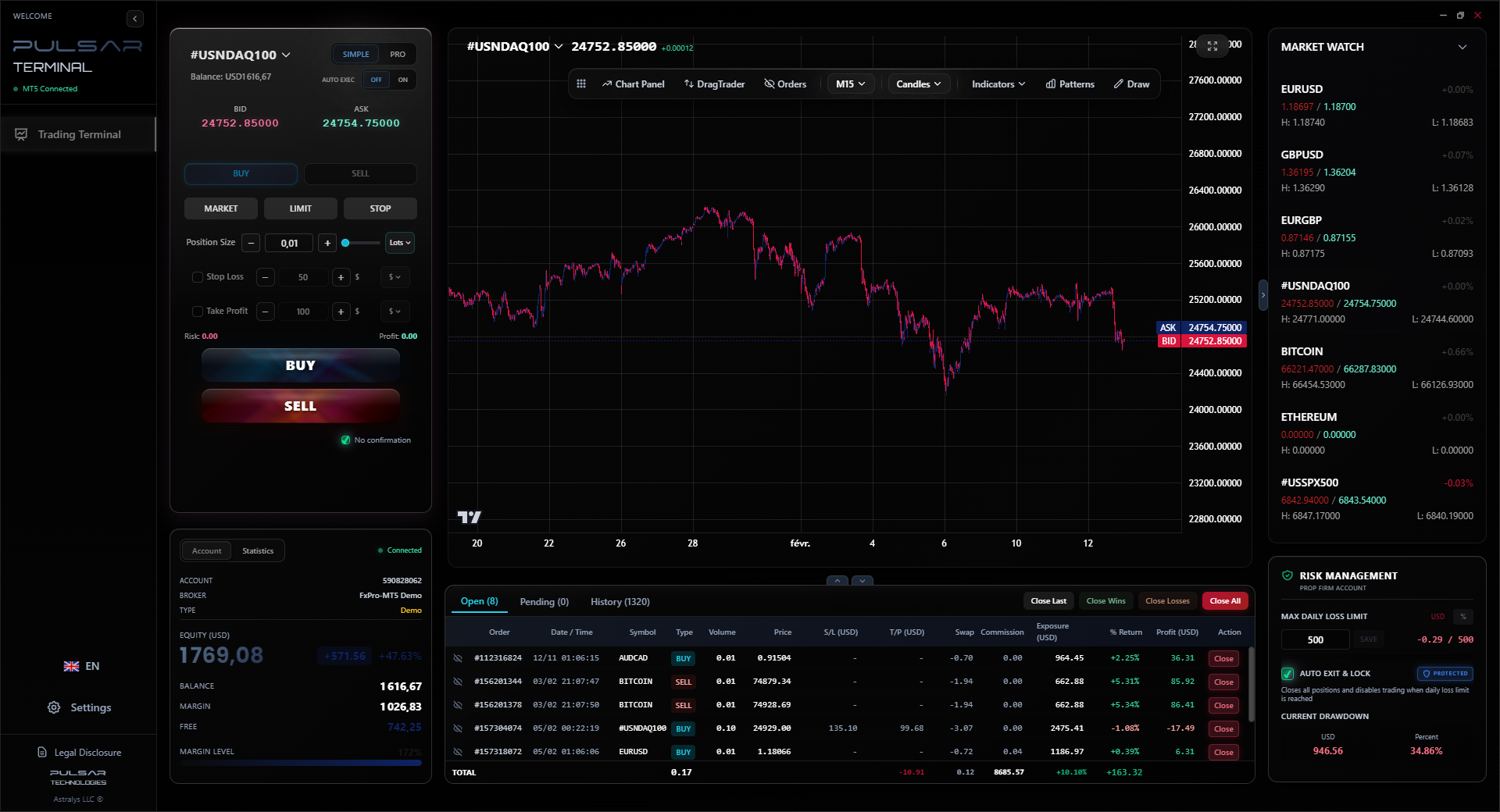
Managing equity drawdown during a prop firm challenge requires constant monitoring, which is where a tool like Pulsar Terminal's prop firm daily loss protection feature automates the watch for you.
Pulsar Terminal
The all-in-one MT5 companion: drag-and-drop orders, multi-TP/SL, trailing stop, grid trading, Volume Profile, and prop firm protection. Used by 1,000+ traders daily.
“Blowing a prop firm challenge because you misread equity is the most expensive lesson you can learn.”
You can't manage what you don't measure. Here's how to keep equity in your line of sight.
Platform Alerts: Most platforms let you set an alert for when your Equity hits a certain value. Set one just above your mental stop-out point. If your Equity drops to R9,000 on a R10,000 account, get a loud alert telling you to reassess everything.
The Equity Curve Chart: This is the single most important chart for your development. Plot your closing equity at the end of each day. You're not looking for an upward line, you're looking for the smoothness of the line. A jagged, steeply declining curve means your risk is too high. A smooth, gently rising curve is the goal. It tells you your equity definition in forex is more than theory, it's practice.
Journal with Equity Focus: In your trade journal, record not just the trade details, but your Equity before and after the trade. This connects your individual decisions directly to their impact on your net worth.

Pro Tip: When you're in a trade, cover up your Balance on your platform. Tape a piece of paper over it. Force yourself to only look at Equity and Free Margin. It rewires your brain to focus on what's actually at risk right now.
💡 Winston's Tip
The goal isn't to have a high balance, it's to have a smooth equity curve. A smooth curve means you're surviving. Survival comes first.
FAQ
Q1Is equity the same as my account balance?
No, absolutely not. Your balance is static and only changes when you close a trade. Your equity is dynamic, changing with every price movement in your open trades. It's your balance plus your current floating profit or loss.
Q2Why did I get a margin call even though my balance was positive?
Because margin calls are based on your Equity, not your Balance. If your open trades have large floating losses, your Equity can fall below your broker's required level (e.g., 100% of your used margin) even while your Balance remains positive from earlier wins. This is the most common reason for unexpected margin calls.
Q3How often does equity update?
Equity updates in real-time, with every tick of the market price for the instruments you have open positions in. It's a live feed of your current net worth in the market.
Q4Should I use equity or balance to calculate my position size?
Always use Equity. Calculating risk as a percentage of your Balance ignores your current exposure. Using Equity ensures you automatically reduce your trade size when you're in a drawdown, which is a key risk management discipline.
Q5What is a good equity/margin ratio to maintain?
There's no magic number, but a ratio below 500% is a sign you're using significant use. I consider anything below 200% to be a high-risk zone where you're vulnerable to being stopped out by normal market volatility. Conservative traders aim to keep it above 1000%.
Q6How do prop firms track equity for their challenges?
Prop firms almost exclusively track the trailing equity drawdown from your starting or highest equity point. Their software monitors your live equity 24/5. If your equity falls a certain percentage (e.g., 5% or 10%) below your starting or peak challenge equity, you fail. They do not use your balance for this calculation.
Q7Can my equity ever be negative?
With a regulated South African broker offering negative balance protection, your equity should not go negative on a retail account. They will stop you out before you owe them money. However, with certain unregulated products or professional accounts, negative equity is possible, meaning you could owe the broker money beyond your deposit.
Prof. Winston's Lesson
Key Takeaways:
- ✓Equity = Balance + Floating P/L. It's your live net worth.
- ✓Margin calls use Equity, not Balance. This catches everyone out.
- ✓Size all positions based on your current Equity, never your Balance.
- ✓A daily equity loss limit (e.g., -3%) is your best defense.
How useful was this article?
Click a star to rate
Weekly Trading Insights
Free weekly analysis & strategies. No spam.
About the Author
David van der Merwe
Emerging Markets Trader
Johannesburg-based trader with 11 years in emerging market currencies. Specializes in ZAR pairs, FSCA-regulated trading, and South African market analysis.
Comments
Risk Disclaimer
Trading financial instruments carries significant risk and may not be suitable for all investors. Past performance does not guarantee future results. This content is for educational purposes only and should not be considered investment advice. Always conduct your own research before trading.
You Might Also Like

Cara Trading Forex Sukses: 7 Prinsip dari Trader Profesional
Cara trading forex sukses dengan 7 prinsip trader pro: manajemen modal, disiplin, journal trading, backtest. Data nyata, bukan janji profit palsu.
Jam Trading Forex Terbaik untuk Trader Indonesia: Panduan Lengkap dengan Tabel Waktu
Panduan jam trading forex untuk trader Indonesia. Tabel 4 sesi dunia, jam emas 20:00-00:00, sesi mana yang harus dihindari. Data akurat + tips dari trader berpengalaman.
Top 5 Sàn Forex Uy Tín Nhất 2026: Review Jujur dari Trader Indonesia
Top 5 sàn forex uy tín 2026 untuk trader Indonesia. Review jujur: spread, deposit, withdraw, dukungan lokal. Exness, XM, IC Markets & lebih.
Get Pulsar Terminal
All these calculators are built into Pulsar Terminal with real-time data from your MT5 account. One-click position sizing, automatic risk management, and instant calculations.
Get Pulsar Terminal