


My screen was a sea of red.

David van der Merwe
Emerging Markets Trader ·  South Africa
☕ 13 min read
What you'll learn:
- 1Equity vs. Balance: The Critical Difference
- 2How to Calculate Your Equity (With ZAR Examples)
- 3The Domino Effect: Equity, Used Margin, and the Dreaded Margin Call
- 4How SA Brokers Handle Equity & Margin: FSCA Rules in Action
- 5Practical Strategies to Protect Your Equity
- 6Mistakes South African Traders Make with Equity
- 7For the Experienced Trader: Equity & Scaling Strategies
My screen was a sea of red. It was March 2020, the Rand was in freefall, and my USD/ZAR long position was bleeding. My account balance still showed a healthy R50,000 from my last profitable trade. But my equity? It was flashing R18,742. That was the real number, the one that mattered. The broker's warning about a potential margin call wasn't based on my balance, it was based on that plummeting equity figure. I learned the hard way that in forex, your balance is just history. Your equity is your current reality. Let's break down what that actually means for you trading from SA.
If you mix these two up, you're setting yourself up for a nasty surprise. It's the most common conceptual mistake I see with new traders.
Your Balance is your net account value from all closed positions. You make a deposit, it's in your balance. You close a trade for a R500 profit, it's added to your balance. You withdraw funds, it comes from your balance. It's a static number that only changes when a trade is settled, or you add/remove money. Think of it as your bank statement from yesterday.
Your Equity is your live, breathing account value. It's your Balance plus or minus the floating profit or loss of all your open positions. This number updates with every tick of the market. If you have a trade open and it's currently R200 in the red, your equity is your balance minus R200. This is the number your broker uses for everything real-time: calculating margin, determining if you're in danger of a margin call, and showing you what you'd actually have if you closed everything right now.

Warning: Your trading platform's "Profit" column is lying to you. It shows your floating P&L. Your Equity is the truth. Always watch your Equity, not your Balance, when you have positions open.
Here’s a simple table for a ZAR-based account:
| Scenario | Balance (R) | Floating P/L (R) | Equity (R) | What It Means |
|---|---|---|---|---|
| No open trades | 10,000 | 0 | 10,000 | Balance = Equity. All quiet. |
| 1 winning trade open | 10,000 | +1,500 | 11,500 | You're up, but it's not real until you close. |
| 1 losing trade open | 10,000 | -3,000 | 7,000 | This is your real risk. Your balance says 10k, but you only have 7k of usable value. |
I once got cocky during a volatile USD/ZAR session. My balance was R25,000. I had a small winning trade open for R800. I thought, "Great, I have room," and opened another position without checking my used margin. My equity was actually already stretched thin because of the first trade's margin requirement. The second trade went against me fast, and my equity dipped below the maintenance margin level. I got a margin call before I could even react. The lesson? Balance is irrelevant when you're in the market. Equity is king.

💡 Winston's Tip
Your balance is a rear-view mirror. Your equity is the windshield. If you're not watching equity, you're driving blind.
The formula is simple, but applying it with our local context is key. Especially when trading exotic pairs like EUR/ZAR or even majors with a ZAR account.
The Formula: Equity = Account Balance + Floating Profit (or - Floating Loss)
Let's run through two real scenarios I've faced.
Example 1: Trading a Major Pair (EUR/USD) with a ZAR Account You deposit R20,000 with an FSCA-regulated broker like Pepperstone. Your balance is R20,000.
- You buy 0.5 lots of EUR/USD at 1.0850.
- The market moves to 1.0870. You're up 20 pips.
- Profit in USD = (0.5 lots * 100,000) * (0.0020) = $100 profit.
- Your broker automatically converts this to ZAR at the current USD/ZAR rate (let's use 18.50).
- Floating Profit in ZAR = $100 * 18.50 = R1,850.
- Your Equity = R20,000 + R1,850 = R21,850.
Example 2: Trading an Exotic Pair (USD/ZAR) Directly This is where it gets very real for us. Your balance is R15,000.
- You sell 0.2 lots of USD/ZAR at 18.7000 (betting the Rand will strengthen).
- The pair rallies to 18.9000. The Rand weakens, you're wrong. You're down 200 pips.
- Loss in ZAR = (0.2 lots * 100,000) * (0.0200) = 400 ZAR pips. Since USD/ZAR is quoted in ZAR, the pip value is fixed? Not quite.
- For a standard lot (100,000), 1 pip on USD/ZAR = R10. So for 0.2 lots, 1 pip = R2.
- Your loss = 200 pips * R2 = R400 loss.
- Your Equity = R15,000 - R400 = R14,600.
Notice the volatility? A 200-pip move on USD/ZAR is common. On a R15k account, that R400 floating loss (2.7% of equity) can happen in minutes. This is why understanding the equity forex meaning isn't academic, it's survival. Always use a position size calculator before you enter, especially with our volatile local pairs.
“Balance is just history. Your equity is your current reality.”
This is the trilogy that makes or breaks you. They are inextricably linked. You can't understand one without the others.
Used Margin: This is the collateral, the "good faith deposit" your broker locks up to keep your trade open. It's a function of your trade size and the use you're using. With the FSCA's use cap of 1:50 for beginners, your margin requirement is higher (safer) than with offshore brokers offering 1:500.
Free Margin: This is your breathing room. Free Margin = Equity - Used Margin. This is the amount you have left to open new positions or absorb losses. If Free Margin hits zero, you can't open new trades. If it goes negative, you're in margin call territory.
Margin Call Level: This is a specific percentage set by your broker (often 50% or 100%). It's calculated as (Equity / Used Margin) * 100.
How the Dominoes Fall
Let's say your broker's margin call level is 50%. You have a R10,000 account (Equity). You open positions that require R4,000 in Used Margin.
- Your Margin Level = (R10,000 / R4,000) * 100 = 250%. You're fine.
- Your trade goes against you. Your equity drops to R2,500.
- New Margin Level = (R2,500 / R4,000) * 100 = 62.5%. You're getting nervous alerts.
- Losses continue. Equity drops to R1,999.
- Margin Level = (R1,999 / R4,000) * 100 = 49.97%.
Boom. Margin Call. At this point, your broker will likely issue a warning to add funds or start automatically closing your losing positions (starting with the biggest loser) until your Margin Level is back above 50%. You don't get to choose which trade they close. It's a forced liquidation.

Pro Tip: Never let your Margin Level get below 100%. I treat 150% as my personal red line. If my calculations show a trade could push me near that, I don't take it. It's that simple. The goal is to stay in the game, not test your broker's risk management system.
Trading with an FSCA-regulated broker like IFX Brokers or Exness (with its ODP license) comes with specific protections that directly impact your equity.
The most important is the use cap. For retail traders classified as beginners, max use is 1:50. For experienced traders who pass certain criteria, it can go to 1:100. This isn't the broker being stingy, it's the FSCA forcing you to use less use, which means you need more margin per trade. This protects your equity by making it harder to blow up your account with one bad trade.
Let's compare the margin requirement on a standard lot (100,000) of EUR/USD:
- At 1:50 use: Required Margin = (100,000 / 50) = $2,000
- At 1:200 use (common offshore): Required Margin = (100,000 / 200) = $500
With 1:50, your equity has to be much higher to open the same size trade. This forces better position sizing. It's a good thing.
Brokers also differ in how they display this info. Some platforms show Equity prominently; others hide it in a separate window. Most FSCA-regulated brokers will have clear warnings and a multi-step process before liquidation, often starting with an email or SMS when your margin level falls below a certain threshold. They're required to treat clients fairly, which includes giving you a chance to react.
However, don't rely on their warning. I've seen systems lag during extreme volatility (like a SARB interest rate announcement). By the time the SMS arrives, your positions might already be partially liquidated. You must monitor your own equity and margin level.
💡 Winston's Tip
The FSCA's 1:50 use limit isn't a cage, it's training wheels for your equity. Use them until you can consistently ride without crashing.
“Never let your Margin Level get below 100%. I treat 150% as my personal red line.”
Managing equity isn't passive. You build habits around it. Here are the non-negotiable ones I drill into every trader I mentor.
1. The 1% Rule (or Less): This is the cornerstone. Never risk more than 1% of your current equity on any single trade. Not your balance, your equity. If your equity is R50,000, your max risk per trade is R500. This means your stop-loss distance and position size must be calculated to result in a loss of no more than R500 if hit. This single rule does more to preserve equity than any fancy indicator. When you're on a losing streak, your position sizes automatically get smaller because your equity is shrinking. It forces discipline.
2. Use Stop-Losses as an Equity Shield: A stop-loss isn't a suggestion, it's a pre-defined cost for being wrong. It directly controls the drawdown on your equity. Setting a tight stop on a volatile pair like GBP/ZAR will get you stopped out a lot. Setting no stop is suicide. The sweet spot is placing your stop at a level where, if the market hits it, the trade idea is objectively invalidated. Use the ATR indicator to gauge recent volatility and place your stop beyond the normal market noise.
3. Regular Equity Tops: Once a month, I do a hard reset. If my equity has grown from R100k to R120k, I withdraw the R20k profit. My trading capital goes back to R100k. This does two things: it banks real profits and it psychologically resets my "normal" equity level. It prevents me from seeing that R120k as my new baseline and unconsciously increasing my position sizes (and risk).
4. The Friday Review: Every Friday after markets close, I write down my closing equity. I track it week-to-week. Is it consistently going up? Is it jagged and volatile? This simple log tells you more about your strategy's health than any backtest. A steady equity curve is the dream. A rollercoaster equity curve means your risk is too high, even if you're profitable.
These strategies turn the abstract concept of equity into a daily management tool. It's the difference between being a gambler and being a business owner. Your trading account is your business, and equity is its current valuation.
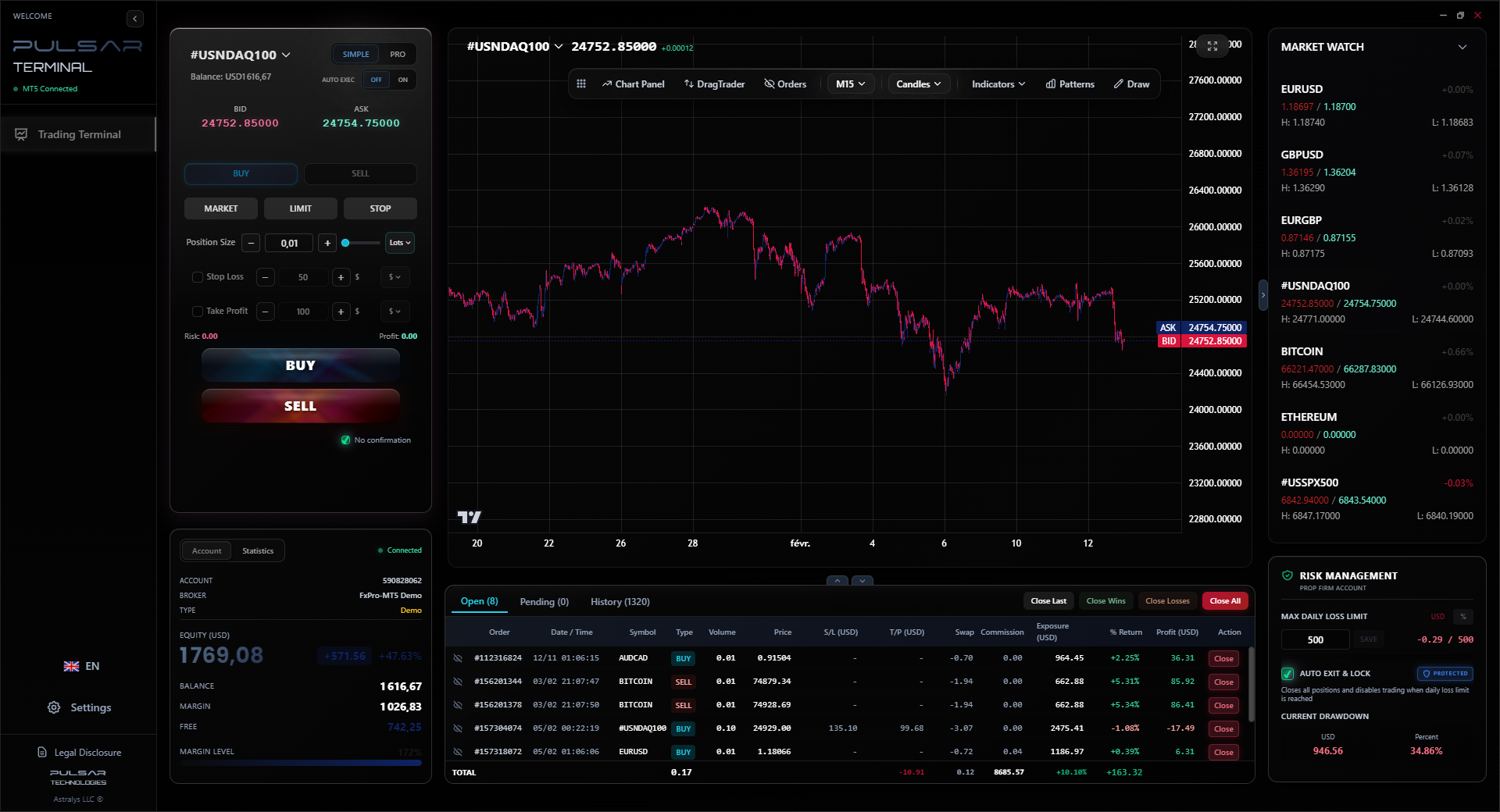
Manually moving stop-losses to breakeven to protect equity is a chore; Pulsar Terminal automates breakeven and trailing stops directly on your MT5 charts, so you can lock in profits without babysitting trades.
Pulsar Terminal
The all-in-one MT5 companion: drag-and-drop orders, multi-TP/SL, trailing stop, grid trading, Volume Profile, and prop firm protection. Used by 1,000+ traders daily.
I've made these. You'll probably make some of them. Let's shorten the learning curve.
Mistake 1: Funding a Trade with "Balance." You see R10,000 balance, you think you can open a trade that uses R9,000 margin. You ignore your existing open trades that are currently R2,000 in the red. Your real equity is R8,000. That R9,000 margin requirement is now 112% of your equity. The platform might let you do it, but you're instantly on the brink of a margin call. This is a critical failure in understanding the equity forex meaning.
Mistake 2: Ignoring ZAR Conversion on Equity. You have a USD account. Your equity is $1,000. You think, "Great, that's about R18,500." But if you have open trades, that equity is moving with the USD/ZAR rate itself. If you're trying to measure your performance in Rand terms, you must convert your starting balance and ending equity at the same point in time to see your real ZAR return. I got excited about a 10% return in a USD account once, only to realize a strengthening Rand meant I actually made only 4% when I withdrew. Now I just use a ZAR-denominated account for simplicity.
Mistake 3: Chasing Losses by Doubling Down. This is the equity killer. You lose R1,000 on a trade. Your equity drops. The emotional response is to immediately take another, bigger trade to "make it back fast." This violates the 1% rule based on your new, lower equity. You're now taking disproportionate risk with a damaged capital base. It's how R20,000 accounts become R5,000 accounts in an afternoon. The correct move after a loss is to trade smaller, not larger.
Mistake 4: Not Accounting for Wider Spreads on ZAR Pairs. You calculate your risk for a USD/ZAR trade based on a 5-pip spread. But during a news event, the spread can widen to 20 pips or more. Your stop-loss might get filled at a much worse price than you planned, creating an immediate, larger-than-expected equity drawdown. Always assume the spread will be at its worst when calculating your potential risk.
“The 1% rule does more to preserve equity than any fancy indicator.”
Once you have the basics locked down, you can use equity as a tool for growth. This is where the real money management happens.
Equity-Based Position Sizing: Instead of trading fixed lots, you size your positions as a percentage of your equity. This is what the 1% rule does for risk. You can apply the same logic to position size. For example, you might decide to allocate 5% of your equity to the margin requirement for any single trade. If your equity is R200,000, you can use R10,000 of margin. As your equity grows to R250,000, your allowed margin per trade grows to R12,500, letting you gradually increase position size during winning streaks. This helps compound returns.
The Equity Trail for Withdrawals: A more sophisticated version of my "monthly top" strategy. You only allow yourself to withdraw profits when your equity hits a new high-water mark by a certain percentage (e.g., 10% above the previous high). This ensures you're only skimming profits during sustained growth periods, not dipping into capital during drawdowns.
Using Equity to Choose Strategies: Your equity level should dictate your strategy. With a R20,000 account, scalping major pairs for small gains might be appropriate to grow steadily. With a R500,000 account, the transaction costs of scalping become less efficient, and a longer-term swing trading approach on larger position sizes might make more sense. The volatility of your equity curve also tells you if your strategy fits your risk tolerance. A 10% weekly drawdown on a R50k account might be stomach-churning; on a R500k account, it's a much larger ZAR amount and needs to be considered.
, mastering equity means moving from seeing it as a simple number on a screen to viewing it as the core metric of your trading business. It's your score, your risk gauge, and your growth engine, all in one.
💡 Winston's Tip
A rising equity curve with small dips is a healthy business. A equity curve that looks like a seismograph is a gambling habit. Know the difference.
FAQ
Q1Is equity the same as my profit?
No. Your profit or loss is only realized (real) when you close a trade. Equity includes both your realized balance and your unrealized, floating profit/loss from open trades. Your equity shows what you would have if you closed everything right now.
Q2Why did my broker close my trade when I still had money in my balance?
Because they don't base margin calls on your balance. They base it on your equity and margin level. If your open trades are losing money, your equity falls. If your equity falls too low relative to the margin you're using, you get a margin call, regardless of what your balance says.
Q3Should I open a USD or ZAR trading account in South Africa?
For simplicity in understanding your equity in Rand terms, a ZAR account is better. It removes currency conversion risk from your profit/loss calculation. However, compare the spreads and fees. Some brokers offer better conditions on USD accounts. If you use a USD account, you must consciously convert your equity to ZAR to understand your real performance.
Q4What's a good margin level to maintain?
Anything above 200% is very safe. I never let mine drop below 150%. If it hits 100%, you have zero free margin and cannot open new trades. Most margin calls happen between 50% and 100%. Treat 150% as your absolute minimum warning line.
Q5How does FSCA use limit protect my equity?
The 1:50 use cap for beginners means you must put up more of your own capital (margin) for each trade. This reduces the size you can trade relative to your equity, which directly limits your potential losses on a single trade. It forces more conservative position sizing, which protects your equity from rapid depletion.
Q6My equity is negative! How is that possible?
If your floating losses are so large that they exceed your account balance, your equity will be negative. This is a catastrophic situation that usually leads to an account blow-out. It means your losses have wiped out your initial capital and you now owe the broker money. This is why stop-losses and the 1% rule are non-negotiable.
Q7Does equity include my bonus or credit from the broker?
Usually not in a usable way. A "bonus" might be added to your balance, but it often comes with restrictive terms (like it can't be withdrawn). More importantly, it cannot be used to meet margin requirements or prevent a margin call. Always calculate your equity and margin based on your real deposited capital, ignoring any promotional credits.
Prof. Winston's Lesson
Key Takeaways:
- ✓Equity = Balance + Floating P/L. Watch equity, not balance.
- ✓Never risk >1% of current equity on a single trade.
- ✓FSCA's 1:50 use protects your equity by design.
- ✓Margin Calls are based on Equity, not your Balance.
- ✓Use a ZAR account to simplify equity tracking.
How useful was this article?
Click a star to rate
Weekly Trading Insights
Free weekly analysis & strategies. No spam.
About the Author
David van der Merwe
Emerging Markets Trader
Johannesburg-based trader with 11 years in emerging market currencies. Specializes in ZAR pairs, FSCA-regulated trading, and South African market analysis.
Comments
Risk Disclaimer
Trading financial instruments carries significant risk and may not be suitable for all investors. Past performance does not guarantee future results. This content is for educational purposes only and should not be considered investment advice. Always conduct your own research before trading.
You Might Also Like

Cara Trading Forex Sukses: 7 Prinsip dari Trader Profesional
Cara trading forex sukses dengan 7 prinsip trader pro: manajemen modal, disiplin, journal trading, backtest. Data nyata, bukan janji profit palsu.
Jam Trading Forex Terbaik untuk Trader Indonesia: Panduan Lengkap dengan Tabel Waktu
Panduan jam trading forex untuk trader Indonesia. Tabel 4 sesi dunia, jam emas 20:00-00:00, sesi mana yang harus dihindari. Data akurat + tips dari trader berpengalaman.
Top 5 Sàn Forex Uy Tín Nhất 2026: Review Jujur dari Trader Indonesia
Top 5 sàn forex uy tín 2026 untuk trader Indonesia. Review jujur: spread, deposit, withdraw, dukungan lokal. Exness, XM, IC Markets & lebih.
Get Pulsar Terminal
All these calculators are built into Pulsar Terminal with real-time data from your MT5 account. One-click position sizing, automatic risk management, and instant calculations.
Get Pulsar Terminal