


If you're looking up the FNB Business Forex contact number because you want to trade currencies, you're already making your first expensive error.

David van der Merwe
Emerging Markets Trader ·  South Africa
☕ 11 min read
What you'll learn:
- 1The FNB Business Forex Contact Numbers (Save These, Then Forget Them)
- 2The Silent Killer: How Bank Forex Fees Destroy Your Capital
- 3SARB & FSCA: The Rulebook You Can't Ignore
- 4How to Actually Get Your Money to a Trading Platform (The Right Way)
- 5The Only Time You Should Dial That FNB Business Forex Contact Number
- 6From Phone Calls to Charts: The Trader's Toolkit
- 7The Bottom Line: Save the Number, Use the Alternative
If you're looking up the FNB Business Forex contact number because you want to trade currencies, you're already making your first expensive error. I'm not being dramatic. Dialling that number connects you to a service designed for business transfers and international payments, not for the speculative, fast-paced world of retail forex trading. The fees they'll quote you are a silent killer of profits. This guide will give you every number you need, then show you exactly why you should never use them for active trading, and what you should do instead to keep your hard-earned rands in your pocket.
Alright, let's get the admin out of the way. You searched for the FNB Business Forex contact number, so here they are, verified and current. Stick these in your phone under 'Money Pit - Avoid'.
For Individuals & General Forex Advice:
- Phone: 0860 1 FOREX (36739)
- Email: forex@fnb.co.za
For Business Clients & Support:
- Phone: 087 0 EFOREX (336739)
- Email: fxsupport@rmb.co.za
For International Dialling & Trade Queries:
- Phone: +27 11 352 5902
- Email: fnbforextrade@fnb.co.za
- Hours: 07:45 - 16:15 (Weekdays)
Branch Forex Services:
- Phone: 087 736 7774
- Hours: 08:15 - 16:30 (Weekdays)
There you go. That's your FNB Business Forex contact number and then some. Now, let's talk about why using these services for trading is like using a bulldozer to trim a bonsai tree. It's the wrong tool, it's clumsy, and it's going to cost you a fortune in hidden fees.

Warning: These channels are for moving money internationally (paying suppliers, receiving invoices, emigrating). They are NOT for executing trades on the EUR/USD or trying to scalp the ZAR. The speed, cost, and functionality are completely wrong for that game.
“Dialling the FNB Business Forex contact number for trading connects you to a service designed for business transfers, not for the speculative, fast-paced world of retail forex.”
This is where most new South African traders get absolutely rinsed. You see the interbank rate on Google, call FNB, and think you're getting a good deal. You're not. You're getting mugged with a smile.
The Fee Structure That Eats Your Lunch
FNB's fees are a masterpiece of making you think you're paying little while taking a lot. Let's break it down with real numbers.
Sending Money Overseas (e.g., Funding a Trading Account):
- Under R10,000: Fixed fee of R200 - R300.
- Over R10,000: 0.55% commission (Min R550, Max R875).
Receiving Money (e.g., Withdrawing Profits):
- Under R10,000: Fixed fee of R75 - R175.
- Over R10,000: 0.55% commission (Min R175, Max R450).
Now, the real thief: the exchange rate margin. FNB doesn't give you the spot rate. They add a margin of 1% to 4% on top. Let's do the math you won't see on their website.

Example: You want to send R100,000 to an international broker. The spot USD/ZAR rate is 18.50.
- Theoretical Value: R100,000 / 18.50 = $5,405.41
- FNB's Cut (using a conservative 2% margin): Effective rate becomes ~18.87.
- What You Actually Get: R100,000 / 18.87 = $5,299.41
- Commission Fee: R100,000 * 0.55% = R550
- Total Loss: You've just paid $106 + R550 before your trade is even placed. That's over R2,500 gone in a blink.
I learned this the hard way in 2015. I funded an early account with R50,000 via my bank. Between the margin and fees, I started with the equivalent of R47,800. I had to make a 4.6% return just to break even on my deposit. That's an insane headwind before you even see a chart. Compare that to a reputable international broker like IC Markets or Pepperstone, where your deposit in ZAR is converted at near-spot rates and the fee is often a tiny, transparent percentage or flat wire fee.
The Speed Problem
Bank transfers take 2-5 business days. In forex, a week is a lifetime. By the time your money lands, the setup you wanted to trade is gone. Need to withdraw profits to cover a bill? Good luck waiting. This lack of agility will strangle any active scalping strategy or even responsive swing trading.

💡 Winston's Tip
A trader who calls his bank for a quote is negotiating from a position of ignorance. The price is never just the number they give you; it's that number plus everything they don't say.
“The real thief isn't the commission fee; it's the 1-4% exchange rate margin your bank quietly adds on top of the spot rate.”
Trading from South Africa isn't a free-for-all. We have one of the more structured regulatory environments, and pretending it doesn't exist is a sure way to get your accounts frozen. The South African Reserve Bank (SARB) controls the flow of money across borders. The Financial Sector Conduct Authority (FSCA) regulates how financial services, including forex brokers, behave.
Here’s what this means for you, the trader:
1. The R11 Million Annual Allowance: As a resident, you have a Single Discretionary Allowance (SDA) of R2 million per year (no tax clearance needed). You also have a Foreign Investment Allowance (FIA) of R10 million per year, but this requires a Tax Compliance Status (TCS) from SARS. That's R11 million total you can legally externalise. For 99.9% of retail traders, this is more than enough. I've never met a retail trader legitimately hitting this cap.
2. Authorised Dealers Are King: Only SARB-authorised dealers (like FNB, Standard Bank, etc.) can legally convert and transfer your ZAR. This is why you can't just hand your buddy dollars for rands at a backstreet rate. Using an unlicensed ‘bucket shop’ for deposits is a great way to lose all your money and potentially face legal issues.
3. The Offshore Trading Reality: Here’s the open secret: nearly 80% of all Rand trading happens outside South Africa. The real liquidity and price action for pairs like USD/ZAR are in London and New York. When you trade with an international FSCA-licensed broker (or a reputable global one), you're tapping into that market. Your broker acts as the conduit. You're not ‘exporting capital’ in the traditional business sense; you're placing a margin trade on a global platform.
4. The FSCA's Role: Always check if your broker is FSCA licensed. It gives you recourse. But understand this: an FSCA license doesn't magically make a broker good. It means they meet minimum standards. I’ve seen FSCA-licensed brokers with terrible spreads. Do your homework on platforms like our XM review or Exness review to see who actually delivers for traders.
“The real thief isn't the commission fee; it's the 1-4% exchange rate margin your bank quietly adds on top of the spot rate.”
Forget the FNB Business Forex contact number for this. The modern path is simpler, cheaper, and faster. Here’s the playbook I use and recommend to every trader I mentor.
Step 1: Choose a Reputable International Broker. This is non-negotiable. Look for brokers with a strong global reputation, tight spreads, and direct support for ZAR deposits. IC Markets, Pepperstone, and Exness are consistently top contenders for South Africans. They have local payment processors.
Step 2: Use Their Local Payment Gateways. This is the magic trick. These brokers partner with South African payment providers (like OZOW, PayFast, or specific forex payment firms). You deposit Rands from your FNB account via a secure online portal. The broker receives Rands and converts them internally at their institutional rates, which are miles better than retail bank rates. The fee is often a small, fixed percentage (0.5%-2%) or sometimes even zero.
Step 3: Withdrawals Are Just as Easy. You request a withdrawal in Rands to your FNB account. The broker converts your balance (in USD, EUR, etc.) to ZAR at a good rate, sends the Rands via the payment gateway, and it lands in 1-3 days. The cost is transparent.
A Real Trade Example: In January 2023, I deposited R20,000 with Pepperstone via their ZAR payment option. The spot USD/ZAR was 17.20. After their tiny fee, my trading account was credited with $1,158. The effective exchange rate was ~17.27. That’s a margin of about 0.4%. If I’d gone through FNB’s formal forex desk with a 2% margin, I would have gotten about $1,135. That’s a $23 (~R400) difference before I even started. Over dozens of deposits, that adds up to a new trading laptop.
What About FNB’s Own Trading Platform? FNB offers Share Trading and some CFD products. It’s clunky, expensive (their spreads are wide), and not built for serious forex traders. It’s a side offering for their banking clients. If you're serious, get a dedicated platform.
💡 Winston's Tip
Regulations aren't walls to stop you; they're the guardrails on the highway. Learn them so you know how fast you can legally go without crashing.
“Your bank is for keeping your savings. Your broker is for executing trades. Blurring those lines is the first and most costly mistake.”
I’m not saying FNB Business Forex is useless. It has a very specific, important purpose. You should call them when:
- You are a business owner needing to pay an overseas supplier for goods (e.g., R500,000 for manufacturing parts).
- You are emigrating and need to transfer large sums (using your R11 million allowance) to set up life abroad.
- You are receiving a large international inheritance or payment and need guidance on SARB documentation.
- You are making a legitimate foreign investment like buying property overseas.
In these cases, the fees, while still high, are a cost of doing legitimate business. The service is designed for these large, infrequent, documentary-heavy transfers. The advisors can guide you through the SARB requirements.
For the retail trader moving R5,000 to R200,000 to a broker to trade? You are not their target client. You will pay their target-client fees for a service you don't need. It’s a fundamental mismatch. Your need is for speed, low cost, and agility - the exact opposite of a traditional bank forex desk.

Pro Tip: If you must use a bank wire for a large deposit, ask your broker for their international banking details. Then, go into your FNB online banking and do a standard international wire yourself. You’ll often get a slightly better rate and avoid the ‘advisory’ premium. Still not ideal, but better than calling.
“Your bank is for keeping your savings. Your broker is for executing trades. Blurring those lines is the first and most costly mistake.”
Your energy is better spent on analysis and execution, not on hold with a bank. Once your money is with a proper broker, your real tools come into play.
1. Master the Platform (MT5): MetaTrader 5 is the industry standard for a reason. Learn it inside out. But the vanilla MT5 has limitations for advanced order management.
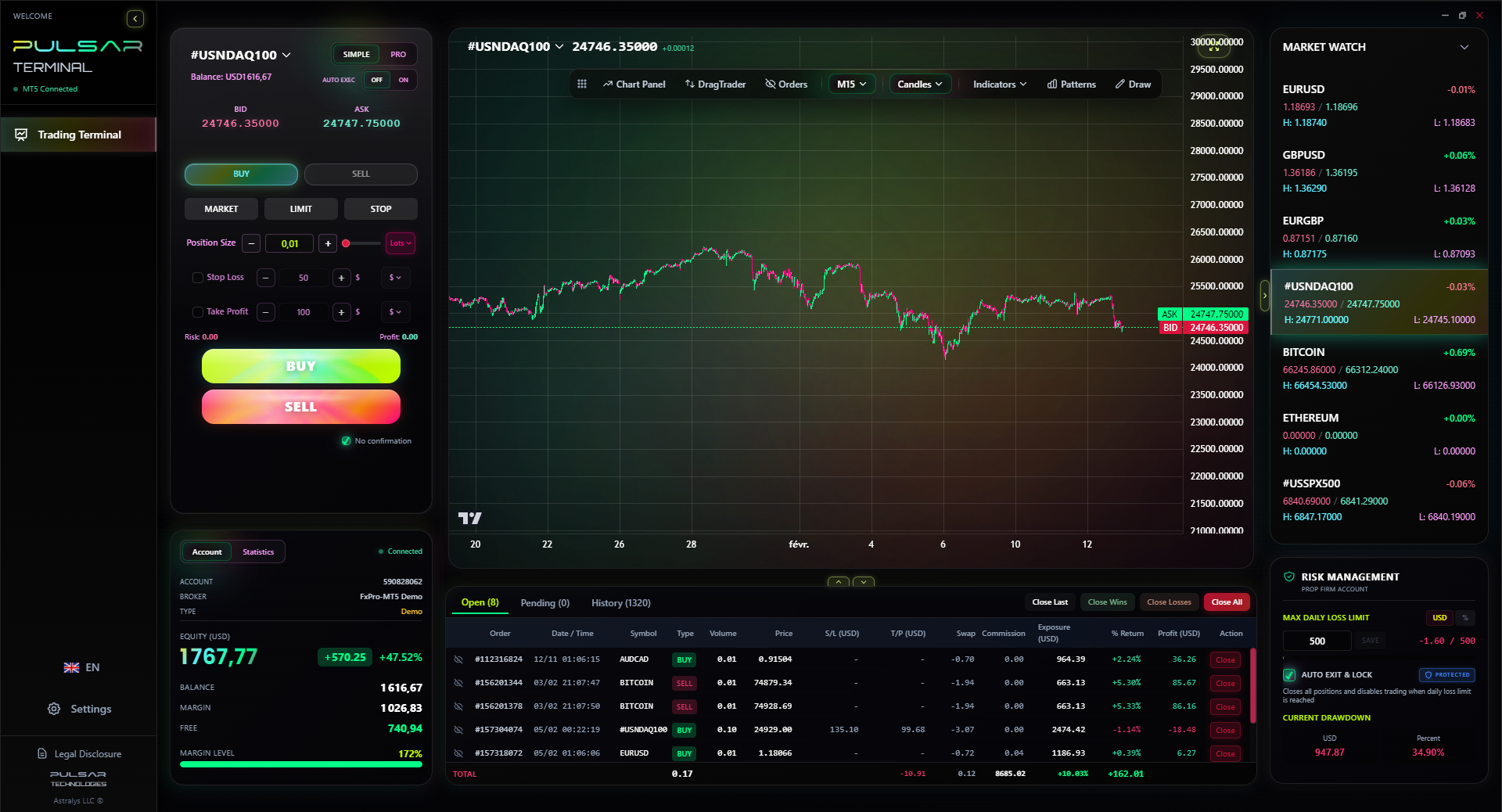
2. Use a Professional Trading Tool: This is where the game changes. A tool like Pulsar Terminal (an add-on for MT5) automates the complex tasks that waste your time and cause errors. Setting multiple take-profit levels, moving stops to breakeven, trailing a stop - these should be one-click operations, not frantic manual adjustments while the market moves against you.
I remember a gold trade in 2021 (XAU/USD). I entered at $1792, targeting $1810. It rallied to $1805, then pulled back sharply. I was manually trying to drag my stop to breakeven and got filled at $1791.5 for a tiny loss. Had I pre-set an automatic breakeven trigger at $1800, I would have been stopped at my entry with no loss, and the trade later hit my target. That missed $1,850 profit was a $1850 lesson in automation. Tools that manage risk for you are force multipliers.
3. Risk Management is Non-Negotiable: All the cheap deposits in the world won't save you from poor risk management. Before you place a trade, know your stop-loss and calculate your position size. Never risk more than 1-2% of your capital on a single trade. Use our free position size calculator religiously. A margin call doesn't care how you funded your account.
4. Analyse with Purpose: Don’t just stare at lines. Use indicators like the RSI indicator and MACD indicator to confirm trends and momentum, not in isolation. Understand what a pip definition really means for your P&L on different pairs. The spread definition is your first cost of doing business - choose brokers where it's low.
💡 Winston's Tip
Your first profit is the money you don't give away in fees. Optimise your funding route before you optimise your trading strategy.
Managing complex trades and risk manually through MT5 is inefficient; tools like Pulsar Terminal automate partial closures, breakeven moves, and trailing stops directly on your charts.
Pulsar Terminal
The all-in-one MT5 companion: drag-and-drop orders, multi-TP/SL, trailing stop, grid trading, Volume Profile, and prop firm protection. Used by 1,000+ traders daily.
“Nearly 80% of all Rand trading happens outside South Africa. Your broker is just a conduit to that real market.”
Let's be brutally honest. The FNB Business Forex contact number is a relic of an older financial world for most aspiring traders. It represents high-cost, slow, administrative currency movement. The modern South African trader operates in a global, digital arena where efficiency is everything.
You have two paths:
Path A (The Old Way): Call FNB. Pay 2-4% in hidden margins. Pay R550+ in fees. Wait 3 days. Start your trading journey already down thousands of rands.
Path B (The Trader's Way): Open an account with a top-tier international broker that accepts ZAR. Deposit online via their local payment gateway in minutes. Pay a fraction of the cost in fees. Start trading with almost all your capital intact.
The choice is obvious. Your bank is for keeping your savings and paying your bills. Your broker is for executing trades. Blurring those lines is the first and most costly mistake you can make.
Keep the FNB Business Forex contact number for when you buy that vineyard in France. For trading the EUR/USD guide or the XAU/USD guide, use the tools and channels built for that specific fight. Your profitability depends on it.
FAQ
Q1What is the main FNB Business Forex contact number?
The primary contact number for FNB Business Forex support is 087 0 EFOREX (336739). For general individual forex advice, you can call 0860 1 FOREX (36739). Remember, these are for international payments and transfers, not for active currency trading.
Q2Can I use FNB to trade forex like on a broker platform?
No, not effectively. FNB's forex services are for transferring currency for business or personal needs (like paying an overseas invoice). They are not designed for the fast, frequent, speculative trades of retail forex trading. The costs (1-4% margin + fees) and slow speed would destroy any potential profits from short-term trading.
Q3Is it legal for South Africans to use international forex brokers?
Yes, it is legal. South African residents can use their annual discretionary allowances (R2 million without tax clearance, R10 million with it) to fund international trading accounts. You must use a SARB-authorised dealer (like your bank) to send the money, but using a reputable international broker as the recipient is a standard practice. Always ensure the broker is regulated by a reputable body like the FSCA, ASIC, or CySEC.
Q4How much does FNB charge for an international forex transfer?
For sending money, FNB charges a fixed fee of R200-R300 for amounts under R10,000, or a 0.55% commission (min R550, max R875) for amounts over R10,000. Crucially, they also apply an exchange rate margin of 1% to 4% on top of the spot rate, which is where the real cost is hidden. For receiving money, fees range from R75 to R450.
Q5What's the cheapest way to fund an international trading account from South Africa?
The cheapest way is to use a broker that offers direct ZAR deposits via local South African payment gateways (like OZOW, PayFast). Brokers like IC Markets, Pepperstone, and Exness offer this. You deposit Rands online, and they convert it at institutional rates with a small, transparent fee (often 0.5%-2%), avoiding the large bank forex margins entirely.
Q6What should I ask FNB Forex if I need to make a large legitimate transfer?
If you're making a large transfer for emigration or investment, call them and ask: 1) What is the exact total cost (fee + their applied exchange rate margin)? 2) What SARB documentation is required for my specific allowance (SDA or FIA)? 3) What is the expected timeline for the funds to arrive? Get everything in writing via email.
Prof. Winston's Lesson
Key Takeaways:
- ✓Bank forex margins cost 1-4% per transfer.
- ✓Use broker ZAR gateways, not bank wires.
- ✓You have a R11m annual externalisation allowance.
- ✓Speed and low cost beat 'service' every time.
How useful was this article?
Click a star to rate
Weekly Trading Insights
Free weekly analysis & strategies. No spam.
About the Author
David van der Merwe
Emerging Markets Trader
Johannesburg-based trader with 11 years in emerging market currencies. Specializes in ZAR pairs, FSCA-regulated trading, and South African market analysis.
Comments
Risk Disclaimer
Trading financial instruments carries significant risk and may not be suitable for all investors. Past performance does not guarantee future results. This content is for educational purposes only and should not be considered investment advice. Always conduct your own research before trading.
You Might Also Like

Cara Trading Forex Sukses: 7 Prinsip dari Trader Profesional
Cara trading forex sukses dengan 7 prinsip trader pro: manajemen modal, disiplin, journal trading, backtest. Data nyata, bukan janji profit palsu.
Jam Trading Forex Terbaik untuk Trader Indonesia: Panduan Lengkap dengan Tabel Waktu
Panduan jam trading forex untuk trader Indonesia. Tabel 4 sesi dunia, jam emas 20:00-00:00, sesi mana yang harus dihindari. Data akurat + tips dari trader berpengalaman.
Top 5 Sàn Forex Uy Tín Nhất 2026: Review Jujur dari Trader Indonesia
Top 5 sàn forex uy tín 2026 untuk trader Indonesia. Review jujur: spread, deposit, withdraw, dukungan lokal. Exness, XM, IC Markets & lebih.
Get Pulsar Terminal
All these calculators are built into Pulsar Terminal with real-time data from your MT5 account. One-click position sizing, automatic risk management, and instant calculations.
Get Pulsar Terminal