


I remember staring at my FNB online banking screen in late 2023, about to send £5,000 to a UK prop firm for a trading challenge.

David van der Merwe
Emerging Markets Trader ·  South Africa
☕ 12 min read
What you'll learn:
- 1The FNB Forex Contact Details (And What They Won't Tell You)
- 2Decoding the FNB Forex Fee Structure: A Trader's Breakdown
- 3South African Forex Rules: What SARB & FSCA Allow (2026 Update)
- 4FNB as a Bank vs. Real Forex Brokers: The Spread Showdown
- 5A Trader's Strategy for Moving Money To and From SA
- 6When You Actually Should Call That FNB Forex Number
- 7Essential Tools for the SA Trader (Beyond a Phone Number)

I remember staring at my FNB online banking screen in late 2023, about to send £5,000 to a UK prop firm for a trading challenge. The transfer fee showed R200, which seemed okay. Then I did the math on the exchange rate margin. FNB's rate was 23.15 ZAR/GBP. The actual interbank rate that morning? 22.87. That hidden 1.2% cost me nearly R1,400 extra on top of the fee. That's when I realized the FNB forex contact number (0860 1 FOREX) was just the starting point. The real conversation every South African trader needs is about the true cost of moving money.
Let's get the basics out of way. If you need to speak to a human at FNB about forex, here's what you need:
Primary Contact: 0860 1 FOREX (36739) International: +27 11 352 5902 Email: forex@fnb.co.za Hours: Mon-Fri 8am-5pm, Sat 8am-12pm
Now, here's what they won't lead with during that call. I learned this the hard way after funding my first live account with an international broker through FNB in 2018. The phone agent was helpful, sure. They processed my SWIFT transfer for USD 2,000. The stated fee was R150. Clean. Simple.
Two days later, when the funds hit my broker, I was short by $42. Where did it go? The agent never mentioned the exchange rate margin - the difference between the rate FNB buys currency at and the rate they sell it to you. That margin is their real profit center, not the flat fee. For major pairs like EUR/USD or GBP/USD, this margin can be 1% to 1.5%. On larger transfers, that dwarfs the administrative fee.

Warning: Always ask for the 'all-in' cost. Say: "What will be the total ZAR amount deducted from my account to deliver X exact foreign currency to the beneficiary?" Don't just ask for the fee.
Their online platform and app are more efficient for straightforward transfers, but the same margin applies. The Secure Chat function in the FNB App is useful for quick queries, but for complex trade requests, you'll need the trade desk email: trade@fnb.co.za. Remember, they are an Authorised Dealer, bound by SARB rules. Every transaction gets reported, which is good for compliance but adds layers you don't face with local ZAR deposits to FSCA-regulated international brokers.

💡 Winston's Tip
The bank's 'fee' is the tip of the iceberg. The real cost is buried in the spread between their buy and sell rate. Always calculate the total ZAR cost using a live mid-market rate before you click confirm.
“The bank's exchange rate margin is their real profit center, not the flat fee.”
FNB's fee schedule looks straightforward until you apply it to real trading scenarios. Let's break it down with numbers from their 2023/2024 guide, which are still largely applicable.
Sending Money Offshore (The Cost of Funding)
This is your biggest concern when depositing to a broker. Say you're sending R15,000 to an IC Markets account.
| Method | Stated Fee | Effective Total Cost (Fee + Typical 1.2% Margin) |
|---|---|---|
| Online/App | 0.55% (min R275) = R82.50 | R82.50 + ~R180 (margin) = ~R262.50 |
| Phone/Banker | Min R550 | R550 + ~R180 (margin) = ~R730 |
The lesson: Always use online. But more importantly, that R180 margin is a silent killer. On a R100,000 transfer, the 0.55% fee is R550, but the 1.2% margin is R1,200. Your real cost is R1,750, or 1.75%.
I made this mistake in 2020. I funded a $5,000 (roughly R90k at the time) account via a banker-assisted transfer. The fee was steep, but I shrugged it off as 'cost of business.' A year later, calculating my total funding costs, I realized I'd paid over R6,000 just in FNB charges across multiple deposits. That was a full trading account's worth of margin I'd burned before placing a single trade.
Receiving Money (The Profit Withdrawal)
The fees are similar on the way back. Withdraw R50,000 in profits from Pepperstone:
- Online Receiving Fee: 0.55% (min R175, max R450) = R275
- Typical Incoming Margin: ~0.8% = R400
- Total Cost to Get Your Money Home: ~R675

Example: You make a 10% return on a R100,000 account. That's R10,000 profit. Getting it back to your FNB account could cost R110 (fee) + ~R800 (margin) = R910. Your net profit is now 9.1%. The bank takes 9% of your profits just moving it.
This two-way friction is why many serious traders I know use foreign currency accounts or leave capital with their broker. FNB's foreign currency accounts are free to open and maintain, which is a rare bright spot. Moving between your FNB USD account and ZAR account is free, but you still face costs getting USD into that account from an international broker.

“On a R100,000 transfer, the silent margin cost can be double the published fee.”
Trading with international brokers is legal, but moving money isn't a free-for-all. The South African Reserve Bank (SARB) and the Financial Sector Conduct Authority (FSCA) set the rules. Ignoring them can freeze your funds.
The cornerstone is the Single Discretionary Allowance (SDA). As a South African resident over 18, you can move up to R1 million per calendar year offshore without special tax clearance. This covers everything: travel, gifts, online subscriptions, and yes, funding trading accounts. In 2026, this is proposed to increase to R2 million. That's huge for traders.
Here's the critical part: This allowance is for capital export. Your trading profits, when repatriated, are not subject to this limit. They are considered 'income' and can be brought back freely, though they may be subject to tax if they constitute revenue from a business (like professional trading).
The New Tax Hurdle (Late 2025 Onward): This one caught me off guard. SARB's Circular 16/2025 changed the game for non-residents. Now, if you're sending South African-source income (like dividends, royalties) to a non-resident, the bank must check their SARS tax compliance first. For traders, the key is this: funds you send offshore to trade are your capital, not SA-source income. Funds you bring back are your income. The new rule primarily affects companies and investments, but it signals tighter oversight. Always have your SARS affairs in order.
The FSCA's Role: The FSCA doesn't regulate global forex brokers. It regulates how financial institutions behave in SA. Their big project is the COFI Bill, expected in 2026. This won't stop you from using a broker like XM, but it reinforces that SA-based entities (like FNB) must follow strict conduct rules. Always use an FSCA-regulated entity for your ZAR banking, and a well-regulated international broker (like ASIC, CySEC) for trading. This separation is your safest bet.

Pro Tip: Keep careful records. When you send R200,000 under your SDA to a broker, file the FNB confirmation. When you withdraw $15,000 in profits, save the broker statement. If SARS ever asks, you can show the capital export and the separate income return. This saved me during a routine audit in 2022.
💡 Winston's Tip
Your Single Discretionary Allowance is your trading lifeline. Use it strategically. Consolidate transfers to minimize the number of times you pay the bank's fixed fee component.
“On a R100,000 transfer, the silent margin cost can be double the published fee.”
This is where the conversation shifts from 'moving money' to 'trading money.' FNB is an Authorised Dealer for currency exchange. They are not, and do not pretend to be, a competitive forex trading broker. The difference in cost is astronomical.
Let's talk about the spread - the difference between the buy and sell price. This is the core cost of trading.
In early 2024, I did a live comparison at 10 AM on a Tuesday, a typically liquid period.
- FNB Online Forex Rate for USD/ZAR: Buy: 18.40, Sell: 18.52. Spread: 12 cents (approx. 65 pips).
- Major International Broker (Raw ECN Account): USD/ZAR Buy: 18.455, Sell: 18.460. Spread: 0.5 cents (approx. 5 pips).
That's a 13-fold difference. On a standard lot (100,000 units), that FNB spread costs you R1,200 before your trade even moves. The broker spread costs about R50. If you're scalping or trading multiple times a day, trading through a bank is financial suicide.
FNB offers services for large, institutional clients or individuals needing physical currency, travelers cheques, or large international settlements. For active trading of currency pairs, you need a dedicated platform like MetaTrader 5, which all major international brokers offer. The market has shifted to electronic, low-latency execution. South Africa's own market is seeing this growth, projected to hit USD 6.85 billion by 2033, driven by these platforms.
My most costly lesson was in 2017. I tried to 'trade' by timing FNB's daily rate updates for a USD transfer I needed for travel. I 'gained' maybe R300 over a week by watching their rate. The broker spread on a single micro-lot trade could have been R5. I wasted hours to save pennies, blinded by the interface I knew. Don't use a bank's retail forex service for active trading. Ever.
“Using a bank's retail forex service for active trading is financial suicide.”
After a decade and thousands in wasted fees, here's the system I've settled on. It minimizes cost and maximizes flexibility.
Step 1: The Funding Route. Use your Single Discretionary Allowance (SDA). Initiate a SWIFT transfer from your FNB account online to your international broker. Currency: USD or EUR. Why? These are the most liquid, with the smallest margins from FNB. Never let FNB convert to a exotic currency; let your broker do it if needed. Always calculate the total ZAR cost using a live mid-market rate (Google Finance) first. If the difference is more than 1.5%, wait a few hours or try the next day.
Step 2: The Withdrawal Route. Withdraw profits from your broker in USD to your FNB Foreign Currency Account (e.g., a Global Account). This avoids an immediate conversion hit. You now have USD sitting in SA. You can:
- Keep it there for future trading deposits (free internal transfer back to your ZAR account, then SWIFT out again).
- Convert to ZAR when the rate is favorable, using FNB's spot rate (which, while not great, is your only option here).
Step 3: The Local Broker Consideration. For practicing with smaller amounts, consider depositing ZAR directly to a South African-based CFD provider that's FSCA-regulated. No forex transfers, no SWIFT fees. The trading conditions (spreads, commissions) won't match a top-tier international broker, but for learning the basics of a swing trading strategy with R5,000, it's far more cost-effective than paying R500 in bank fees.
Step 4: Tax and Records. Open a separate spreadsheet. Log every single cross-border movement: Date, Amount (ZAR & Foreign), Purpose (e.g., 'SDA - Capital Export to Broker X'), Reference Number. When you withdraw, log it as 'Repatriation of Trading Income.' This isn't just for SARS; it helps you track your true net profitability after all financial logistics.
Warning: Never, ever use informal or unlicensed channels to move money offshore. It's illegal (flouting Exchange Control) and risks total loss of funds. The 'better rate' is not worth a margin call from the Reserve Bank on your entire financial life.
💡 Winston's Tip
A trader's profitability is net of all costs: spreads, commissions, and bank fees. A system that generates 15% returns but loses 3% to financial logistics is only a 12% system. Optimize the entire chain.

“Using a bank's retail forex service for active trading is financial suicide.”
With all this talk about avoiding bank forex for trading, when is the 0860 1 FOREX number actually useful for a trader?
- Large, One-Off Capital Movements: If you're moving a significant portion of your SDA (say, R500k+) to establish a large account, a phone call can be prudent. Confirm the process, timelines, and document the agent's name and reference. Get written email confirmation of the rate locked in, if possible.
- Setting Up a Foreign Currency Account: The online process is smooth, but if you hit a snag setting up your USD Global Account for receiving profits, call them. It's a core banking product, and their support is generally good.
- Dispute or Delay on a SWIFT Transfer: SWIFT transfers can get stuck. If your broker hasn't received funds in 3-4 business days, call FNB Forex with your SWIFT MT103 reference. They can trace it.
- Clarifying SARS Compliance for Large Receipts: If you're bringing back a life-changing sum (congratulations), and your local branch seems confused, call the forex desk. They deal with these rules daily and can guide you on the documentation needed to receive seven-figure sums from overseas.
I called them in 2021 when a $25k withdrawal from my broker was delayed. The FNB agent identified the holdup in two minutes: my broker had used a slightly different account name on the SWIFT vs. my FNB records. A 10-minute call saved days of anxiety. Use them as experts in the logistics of moving money, not the trading of money.

“Your edge comes from your trading setup, not from knowing a customer service number.”
Your edge doesn't come from knowing a contact number. It comes from your setup. Here are the non-negotiable tools in my stack that save me more than any bank fee ever cost.
A Reliable International Broker: This is your primary venue. Look for tight spreads on majors, clear regulation (ASIC, FCA, CySEC), and strong MT4/MT5 support. I've had consistent execution with brokers like IC Markets and Pepperstone for years. Their raw spreads on EUR/USD are often below 0.1 pips during London/NY overlap.
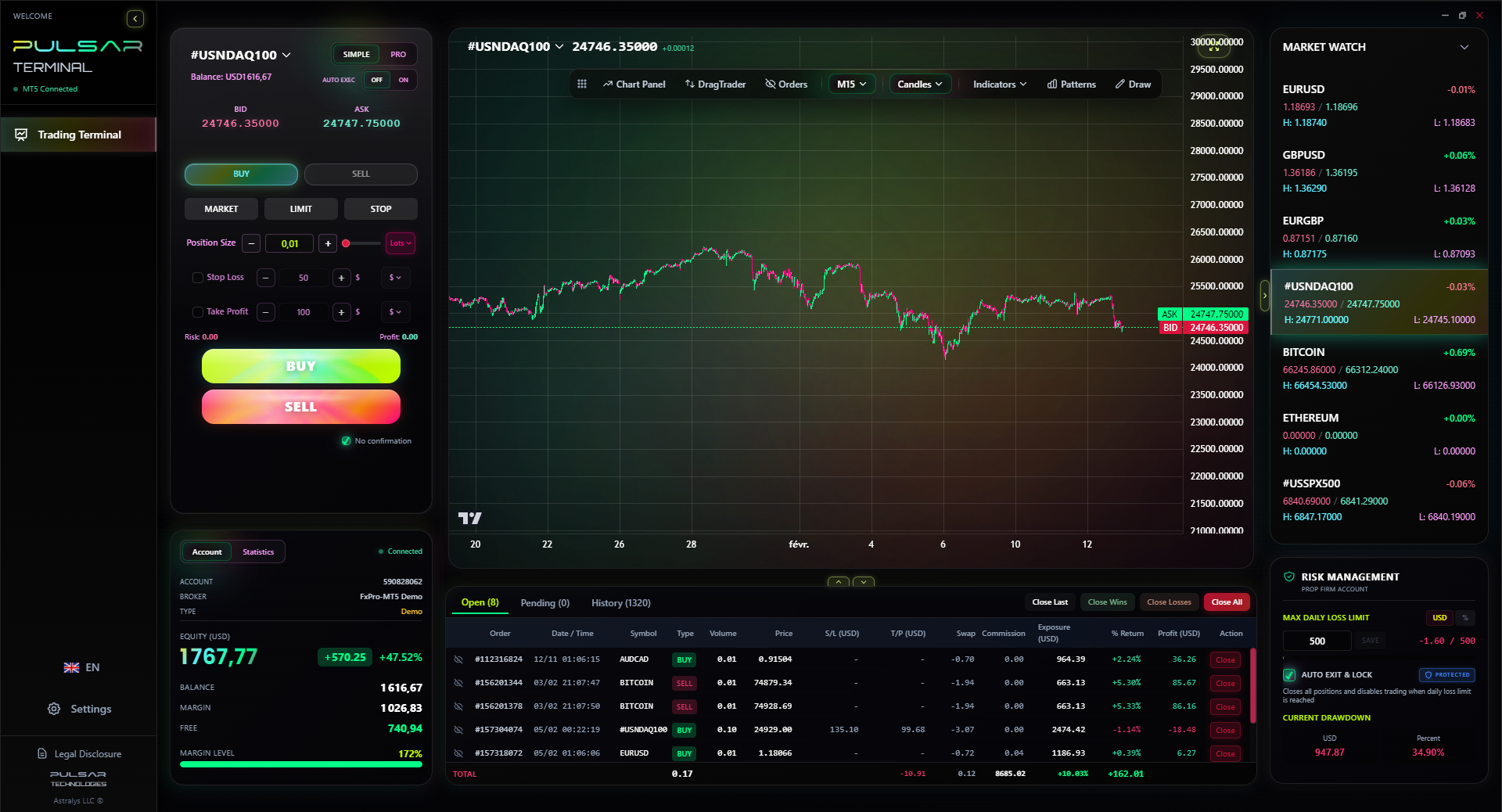
Advanced Charting Software: MT5 is good, but I run Pulsar Terminal alongside it. Why? The automation. Setting a multi-level take-profit with partial closures on a gold (XAU/USD) trade, or a trailing stop that activates only after a certain profit level, is drag-and-drop. This isn't just convenience; it removes emotional, costly decisions from the equation.
A Proper Risk Calculator: Never guess your position size. Use a position size calculator religiously. My rule: never risk more than 1% of my active trading capital on a single trade. In 2019, I broke this rule on a 'sure thing' ZAR short. I risked 3%. The trade went south, and the loss set me back three months. The calculator is your discipline enforcer.
Market Profile & Volume Tools: Understanding where the market has traded over time (Market Profile) and where volume is concentrated (Volume Profile) is key. These are built into Pulsar and help identify key support/resistance zones far better than just drawing lines on a chart. It helps you place stops beyond the high-volume nodes, avoiding getting stopped out by market noise.
These tools turn you from someone who just calls a bank for forex rates into a systematic operator. The phone becomes a utility, not a lifeline.
Managing complex trade exits and risk is where profits are saved, and tools like Pulsar Terminal automate this directly on your MT5 platform.
Pulsar Terminal
The all-in-one MT5 companion: drag-and-drop orders, multi-TP/SL, trailing stop, grid trading, Volume Profile, and prop firm protection. Used by 1,000+ traders daily.
FAQ
Q1What is the FNB forex contact number for general inquiries?
The main FNB forex contact number is 0860 1 FOREX (36739), operating Monday to Friday 8am-5pm and Saturday 8am-12pm. For international callers, dial +27 11 352 5902.
Q2Is it legal for South Africans to trade forex with international brokers?
Yes, it is completely legal. South African residents can use their Single Discretionary Allowance (currently R1 million, proposed to increase to R2 million in 2026) to send funds offshore to regulated international brokers for trading. Profits can be repatriated freely, though they may be subject to normal tax rules.
Q3What are the hidden costs when using FNB for forex transfers?
The biggest hidden cost is the exchange rate margin, typically 1% to 1.5% on top of the published fee. For example, on a R100,000 transfer, a R550 fee might be visible, but a R1,200 loss from a poor exchange rate is often hidden, making the real cost around R1,750.
Q4Should I use FNB to actively trade forex?
Absolutely not. FNB's spreads are designed for currency exchange, not active trading. A spread on USD/ZAR can be 65 pips vs. 5 pips at a real broker. This makes any short-term trading strategy impossible and extremely costly.
Q5What is the best way to withdraw trading profits to South Africa?
Withdraw profits in USD to an FNB Foreign Currency (Global) Account. This avoids an immediate conversion. You can then convert to ZAR within FNB when rates are favorable, or hold the USD for future trading deposits. This two-step process gives you control and minimizes conversion costs.
Q6Do I need tax clearance from SARS to send money to a forex broker?
Not for amounts within your Single Discretionary Allowance (up to R1 million). This allowance is for capital export and requires no prior tax clearance. However, you must be tax compliant in general. Different rules apply for larger amounts or corporate structures.
Q7Can FNB freeze my account for trading with international brokers?
No, not for using legitimate, regulated brokers and your SDA. FNB, as an Authorised Dealer, is required to report the transactions to SARB, which is standard procedure. Problems only arise if you use illegal, unlicensed channels to move money or attempt to circumvent exchange control regulations.
Prof. Winston's Lesson
Key Takeaways:
- ✓FNB's real forex cost is the 1-1.5% exchange rate margin, not the fee.
- ✓Use your full R1 million SDA (R2m in 2026) for broker funding legally.
- ✓Never trade forex through a bank; spreads are 10x wider than brokers.
- ✓Withdraw profits to an FNB USD account first to control conversion timing.
- ✓A 3% loss to bank fees turns a 15% return into a 12% return.
How useful was this article?
Click a star to rate
Weekly Trading Insights
Free weekly analysis & strategies. No spam.
About the Author
David van der Merwe
Emerging Markets Trader
Johannesburg-based trader with 11 years in emerging market currencies. Specializes in ZAR pairs, FSCA-regulated trading, and South African market analysis.
Comments
Risk Disclaimer
Trading financial instruments carries significant risk and may not be suitable for all investors. Past performance does not guarantee future results. This content is for educational purposes only and should not be considered investment advice. Always conduct your own research before trading.
You Might Also Like

Cara Trading Forex Sukses: 7 Prinsip dari Trader Profesional
Cara trading forex sukses dengan 7 prinsip trader pro: manajemen modal, disiplin, journal trading, backtest. Data nyata, bukan janji profit palsu.
Jam Trading Forex Terbaik untuk Trader Indonesia: Panduan Lengkap dengan Tabel Waktu
Panduan jam trading forex untuk trader Indonesia. Tabel 4 sesi dunia, jam emas 20:00-00:00, sesi mana yang harus dihindari. Data akurat + tips dari trader berpengalaman.
Top 5 Sàn Forex Uy Tín Nhất 2026: Review Jujur dari Trader Indonesia
Top 5 sàn forex uy tín 2026 untuk trader Indonesia. Review jujur: spread, deposit, withdraw, dukungan lokal. Exness, XM, IC Markets & lebih.
Get Pulsar Terminal
All these calculators are built into Pulsar Terminal with real-time data from your MT5 account. One-click position sizing, automatic risk management, and instant calculations.
Get Pulsar Terminal