


If you think receiving your international trading profits through FNB is just a simple bank transfer, you're in for a surprise.

David van der Merwe
Emerging Markets Trader ·  South Africa
☕ 11 min read
What you'll learn:
If you think receiving your international trading profits through FNB is just a simple bank transfer, you're in for a surprise. I've watched too many traders get caught out by hidden fees, compliance headaches, and delays that eat into their hard-earned profits. The truth is, navigating FNB forex receipts is a skill in itself, especially with SARB regulations constantly shifting. Let me walk you through exactly how it works, what it costs, and how to keep more of your money in your pocket.
When we talk about FNB forex receipts, we're specifically referring to receiving money from outside South Africa into your FNB account. This isn't just a domestic EFT. It's an international transfer that has to pass through the South African Reserve Bank's (SARB) exchange control system. As an Authorised Dealer, FNB acts as the gatekeeper, ensuring every cent coming in complies with our country's financial regulations.
For us traders, this is how we get paid. Whether it's profits from a prop firm challenge, withdrawals from an international broker like IC Markets or Pepperstone, or even dividends from overseas investments, it all lands as a forex receipt. The key thing to understand is that FNB doesn't just credit your account. They convert the foreign currency to ZAR (unless you have a Global Account) and take their cut through fees and the exchange rate margin.
I remember my first substantial withdrawal from a trading account held with an offshore broker. I was expecting a certain rand amount based on the live USD/ZAR rate. What actually arrived was about 3.5% less. That was my harsh introduction to how the bank's margin works on these transactions. It's not a scam, it's just how they make money on the service, but you need to factor it into your profit calculations.

Warning: Don't confuse the interbank rate you see on your trading platform with the rate FNB will give you. The bank's applied rate will always include their margin, which is a hidden cost on every receipt.
Let's talk numbers, because this is where most of the confusion (and profit erosion) happens. FNB's fee structure for receiving international payments has two main components: a fixed commission and the exchange rate margin.
The Commission Structure
This is the straightforward part, but it still stings. For any incoming SWIFT transfer over R10,000, FNB charges a commission of 0.55%. There's a minimum of R175 and a cap of R450 per transaction. So, if you're receiving R50,000, you'll pay R275 (0.55% of R50k). If you're receiving R200,000, you'll hit the cap and pay R450. For smaller amounts under R10k, it's a flat fee between R75 and R175.
There's another sneaky one: a R130 fee if the sending bank mistakenly sends the funds in ZAR instead of the original foreign currency. This happens more often than you'd think, especially with less experienced admin staff at smaller prop firms.
The Exchange Rate Margin (The Silent Killer)
This is the big one. The commission is visible, but the margin on the exchange rate is where you can really lose out. FNB applies a margin - think of it as a spread - to the conversion. For major currencies like USD, EUR, and GBP, this is typically between 2% and 4.5%. I've consistently seen it around 3-3.5% for USD/ZAR conversions on my receipts.
Let's do the math with a real example from last quarter. I withdrew $10,000 from my broker. The interbank rate that day was around R18.50/USD. So, in a perfect world, that's R185,000.
Here's what actually happened:
- Broker sent: $10,000
- FNB's applied rate (with ~3.2% margin): ~R17.91/USD
- Gross ZAR amount: R179,100
- Minus 0.55% commission (R985): R178,115
I lost nearly R7,000 compared to the interbank rate. That's a significant chunk of profit. You must use a position size calculator that factors in these withdrawal costs, not just your trading spreads.

Example: Receiving $5,000 (USD) with USD/ZAR at 18.50.
- Interbank Value: R92,500
- FNB Rate (3% margin): R17.945/USD → Value: R89,725
- Minus Commission (0.55% of R89,725 = ~R493): Final Credit: ~R89,232
- Total Cost: R3,268 (≈3.5% of the value)

💡 Winston's Tip
The bank's margin on the exchange rate is a silent tax on every international win. Calculate it, track it, and factor it into your profit targets before you even place the trade.
“The exchange rate margin is the silent killer of your trading profits, often costing you 3 times more than the visible commission.”
You can't talk about moving money in or out of South Africa without dealing with the Financial Surveillance Department of the SARB. They're the ultimate authority, and FNB is their agent on the ground. Every single forex receipt you get is reported to the SARB by FNB. This isn't optional.
When the money arrives, FNB will notify you (usually via inContact) and ask you to "process" the receipt on their app or online banking. This is where you assign a Balance of Payments (BoP) code. You have to tell them why you're getting this money. For traders, the most common codes are:
- Salary/Income from Abroad: If you're being paid by an overseas entity for services (like a prop firm).
- Gifts: For personal gifts (but there are limits).
- Other Current Transfers: A catch-all, but you need to be able to justify it.
Getting this wrong can freeze your funds. I once used "Gift" for a trading profit withdrawal, and FNB's compliance team asked for proof of the donor's relationship to me. It was a week-long back-and-forth to re-categorize it. Now I'm careful with the codes.
The rules are also shifting. In late 2025, SARB tried to tighten things, demanding tax clearance (a TCS PIN) for many non-resident income flows. They walked some of it back by December, but rules on things like rental income and directors' fees for emigrants stayed tight. The proposed changes for 2026 look positive for individuals - like potentially doubling the Single Discretionary Allowance to R2 million - but the core compliance requirement remains. You must be tax-compliant with SARS to smoothly receive funds.

Pro Tip: Always keep records of your trading statements, prop firm contracts, or broker withdrawal confirmations. If FNB's compliance team queries a receipt, you need to prove the source of funds immediately to avoid delays.
Here's a potential game-plan: don't convert the money immediately. That's where an FNB Global Account comes in. It's a foreign currency account you can open alongside your regular FNB account. You can hold USD, EUR, GBP, and a few other currencies in it.
Why would you do this? To avoid FNB's conversion margin at the moment of receipt. If your broker sends you USD, it can land directly in your USD Global Account. No immediate conversion, no margin loss. You then have control. You can wait for a more favorable USD/ZAR rate to convert, or use the USD to fund another international trading account directly.
I opened one two years ago, and it's saved me thousands. Here's a concrete example: In January, I received $8,000 in profits. The USD/ZAR rate was 18.20, but I felt the Rand was weak. Instead of converting at FNB's margin-adjusted ~17.62, I parked the USD in my Global Account. I waited six weeks, converted when the rate hit 18.80, and used a cheaper forex service for the conversion. I gained an extra R8,000+ compared to letting FNB convert it on day one.
There are caveats. The account has no monthly fee, but you must fund it within three months of opening. The real power is for active traders who constantly move money between international brokers and their local bank. It decouples your receipt from the conversion decision. For managing multiple trades and conversions, having a tool that helps you visualize the right moments is key. Platforms with advanced charting can help you time your currency conversions like a trade.
It's not for tiny amounts - the paperwork and effort need to be worth it - but for any trader regularly receiving four-figure USD sums or more, it's a no-brainer.
💡 Winston's Tip
Your Global Account isn't just a bank account; it's a strategic tool. Use it to separate the act of receiving money from the decision of converting it. That control is power.
“An FNB Global Account turns you from a passive recipient into an active manager of your currency risk.”
Let's make this practical. Here's the exact process, from your broker's withdrawal to money in your pocket.
1. Initiate Withdrawal from Your Broker: Whether it's Exness, XM, or a prop firm, you'll request a withdrawal to your South African bank account. You will need FNB's SWIFT code: FIRNZAJJ. Provide your full FNB account details and branch code. Always request the withdrawal in the original currency (e.g., USD), not ZAR.
2. The Waiting Period (2-5 Business Days): The funds move through the SWIFT network. This is the black box period. Your broker will show it as "processed," but FNB won't see it yet.
3. FNB Notification: You'll get an inContact SMS/email saying "You have a pending international receipt." This means the funds have arrived at FNB but are on hold pending your instructions.
4. Log In & Process: Go to FNB Online Banking or the App. Navigate to the Forex/International Payments section. You'll see the pending transaction. You must:
- Select the correct BoP code (e.g., "Income from Abroad").
- Choose which account to pay into (your main account or a Global Account).
- Accept the exchange rate they offer (if converting).
5. Funds Released: Once you submit, compliance checks run. If all is good, funds are credited within 24 hours. The entire timeline from broker withdrawal to usable funds is typically 3-7 business days. I factor in a full week for my cash flow planning.
Delays happen. The most common culprit is an incorrect BoP code or a compliance spot-check. Having your documents ready is crucial. A clean, well-documented trading history makes this process infinitely smoother.
You can claw back some of those fees. FNB's eBucks rewards program offers cashback on forex charges. You can earn up to 50% back in eBucks on the transaction charges for receiving foreign currency. If you set up a Standing Instruction for regular receipts (like a monthly prop firm payout), you can get 15% back.
It's not life-changing money, but it's something. On a R450 commission, getting R225 back in eBucks (which you can use for fuel or groceries) softens the blow. You need to be on at least the eBucks Reward Level 3 to get the 50% benefit, which requires banking with FNB as your primary account.
The bigger opportunity is timing your conversions. If you use a Global Account, you're running a long-term USD/ZAR (or other currency) trade. Don't just convert the moment you need rands. I keep a simple log of my target conversion rates based on technical levels. I might use the RSI indicator on the weekly USD/ZAR chart to identify overbought/oversold conditions for the Rand. If the RSI is above 70, the Rand is technically weak (USD strong), which might be a good time to convert USD to ZAR.
This requires discipline. It's tempting to convert when you need cash, but sometimes waiting two weeks can mean a 3-5% difference in your final rand total. That's a better return than most trades! Treat your currency conversion like a trade: have a plan, an entry point, and a stop-loss (a point where you convert regardless because you need the funds). Managing multiple pending conversion decisions alongside active trades can be hectic. Having a trading journal that tracks both your market positions and your currency exposure is essential.
💡 Winston's Tip
Compliance isn't bureaucracy; it's a trade condition. The trader with perfect records sleeps well and gets their money faster. File every statement.
When you're managing the currency risk of your Global Account conversions alongside your live trades, a unified platform for tracking both your market positions and your personal forex exposure is invaluable.
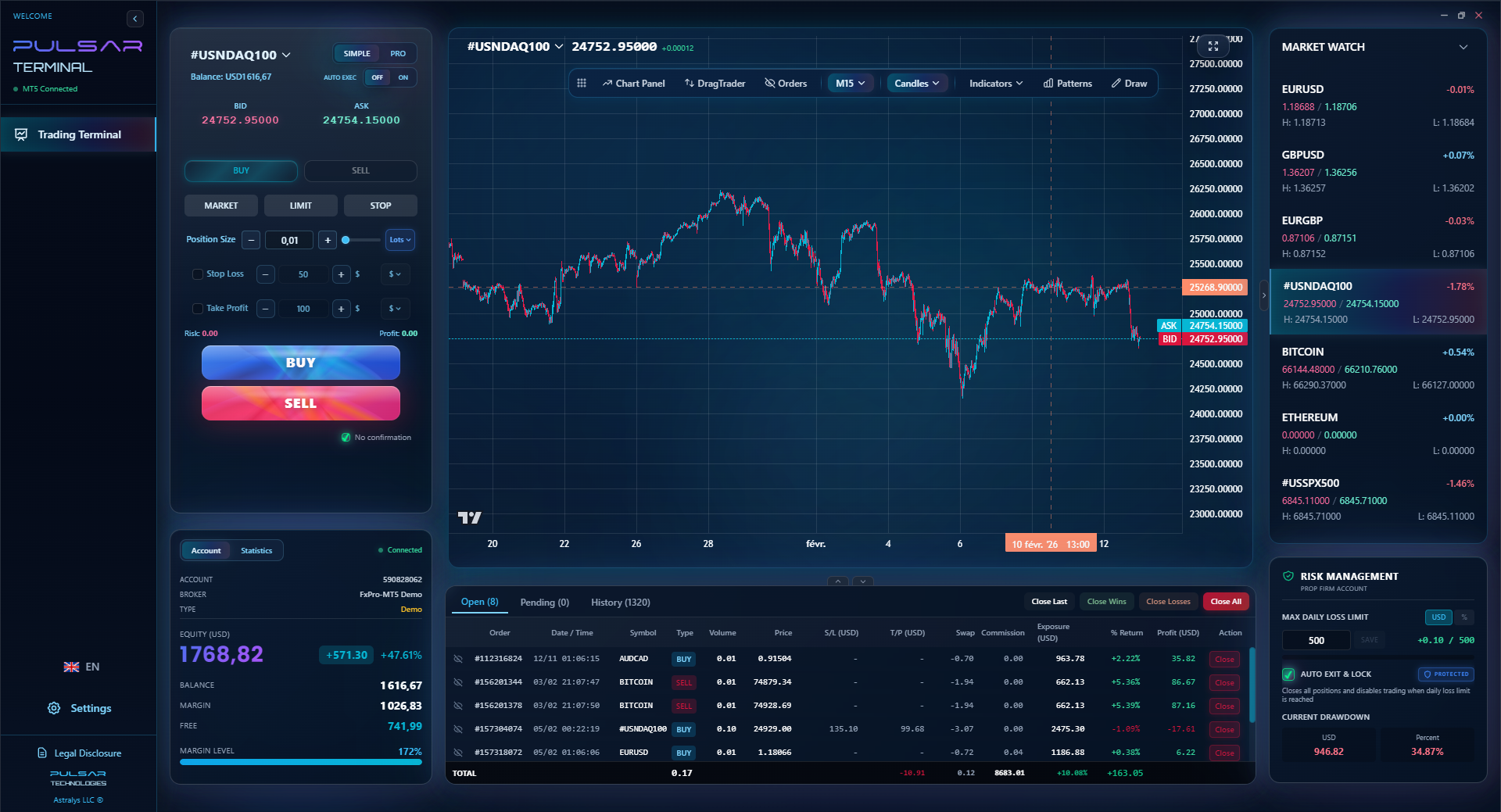
Pulsar Terminal
The all-in-one MT5 companion: drag-and-drop orders, multi-TP/SL, trailing stop, grid trading, Volume Profile, and prop firm protection. Used by 1,000+ traders daily.
“In South Africa, your trading profitability isn't just about your entries and exits; it's about how much of that profit survives the journey home.”
I've made these mistakes so you don't have to. Learn from my losses.
1. Assuming the Rate is Fair: Your biggest cost is the margin, not the commission. Never assume you're getting the market rate. Always check the actual rate applied on your statement and compare it to the mid-market rate on Google or XE.com at the time. The difference is your real fee.
2. Poor Documentation: SARB can audit transactions years later. If you can't prove that $20,000 receipt from "XYZ Prop LLC" was legitimate trading income, you could face penalties or have future transactions blocked. Save every statement, contract, and trade confirmation.
3. Using the Wrong BoP Code: This causes immediate delays. "Gift" has a annual limit. "Inheritance" requires a death certificate. For trading income, "Income from Abroad" or the specific "Other" code for independent contractor work is usually correct. When in doubt, call FNB's forex desk before you process the receipt.
4. Not Planning for the Delay: Needing that money to cover a margin call in three days? Bad idea. The forex receipt process is not instant. Always have a local cash buffer so you're not forced to make poor trading decisions due to banking delays.
5. Ignoring Tax Implications: This is critical. The money you receive is likely taxable income in South Africa. SARS sees it when SARB does. You are responsible for declaring your worldwide income, including trading profits from international brokers. The fact that FNB converted it and reported it creates a paper trail. Consult a tax professional who understands trading income. The few thousand rand in fees is worth the peace of mind.
FAQ
Q1How long does it take to receive forex funds into my FNB account?
From the moment your broker initiates the payment, expect 3 to 7 full business days. The funds sit at FNB pending your processing for 1-2 days, and after you provide the BoP code, it takes another 24 hours to clear. Always plan for a week.
Q2Can I receive forex without converting it to Rands?
Yes, but you need an FNB Global Account in the specific foreign currency (e.g., USD, EUR). When processing the receipt, you select to pay it into that Global Account. This lets you hold the foreign currency and decide when to convert it, avoiding FNB's conversion margin immediately.
Q3What is the single biggest cost when receiving forex with FNB?
The exchange rate margin (typically 2-4.5%) is by far the largest cost, often dwarfing the 0.55% commission. On a R100,000 receipt, a 3% margin costs you R3,000, while the commission is only R550.
Q4What documents do I need to provide for a large forex receipt?
FNB's compliance team may ask for: 1) A copy of your ID, 2) Proof of the source of funds (e.g., broker statement showing the withdrawal, prop firm profit & loss statement), and 3) Sometimes a contract or agreement with the sending entity. Have these ready digitally to avoid delays.
Q5Are there any limits on how much forex I can receive?
There's no strict SARB limit on receiving funds, but large or unusual amounts will trigger mandatory compliance checks. The limits apply more to sending money out (like the R1 million Single Discretionary Allowance). However, you must be able to prove the legitimate source of any funds you receive.
Q6Is it cheaper to use a specialist forex company instead of FNB?
Often, yes. For converting large sums from a Global Account to ZAR, specialist forex brokers often offer margins closer to 1% compared to FNB's 3%+. However, you must still receive the funds into a South African bank first. The hybrid approach is best: receive USD into an FNB Global Account, then use a cheaper service for the final conversion to ZAR.
Prof. Winston's Lesson
Key Takeaways:
- ✓The real cost of an FNB forex receipt is the 2-4.5% exchange rate margin, not the 0.55% commission.
- ✓Always request international withdrawals in the original currency, not ZAR, to avoid a R130 penalty fee.
- ✓Use an FNB Global Account to avoid immediate conversion and time your exchange like a trade.
- ✓Factor in a full 3-7 business day delay for funds to clear and become usable.
- ✓careful record-keeping is non-negotiable for smooth SARB and FNB compliance.
How useful was this article?
Click a star to rate
Weekly Trading Insights
Free weekly analysis & strategies. No spam.
About the Author
David van der Merwe
Emerging Markets Trader
Johannesburg-based trader with 11 years in emerging market currencies. Specializes in ZAR pairs, FSCA-regulated trading, and South African market analysis.
Comments
Risk Disclaimer
Trading financial instruments carries significant risk and may not be suitable for all investors. Past performance does not guarantee future results. This content is for educational purposes only and should not be considered investment advice. Always conduct your own research before trading.
You Might Also Like

Cara Trading Forex Sukses: 7 Prinsip dari Trader Profesional
Cara trading forex sukses dengan 7 prinsip trader pro: manajemen modal, disiplin, journal trading, backtest. Data nyata, bukan janji profit palsu.
Jam Trading Forex Terbaik untuk Trader Indonesia: Panduan Lengkap dengan Tabel Waktu
Panduan jam trading forex untuk trader Indonesia. Tabel 4 sesi dunia, jam emas 20:00-00:00, sesi mana yang harus dihindari. Data akurat + tips dari trader berpengalaman.
Top 5 Sàn Forex Uy Tín Nhất 2026: Review Jujur dari Trader Indonesia
Top 5 sàn forex uy tín 2026 untuk trader Indonesia. Review jujur: spread, deposit, withdraw, dukungan lokal. Exness, XM, IC Markets & lebih.
Get Pulsar Terminal
All these calculators are built into Pulsar Terminal with real-time data from your MT5 account. One-click position sizing, automatic risk management, and instant calculations.
Get Pulsar Terminal