


I was sitting in a coffee shop on Rivonia Road in 2023, watching the USD/ZAR tick up past R18.80, feeling that familiar itch to get exposure.

David van der Merwe
Emerging Markets Trader ·  South Africa
☕ 9 min read
What you'll learn:
- 1What FNB Forex in Sandton Actually Is (And What It Isn't)
- 2The Real Cost Breakdown: Where Your Money Actually Goes
- 3FNB vs. Real FSCA-Regulated Forex Brokers: A Side-by-Side Smackdown
- 4Trading the ZAR: Why You Need More Than a Bank
- 5A Practical Guide for the Sandton-Based Aspiring Trader
- 6The Future: Regulations, PAPSS, and What 2026 Means for You
I was sitting in a coffee shop on Rivonia Road in 2023, watching the USD/ZAR tick up past R18.80, feeling that familiar itch to get exposure. A guy at the next table, phone in hand, was loudly telling his broker to 'buy dollars through FNB.' He sounded confident. I knew exactly what was about to happen to his wallet. That moment crystallized a common Johannesburg confusion: using a bank's foreign exchange service for what is, in reality, a speculative trading decision. Let's clear that up right now.
Let's get this straight from the start. When you walk into FNB at 4 Merchant Place in Sandton or use their app, you're accessing a foreign exchange service, not a forex trading platform. This is a critical distinction that costs new traders thousands.
FNB's forex offering is designed for legitimate international payments: sending money abroad for tuition, buying property offshore, paying for imports, or using your travel allowance. They've won awards for this service, and for those specific needs, they're competent. You get a rate, pay a fee, and the money moves. End of story.
What you don't get is a leveraged trading account where you can speculate on the Rand's minute-to-minute movements against the dollar. You can't set a stop-loss at R18.75 and a take-profit at R19.10 on USD/ZAR. You can't short the Euro if you think the ECB is dovish. Their platform is for transacting, not trading. Mistaking one for the other is like using a forklift to race in the Kyalami Grand Prix – you're using the wrong tool entirely, and it will end badly.

Warning: Using a bank's FX service for short-term speculation is brutally expensive. The 2-4.5% margin FNB adds is equivalent to a spread of 200-450 pips on USD/ZAR. A real broker might offer a 15-30 pip spread. You're starting the race 200 pips behind.
Banks aren't charities. Their forex services are a profit center, and the pricing is layered so you feel the pain in different places. Here’s what happens to your Rands.
The Obvious Fees
If you're sending over R10,000 internationally online, FNB charges a 0.55% commission (min R275, max R550). That's just the ticket price. Then there's the receiving fee if money comes in. But these are just the appetizers.
The Main Course: The Exchange Rate Margin
This is the silent killer. FNB (and all banks) don't give you the real interbank rate. They add a margin, typically between 1% and 4%. Let's do the math everyone ignores.

Example: You want to convert R100,000 to USD. The real interbank rate is 1 USD = R18.50. You should get $5,405.41. With a 3% margin, FNB gives you a rate of ~R19.06. You now get ~$5,246.59. That's a difference of $158.82 that vanished into thin air. On a R100k transaction, you just paid R2,938 in hidden margin costs, plus your commission.
The Subscription Surcharge
That 2% 'international payment fee' on Rand payments to Netflix or Google? It's a reminder that any cross-border movement of value has a cost with a traditional bank. For a trader, these costs are anathema. We fight for every pip; giving up 2% before you even start is suicide.
I learned this the hard way early on. In 2017, I needed to fund an overseas broker. I used my local bank's FX service, thinking it was 'safe.' A R50,000 transfer lost over R2,500 to fees and margin before it even hit my trading account. That was my tuition fee for understanding the difference between a payment and a trading deposit. Use a proper FSCA-regulated broker for deposits; their payment processors get far better rates.

💡 Winston's Tip
A bank's exchange rate margin is a toll bridge. You pay it every time you cross, regardless of which direction the market is moving. Traders can't afford tolls.
“The 2-4.5% margin FNB adds is equivalent to a spread of 200-450 pips. You're starting the race 200 pips behind.”
This isn't a comparison of similar things. It's a comparison of tools for completely different jobs. But since the confusion is rampant, here's the scorecard.
| Feature | FNB Forex Service | FSCA-Regulated Broker (e.g., IC Markets, Pepperstone) |
|---|---|---|
| Primary Purpose | International Payments & Currency Conversion | Speculative Trading on Price Movements |
| use | None (1:1) | Typically 50:1 to 500:1 (capped at 1:200 for majors in 2026) |
| Cost Structure | Commission + Hidden Exchange Rate Margin (1-4.5%) | Spread (e.g., 1.3 pips on EUR/USD) + Possible Commission |
| Platform | Online Banking / FNB App | MetaTrader 4/5, cTrader, Proprietary Platforms |
| Ability to Short | No | Yes |
| Stop-Loss/Take-Profit Orders | No | Yes |
| Charting & Analysis | Basic rate charts | Advanced charts with dozens of indicators & drawing tools |
| Minimum 'Deposit' | Subject to transfer fees | Can be as low as $5 (e.g., XM) |
| Regulator | SARB (Exchange Controls), FSCA (Conduct) | FSCA (Financial Sector Conduct Authority) |
If your goal is to trade, the right-hand column is your only viable choice. The use alone changes the game. Putting up R10,000 margin to control a R1,000,000 position (at 100:1) is simply impossible with a bank. This is why the retail trading boom is happening on dedicated platforms, not banking apps.

Pro Tip: Need a foreign currency account to receive trading profits from an international broker? FNB's Foreign Currency Account (FCA) can be useful here. No monthly fees, and you can park your USD or EUR profits there. It's a good post-trade tool, not a trading tool.
Trading South African Rand pairs like USD/ZAR, EUR/ZAR, or GBP/ZAR is a unique beast. The volatility can be spectacular, which is why you need a trader's toolkit, not a banker's payment slip.
Liquidity & Spreads: USD/ZAR is an exotic pair. It's less liquid than EUR/USD, so spreads are wider. A good broker might offer a 15-30 pip spread. Remember, FNB's effective spread is 200-450 pips. You cannot scalp with a 300-pip handicap. I tried swing trading ZAR moves by timing bank conversions in 2019. The round-trip costs (margin on the way out, margin on the way back) wiped out any profit from a 5% move. It was a futile exercise.
What Moves the ZAR: You need to watch:
- SARB Repo Rate: The big one. Hawkish holds or hikes can rocket the Rand. Dovish turns crush it.
- Commodity Prices: Strong gold/platinum prices often support ZAR.
- Risk Sentiment: In 'risk-off' moments, ZAR gets sold like a hot potato.
- Local Politics & Eskom: Self-explanatory for any South African.
To react to these in real-time, you need a platform where you can enter, exit, and manage risk instantly. You can't call FNB Sandton and say "sell my dollars now, the repo rate decision was dovish!" By the time you get through, the move is over. A trading platform lets you set orders in advance or execute in milliseconds.
Managing the risk of these volatile pairs is non-negotiable. You must use a position size calculator and understand that a 50-pip stop on USD/ZAR is very tight. A single margin call from a ZAR spike can ruin a month.
💡 Winston's Tip
Your first lesson in trading the ZAR isn't about entries; it's about surviving the volatility. Size your positions as if Eskom is about to announce stage 8 load-shedding. Because sometimes, it feels like they just did.
“Keep your trading capital and your life capital separate. It creates essential psychological boundaries.”
So you're in Sandton, Jo'burg's financial hub, and you want in on the forex market. Here's your step-by-step, no-BS plan.
Step 1: Education Before Capital. Don't deposit a cent. Learn what a pip is, what spread means, and how use amplifies both gains and losses. Use demo accounts relentlessly.
Step 2: Choose a Regulated Broker, Not a Bank. Your first real financial decision. Pick an FSCA-regulated broker. This is non-negotiable for client fund protection. Do not, under any circumstances, use an unregulated offshore bucket shop. Your FNB Forex service won't help you when those guys vanish with your money.
Step 3: Fund Your Trading Account Smartly. This is the only place FNB might touch your trading journey. You'll likely need to make an international transfer to your broker. Do it online, understand the fees (that 0.55% commission will apply), and send the funds. Consider starting small. Many brokers accept credit/debit cards or local payment methods with better rates than international SWIFT transfers.
Step 4: Develop a Strategy & Use the Tools. Are you a swing trader holding for days, or a day trader? Your strategy dictates everything. Use the platform's tools. Set stop-losses on every trade. Religiously. I didn't on a GBP/ZAR trade in 2020, thinking 'it'll come back.' It didn't. A 400-pip move against me turned a bad trade into a catastrophic one.
Step 5: Keep Banking for Banking. Use your FNB account for your salary, living expenses, and maybe that FCA to eventually receive profits. Keep your trading capital and your life capital separate. It creates essential psychological boundaries.
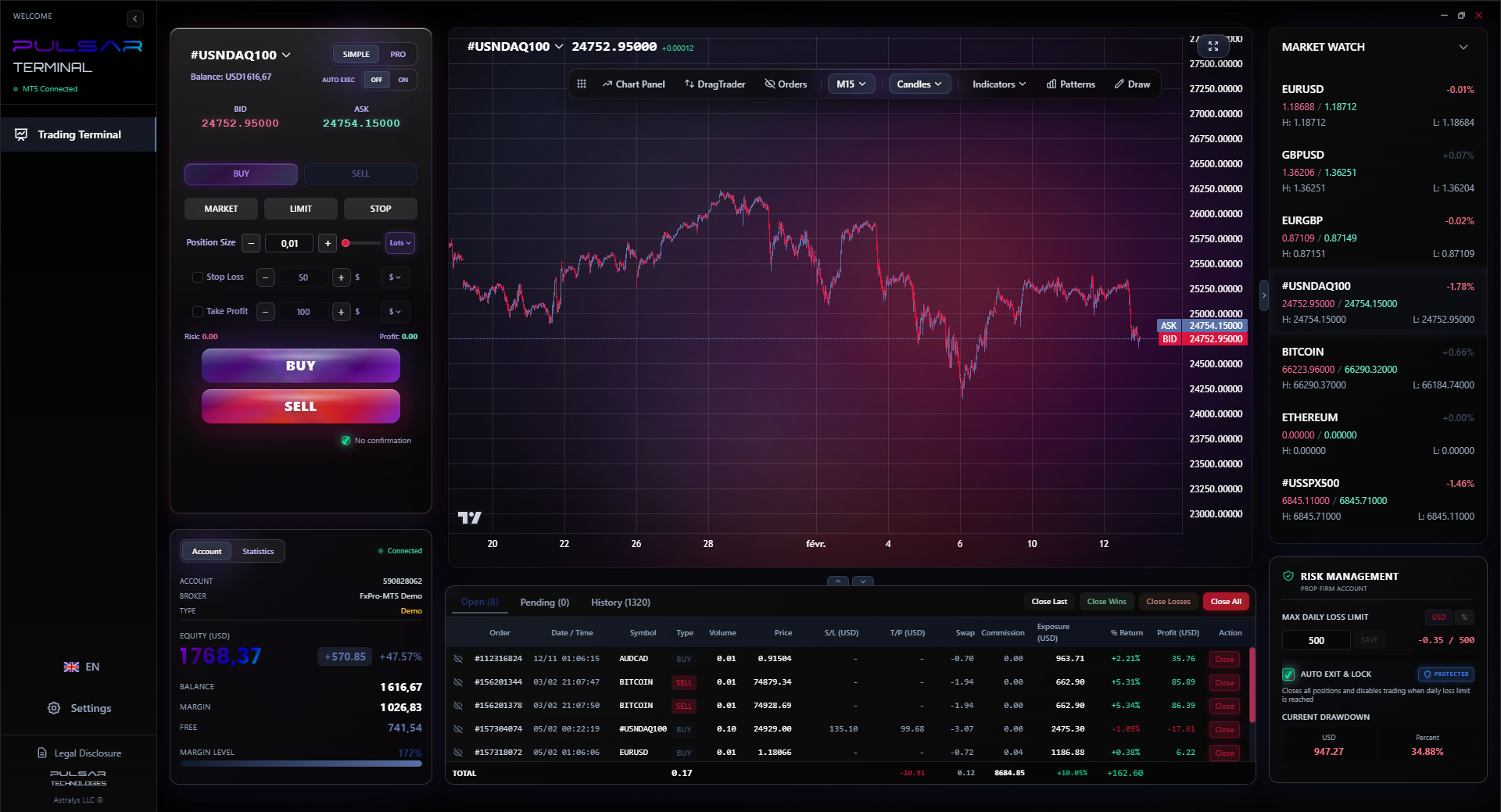
Managing volatile pairs like USD/ZAR requires precise order management, which is where a tool like Pulsar Terminal, with its drag-and-drop orders and multi-level take-profit/stop-loss features on MT5, becomes indispensable.
Pulsar Terminal
The all-in-one MT5 companion: drag-and-drop orders, multi-TP/SL, trailing stop, grid trading, Volume Profile, and prop firm protection. Used by 1,000+ traders daily.
The landscape is shifting. Being aware of this isn't optional.
The use Cap (Coming 2026): The FSCA's intention to cap use at 1:200 for major pairs is a big deal. It's a risk-management move. For you, it means less potential buying power on pairs like EUR/USD, but also less risk of a blow-up from over-use. It brings SA closer to global standards (like ESMA in Europe). If you're used to 500:1, adjust your expectations and your position sizing now.
Pan-African Payments and Settlement System (PAPSS): This is fascinating. A platform for direct conversion between African currencies, bypassing the USD? If it gains traction, it could reduce costs for intra-Africa trade dramatically. For traders, it might eventually create new, more liquid African currency pairs to watch. It's a long-term play, but it signals where the continent's financial infrastructure is trying to go.
Market Growth: The projected growth to a $6.85 billion market by 2033 means more competition, better technology, and more services tailored to South Africans. The boom in retail trading app downloads in 2025 is just the start. The key is to grow with the market, using regulated, professional tools, not by trying to force a square banking peg into a round trading hole.
The FSCA's 2026 conference theme, "Reimagining Regulation for a Changing World," says it all. The change is here. Your approach needs to change with it.
FAQ
Q1Can I trade forex through my FNB Online Banking app?
No, you cannot trade forex (speculate on price movements with use) through FNB's app. You can only buy or sell foreign currency for payment purposes at their set rate, which includes a significant margin. It's a currency conversion service, not a trading platform.
Q2What are the advantages of using FNB for forex then?
FNB's forex services are advantageous for their intended purpose: secure, compliant international payments and travel money. They handle the SARB exchange control paperwork (like the R1 million discretionary allowance), which is valuable. For holding foreign currency from overseas income, their Foreign Currency Account (FCA) is also a useful, fee-free product.
Q3I'm in Sandton, where can I go for real forex trading advice?
Seek education, not just advice. Many reputable online educators and coaches exist. Be wary of 'signal sellers' or 'investment groups' promising guaranteed returns. Your foundation should be self-education, using demo accounts, and choosing an FSCA-regulated broker. A physical address in Sandton doesn't equate to trading expertise.
Q4How do I fund an international forex broker from South Africa?
Most FSCA-regulated brokers offer multiple options: international bank wire (via your FNB account, but mind the fees), credit/debit card, or specialised payment processors like Ozow, PayFast, or Skrill. Processors often have better exchange rates and lower fees than a standard bank SWIFT transfer. Always check your broker's specific deposit options.
Q5Is forex trading through an international broker legal for South Africans?
Yes, it is legal, but you must use a broker that is authorised to offer services in South Africa. The safest route is to use a broker licensed by the South African Financial Sector Conduct Authority (FSCA). This ensures they comply with local regulations, including client fund segregation.
Q6What's the single biggest mistake people make with FNB and forex?
The biggest mistake is conflating cost with safety. People think using their big, familiar bank is 'safer' for trading activities. In reality, the excessive costs (the margin) make it statistically almost impossible to profit from short-term currency speculation. The 'safe' bank product is almost guaranteed to lose you money if used for trading. Real safety comes from using a regulated broker with transparent, low costs and proper risk management tools.
Prof. Winston's Lesson
Key Takeaways:
- ✓Banks sell FX services; brokers provide trading platforms. Know the difference.
- ✓A 3% bank margin can wipe out the profit from a 5% currency move.
- ✓Always use an FSCA-regulated broker for speculative trading.
- ✓Size ZAR trades for volatility, not just your account balance.
How useful was this article?
Click a star to rate
Weekly Trading Insights
Free weekly analysis & strategies. No spam.
About the Author
David van der Merwe
Emerging Markets Trader
Johannesburg-based trader with 11 years in emerging market currencies. Specializes in ZAR pairs, FSCA-regulated trading, and South African market analysis.
Comments
Risk Disclaimer
Trading financial instruments carries significant risk and may not be suitable for all investors. Past performance does not guarantee future results. This content is for educational purposes only and should not be considered investment advice. Always conduct your own research before trading.
You Might Also Like

Cara Trading Forex Sukses: 7 Prinsip dari Trader Profesional
Cara trading forex sukses dengan 7 prinsip trader pro: manajemen modal, disiplin, journal trading, backtest. Data nyata, bukan janji profit palsu.
Jam Trading Forex Terbaik untuk Trader Indonesia: Panduan Lengkap dengan Tabel Waktu
Panduan jam trading forex untuk trader Indonesia. Tabel 4 sesi dunia, jam emas 20:00-00:00, sesi mana yang harus dihindari. Data akurat + tips dari trader berpengalaman.
Top 5 Sàn Forex Uy Tín Nhất 2026: Review Jujur dari Trader Indonesia
Top 5 sàn forex uy tín 2026 untuk trader Indonesia. Review jujur: spread, deposit, withdraw, dukungan lokal. Exness, XM, IC Markets & lebih.
Get Pulsar Terminal
All these calculators are built into Pulsar Terminal with real-time data from your MT5 account. One-click position sizing, automatic risk management, and instant calculations.
Get Pulsar Terminal