


Most Nigerian traders think learning forex is about charts and strategies.

Olumide Adeyemi
West African Trading Pioneer ·  Nigeria
☕ 9 min read
What you'll learn:
- 1Why This Secret Language Matters More Than Your Strategy
- 2The Core P&L Abbreviations: PIP, Lot, Spread
- 3Order Execution: SL, TP, and the Art of Exit
- 4Account & Margin Lingo: Equity, Free Margin, use
- 5The Nigerian Context: NGN, CBN, and Local Realities
- 6Chart & Analysis Shorthand: RSI, MACD, MA
- 7Common Pitfalls & How to Avoid Them

Most Nigerian traders think learning forex is about charts and strategies. They're wrong. The real first step, the one that separates the funded from the blown-out, is cracking the code of forex abbreviations. I've watched more accounts get liquidated from a misunderstood 'SL' or a miscalculated 'pip' than from any bad market call. This isn't just jargon. It's the operational manual for your money. I'll prove it by showing you how these tiny acronyms control your risk, your profit, and your sanity in the Naira-based market.
When I first started, I was all about the MACD crossover and the perfect engulfing candle. I'd spend hours analyzing, then place a trade with a sloppy stop-loss because I didn't truly grasp the relationship between pips, lot size, and my account balance. The result? A nasty margin call on a USD/NGN trade that should have been a winner. The market didn't beat me. My own fuzzy understanding of the toolkit did.
These abbreviations are the nuts and bolts. You can have a genius-level market forecast, but if you don't know how to set a TP (Take Profit) or what the spread means for your entry, you're building on sand. For us trading with Naira, it gets even more critical. Understanding how your broker converts PIP value from USD to NGN can be the difference between calculating a 5% risk and accidentally risking 15%.

Warning: Never enter a trade if you can't instantly translate the abbreviation on your platform into a specific Naira amount at risk. If 'SL 50 pips' is just a number, not a value, you're gambling.
This foundation isn't glamorous. But it's what lets you execute a scalping strategy precisely or manage a swing trading position over weeks. It turns you from a spectator into a technician.
“The market didn't beat me. My own fuzzy understanding of the toolkit did.”
This is where your profit and loss are born. Get these wrong, and your math will lie to you.
PIP (Percentage in Point)
The PIP is the smallest price move a currency pair can make. For most pairs like EUR/USD, it's 0.0001. But here's the trap: for pairs with the JPY, like USD/JPY, it's 0.01. I learned this the hard way. I once calculated my risk on USD/JPY using 0.0001, thinking I was risking 30 pips. I was actually risking 300. The loss was swift and educational.
The value of a pip depends on your lot size. For a standard lot (100,000 units), a pip is usually $10. For a mini lot (10,000 units), it's $1. You must use a position size calculator every single time. Don't guess.
Lot Size (Standard, Mini, Micro)
This is your trade size multiplier. Trading 1 standard lot on EUR/USD means each pip movement changes your P&L by about $10. When your capital is in Naira, you need to factor in the USD/NGN rate to know what that really means for your buying power. A $100 loss isn't just 100 units; it's roughly ₦140,000 (at ~₦1400/$). That context changes everything.
Spread (The Hidden Cost)
The spread is the difference between the buy (ask) and sell (bid) price. It's how many brokers make their money. A 1.2 pip spread on EUR/USD means your trade starts 1.2 pips in the red. If you're scalping for 5 pips, that spread is eating 24% of your potential profit right off the bat. Always check the live spread before clicking buy. Some brokers like IC Markets offer raw spreads, which can be a game-changer for certain styles.

Example: You buy EUR/USD at 1.0850 (ask). The bid is 1.0848. The spread is 2 pips. Your trade is instantly down 2 pips. To be in profit, price must move above 1.0852, not 1.0850.

💡 Winston's Tip
Never let a platform's default settings define your risk. A 'standard lot' isn't a recommendation, it's a trap for the uninformed. Your lot size should be a calculated output from your risk percentage and stop-loss distance.


“If 'SL 50 pips' is just a number, not a Naira value, you're gambling.”
Entries get the glory, but exits define your career. These abbreviations control your exits.
SL (Stop Loss): This is your pre-defined pain threshold. It's not a suggestion. It's an automated command that says, "I was wrong, get me out." The biggest mistake I see? Placing an SL based on a round number (like 50 pips) instead of a logical market level (like below a swing low). In 2023, I left an SL on a GBP/USD trade just 5 pips below a major support level. Price spiked down, took my SL, and rallied 80 pips. My analysis was right, my SL abbreviation was lazy.
TP (Take Profit): Your profit target. The discipline here is just as important. Greed makes you move TP levels further away. Fear makes you close early. Setting a TP and walking away is a skill. Consider using multiple TPs to bank partial profits.
Market Order vs. Pending Order: A market order executes NOW at the current price. A pending order (like Buy Limit, Sell Stop) sets a trap at a future price. Pending orders are crucial for trading news or specific levels without staring at the screen.
These tools are meaningless without a plan. Before any trade, write down: SL = [price], TP = [price]. Then use the platform's tools to set them automatically. Your future self will thank you.
“If 'SL 50 pips' is just a number, not a Naira value, you're gambling.”
This is the dashboard of your trading car. Ignore it, and you'll crash.
Balance vs. Equity: Your Balance is your account's cash before any open trades. Your Equity is Balance plus/minus the current profit/loss of your open trades. This is your real-time net worth. If you have a losing trade open, your Equity is less than your Balance. This is the number that matters for margin call calculations.
Free Margin: This is your available trading capital. It's Equity minus the margin used for your current positions. If Free Margin hits zero, you can't open new trades. It's your breathing room.
use (e.g., 1:100): This is a double-edged sword, especially in Nigeria. use of 1:100 means you control $10,000 with only $100 of your own capital (margin). It amplifies both gains and losses. With Naira's volatility, over-leveraging is the fastest route to a zero account. The CBN and SEC have pushed for lower use for a reason. I used 1:500 early on. One bad EUR/USD trade wiped out 40% of my account in minutes. Now, I rarely exceed 1:30 for major pairs.
Margin Call & Stop Out: A Margin Call is a warning (usually at 50-100% of margin level) that your positions are going south. Stop Out is the forced liquidation (usually at 20-50%) where the broker closes your worst trade to protect themselves. It's not a gentle nudge. It's a guillotine.
💡 Winston's Tip
If you can't explain the difference between your Balance and your Equity to a 10-year-old, you have no business having an open position. Clarity on your real-time net worth is non-negotiable.

“Entries get the glory, but exits define your career.”
Trading from Nigeria adds its own layer of abbreviations and realities.
NGN (Naira): Your home currency. Every profit and loss converts to NGN. This affects your psychology. A $200 loss feels different when it's ₦280,000. You must always be aware of the USD/NGN exchange rate, both for funding your broker and withdrawing profits. Payment delays or bank charges can eat into small gains.
CBN (Central Bank of Nigeria) & SEC (Securities and Exchange Commission): The regulators. Their policies directly affect you. The SEC's 2022 recognition of forex trading as a capital market activity was huge for legitimacy. You need to know if your broker is on the SEC's approved list or if there are any current CBN restrictions on international transfers. This isn't just bureaucracy. It's about the safety of your funds.
Local Broker vs. International Broker: A 'local' broker might operate in Naira and offer easier deposits. An international broker like Exness or XM offers global markets but requires dealing in USD. Each has pros and cons around spreads, asset selection, and regulatory protection. Do your homework.

Pro Tip: Always calculate your risk as a percentage of your Naira account equity, not in pips or dollars. If you decide to risk 2% per trade, work backwards from your Naira equity to determine the correct lot size in dollars. This anchors your strategy to your local reality.
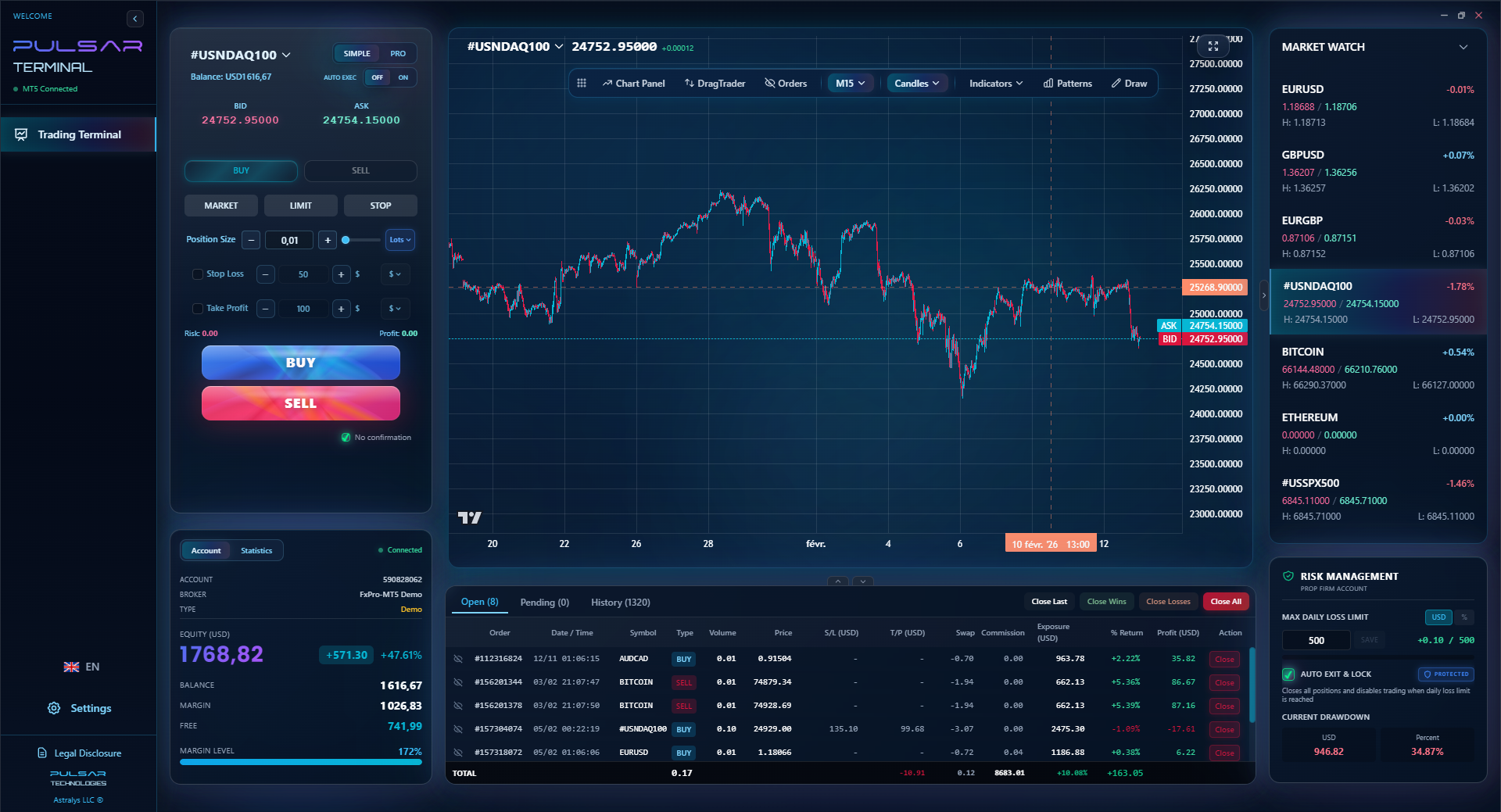
Manually calculating and adjusting multiple take-profit levels for a single trade is tedious and error-prone, but Pulsar Terminal automates this with its multi-TP and partial closure tools directly on your MT5 chart.
Pulsar Terminal
The all-in-one MT5 companion: drag-and-drop orders, multi-TP/SL, trailing stop, grid trading, Volume Profile, and prop firm protection. Used by 1,000+ traders daily.
“Entries get the glory, but exits define your career.”
These are the abbreviations on your charts. They're tools, not crystal balls.
RSI (Relative Strength Index): Measures momentum on a scale of 0-100. Above 70 is traditionally overbought, below 30 oversold. In a strong trend, RSI can stay overbought/oversold for a long time. I used to sell every time RSI hit 70 in an uptrend. I missed massive rallies. Now, I use it more for divergence signals (when price makes a new high but RSI doesn't).
MACD (Moving Average Convergence Divergence): Shows the relationship between two moving averages. The MACD line crossing the signal line is a common trigger. But it's lagging. It confirms moves, it doesn't predict them. Don't enter a trade based solely on a MACD crossover. Wait for price action to confirm.
MA (Moving Average): Like the 50 MA or 200 MA. These are dynamic support/resistance levels. The 200 MA is a major trend filter. Price above it suggests a bullish bias, below it bearish. But in ranging markets, price will chop around these MAs, giving false signals.
The key with all indicators? Keep it simple. I know traders with 10 indicators on a chart. It's chaos. Pick two or three you understand deeply. The chart shows price. Everything else is just a derivative commentary on that price.
💡 Winston's Tip
The most powerful abbreviation in your arsenal isn't on any list: 'JFT' – Just Follow The plan. Your SL, TP, and risk % are that plan. Clicking 'buy' without them is just expensive entertainment.

“use is a risk multiplier, not a profit guarantee.”
Let's translate common mistakes into the language of abbreviations.
Pitfall 1: Confusing 'Pips Gained' with 'Money Made'. You close a trade, thrilled you made 50 pips. But you were trading a micro lot (0.01). That's $0.50 per pip, so you made $25. After spread and potential commission, maybe $22. If you risked 20 pips to make 50, that's a good ratio. But don't confuse the pip count with the cash value.
Pitfall 2: Ignoring the Spread on Entry and Exit. You buy and the spread is 3 pips. You sell and the spread is 3 pips. Your break-even point isn't the price you bought at. It's that price plus 6 pips. This kills scalpers who don't use tight-spread accounts like those from Pepperstone.
Pitfall 3: Setting SL/TP Based on Wishful Thinking, Not Market Structure. Your SL should be where your trade idea is invalidated, not where you can't afford to lose more money. Your TP should be at a logical area of resistance or a measured move, not at a round number that feels nice.
Pitfall 4: Over-Leveraging Because 'Free Margin' is High. Just because you have Free Margin doesn't mean you should use it. use is a risk multiplier, not a profit guarantee. Treat high use with extreme caution.
The antidote to all of these is a written trading plan that defines, in clear terms, your risk per trade (as a %), your entry/exit rules, and your maximum daily loss. Then, use the platform's order types (SL, TP) to automate that plan. Your emotions are your biggest enemy. These abbreviations, used correctly, are your automated defense system.

FAQ
Q1What is the most important forex abbreviation for a beginner in Nigeria to understand first?
PIP. Without a solid grasp of what a pip is and how its value is calculated based on your lot size and the currency pair, you cannot accurately measure risk or reward. Everything else - SL, TP, use - builds on this. Misunderstanding pips is the root cause of most beginner account blowouts.
Q2How does the USD/NGN rate affect my trading with a foreign broker?
It affects you in two main ways. First, when you deposit or withdraw, your Naira is converted to USD (and vice versa) at your bank's or payment processor's rate, which often includes fees and a margin. Second, your psychological frame changes. A $100 loss is roughly ₦140,000 (as of mid-2026). You must always think of your account equity and risk in both USD and NGN terms to maintain proper perspective and discipline.
Q3Is high use (like 1:500) good for a Nigerian trader?
Almost never. While it seems attractive to control large positions with little capital, it dramatically increases your risk of a margin call. Given the volatility of both forex markets and the Naira, high use can wipe out an account from a very small, normal market move. The SEC's push for lower use is for trader protection. Start low (1:10 or 1:30) to learn proper risk management first.
Q4What's the difference between 'Balance' and 'Equity' on my MT5 platform?
Your Balance is the cash in your account from settled (closed) trades. Your Equity is your Balance plus the floating profit or loss from any currently open positions. If you have a trade running that's down $50, your Equity will be $50 less than your Balance. Your Equity is your real-time account value and is the number used to calculate your Margin Level and Free Margin.
Q5Why does my trade sometimes close before it hits my exact Stop Loss price?
This is usually due to a concept called 'slippage.' During periods of high volatility (like major news releases), price can jump over your SL order. If your SL is at 1.0800, but the next available sell price after a news spike is 1.0795, your order will execute at that worse price (1.0795). This is why it's dangerous to trade with tight stops during high-impact news events.
Q6What does 'CFD' mean next to the asset name on my broker's platform?
CFD stands for Contract for Difference. It means you are not buying the actual physical asset (like a barrel of oil or a share of Apple). You are entering a contract with your broker to exchange the difference in the asset's price from when you open the trade to when you close it. This allows for use, short-selling, and trading on margin, but it also means you don't own the underlying asset.
Q7Are brokers like Exness and XM legal for Nigerian traders to use?
As of 2026, yes, but the regulatory landscape is evolving. The Nigerian SEC now recognizes and regulates forex trading. It is crucial to check if an international broker is registered with the SEC or holds a strong international license (like from CySEC, FCA, ASIC). Using an unregulated broker poses a significant risk to your funds. Always verify a broker's regulatory status directly on the regulator's website before depositing.
Prof. Winston's Lesson
Key Takeaways:
- ✓A PIP's value changes with lot size and pair. Never assume.
- ✓Your Equity, not your Balance, determines your margin safety.
- ✓Set SL/TP at market structure levels, not round numbers.
- ✓Calculate all risk as a percentage of your Naira equity.
How useful was this article?
Click a star to rate
Weekly Trading Insights
Free weekly analysis & strategies. No spam.
About the Author
Olumide Adeyemi
West African Trading Pioneer
One of Nigeria's most active forex trading educators. 8 years of experience trading from Lagos. Specializes in low-capital strategies and prop firm challenges for African traders.
Comments
Risk Disclaimer
Trading financial instruments carries significant risk and may not be suitable for all investors. Past performance does not guarantee future results. This content is for educational purposes only and should not be considered investment advice. Always conduct your own research before trading.
You Might Also Like

Cara Trading Forex Sukses: 7 Prinsip dari Trader Profesional
Cara trading forex sukses dengan 7 prinsip trader pro: manajemen modal, disiplin, journal trading, backtest. Data nyata, bukan janji profit palsu.
Jam Trading Forex Terbaik untuk Trader Indonesia: Panduan Lengkap dengan Tabel Waktu
Panduan jam trading forex untuk trader Indonesia. Tabel 4 sesi dunia, jam emas 20:00-00:00, sesi mana yang harus dihindari. Data akurat + tips dari trader berpengalaman.
Top 5 Sàn Forex Uy Tín Nhất 2026: Review Jujur dari Trader Indonesia
Top 5 sàn forex uy tín 2026 untuk trader Indonesia. Review jujur: spread, deposit, withdraw, dukungan lokal. Exness, XM, IC Markets & lebih.
Get Pulsar Terminal
All these calculators are built into Pulsar Terminal with real-time data from your MT5 account. One-click position sizing, automatic risk management, and instant calculations.
Get Pulsar Terminal