


You're looking for a forex agent in South Africa, right? You've probably seen the ads promising easy money, zero spreads, and insane use.

David van der Merwe
Emerging Markets Trader ·  South Africa
☕ 11 min read
What you'll learn:
- 1What You Actually Mean by 'Forex Agent' (And Why It's Dangerous)
- 2FSCA Regulation: Your Only Safety Net
- 3The Real Costs: Spreads, Commissions, and Hidden Fees
- 4Broker Comparison: Cutting Through the Marketing
- 5Trading ZAR Pairs: It's a Different Beast
- 6Deposits & Withdrawals: The Practical Headache
- 7Common Traps New South African Traders Fall Into
- 8Your Action Checklist: Getting Started the Right Way
You're looking for a forex agent in South Africa, right? You've probably seen the ads promising easy money, zero spreads, and insane use. Let me stop you right there. What you're actually looking for is a regulated forex broker, not some shady 'agent' operating out of a Sandton coffee shop. The difference is your entire life savings. I've traded through the good, the bad, and the utterly disastrous brokers here. This guide cuts through the marketing fluff and tells you exactly what to look for, what to avoid, and how much it will really cost you.
Let's get this straight. In South Africa, the term 'forex agent' is a red flag. It's vague, unregulated, and often used by individuals or unlicensed entities offering to 'manage' your money or give you 'signals' for a fee. What you need is a Financial Services Provider (FSP) licensed by the Financial Sector Conduct Authority (FSCA).
A real broker is a company, not a guy on WhatsApp. They provide you with a platform (like MT4 or MT5), access to live markets, and execute your trades. They don't trade for you, and they sure as hell don't guarantee profits. Anyone calling themselves an 'agent' and offering managed accounts without a clear FSCA license number is playing with fire. I learned this the hard way early on, trusting a 'guru' who blew through R50,000 of my capital in two weeks on reckless gold trades. Poof. Gone.
Your first and only non-negotiable filter is FSCA regulation. It's not perfect, but it means client funds should be segregated, there's a complaints process, and the broker has to follow some basic rules. Trading with an unregulated entity is like handing your cash to a stranger at a taxi rank and hoping they'll bring back your profits.
The FSCA is your guardian, however sleepy it might seem sometimes. They operate under the Financial Sector Regulation Act. A broker's FSCA license isn't just a logo on a website, it's a specific number you can and must verify on the FSCA's own database.
What FSCA Regulation Actually Means for You
It means the broker has to keep your money in a separate bank account from their own operating funds (in theory). If they go bust, your capital isn't automatically used to pay their bills. It also means they have to disclose their fees, use, and risks clearly. They need proper anti-money laundering checks (KYC), which is why you have to send your ID and proof of address.
Now, here's a critical nuance many miss. Some international brokers have a local FSCA license (like Exness or Tickmill). Others are 'juristic representatives' of a foreign entity (like FP Markets). Both are legal pathways, but I personally lean towards brokers with a direct FSCA license for my main account. It just feels closer to home if something goes wrong.

Warning: Some offshore brokers will happily accept South African clients without FSCA oversight. The sign-up is easier, use is higher. It's tempting. But if you have a dispute, who are you going to call? The financial ombud in Vanuatu? Good luck with that. Stick to the FSCA list.

💡 Winston's Tip
A broker is a utility, not a partner. Your loyalty should be to your own profitability, not their brand. If their service or costs slip, be ready to move.
“Trading with an unregulated entity is like handing your cash to a stranger at a taxi rank.”
Forget the 'from 0.0 pips' headline. Let's talk about what you'll actually pay on a Tuesday morning when the JSE opens. Costs will eat your account faster than a bad trade if you're not careful.
Spreads: This is the difference between the buy and sell price. On EUR/USD, a good raw spread can be 0.1-0.3 pips, but you'll pay a commission on top. On a standard account, expect 0.8-1.2 pips with no commission. Now, for the pairs you care about: USD/ZAR. This isn't a major pair. It's exotic and volatile. Don't expect tight spreads. On a good day with a broker like Pepperstone, you might see 5 pips. On a volatile day during a SARB announcement, it can blow out to 15-20 pips easily. That's R150-R200 gone per standard lot before your trade even moves.
Commissions: If you choose a raw/ECN account, you pay per trade. Let's use real numbers from my Exness review. On their ECN, it's $3.50 per lot, per side. So a round turn (opening and closing a 1-lot trade) costs $7. That's about R130 at current rates. You need your trade to make more than that just to break even.
The Silent Killers:
- Swap Fees: Holding a USD/ZAR position overnight? You'll pay or earn a swap based on the interest rate differential. It can add up over time, especially if you're a swing trader.
- Currency Conversion: Your account is in ZAR, but you're trading USD pairs. Most brokers whack a 1-2% fee on the conversion when you deposit and withdraw. Deposit R10,000, and R200 could vanish before you place a trade.
- Bank Fees: This one hurts. Sending money overseas via Capitec or FNB can cost you R250-R500 per transfer. Receiving it back? Another R250-R350. I once made a R2000 profit on a trade, only to have R800 eaten by round-trip bank fees. Use a broker with local ZAR deposit options whenever possible.

Example: You trade 1 mini lot (0.1) of USD/ZAR. Spread is 8 pips (R80). Commission is R13. Your trade needs to move 9 pips in your favor just to reach breakeven. That's before swap or bank fees. This is why you must use a position size calculator.
Here’s a blunt look at some major players for South Africans, based on my experience and the hard numbers. This isn't exhaustive, but it's a starting point.
| Broker | FSCA Status | Min. Deposit (USD) | Typical EUR/USD Spread | Key Point for SA Traders |
|---|---|---|---|---|
| Exness | Direct License | $10 | 0.0 pips + commission | High use offered, popular for scalping strategy. Local ZAR deposits via Ozow/PayFast. |
| XM | Direct License | $5 | 0.8 pips (Standard) | Low barrier to entry, huge educational content. Spreads on exotics can be wide. |
| Tickmill | Direct License | $100 | 0.0 pips + commission | Very reputable, tight raw spreads. Good for active traders. |
| Vantage | Direct License | $50 | 0.0 pips (ECN) + comm | Strong all-rounder with good MT4/MT5 support. |
| FP Markets | Juristic Rep | $100 AUD | 0.0 pips (ECN) + comm | Excellent execution, vast instrument list. ASIC regulation adds another layer. |
| IC Markets | Not FSCA Licensed | $200 | 0.0 pips + commission | Great offshore option, but you forfeit FSCA protection. Used by many experienced traders. |
My main account for the last 3 years has been with an FSCA-licensed broker offering raw spreads. I keep a smaller account with a broker like IC Markets for specific strategies where I need their particular platform tools. Never put all your eggs in one broker's basket.
“Forget the 'from 0.0 pips' headline. Let's talk about what you'll actually pay on a Tuesday morning.”
You're South African. You naturally look at USD/ZAR, EUR/ZAR. I get it. But trading your own currency is psychologically tricky and fundamentally wild.
USD/ZAR isn't just a forex pair, it's a sentiment gauge for the country. It reacts violently to: SARB interest rate decisions, political drama (and we have plenty), commodity prices (gold/platinum), and global 'risk-on/risk-off' flows. The spread alone makes short-term trading a nightmare. I don't scalp ZAR pairs. Full stop.
The liquidity also dries up outside major session overlaps. Try getting a good fill on EUR/ZAR at 10 PM South African time. The spread will be monstrous. If you must trade it, treat it as a swing trading or positional play on broader themes. Use wider stops. A 50-pip stop on USD/ZAR is nothing, it can get taken out by a single headline. I once had a 30-pip profit on a USD/ZAR trade turn into a 120-pip loss in under an hour after a surprise cabinet reshuffle rumor hit the wires.

Pro Tip: If you want exposure to ZAR moves without the horrific spreads, look at major pairs correlated to global risk. AUD/USD (linked to commodities) or EUR/USD often move in sympathy with EM currencies like the Rand, but with far better liquidity and tighter costs.
💡 Winston's Tip
The true cost of a trade isn't just the spread. Add the commission, potential slippage, and the bank fee to get your money in and out. That's your real breakeven hurdle.
This is where the rubber meets the road. SARB exchange controls are real. You have a R11 million annual discretionary allowance. For 99% of traders starting out, that's not the limit. The limit is your bank's compliance department and the fees.
Best Practice:
- Use a broker with local ZAR settlement. Brokers like Exness, XM, and others have partnerships with local payment processors (Ozow, PayFast, etc.). You deposit Rands from your FNB/Capitec account, they convert it at a reasonable rate inside the broker. It's faster and often cheaper.
- If you must do an international wire, call your bank first. Tell them you're sending money for 'online trading' with an FSCA-licensed broker. Have the broker's FSP number ready. If you don't, they might block the payment, and you'll waste days unblocking it.
- Document everything. Keep records of every deposit, withdrawal, and the FSCA authorization. For tax purposes (yes, you have to pay tax on trading profits), this paper trail is gold.
I use the local deposit method for monthly top-ups. For larger, initial deposits, I sometimes still do a wire. It's a pain, but it's the cost of doing business in a regulated environment. The peace of mind is worth the R500 fee.
“Your first and only non-negotiable filter is FSCA regulation.”
I've made these mistakes so you don't have to.
Trap 1: Chasing Bonuses. A 100% deposit bonus? It's a leash, not a gift. You'll have to trade a monstrous volume (like 5 million ZAR worth) to withdraw your own money. Brokers like XM offer bonuses, but read the terms. I turned a R5,000 bonus into a R15,000 trading volume requirement once. Never again.
Trap 2: Over-leveraging. Just because an FSCA broker offers 1:500 or 1:1000 use doesn't mean you should use it. On a volatile pair like USD/ZAR, 1:100 use can margin call you on a 1% move. I use 1:30 max for my standard trades. use is a tool, not a strategy.
Trap 3: Ignoring the Platform. You choose a broker for their costs, but you live on their platform. If their version of MT4 is clunky or their mobile app crashes, you're dead in the water. Always open a demo account first and test it during a busy market open (London, 10 AM our time). Can you place a trade quickly? Does the chart freeze?
Trap 4: Signal Services & 'Prop Firms'. These are often marketed by 'forex agents'. You pay for signals or pay to take a 'challenge' to manage 'their' capital. The vast majority are structured for you to fail. The challenge rules are designed to be almost impossible, and the signal seller makes money whether you win or lose. Focus on building your own edge.
💡 Winston's Tip
Test a broker's character with a small withdrawal before a large deposit. Their efficiency in returning your money tells you everything about how they'll treat you when you're winning big.
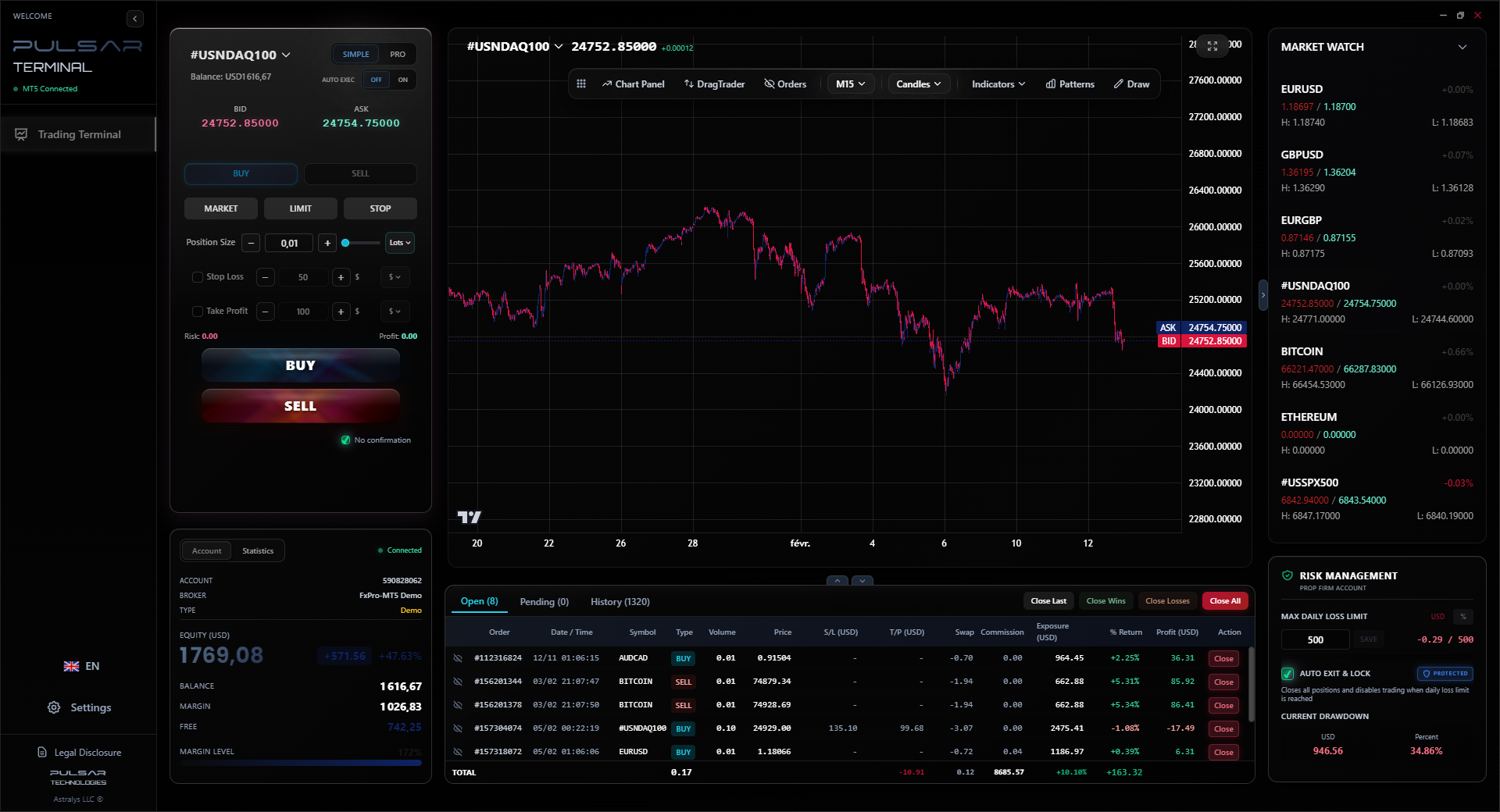
Managing multiple trades and complex exits on volatile pairs like USD/ZAR is stressful, which is why a tool like Pulsar Terminal that lets you set multi-TP/SL and trailing stops directly on MT5 is a game-saver.
Pulsar Terminal
The all-in-one MT5 companion: drag-and-drop orders, multi-TP/SL, trailing stop, grid trading, Volume Profile, and prop firm protection. Used by 1,000+ traders daily.
- Define Your Strategy: Are you a scalper, swing trader, or long-term? This dictates your broker choice (ECN vs Standard accounts).
- Shortlist 3 FSCA Brokers: From the list above, pick a few that match your strategy and budget.
- Open Demo Accounts: Not for one day. Trade them for a full month. Test executions, spreads at different times, and the platform.
- Verify the FSP Number: Go to the FSCA website and type in the number the broker gives you. Confirm the name matches exactly.
- Start Small: Open a live account with the minimum deposit. Not R50,000. Start with R2,000 or $100. Your goal is not to get rich, it's to test the entire process: deposit, trade, withdraw.
- Make a Withdrawal First: Seriously. Before you even think about serious trading, make a small withdrawal of R500. If you can get your money back smoothly, you've passed the first real test.
- Keep a Trading Journal: Note every trade, the broker used, the spread, the slippage. This data is more valuable than any guru's advice.
Finding the right broker isn't sexy. It's administrative work. But it's the foundation. A bad foundation cracks under pressure. Do this work now, and you can focus on what actually matters: learning to trade.
FAQ
Q1Is forex trading legal in South Africa?
Yes, absolutely. It's legal when you trade through a Financial Services Provider (FSP) that is authorized by the Financial Sector Conduct Authority (FSCA). Trading with unlicensed offshore entities or individuals is where you run into legal and financial risk.
Q2What is the minimum amount I need to start forex trading in South Africa?
Technically, you can start with as little as $5 (about R90) with some brokers like XM. But realistically, that's just for getting a feel of the platform. A more practical starting amount that allows for proper risk management is between R2,000 and R5,000. Remember, the minimum deposit isn't your trading capital strategy.
Q3How do I verify a broker's FSCA license?
Go to the FSCA's official website (www.fsca.co.za). Use their 'Search for Financial Services Providers' tool. Enter the FSP number the broker provides you. The company name on the FSCA register must match the broker you're signing up with exactly. If it doesn't, walk away.
Q4Why are spreads on USD/ZAR so high?
USD/ZAR is an exotic currency pair, not a major like EUR/USD. It has lower liquidity and higher volatility. Fewer banks and institutions are making a market in it, so the difference between the buy and sell price (the spread) is naturally wider to compensate for the broker's risk, especially during off-peak hours or around local news events.
Q5Do I pay tax on my forex trading profits in South Africa?
Yes. The South African Revenue Service (SARS) views forex trading profits as income if you're trading frequently (seen as carrying on a trade). You need to declare it in your annual tax return. Keep careful records of all your trades, deposits, and withdrawals. It's not capital gains unless you're making very long-term, infrequent trades.
Q6What's better, a Standard account with no commission or a Raw/ECN account with a commission?
It depends on your trade size and frequency. If you trade small volumes (mini or micro lots) infrequently, a Standard account's wider spread might be cheaper overall. If you trade larger sizes or are a frequent scalper, the tighter raw spread plus a fixed commission usually works out cheaper. You have to do the math for your own trading style.
Q7Can I use international brokers like Pepperstone or IC Markets?
They will accept you as a client, but they are not FSCA-licensed. This means you won't have the protection of the local regulator if something goes wrong. Many experienced South African traders use them for their superior technology and conditions, but they accept that they are operating in an unregulated space relative to SA law. It's a risk-reward decision.
Prof. Winston's Lesson
Key Takeaways:
- ✓FSCA license verification is non-negotiable.
- ✓Real trading costs include spreads, commissions, AND bank fees.
- ✓USD/ZAR spreads are wide; trade it as a swing, not a scalp.
- ✓Test the withdrawal process before making a large deposit.
- ✓use above 1:30 is a risk accelerator, not a skill.
How useful was this article?
Click a star to rate
Weekly Trading Insights
Free weekly analysis & strategies. No spam.
About the Author
David van der Merwe
Emerging Markets Trader
Johannesburg-based trader with 11 years in emerging market currencies. Specializes in ZAR pairs, FSCA-regulated trading, and South African market analysis.
Comments
Risk Disclaimer
Trading financial instruments carries significant risk and may not be suitable for all investors. Past performance does not guarantee future results. This content is for educational purposes only and should not be considered investment advice. Always conduct your own research before trading.
You Might Also Like

Cara Trading Forex Sukses: 7 Prinsip dari Trader Profesional
Cara trading forex sukses dengan 7 prinsip trader pro: manajemen modal, disiplin, journal trading, backtest. Data nyata, bukan janji profit palsu.
Jam Trading Forex Terbaik untuk Trader Indonesia: Panduan Lengkap dengan Tabel Waktu
Panduan jam trading forex untuk trader Indonesia. Tabel 4 sesi dunia, jam emas 20:00-00:00, sesi mana yang harus dihindari. Data akurat + tips dari trader berpengalaman.
Top 5 Sàn Forex Uy Tín Nhất 2026: Review Jujur dari Trader Indonesia
Top 5 sàn forex uy tín 2026 untuk trader Indonesia. Review jujur: spread, deposit, withdraw, dukungan lokal. Exness, XM, IC Markets & lebih.
Get Pulsar Terminal
All these calculators are built into Pulsar Terminal with real-time data from your MT5 account. One-click position sizing, automatic risk management, and instant calculations.
Get Pulsar Terminal