


Let's cut through the hype.

Sarah Collins
Trading Strategist ·  United Kingdom
☕ 10 min read
What you'll learn:
Let's cut through the hype. The biggest myth about forex AI trading is that you can buy a £200 robot, plug it in, and watch the money roll in while you sip pints. I've lost more money testing that fantasy than I care to admit. The reality in the UK is a complex mix of powerful technology, strict FCA oversight, and marketing nonsense. I'll show you what actually works, what will get you burned, and how to approach this world without losing your shirt.
When people say 'forex AI trading,' they're usually talking about one of three things, and only one is remotely intelligent.
First, you've got the basic Expert Advisors (EAs) on MetaTrader. These are simple scripts that follow if-then rules. 'Buy if the RSI is below 30.' That's not AI. That's automation. I coded my first one in 2014 for EUR/USD. It made £1,200 in a quiet month, then lost £3,400 when volatility spiked. It had no concept of 'why.'
Second, there's social/copy trading. Platforms like eToro let you mirror another trader. The 'AI' part is often just a basic matching algorithm. It's outsourcing your brain, not augmenting it.
The third category is where the real action is: machine learning models. These systems analyze vast datasets - price, order flow, even news sentiment - to find patterns invisible to humans. A hedge fund I consulted for used one that factored in GBP futures liquidity and Bank of England speech transcripts. That's proper AI. But you're not getting that for a one-time fee on a website. The FCA notes that 75% of UK financial firms now use some form of AI, but most retail 'AI' products are in the first two categories, dressed up in buzzwords.

Warning: If a sales page promises '100% AI-powered, self-learning profits,' it's lying. Genuine adaptive machine learning models cost six figures to develop and require continuous data feeds and retraining. They're not sold in a zip file.
The key is managing your expectations. You're probably looking at sophisticated automation, not artificial general intelligence. That doesn't mean it's useless. A well-tested EA that executes a solid scalping strategy flawlessly is a fantastic tool. Just don't expect it to think.

💡 Winston's Tip
Never backtest an AI strategy on the same data you used to train it. That's like giving a student the exam answers and calling them a genius. Always use out-of-sample data.
Here's the crucial bit for UK traders: there is no 'AI regulation.' The FCA isn't creating special rules for robots. They're using existing frameworks to clobber you if you mess up.
The Rules That Actually Matter
Your automated trading falls under the same principles as if you were clicking buttons yourself. The Senior Managers and Certification Regime (SMCR) means ultimate accountability sits with a human. If your AI goes rogue and violates market rules, you are responsible. The FCA has made this crystal clear.
For firms offering automated strategies or signals, FCA authorization is often required. That guy on Instagram selling a 'guaranteed' EA? He's likely breaking the law if he's not authorized. The FCA's Consumer Duty also applies: products must offer fair value. A robot that loses 80% of client money while charging a monthly fee is going to attract very unwelcome attention.
The Platform's Responsibility
Brokers like Pepperstone or IC Markets that offer MT4/MT5 aren't responsible for your EA's logic. But under MiFID II principles (which still shape UK rules), they must have systems to prevent erroneous orders and market abuse. If your bot starts spamming thousands of orders, they'll shut it down - and possibly your account.

Pro Tip: Always test new EAs on a demo account with your broker first. Their server latency and order execution logic can differ from your backtesting software, causing nasty surprises. I once had a grid EA work perfectly on a demo with one broker but instantly cause a margin call on a live account with another due to slower execution.
The regulatory landscape is evolving. The FCA and Bank of England's 2024 survey found massive AI adoption, and they're running an 'AI Live Testing' scheme. But their core message remains: the rules are the rules, tech doesn't change that.
“You're probably looking at sophisticated automation, not artificial general intelligence.”
Let's talk numbers. The price of the robot is just the entry fee. The real costs will eat you alive if you're not careful.
1. The 'AI' Product Itself:
- Garbage Tier (£0 - £100): Mostly recycled code from forums. Avoid.
- Mass-Market Robots (£100 - £2,500): This is the sweet spot for marketing. You're paying for the sales funnel, not the tech. Many have hidden monthly fees for 'signal updates'.
- Custom Development (£1,000 - £10,000+): Hiring a programmer to build your strategy. I paid £2,800 for a custom volatility-based EA. It broke even for 11 months before finally turning a consistent profit. A long, expensive road.
2. The Brokerage Costs (This is the killer): Your AI will trade. A lot. That means every cost is magnified.
| Cost Type | Typical Range (Major Pairs) | Impact on AI Trading |
|---|---|---|
| Spread | 0.0 - 1.5 pips | Huge. A scalping bot making 50 trades a day gets destroyed by a 1-pip spread. |
| Commission | £3 - £7 per round lot | Directly subtracts from every profitable trade. |
| Swap/Rollover | Variable | Can turn a winning positional strategy into a loser if not factored in. |
I learned this the hard way. In 2019, I ran a martingale-style EA on GBP/JPY. It was making small gains, but the spread widened during Asian sessions. The bot kept entering trades at the worst possible spread, and the commissions turned a theoretical 5% monthly gain into a 2% loss. Always use a position size calculator that includes commission costs.
3. The Hidden Cost: Your Time. You must monitor it. You must update it when your broker's MT4 builds change. You must have the infrastructure (a VPS, ~£20/month) so it runs 24/5. This isn't passive income. It's active system management.
Not all brokers are created equal for automation. You need one that's both FCA-regulated and tech-friendly.
Essential Platform Features:
- MT4/MT5 or cTrader Support: Non-negotiable. These are the ecosystems where 99% of EAs live.
- Reliable VPS Hosting: Offers low-latency, stable uptime. Many brokers provide this free with a minimum account size.
- Clear API Documentation: If you're going beyond standard EAs, you'll need API access for custom integrations.
- Raw Spread Accounts: For high-frequency strategies, you need the tightest spreads possible, even with a commission.
UK Broker Snapshot for AI Traders:
- Pepperstone (FCA): Excellent for raw spreads (0.0 pips on Razor) and MT4/MT5/cTrader support. Their commission (£4.50 per lot round turn) is competitive.
- IC Markets (FCA via IC Markets UK): Built for algo traders. Low latency, great VPS, and very popular with the coding community.
- IG (FCA): Offers ProRealTime with its own scripting language and a full Python API for serious developers. Not for beginners.
- XM (FCA): Good all-rounder with solid MT4/MT5 support and flexible minimum deposits, suitable for testing strategies with smaller capital.
Payment Methods: Funding is easy in the UK. Bank transfer (BACS/Faster Payments) is usually free and fast. PayPal, Skrill, and debit cards are common. Stick to GBP-denominated accounts to avoid conversion fees.

Example: Let's say your AI trades EUR/USD 10 times a day, 1 lot per trade, on a 0.1 pip spread + £3 commission account vs. a 1.0 pip spread, no commission account.
- Account A (Tight Spread): Spread cost: 10 trades * 1 lot * £0.10 = £1. Commission: 10 trades * £3 = £30. Total: £31/day.
- Account B (Wide Spread): Spread cost: 10 trades * 1 lot * £1.00 = £10. Commission: £0. Total: £10/day. Account B is cheaper unless your strategy profits from ultra-precise entries. This math is critical.
💡 Winston's Tip
The most important line of code in any EA is not the entry logic. It's the maximum daily loss limit. Hard-code it. Your future self will thank you.
“The traders who thrive will be those who use the tech to enhance their discipline, not replace their brain.”
This is the crossroads. Do you buy a 'black box' robot or build your own system?
The Buying Trap: You see the track record: 'Up 300% in 6 months!' What they don't show you is the 80% drawdown that happened two years ago, or that the strategy only works in a raging bull market for XAU/USD. My worst purchase was a 'Neural Network Gold EA' for $500. It had a beautiful equity curve. On my live account, it entered one trade, went 50 pips against me, and never closed it. The code was designed to only close trades on a specific Friday of the month. Utter garbage.
The Building Path (The Smarter Choice):
- Learn a Strategy First: Don't start with code. Master a manual strategy, like swing trading using MACD and support/resistance. Profit with it manually for at least 6 months.
- Define EVERY Rule: Entry, exit, position size, what to do during news. Leave zero ambiguity. 'Feel' doesn't translate to code.
- Find a Coder (or Learn MQL5): Use a site like MQL5.com. Be specific. Offer a fixed price for the first version and a bonus for a profitable 3-month live test. I've hired developers from there for £800-£1,500 per project.
- Backtest, Then Forward Test: Use MT5's strategy tester, then run it on a demo for a full market cycle (e.g., high and low volatility periods).
The Hybrid Approach: Use AI tools for specific tasks, not the whole trade. I now use a simple volatility scanner I built. It doesn't place trades. It just alerts me when EUR/USD conditions match my high-probability setup. I still click the button. The AI handles the data-crunching; I handle the discretion. This keeps me within the FCA's 'appropriate human oversight' guidance and stops me from doing something stupid.
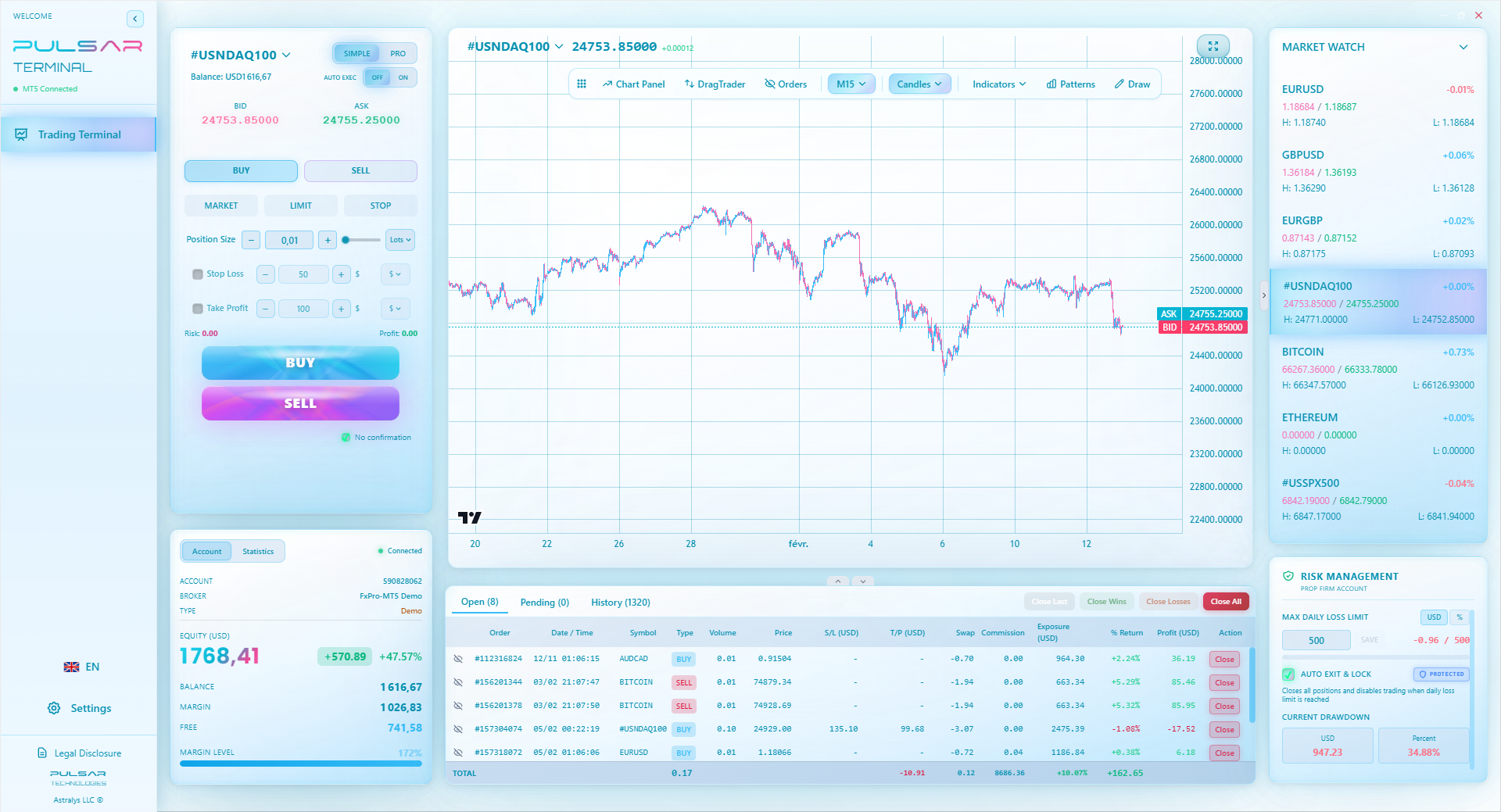
When building your own automated rules, a tool like Pulsar Terminal lets you visually create and manage complex order grids and risk protocols directly on your MT5 charts, turning your strategy logic into one-click actions.
Pulsar Terminal
The all-in-one MT5 companion: drag-and-drop orders, multi-TP/SL, trailing stop, grid trading, Volume Profile, and prop firm protection. Used by 1,000+ traders daily.
Where is this all going? The FCA's 2026 review will shape the retail landscape. Expect more guidance on 'explainable AI' and audit trails. The regulator is using AI itself to monitor markets, so they know what's possible.
For you, the retail trader, the future is about augmentation, not replacement. The tools will get better at screening opportunities and managing risk. For example, a proper AI could analyze a decade of data to tell you, 'Your RSI strategy has a 70% failure rate when the 10-year Treasury yield is above 4%.' That's useful.
The Final Reality Check:
- No Silver Bullet: If a strategy is fundamentally flawed, automating it just loses money faster.
- You Are the Risk Manager: The AI is the pilot. You are the chief engineer watching the engine temperature. If you walk away, the plane crashes.
- Start Small: Allocate a tiny portion of your capital (e.g., 5-10%) to automated trading. Prove it works over years, not months.
- Beware of Over-Optimization: A system tuned perfectly for past data will fail spectacularly with new data. This is the cardinal sin of AI trading.
Forex AI trading in the UK is a powerful assistant, not a master. It requires more knowledge, not less. Understand the regulations, respect the costs, and never surrender your judgment to a line of code. The traders who thrive will be those who use the tech to enhance their discipline, not replace their brain.
FAQ
Q1Is forex AI trading legal in the UK?
Yes, it's completely legal. However, it's not unregulated. You are fully responsible for the actions of your automated system under existing FCA rules like the Senior Managers Regime. Firms selling trading robots or signals usually require FCA authorization.
Q2What's the best forex trading platform for AI in the UK?
MetaTrader 5 (MT5) is generally the best for retail traders due to its superior strategy tester, more data points for analysis, and widespread support from brokers like IC Markets and Pepperstone. MT4 is still viable but is older technology.
Q3How much money do I need to start forex AI trading?
Technically, you can start with a few hundred pounds. Realistically, you need enough to withstand drawdowns and cover costs. For serious testing, a £5,000-£10,000 dedicated account is a more sensible minimum. Remember, 72-81% of retail CFD traders lose money; automation doesn't change that math without a genuine edge.
Q4Can I use a free forex trading robot?
You can, but you probably shouldn't. Free robots are often poorly coded, contain outdated logic, or worse, have 'malicious' code designed to trade against you (a concept called 'sniping'). There's no free lunch. If the strategy was truly profitable, the creator wouldn't be giving it away.
Q5Does the FCA regulate forex robots?
Not directly. The FCA regulates the firms and individuals that provide financial services. If a company is marketing and selling a forex robot as an investment product, that firm likely needs to be FCA-authorized. The robot itself is just software; the FCA regulates the conduct around its sale and use.
Q6What's the biggest risk with forex AI?
Over-reliance and lack of oversight. The biggest losses I've seen (including my own) come from assuming the AI 'has it covered' and not monitoring for changing market conditions (like a shift from trending to ranging markets) or technical failures like a missed internet connection causing missed stop-loss orders.
Q7Should I use a VPS for my forex robot?
Absolutely, yes. A Virtual Private Server (costing ~£15-£30/month) runs your trading platform 24/5 without interruption. If your home internet or power goes out, your strategy stops. Many UK brokers offer a free VPS if you maintain a minimum account balance.
Prof. Winston's Lesson
Key Takeaways:
- ✓Genuine adaptive AI costs six figures; retail 'AI' is mostly marketing.
- ✓You are 100% liable for your robot's actions under FCA rules.
- ✓Broker spreads & commissions are magnified by frequent AI trading.
- ✓Build a system around a proven manual strategy, not the other way around.
- ✓Use a VPS. A £20/month server is cheaper than a missed £2,000 stop-loss.
How useful was this article?
Click a star to rate
Weekly Trading Insights
Free weekly analysis & strategies. No spam.
About the Author
Sarah Collins
Trading Strategist
London-based trading strategist with 12 years in financial markets. Former analyst at a City of London brokerage. Covers GBP pairs, European markets, and FCA-regulated trading.
Comments
Risk Disclaimer
Trading financial instruments carries significant risk and may not be suitable for all investors. Past performance does not guarantee future results. This content is for educational purposes only and should not be considered investment advice. Always conduct your own research before trading.
You Might Also Like

Cara Trading Forex Sukses: 7 Prinsip dari Trader Profesional
Cara trading forex sukses dengan 7 prinsip trader pro: manajemen modal, disiplin, journal trading, backtest. Data nyata, bukan janji profit palsu.
Jam Trading Forex Terbaik untuk Trader Indonesia: Panduan Lengkap dengan Tabel Waktu
Panduan jam trading forex untuk trader Indonesia. Tabel 4 sesi dunia, jam emas 20:00-00:00, sesi mana yang harus dihindari. Data akurat + tips dari trader berpengalaman.
Top 5 Sàn Forex Uy Tín Nhất 2026: Review Jujur dari Trader Indonesia
Top 5 sàn forex uy tín 2026 untuk trader Indonesia. Review jujur: spread, deposit, withdraw, dukungan lokal. Exness, XM, IC Markets & lebih.
Get Pulsar Terminal
All these calculators are built into Pulsar Terminal with real-time data from your MT5 account. One-click position sizing, automatic risk management, and instant calculations.
Get Pulsar Terminal