


Here's a fact that made me pause: over 70% of Nigerian traders I've met in online communities identify as Muslim, yet a staggering number are unsure if their trading activity is Islamically permissible.

Olumide Adeyemi
West African Trading Pioneer ·  Nigeria
☕ 11 min read
What you'll learn:
Here's a fact that made me pause: over 70% of Nigerian traders I've met in online communities identify as Muslim, yet a staggering number are unsure if their trading activity is Islamically permissible. I wasn't sure myself for years. I used to think avoiding pork and praying five times a day covered it, while my trading account quietly accrued swap fees on overnight positions. It wasn't until a brother at the mosque asked a pointed question about 'riba' that I had to confront the grey area my trading lived in. This guide is the result of that journey, the mistakes I made, and the clarity I found.
Let's cut straight to it. The short answer is: it can be, but it's not automatic. The long answer requires us to look at why conventional forex trading often runs into Islamic principles. The primary issue isn't the act of exchanging currencies itself. That's a legitimate business need (sarf). The problems creep in with how modern, leveraged speculative trading is conducted.
There are three major red flags from an Islamic finance perspective:
-
Riba (Interest/Usury): This is the big one. In forex, riba most commonly appears as the swap or rollover fee. This is an interest charge (or credit) you pay or receive for holding a position overnight. Because money is being exchanged for money with a time-based premium, it's considered riba. No way around it.
-
Gharar (Excessive Uncertainty/Gambling): This refers to excessive risk, deception, or ambiguity in a contract. Pure speculation with no underlying asset or economic purpose can be seen as gharar. However, most scholars agree that educated speculation based on analysis (like we do with technicals and fundamentals) moves it away from gambling and towards a commercial risk (ghorm). The key is knowledge and intent.
-
Maysir (Gambling): Closely tied to gharar. If your trading is purely guesswork, chasing luck with no strategy, it veers into maysir.
So, is it halal? A growing consensus among contemporary Islamic scholars is that currency trading is permissible if it avoids riba (swaps) and is conducted as a serious business venture, not gambling. This is where the concept of an Islamic forex account comes in.

Warning: Don't assume your trading is halal just because you're a Muslim. The default state of a standard trading account at most brokers involves riba through swaps. You have to actively choose a compliant path.
When I first heard about 'swap-free' accounts, I thought it was a marketing gimmick. I was wrong. A proper Islamic forex account is a structural adjustment to remove riba from the trading relationship. Here's the mechanics, stripped bare.
Brokers don't just 'waive' the swap fee out of kindness. In a standard account, they hedge your position in the interbank market and incur costs (or gains) themselves. To offer a swap-free account compliantly, they typically use one of two methods:
-
Administrative Fee Model: Instead of a daily interest charge, they may charge a fixed, one-time administrative fee for holding positions open beyond a certain period (e.g., after 3 days). This fee is meant to cover their operational costs without being time-based interest. It's crucial this fee is transparent and not proportional to the position size in an interest-like way.
-
Price Adjustment Model: The cost of holding the position is baked into the spread or a separate fixed commission from the start. No daily charges appear.
What to Look For (And What I Got Wrong):
I once signed up with a broker offering 'Islamic accounts' only to find they just disabled swaps but charged massive, unpredictable commissions on long-term trades. It felt more expensive and less transparent. A good Islamic account should have clear terms. Ask: Is there a flat admin fee? Is it applied after X days? Is the spread wider? Compare it directly to their standard account using a position size calculator to see the real cost difference.
Also, not all instruments are available swap-free. Major pairs like EUR/USD usually are, but exotics or some CFDs might not be. Always check the broker's specification list.
| Feature | Standard Account | Islamic/Swap-Free Account |
|---|---|---|
| Overnight Holding Cost | Swap/Rollover Interest (Riba) | Fixed Admin Fee or Adjusted Spread |
| Compliance | Conventional | Designed for Sharia Principles |
| Suitability | All Traders | Traders avoiding Riba |
| Typical Use | Any strategy | Especially swing trading & long-term holds |
“The default state of a standard trading account at most brokers involves riba through swaps. You have to actively choose a compliant path.”
This is where your due diligence is a religious duty. A broker's website might have a crescent moon icon on it, but that doesn't guarantee a legitimately structured Islamic account. In Nigeria, you're looking for two things: a broker with a solid global reputation for offering true Islamic accounts, and one that services Nigerian clients reliably.
Based on my experience and the consensus in trading circles here, these brokers are consistently mentioned for their Islamic account offerings:
-
Exness: They call them 'Swap-Free' accounts. Registration is straightforward for Nigerians, and they have local deposit/withdrawal options. I've held swing trades in their swap-free account for weeks. The terms were clear: no swaps, but a reasonable fixed commission applied after 7 days. Read our full Exness review for more details.
-
IC Markets: Their 'Raw Spread' account can be configured as swap-free. Their execution is excellent, which matters for any trading style, including scalping strategy. I found their customer service responsive when I had questions about the specifics of their swap-free policy. Check the IC Markets review.
-
XM: They offer dedicated Islamic accounts on all platforms. XM is hugely popular in Nigeria, partly due to their extensive educational resources. Their swap-free terms are prominently displayed. See the XM review.
-
Pepperstone: Offers swap-free accounts on request. Pepperstone is known for tight spreads and good regulation. You need to apply for the swap-free status on your account after opening it. Our Pepperstone review covers this process.

Pro Tip: Always open a demo Islamic account first. Hold a position for 10 days. Check the transaction history. Do you see any swap charges? If you see a 'commission' or 'admin fee', is it clearly stated in the terms you agreed to? This test saved me from two poorly structured accounts.

💡 Winston's Tip
A swap-free account changes your breakeven math. Backtest your strategy with the broker's specific admin fees, not just spreads, to see the real impact on your edge.
Getting the right account is just the container. What you put in it - your actions and intentions - is what truly matters. This is where forex and Islam connect on a deeper level than just avoiding swaps.
Intent (Niyyah)
Your intention must be clear. Are you trading to provide for your family, to build wealth responsibly, and to engage in a legitimate commercial activity? Or are you trading for the thrill, to get rich quick, or to gamble? The former aligns with Islamic principles of seeking halal provision. The latter drifts into maysir. I had to check my own niyyah after a big loss. Was I revenge trading? That's gambling. I stepped away.
Risk Management as a Duty
In Islam, preserving wealth is important. Reckless trading that risks your capital and your family's well-being is not just bad trading, it's irresponsible. Using stop-losses isn't just a tactic, it's a form of financial self-preservation. I learned this the hard way early on, ignoring my stops and facing a margin call. Proper risk management is a shield.
Avoiding Haram Industries
Many brokers offer CFDs on stocks, commodities, and indices. If you trade these through an Islamic account, you must also ensure the underlying asset is halal. This means avoiding CFDs on companies involved in alcohol, gambling, conventional banking (with interest), pork, or adult entertainment. Trading gold (XAU/USD) is generally considered permissible, but check if the contract is structured Islamically.
The Concept of Ghorm (Commercial Risk)
Legitimate trading involves ghorm - the commercial risk you undertake in hope of profit. This is halal. The line between ghorm and maysir is drawn by your approach. Are you analyzing the market using tools like the RSI indicator or MACD indicator to make informed decisions? That's ghorm. Are you placing trades based on a 'feeling' or a tip from a random Telegram group? That's leaning towards maysir.
“A halal account doesn't make up for a haram mindset of greed and indiscipline.”
When you remove the cost/benefit of swaps, your strategic calculus changes. You're no longer penalized (or rewarded) for holding positions long-term, but you also lose the potential carry-trade income. Here’s what works.
Swing Trading Becomes King: This is the most natural fit. Holding positions for days or weeks to capture larger market moves is now cost-effective. You can wait for your thesis to play out without a daily interest drain. My most successful Islamic account trades have been swing trades on major pairs, using weekly and daily charts to find direction.
Scalping is Still Viable: Since scalpers rarely hold positions overnight, swaps were never a big factor anyway. An Islamic account is perfectly fine for scalping strategy. Just watch for any unusual commission structures the broker might apply.
Position Trading is Fully Unlocked: Want to hold a fundamental view on the USD for months? In a standard account, the swap costs could be crippling. In a swap-free account, you can do this. It allows for truly long-term investment-style approaches to forex.
What You Lose: The 'carry trade' strategy - buying a high-interest-rate currency and selling a low-interest-rate one to profit from the swap - is completely off the table. That's not a loss; it's a removal of a riba-based strategy. Your edge must now come purely from price movement analysis.

Example: In 2022, I held a long-term bearish view on the JPY. In a standard account, holding a USD/JPY short (selling USD, buying JPY) would have paid me positive swap daily as the JPY had a lower interest rate. But that's riba-based profit. In my Islamic account, I held the same short position for 3 months with no swap. I made a 420-pip profit purely from price movement. The profit was less than it would have been with swaps, but it was clean and aligned with my principles. Understanding the value of a pip definition was key to calculating that pure price gain.
💡 Winston's Tip
The most 'Islamic' part of your trading isn't the account type, it's your journal. If your journal shows discipline and analysis, you're trading. If it shows chaos, you're gambling.
I've made most of these. Learn from my stumbles.
Mistake 1: Assuming 'Swap-Free' Means 'Cost-Free'. Brokers are businesses. They will recover their costs. My first Islamic account had a wider spread. I didn't calculate it. Over 50 trades, that wider spread definition cost me more than the swaps would have in a standard account on my typical holding period. Solution: Do the math. Use a demo to compare the all-in cost of trading 10 lots over a month in both account types.
Mistake 2: Not Verifying the Terms. I once had an account that was swap-free for the first 10 days, then started charging a fee that scaled with the position size and time - effectively a variable interest rate. It was hidden in a PDF appendix. Solution: Read the schedule of fees. Email customer support and get confirmation in writing: "Are there any fees for holding positions overnight? If yes, how are they calculated?"
Mistake 3: Letting Compliance Breed Complacency. I fell into this trap. "My account is halal, so I'm good." I started overtrading, neglecting my strategy. A halal account doesn't make up for a haram mindset of greed and indiscipline. Solution: Your trading journal should track not just P&L, but your adherence to your own rules. The account type is one rule.
Mistake 4: Ignoring the Underlying Asset. Trading a halal account but using it to buy a CFD on a brewery stock. The contradiction is obvious but easy to overlook when you're just looking at charts. Solution: Know what you're trading. If it's a stock CFD, research the company.
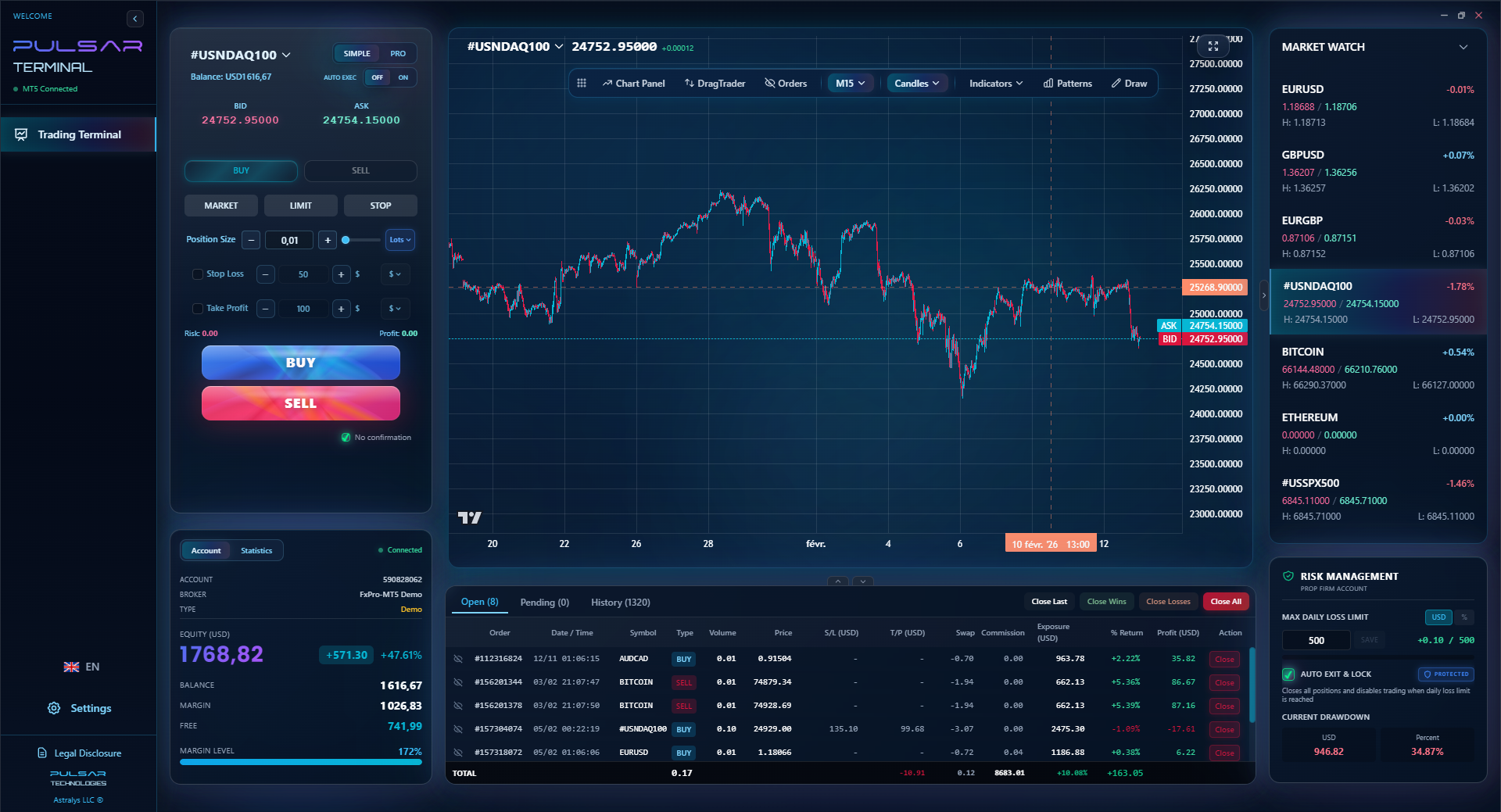
Managing the precise risk of swing trades in a halal account is critical, and Pulsar Terminal's drag-and-drop order tools with multi-level take-profits let you plan complex, disciplined exits directly on your MT5 chart.
Pulsar Terminal
The all-in-one MT5 companion: drag-and-drop orders, multi-TP/SL, trailing stop, grid trading, Volume Profile, and prop firm protection. Used by 1,000+ traders daily.
“The peace of mind that comes from knowing my livelihood is aligned with my faith is a profit no swap can ever provide.”
You don't have to figure this out alone. The intersection of forex and Islam has sparked active discussion, especially in Nigeria.
Seek Knowledgeable Scholars: Find a scholar who understands both Islamic finance and the mechanics of modern markets. The generic answer of "trading is gambling" from someone who doesn't understand a candlestick chart isn't helpful. More scholars are becoming financially literate.
Join Niche Communities: Look for online forums or Telegram groups specifically for Muslim traders. The discussions there are gold. You'll get broker recommendations, strategy talks that consider halal parameters, and moral support. I've learned more from a few honest conversations in these groups than from years of generic forex webinars.
Educate Yourself Relentlessly: Your duty to understand your trade doesn't end with Islamic rules. It extends to market mechanics. The better you understand risk, technical analysis, and fundamentals, the further you move your activity from gharar/maysir and towards informed commercial risk (ghorm). Use the educational materials from brokers like XM or IC Markets, but filter everything through your own ethical framework.
This path requires more work. More questions. More diligence. But for me, the peace of mind that comes from knowing my livelihood is aligned with my faith is a profit no swap can ever provide.
FAQ
Q1Do I have to pay Zakat on my forex trading profits?
Yes, generally. If your trading capital meets the nisab (minimum threshold) and has been held for one lunar year (Hawl), Zakat is due on the capital and the profits. The rate is 2.5%. It's wise to keep a separate record of your trading capital to calculate this accurately at the end of each year.
Q2Can I trade cryptocurrencies with an Islamic forex account?
This is a complex and debated area. Most Islamic forex accounts only cover forex, metals, indices, and CFDs. The permissibility of cryptocurrencies themselves is still under scholarly debate - some see them as a digital asset (halal), others highlight the extreme volatility as gharar. Even if a broker offers crypto CFDs on a swap-free basis, the underlying asset's permissibility is a separate question you must research.
Q3What if my broker secretly charges swap on my Islamic account?
This is a serious breach of contract and trust. Scrutinize your daily statement. If you see any charge labeled 'swap', 'rollover', or 'interest', contact support immediately with screenshots. If unresolved, consider it a major red flag and switch brokers. Your trust and compliance are paramount.
Q4Is day trading (no overnight holds) automatically halal since it avoids swaps?
It avoids the riba of swaps, but not necessarily gharar or maysir. If your day trading is disciplined, based on analysis, and with proper risk management, it aligns better with halal principles. If it's frantic, emotional gambling on one-minute charts, the activity itself may be problematic regardless of the account type.
Q5Are there any Nigerian-owned brokers with proper Islamic accounts?
While there are local platforms, the most reliable Islamic account structures I've found are with the well-regulated international brokers servicing Nigeria (like Exness, XM, IC Markets). They have the scale and regulatory impetus to properly administer these accounts. Always prioritize a broker's regulatory standing and the transparency of its swap-free terms over local ownership.
Q6Can I convert my existing standard trading account to an Islamic account?
Usually, yes. Most brokers allow you to request a conversion. However, this often requires closing all open positions first, as the account structure changes. Contact your broker's support team for their specific procedure. Do not assume your open positions will automatically become swap-free.
Prof. Winston's Lesson
Key Takeaways:
- ✓Swap fees = Riba. A true Islamic account must remove them.
- ✓Always test a swap-free demo for 10+ days to see real fees.
- ✓Calculate all costs: wider spreads can negate swap-free benefits.
- ✓Your strategy must adapt; the carry trade is off the table.
How useful was this article?
Click a star to rate
Weekly Trading Insights
Free weekly analysis & strategies. No spam.
About the Author
Olumide Adeyemi
West African Trading Pioneer
One of Nigeria's most active forex trading educators. 8 years of experience trading from Lagos. Specializes in low-capital strategies and prop firm challenges for African traders.
Comments
Risk Disclaimer
Trading financial instruments carries significant risk and may not be suitable for all investors. Past performance does not guarantee future results. This content is for educational purposes only and should not be considered investment advice. Always conduct your own research before trading.
You Might Also Like

Cara Trading Forex Sukses: 7 Prinsip dari Trader Profesional
Cara trading forex sukses dengan 7 prinsip trader pro: manajemen modal, disiplin, journal trading, backtest. Data nyata, bukan janji profit palsu.
Jam Trading Forex Terbaik untuk Trader Indonesia: Panduan Lengkap dengan Tabel Waktu
Panduan jam trading forex untuk trader Indonesia. Tabel 4 sesi dunia, jam emas 20:00-00:00, sesi mana yang harus dihindari. Data akurat + tips dari trader berpengalaman.
Top 5 Sàn Forex Uy Tín Nhất 2026: Review Jujur dari Trader Indonesia
Top 5 sàn forex uy tín 2026 untuk trader Indonesia. Review jujur: spread, deposit, withdraw, dukungan lokal. Exness, XM, IC Markets & lebih.
Get Pulsar Terminal
All these calculators are built into Pulsar Terminal with real-time data from your MT5 account. One-click position sizing, automatic risk management, and instant calculations.
Get Pulsar Terminal