


Let's cut through the noise.

Olumide Adeyemi
West African Trading Pioneer ·  Nigeria
☕ 8 min read
What you'll learn:
Let's cut through the noise. The 'forex background' in Nigeria isn't about some get-rich-quick scheme you saw on Instagram. It's a messy, regulated, and brutally expensive reality where the government takes its cut and the Naira does whatever it wants. I've traded here for over a decade, and I'll show you the real landscape - the taxes, the legal loopholes, and the exact numbers you need to survive. Forget the hype; this is the foundation you should have learned first.
Here's the uncomfortable truth about the forex background in Nigeria: while trading is legal for you, the regulatory safety net is practically non-existent. The Central Bank of Nigeria (CBN) and the Securities and Exchange Commission (SEC) are the big names, but their focus isn't on protecting retail punters like us.
The SEC doesn't license retail forex brokers. Let that sink in. The local framework is so underdeveloped that your primary protection comes from the international regulators overseeing your chosen broker. That's why you'll see every serious Nigerian trader on platforms like Exness, IC Markets, or Pepperstone. They're regulated offshore (CySEC, ASIC, FCA), which is ironically safer.
The CBN's new Foreign Exchange Code (2025) is a step towards transparency, but it's aimed at institutional players. For a broker to get a CBN license, they need about ₦5 million in fees and ₦10 million in share capital. That's why they don't bother with us. Your legal footing is this: you can trade, but if your international broker goes rogue, don't expect the SEC to bail you out. Your first line of defense is your own due diligence.

Warning: Trading with an unregulated 'local' broker promising crazy bonuses is the fastest way to lose everything. Your funds aren't protected. Always verify international regulation.
I learned this the hard way early on. I deposited ₦300,000 with a 'local platform' with a Lagos office. When I tried to withdraw profits, they vanished. Phone lines dead, office empty. That money was gone. The forex background here means you are your own regulator.

💡 Winston's Tip
Your first goal isn't profit. It's surviving 100 trades without breaking your own rules. That's how you build a real forex background.
“The SEC doesn't license retail forex brokers. Let that sink in.”
Profits aren't really profits until the taxman gets his share. In Nigeria, that's a 10% Capital Gains Tax on your net trading profits. Yes, you read that right. Ten percent. Most new traders completely ignore this, which is a fantastic way to get a nasty surprise later.
You're responsible for declaring this yourself. The FIRS isn't actively hunting every retail trader yet, but as the market grows (over 500,000 of us now), that will change. Keep a careful trading journal. Not just screenshots, but a proper log of every trade, entry, exit, and profit/loss in Naira terms. When you convert your USD profits back to Naira, that's your taxable event.
How to Calculate What You Owe
Let's say you fund your IC Markets account with $1000 (≈₦1.5M). You trade for a year and end with $1500. Your gross profit is $500. After accounting for spreads, commissions, and maybe a loss on EUR/USD, your net profit is $400. You convert that to Naira at ₦1,470/$1. Your taxable gain is ₦588,000. Ten percent of that is ₦58,800 owed to the government.

Example: Net Profit in USD: $400 Exchange Rate: ₦1,470/$1 Profit in NGN: ₦588,000 Capital Gains Tax (10%): ₦58,800 Your actual take-home profit: ₦529,200
Factor this into your position size calculator. If your strategy aims for a 20% return, remember that 10% of that is gone. It changes your real risk-reward math. This is a non-negotiable part of your forex background.
“Profits aren't really profits until the taxman gets his 10% share.”
Forget the ads saying 'Start with $5'. You can, but you'll blow up. Let's talk real numbers for a Nigerian context.
The global daily forex volume is over $6 trillion. Nigeria's own market turnover hit $8.6 billion in 2025. There's liquidity, but you need enough capital to withstand the noise. A $10 account (₦15k) with a 1:500 use is one bad trade away from a margin call.
Based on my experience and coaching hundreds of traders, here’s the brutal truth:
- The 'Learn to Lose' Amount: $100 - $500 (₦150k - ₦750k). This is capital you can afford to lose completely while you learn what a pip really means and how emotions affect you.
- The 'Serious Beginner' Minimum: $500 - $1,000 (₦750k - ₦1.5M). This allows for proper position size calculator use, realistic risk of 1-2% per trade, and the ability to trade more than one pair without over-leveraging.
- The 'This is a Business' Capital: $5,000+ (₦7.5M+). At this level, you're not gambling. You're implementing strategies, maybe swing trading, and the 10% tax starts to be a meaningful consideration.
My first 'real' deposit was ₦500,000 (about $330 at the time). I was so scared of losing it that I overtraded on tiny moves, got chopped up by the spread, and lost 30% in two weeks. The capital wasn't the problem; my mindset was. Having enough to breathe matters.
Broker minimums are all over the place. You can find $0 with HFM, $5 with XM, or $200 with IC Markets. The minimum deposit is irrelevant. Focus on the capital you need to trade your plan safely.
💡 Winston's Tip
The 10% tax is your silent partner. Calculate your position size *after* accounting for it, or you're just trading for the government.
“High use is the shiny trap that turns a small mistake into a margin call.”
This is where your forex background gets practical. Choosing a broker in Nigeria is about navigating a minefield of offers. High use is the shiny trap.
use: You'll see offers up to 1:1000. AvaTrade and Pepperstone offer up to 1:400 for Nigerian clients. This is a double-edged sword. It lets you control large positions with little capital, but it also amplifies losses. Using 1:1000 use on a $100 account means a 0.1% move against you wipes you out. I never use more than 1:50, even on a scalping strategy.
Spreads: This is your transaction cost. For EUR/USD, look for brokers with consistently low spreads. Fusion Markets, Pepperstone, and IC Markets are famous for this. Compare this table:
| Broker | Avg. EUR/USD Spread (Standard Acc) | Key Feature for Nigerians |
|---|---|---|
| Capital.com | 0.64 pips | Low minimum deposit ($20) |
| XTB | 0.92 pips | Great xStation 5 platform |
| IC Markets | 0.62 pips (Raw Spread) | Raw pricing, low commission |
A 2-pip spread vs. a 0.6-pip spread might not seem like much, but over 100 trades, it's a massive drain on your profits. Always check the live spread on the pair you'll trade most.
Platforms: MT4 and MT5 are the kings. They're stable, have countless indicators like the RSI and MACD, and are supported everywhere. Some brokers like XTB have excellent proprietary platforms (xStation 5). My advice? Start with MT5. It's more modern and handles hedging better. All your strategy development and tools, like advanced order management, will be built around it.
“High use is the shiny trap that turns a small mistake into a margin call.”
Your forex background is uniquely Nigerian because you're constantly dancing with the Naira. It's not just a currency pair you might trade (NGN/USD is rarely available retail); it's the yardstick for your entire P&L.
In April 2024, it was around ₦1,235/$. By February 2024, it crashed to ₦1,544/$. This volatility affects you in two critical ways:
- Funding and Withdrawals: You deposit Naira, it's converted to USD. You profit in USD, you withdraw and convert back to Naira. If the Naira weakens while your profits are sitting in USD, you get a bonus when you withdraw. If it strengthens, you lose. I once had a $2,000 profit sitting for a month. The Naira strengthened from ₦1,520 to ₦1,420. My ₦3.04M profit became ₦2.84M at withdrawal - a ₦200,000 loss from exchange moves alone.
- Psychological Pressure: Seeing your account in USD while your bills are in Naira creates a weird disconnect. A $100 loss feels different when it's ₦150,000 vs. ₦140,000. You must base your risk management on the USD value. Use a position size calculator in dollars, not the fluctuating Naira equivalent.
Nigeria's external reserves (around $32.8B in April 2024) and net FX inflows ($4.4B in a recent month) are the macro backdrop. You don't need to be an economist, but knowing the Naira is under pressure tells you that local banks will have issues with international transfers, withdrawal delays might happen, and your buying power is changing. Trade in USD, live in Naira, and always account for the gap.
💡 Winston's Tip
Pick one major currency pair and learn its personality. Trying to trade everything is the hallmark of an amateur. Master EUR/USD first.
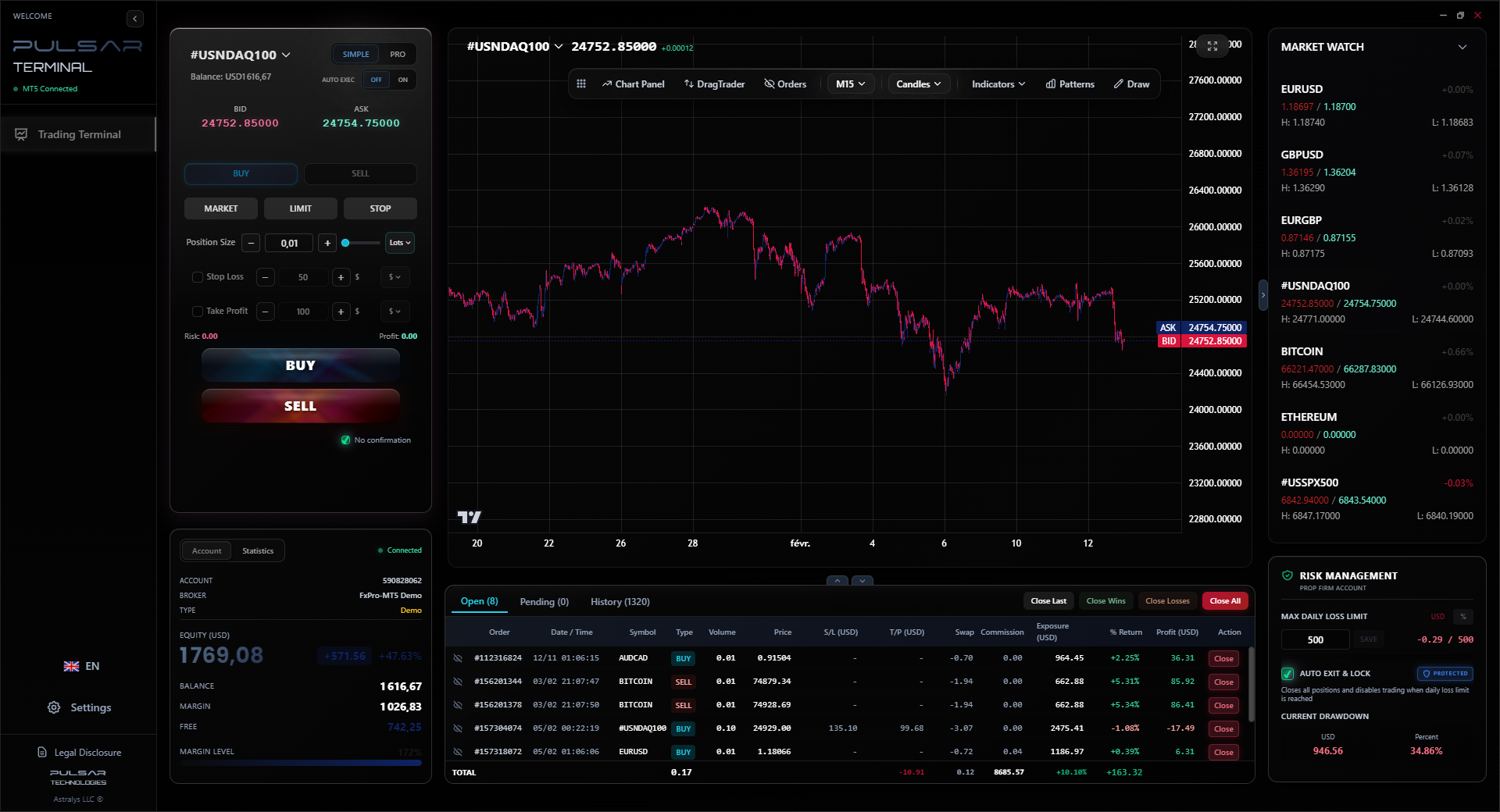
Managing complex trades and risk in a volatile market is exhausting, which is why tools like Pulsar Terminal automate orders, trailing stops, and daily loss limits directly on your MT5 platform.
Pulsar Terminal
The all-in-one MT5 companion: drag-and-drop orders, multi-TP/SL, trailing stop, grid trading, Volume Profile, and prop firm protection. Used by 1,000+ traders daily.
“Trade in USD, live in Naira, and always account for the gap.”
So, with this forex background, how do you start correctly? Most people get it backwards. They look for a secret indicator before understanding the market's structure.
First, education is free. Learn what moves currencies. It's not magic; it's interest rates, economic data, and geopolitics. Then, and only then, touch a chart.
Second, choose your broker based on cold facts, not bonuses. Regulated, low spreads, reliable withdrawals. Read our deep Exness review or Pepperstone review for specifics.
Third, develop a simple, written plan. It should answer:
- What pairs do I trade? (Stick with majors like EUR/USD or XAU/USD first).
- What's my maximum risk per trade? (1% is standard).
- What's my strategy? (e.g., price action on the 4H chart for swing trading).
- When do I stop trading for the day? (e.g., after 2 losses).

Pro Tip: Your first 100 trades should be on a demo account with the sole goal of following your plan perfectly, not making money. Consistency is the real skill.
Finally, accept the tax obligation. Set aside 10% of your net profits in a separate account quarterly. Don't let it become a future crisis. This disciplined foundation, built on the real Nigerian forex background, is what separates those who last from those who become another statistic.
FAQ
Q1Is forex trading legal and safe in Nigeria?
It's legal for individuals, but 'safe' depends on you. There's no strong local regulator protecting retail traders. Your safety comes from using internationally regulated brokers (like FCA or ASIC-regulated firms) and your own risk management. The platform is legal; losing all your money is also perfectly legal if you're not careful.
Q2How much tax do I pay on forex profits in Nigeria?
You pay a 10% Capital Gains Tax on your net trading profits when you convert them back to Naira. It's your responsibility to declare and pay this to the Federal Inland Revenue Service (FIRS). Keep detailed records of all trades and withdrawals.
Q3What is a realistic amount of money to start forex trading in Nigeria?
While you can technically start with $10, you'll likely lose it learning. A realistic amount that allows for proper risk management is between $500 and $1,000 (roughly ₦750,000 to ₦1,500,000). This lets you risk 1-2% per trade without being wiped out by a single bad move or the spread.
Q4Which brokers are best for Nigerian traders?
Nigerians typically use internationally regulated brokers that accept clients from here. Popular and reputable choices include IC Markets, Pepperstone, Exness, XM, and FXTM. Look for low spreads on your preferred pairs, reliable deposit/withdrawal methods (like bank transfer or crypto), and strong platforms like MT4/MT5.
Q5How does the Naira exchange rate affect my trading?
It affects your final profit/loss in Naira terms. You fund and withdraw in Naira, but your trading account is in USD. If the Naira weakens against the dollar between your deposit and withdrawal, you'll get more Naira back for your USD profits (and vice versa). Always measure your trading performance in USD first.
Q6Can I trade the Naira (NGN) on forex platforms?
Almost never on major retail platforms. The Naira is not freely convertible for speculative trading. You'll be trading major pairs like EUR/USD, GBP/USD, or USD/JPY, and commodities like gold (XAU/USD). Your interaction with the Naira is only when funding or withdrawing from your broker.
Q7What's the biggest mistake new Nigerian traders make?
Two tied for first: 1) Using excessive use (like 1:500 or 1:1000) which destroys accounts on small market moves, and 2) Treating trading like a gamble or a quick side hustle instead of a skilled profession that requires education, a plan, and extreme discipline. Ignoring the 10% tax is a close third.
Prof. Winston's Lesson
Key Takeaways:
- ✓Forex is legal, but you are your own primary regulator in Nigeria.
- ✓Factor the 10% Capital Gains Tax into every profit calculation.
- ✓Start with at least $500 ($750k) to practice realistic risk management.
- ✓Choose brokers for low spreads & regulation, not high use.
- ✓The volatile Naira exchange rate is a hidden profit/loss factor.
How useful was this article?
Click a star to rate
Weekly Trading Insights
Free weekly analysis & strategies. No spam.
About the Author
Olumide Adeyemi
West African Trading Pioneer
One of Nigeria's most active forex trading educators. 8 years of experience trading from Lagos. Specializes in low-capital strategies and prop firm challenges for African traders.
Comments
Risk Disclaimer
Trading financial instruments carries significant risk and may not be suitable for all investors. Past performance does not guarantee future results. This content is for educational purposes only and should not be considered investment advice. Always conduct your own research before trading.
You Might Also Like

Cara Trading Forex Sukses: 7 Prinsip dari Trader Profesional
Cara trading forex sukses dengan 7 prinsip trader pro: manajemen modal, disiplin, journal trading, backtest. Data nyata, bukan janji profit palsu.
Jam Trading Forex Terbaik untuk Trader Indonesia: Panduan Lengkap dengan Tabel Waktu
Panduan jam trading forex untuk trader Indonesia. Tabel 4 sesi dunia, jam emas 20:00-00:00, sesi mana yang harus dihindari. Data akurat + tips dari trader berpengalaman.
Top 5 Sàn Forex Uy Tín Nhất 2026: Review Jujur dari Trader Indonesia
Top 5 sàn forex uy tín 2026 untuk trader Indonesia. Review jujur: spread, deposit, withdraw, dukungan lokal. Exness, XM, IC Markets & lebih.
Get Pulsar Terminal
All these calculators are built into Pulsar Terminal with real-time data from your MT5 account. One-click position sizing, automatic risk management, and instant calculations.
Get Pulsar Terminal