


I remember staring at my screen in my flat in Sandton, my coffee gone cold.

David van der Merwe
Emerging Markets Trader ·  South Africa
☕ 11 min read
What you'll learn:
- 1What Actually Kills Your Trading Account?
- 2The Hidden Fees That Eat Your Rands
- 3Execution, Slippage, and the Dreaded Requote
- 4Withdrawal & Deposit Red Flags for South Africans
- 5Regulation & Safety: Your Financial FSCA
- 6Platform, Tools, and Reliability
- 7Your South African Broker Comparison Checklist
- 8Final Words: It's About Protecting Your Capital

I remember staring at my screen in my flat in Sandton, my coffee gone cold. It was March 2020, the day the Rand went haywire. I had a short position on USD/ZAR at 18.45. The news hit, and the chart spiked to 19.20 in a blink. My stop-loss? It was there, clear as day at 18.65. The platform showed my order was 'filled' at 18.89. That 24-cent gap, that 'slippage', wasn't just a bad fill. It was a R4,800 lesson from the real forex broker killer. It's not a flashy scam site. It's the quiet, daily grind of poor execution and hidden costs that bleeds your account dry.
When most guys hear 'forex broker killer', they picture some dodgy offshore bucket shop that vanishes with their money. And sure, those exist. But the real killer, the one that gets more South African traders, is far more subtle. It's the consistent, legal drain on your capital that happens with every single trade you place.
Think about it. You're not just trading against the market. You're trading against the spread, the commission, the overnight swap fees, and the quality of your order execution. A broker with a 'low' 1.5 pip spread on EUR/USD might sound good, but if their execution is slow and you get slipped 2 pips on every market order, your real cost is 3.5 pips. Over 100 trades, that's the difference between a profitable strategy and a losing one.
I learned this the hard way early on. I was scalping on a platform that advertised 'raw spreads'. My scalping strategy was tight, aiming for 5-7 pips per trade. After a month of what I thought was break-even trading, I ran the numbers. The spread was low, but the 'requotes' and tiny delays on execution meant my average entry was 1.8 pips worse than my click price. That was the forex broker killer in action, quietly taking a 25% cut of every target I had.

Warning: A cheap spread means nothing if your orders aren't filled at the price you see. Always test a broker's execution with small, real-money trades before committing serious capital.
The killer isn't one thing. It's a combination: wide spreads on exotic pairs like USD/ZAR, huge swap fees if you hold positions overnight (which eats into carry trades), and unreliable platforms that freeze during the SARB announcement. Your first job as a trader isn't to pick winners. It's to choose a battlefield where the house doesn't have an overwhelming edge.

💡 Winston's Tip
A broker's true colours show during withdrawals, not deposits. Always do a small test withdrawal first. If it's a hassle for R500, imagine R50,000.
Let's talk numbers, the kind that come out of your Standard Bank account. Brokers make money in ways that aren't always upfront. You need to audit your trading statement like you're checking a restaurant bill in Camps Bay.
The Spread Markup
This is the classic. The broker quotes you a price with a built-in difference (spread) between buy and sell. For majors like EUR/USD, this can be tight (0.1-1.5 pips). For USD/ZAR, it can be 50-150 pips or more! That's R500 to R1,500 per standard lot before you're even in profit. Always check the live spread on the pairs you actually trade, not just the advertised 'from' spread.
Commissions and Financing
Some brokers offer 'zero spread' but charge a commission per lot. This can be cleaner, but you must calculate it. R75 per round turn per lot? That adds up. Then there's financing or 'swap fees'. Holding a USD/ZAR position overnight can cost you. I once held a long ZAR trade over a weekend, forgetting about the triple swap charge. It cost me R320 on a single lot. Not a bank breaker, but it turned a winning trade into a scratch.
The Inactivity Fee
This one catches many South Africans. Life gets busy, you take a month off from trading. Then you get an email: 'Inactivity fee of R500 deducted'. It's in the terms, page 47. Always know your broker's policy. If you need to pause, sometimes withdrawing most of your funds (leaving a small balance) can avoid this.

Example: Let's say you trade 10 lots of EUR/USD monthly.
- Broker A: 1.8 pip spread, no commission. Cost: 10 lots * 1.8 pips * R1.40 per pip* = R252
- Broker B: 0.3 pip spread, R75 commission per lot. Cost: (10 lots * 0.3 pips * R1.40) + (10 lots * R75) = R4.20 + R750 = R754.20 *Using a rough ZAR/pip value for illustration. The 'cheaper' broker can be far more expensive for your style.
Use a position size calculator that includes commission to understand your true break-even point. The forex broker killer thrives in the gap between what you think a trade costs and what it actually costs.
“A cheap spread means nothing if your orders aren't filled at the price you see on your screen.”
This is where the rubber meets the road. You see a setup on your XAU/USD guide chart, you click buy... and nothing happens. Or a pop-up says 'Price has changed. Accept 1724.85?' You just got requoted. In fast markets, that new price can be miles away from your edge.
Slippage is when your order, especially a stop-loss or market order, gets filled at a worse price than you specified. It's common during news events like US Non-Farm Payrolls or local budget speeches. The question is: how much worse? Reputable brokers with strong liquidity partners will have minimal slippage. Shady ones? It always seems to go against you.
Here's a personal rule: I will not trade a major news event with a broker until I've seen how they handle volatility. I test with a tiny lot. On one well-known platform (I won't name it, but check our XM review for clues), my stop on GBP/USD during Brexit volatility was slipped 22 pips. On another, like IC Markets, the same event caused only 3 pips of slippage. That's the difference between a managed risk and a margin call.

Pro Tip: Use limit orders instead of market orders whenever possible. You set the exact price you're willing to pay. The trade might not get filled if the price never reaches it, but you'll never get a nasty surprise on entry. It puts you in control.
Getting your money in and out is the ultimate test. If it's difficult to withdraw, nothing else matters. For us in SA, we have specific hurdles.
Deposit Methods: Look for Instant EFT (like Ozow), Credit Card, or direct bank transfer. The funds should reflect in your trading account within minutes to a few hours, not days. If a broker only accepts obscure e-wallets or crypto, ask why. It might be a setup to make withdrawals harder.
The Withdrawal Shuffle: This is the forex broker killer's favorite move. You submit a withdrawal request. Then you get an email: 'Please send a copy of your ID, a utility bill, a selfie with your ID, a bank statement confirming your deposit method...' They drag it out. A good broker verifies you once on deposit. Withdrawals should be simple, back to the source, within 1-3 business days.
I had an experience where a broker 'lost' my withdrawal request three times. Each time, the 5-day processing clock restarted. It took 23 days to get R15,000 back. The stress wasn't worth it. Now, I always do a small test withdrawal of R500-R1000 before I deposit larger amounts. If that's smooth, we're in business.
Watch for 'bonuses' that tie your funds up with impossible trading volume requirements. You deposit R10,000, get a '100% bonus', and now you have to turn over R4 million in volume before you can withdraw your own money. That's not a bonus. It's a trap.
💡 Winston's Tip
The spread is the price of admission. But slippage is the pickpocket in the crowd. Watch your trade confirmations like a hawk.
“Do a test withdrawal of R500 before you deposit R50,000. The ease of getting your money out is the ultimate litmus test.”
This is your shield. In South Africa, the Financial Sector Conduct Authority (FSCA) is the main regulator. A broker licensed by the FSCA must follow strict rules: client money segregation (your funds are kept separate from the broker's operating money), regular audits, and a dispute resolution process.
Why it matters: If an FSCA-regulated broker goes under, your money isn't part of their assets to be claimed by creditors. It should be safe. Also, you have a local authority to complain to if things go wrong.
Many international brokers also hold top-tier licenses from places like Cyprus (CySEC) or Australia (ASIC). These are generally solid. The red flag is a broker with only an offshore license from a place like St. Vincent and the Grenadines or Vanuatu. There's little to no oversight. When I was starting out, I was lured by the crazy use (1:1000!) offered by these offshore entities. The use is a killer, but the lack of regulatory recourse is the murderer.
Check the broker's website footer. It should clearly state their regulatory number and a link to the regulator's register. Verify it. Don't just trust the logo. A true forex broker killer often wears the disguise of a legitimate firm.
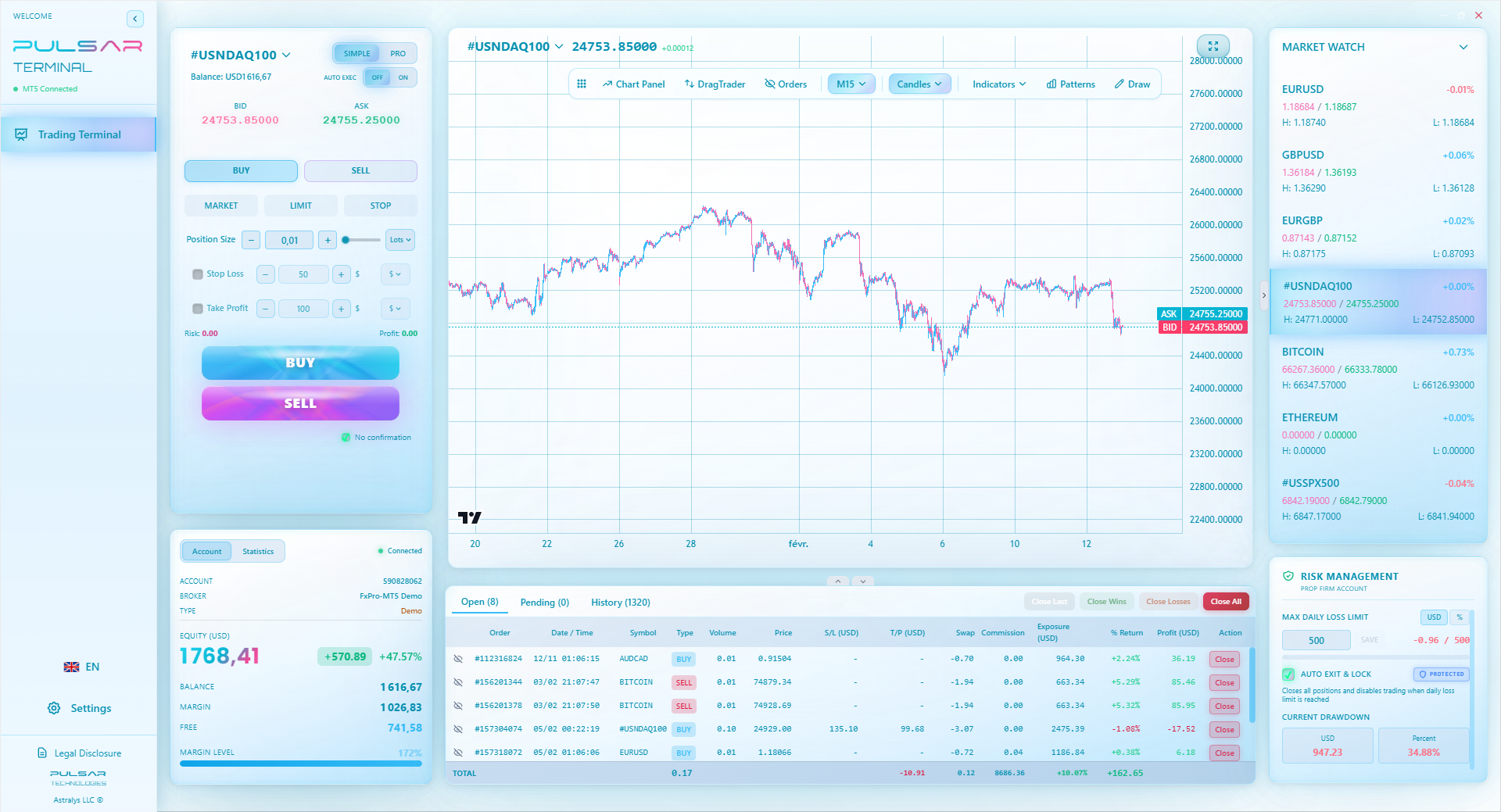
When testing a broker's execution, precise order placement is key, and tools like Pulsar Terminal for MT5 give you drag-and-drop control to manage entries and exits without hesitation.
Pulsar Terminal
The all-in-one MT5 companion: drag-and-drop orders, multi-TP/SL, trailing stop, grid trading, Volume Profile, and prop firm protection. Used by 1,000+ traders daily.
Your trading platform is your cockpit. If it's glitchy, slow, or lacks basic tools, you're flying blind. Most brokers offer MT4 or MT5, which is a good start. But the broker's server stability and the tools they bundle with it make a huge difference.
Does the chart freeze when volume picks up? Does your pending order get executed 5 seconds after price hits it? I was in a trade on the JSE Top 40 CFD once, and the platform froze right as the SARB made an announcement. By the time it came back, my stop was obliterated. The broker blamed 'unprecedented volatility'. My account blamed poor infrastructure.
You need reliable access to basic tools. Can you easily set a trailing stop? Can you place a stop-loss and take-profit order the moment you open a trade (a 'bracket order')? For more advanced swing trading ideas, do they offer decent charting tools or integration with TradingView?
Some brokers offer their own proprietary platforms. They can be great, but test them thoroughly. I prefer the universality of MT5. I know it, my MACD indicator works on it, and if I'm unhappy with the broker, I can often take my skills and strategies to another one that supports MT5 without relearning everything. Don't get locked into a proprietary system that's mediocre.

“You're not just trading against the market. You're trading against the spread, the commission, and the quality of your order execution.”
Don't just take a friend's word or a flashy YouTube ad. Do your own homework. Here’s a practical checklist. Open a spreadsheet and compare at least 3 brokers.
| Feature | What to Look For | Red Flag |
|---|---|---|
| Regulation | FSCA, ASIC, CySEC clearly displayed & verifiable. | Only offshore (SVG, Vanuatu). |
| USD/ZAR Spread | Check live at 10am SAST & during US open. | Consistently above 80 pips for a standard account. |
| Deposit/Withdrawal | Instant EFT, Credit Card, 1-3 day withdrawals. | Only crypto, lengthy 'verification' on every withdrawal. |
| Platform | Stable MT4/MT5, mobile app works. | Frequent disconnects, proprietary-only platform. |
| Execution | Demo test: place 20 market orders. Note slippage/requotes. | More than 30% requote rate or consistent negative slippage. |
| Customer Support | Call them. Ask a technical question. Are they in SA? | Only email support, 48hr+ response time, no local number. |
Start with a demo account. Then, open a live account with the smallest possible deposit. Place real trades for a month. Track everything: the fills, the spreads at your trading times, the withdrawal process. This due diligence is the single best thing you can do to immunize yourself against the forex broker killer.
Look at detailed reviews that go beyond the surface. Our deep dives on brokers like Pepperstone and Exness break down these exact points for the South African context. Use them as a starting point, not the final word.
💡 Winston's Tip
Your trading platform is your weapon. If it jams when you need it most, you're dead in the water. Reliability isn't a feature, it's the foundation.
Trading is hard enough. You're battling your own psychology, analysing complex markets, and managing risk. The last thing you need is a partner - your broker - working against you, even in small ways.
The forex broker killer isn't dramatic. It's death by a thousand cuts. A few pips of slippage here, a wide spread there, a withdrawal fee you forgot about. Over a year, it can easily add up to 10-20% of your trading capital, vanished. That's capital that could have been compounding in your winning trades.
Your broker is a utility, like your internet connection. You want it to be fast, reliable, and fairly priced. You don't want to think about it. When you stop worrying about whether your order will fill or if you'll get your money back, you can focus on what actually matters: your trading plan.
So take a weekend. Do the checklist. Make the calls. Test the platforms. The few hours you invest in finding a truly professional broker will pay for itself a hundred times over. It won't make you a profitable trader, but it will ensure that when you do find your edge, the market - and not your brokerage - is the only thing you're up against.
FAQ
Q1What is the single biggest 'forex broker killer' for beginners in South Africa?
Without a doubt, it's ignoring the total cost of trading. Beginners fixate on the spread but forget about commissions, swap fees on held positions (especially on ZAR pairs), and the hidden cost of poor execution (slippage and requotes). A 'cheap' broker with bad execution can be far more expensive than a 'pricier' one that fills your orders instantly at the right price.
Q2Is an FSCA-regulated broker always safe?
It's the safest option for South Africans, but 'safe' doesn't mean 'guaranteed profits'. The FSCA ensures client funds are segregated and the broker operates with transparency. It gives you a local recourse for disputes. However, it doesn't protect you from market losses or from choosing a broker with terrible trading conditions. Always combine regulation with your own due diligence on spreads and execution.
Q3How can I test a broker's execution before depositing real money?
Open a demo account and trade it like it's real. But demos sometimes have perfect execution. The real test is a small live account. Deposit the minimum (maybe R500-R1000). Place small lot orders (0.01 lots) during different market conditions - quiet Asian session, volatile London open. Use market orders and note the fill price vs. the quoted price. Try to trigger a stop-loss in a fast-moving market. The live environment reveals the true execution quality.
Q4What's a reasonable spread for USD/ZAR?
This varies, but for a standard account (not a premium or raw spread account), expect 50-100 pips during normal liquid hours. If you're seeing consistently over 120 pips, it's on the high side. Remember, a pip in USD/ZAR is worth roughly R1.00 per standard lot (100,000 units), so a 80-pip spread costs you R80 to enter and exit a trade before any price movement.
Q5Should I avoid brokers that offer high use like 1:500?
Not necessarily avoid, but be extremely cautious. High use is a tool, and like any powerful tool, it's dangerous in inexperienced hands. The broker offering it isn't inherently bad (many regulated ones do), but it enables you to blow up your account faster. The real killer is the trader who uses maximum use on every trade. I never use more than 1:20, even if 1:500 is available. Control your own risk.
Q6How long should a withdrawal to my South African bank account take?
From a reputable, well-regulated broker, a withdrawal back to your original deposit method (like your credit card or bank account) should be processed within 24-48 business hours. The funds showing in your SA account can take an additional 1-3 business days for the bank transfer to clear. If a broker quotes '7-14 business days' as a standard, that's a yellow flag. Longer than that is a major red flag.
Prof. Winston's Lesson
Key Takeaways:
- ✓Test execution with live micro-lots before trusting a broker.
- ✓Calculate TOTAL cost: spread + commission + swap + slippage.
- ✓FSCA regulation is your primary shield for safety.
- ✓Withdrawal ease is more important than deposit bonuses.
- ✓Platform reliability is non-negotiable during volatility.
How useful was this article?
Click a star to rate
Weekly Trading Insights
Free weekly analysis & strategies. No spam.
About the Author
David van der Merwe
Emerging Markets Trader
Johannesburg-based trader with 11 years in emerging market currencies. Specializes in ZAR pairs, FSCA-regulated trading, and South African market analysis.
Comments
Risk Disclaimer
Trading financial instruments carries significant risk and may not be suitable for all investors. Past performance does not guarantee future results. This content is for educational purposes only and should not be considered investment advice. Always conduct your own research before trading.
You Might Also Like

Cara Trading Forex Sukses: 7 Prinsip dari Trader Profesional
Cara trading forex sukses dengan 7 prinsip trader pro: manajemen modal, disiplin, journal trading, backtest. Data nyata, bukan janji profit palsu.
Jam Trading Forex Terbaik untuk Trader Indonesia: Panduan Lengkap dengan Tabel Waktu
Panduan jam trading forex untuk trader Indonesia. Tabel 4 sesi dunia, jam emas 20:00-00:00, sesi mana yang harus dihindari. Data akurat + tips dari trader berpengalaman.
Top 5 Sàn Forex Uy Tín Nhất 2026: Review Jujur dari Trader Indonesia
Top 5 sàn forex uy tín 2026 untuk trader Indonesia. Review jujur: spread, deposit, withdraw, dukungan lokal. Exness, XM, IC Markets & lebih.
Get Pulsar Terminal
All these calculators are built into Pulsar Terminal with real-time data from your MT5 account. One-click position sizing, automatic risk management, and instant calculations.
Get Pulsar Terminal