


I remember staring at my screen in late 2022, watching USD/INR hit 83.

Rajesh Sharma
Senior Forex Analyst ·  India
India
☕ 10 min read
What you'll learn:
I remember staring at my screen in late 2022, watching USD/INR hit 83. The market was pure chaos. My broker's platform was lagging, spreads had blown out to 15 pips, and I was stuck in a losing position. That was the moment I realized the standard advice for forex traders just doesn't cut it here. In India, you're not just trading the markets, you're trading within a system with unique rules, brokers with specific weaknesses, and instruments that behave differently. This guide is about building a strategy that works within - and sometimes against - that very system. It's about finding the edges that most retail traders miss.
Trading forex from India isn't like trading from London or New York. The Reserve Bank of India (RBI) has a tight grip. You can't just open an account with any international broker and trade major pairs directly. The legal route is trading INR pairs (like USD/INR, EUR/INR) or cross-currency pairs (like EUR/GBP) on exchanges like the NSE, BSE, or MCX-SX. The other path, which many take, involves international brokers offering contracts for difference (CFDs) on forex pairs. This creates a unique landscape.
Your first decision is path-dependent. Going the exchange route means lower use (max 1:50 on MCX-SX), transparent pricing, but limited pairs. The international CFD route offers more pairs, higher use, but comes with regulatory grey areas and broker dependency. I've done both. My early years were on Indian exchanges, grinding out small moves on USD/INR. The spread definition was tight, but the moves could be painfully slow for a scalping strategy.

Warning: Using an unregulated international broker carries the risk of your funds not being protected under Indian law. Always prioritize brokers with strong international reputations if you go that route. Check our Exness review and IC Markets review for regulated options popular with experienced Indian traders.
The real 'battlefield' aspect is the broker's execution. During high volatility - like around RBI announcements or global USD shocks - many platforms suffer. Requotes, slippage, and widened spreads are the broker's defense mechanism against loss. Your strategy must be built to either avoid these periods or be so strong that it can withstand them.

💡 Winston's Tip
A broker's 'ECN' or 'Raw Spread' account often has lower spreads but charges a commission per lot. Do the math: spread + commission. For high-volume trading, it's usually cheaper. For occasional trading, a standard account might be better.

This isn't about a secret indicator. It's a philosophy. The goal is to design your trading so that common broker pain points become minor annoyances, not account killers.
1. Trade Less, Not More: The more you trade, the more you pay in spreads and commissions. This is the broker's lifeblood. A high-frequency strategy in a low-liquidity environment (like certain cross pairs) is a recipe for giving your money away. I learned this the hard way trying to scalp GBP/INR. Ten trades a day with a 5-pip effective cost (spread + commission) means you start 50 pips in the hole. You need a monster win-rate just to break even.
2. Favor Limit Orders Over Market Orders: This is non-negotiable. A market order during slow liquidity is an invitation for slippage. Your broker's quoted price is not guaranteed. By using limit orders to enter and take profit, you control the price. You might miss a trade, but you'll never get a nasty surprise on your fill. This single habit saved me over 200 pips in slippage last year.
3. Know Your Broker's 'Weak Hours': Every broker has times when their liquidity providers are thin. For many serving Indian clients, this can be during early Indian morning (when London is closed and US is asleep) or late Indian night. Avoid trading exotic pairs or even majors during these windows. Stick to the 1:30 PM to 11:30 PM IST window when London and US sessions overlap for the best execution.
4. Size for Survival: Your position size calculator is your best friend. The killer move is to size your positions so that the broker's maximum possible spread during news won't blow through your stop-loss. If your stop is 20 pips away, and the spread can gap to 10 pips, you're already risking 50% of your trade on execution alone. Size smaller, place stops wider, or don't trade the news.

“Your first goal isn't a Lamborghini, it's to survive the next six months without blowing up your account.”
You can't fight the tape. Choosing the right instrument is 80% of the work.
For Indian Exchange Traders:
- USD/INR Futures: This is your bread and butter. High liquidity, tight spreads. The trend can be persistent, driven by macro flows. It's great for swing trading over days or weeks. Don't expect 100-pip daily swings; 20-40 pips is a big day.
- Cross-Currency Futures (EUR/INR, GBP/INR, JPY/INR): Lower liquidity. Use these only if you have a very strong view on that specific currency vs. the INR. The spreads will eat you alive if you're wrong.
For International Broker Traders:
- Major Pairs (EUR/USD, GBP/USD): Stick to these. The liquidity is immense, meaning your broker gets the best prices from their LPs. Spreads are tightest here. I've had my most consistent results with EUR/USD. Check our dedicated EUR/USD guide for specific setups.
- Gold (XAU/USD): A favorite among Indian traders, and for good reason. It's culturally relevant, often acts as a hedge against INR volatility, and has great liquidity. It does require a different approach than forex. Our XAU/USD guide breaks it down.
- What to AVOID: Exotic pairs (like USD/TRY, USD/ZAR) and low-volume cross pairs (like EUR/GBP on a bad broker). The spreads are criminal, and the slippage can be a trade-killer.

Example: Let's say you have a $10,000 account. Trading EUR/USD, the spread might be 0.8 pips. Trading USD/TRY, it could be 50 pips. On a standard lot ($100,000), that's an $8 cost vs. a $500 cost just to open the trade. You're down 5% before the market even moves.
Here's where the rubber meets the road. Let's build a sample trade from scratch, the broker-killer way.
Step 1: The Setup (Using Price Action & One Confirmation Indicator) Forget the 10-indicator chaos. I use pure price structure (support/resistance, trendlines) confirmed by the MACD indicator for momentum or the RSI indicator for overbought/oversold levels on higher timeframes. The 4-hour and daily charts are your friends for finding quality levels.
Step 2: The Entry (Limit Order Only) You see EUR/USD approaching a strong daily support level at 1.0720. The RSI on the 4H chart is dipping into oversold territory (<30). Instead of slamming a market order, you place a BUY LIMIT order at 1.0725. Why a few pips above? Because price often kisses a level and reverses without hitting it exactly. You're giving the trade room to breathe.
Step 3: Stop Loss & Take Profit (Multi-Level) This is critical. Never use a single take-profit. Brokers love when you do that.
- Stop Loss: Place it at 1.0690, 35 pips below your entry. It's beyond the obvious support, so random noise won't take you out.
- Take Profit 1: Set at 1.0760 (35 pips). This secures a 1:1 risk-to-reward.
- Take Profit 2: Set at 1.0800 (75 pips). Move your stop loss to breakeven once TP1 is hit. This lets you run the winner for free.
By taking partial profits, you bank some gain and reduce the broker's chance of the trade whipsawing back to your entry. I once let a 70-pip profit turn into a 15-pip loss because I got greedy with one TP level. Never again.
Step 4: The Review Win or lose, note the execution. Did your limit order fill cleanly? Was the spread wide when it filled? This data is gold for understanding your broker's real behavior.
💡 Winston's Tip
If a trade moves 15-20 pips in your favor immediately, consider moving your stop-loss to breakeven right then. You've just eliminated broker slippage and spread costs from that trade. Now you're playing with the house's money.
“The killer move is to size your positions so that the broker's maximum possible spread during news won't blow through your stop-loss.”
Brokers aren't evil, but they are businesses. Their incentives aren't always aligned with yours. Here’s what to watch for.
Widened Spreads at Key Times: They'll widen spreads around major news (US Non-Farm Payrolls, RBI policy) and during market opens/closes. The counter? Simple. Don't trade 5 minutes before and after major news. If you must, use limit orders only and expect wider stops.
Platform 'Glitches' During Volatility: Ever hit sell and nothing happens? Or get a 'price no longer valid' message as the market runs away from you? This is often a liquidity issue. The counter: Have a backup. Know your broker's mobile app and phone number for manual orders. In 2020, during a flash crash, my MT4 froze. I closed a trade manually via their mobile app and saved about $800.
Bonus Promotions for High Volume: They might offer cashback or contests for lots traded. This is designed to make you trade more. Ignore it. Your strategy should be based on market opportunities, not broker rebates.
Slippage on Stop-Losses: Your stop is a market order. In fast markets, it can get filled far worse than you planned. The counter: Use Guaranteed Stop Losses (if your broker offers them, usually for a fee) on high-risk events, or place mental stops and manually exit if you can watch the market. Be aware of the risks of a margin call if you use mental stops.
Choosing the right partner is half the battle. We've stress-tested many. For raw execution speed and tight spreads, Pepperstone is hard to beat. For those who value a vast range of tools and educational resources, XM has a strong offering. Do your homework.
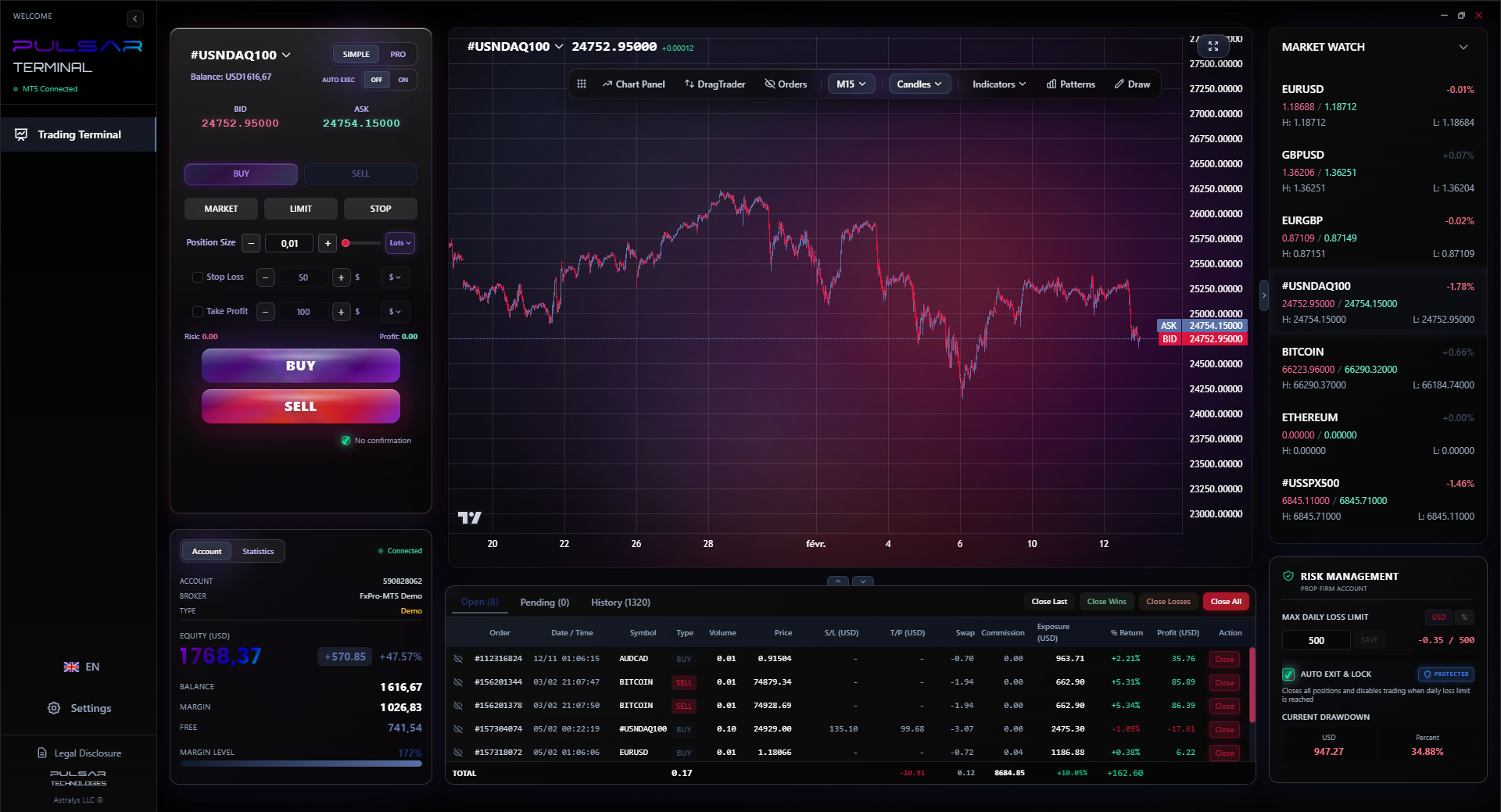
Managing multi-level take-profits and moving stops to breakeven manually is a hassle; Pulsar Terminal automates this entire process directly on your MT5 chart with a single drag-and-drop order.
Pulsar Terminal
The all-in-one MT5 companion: drag-and-drop orders, multi-TP/SL, trailing stop, grid trading, Volume Profile, and prop firm protection. Used by 1,000+ traders daily.
We have unique psychological hurdles. There's immense social pressure for quick, lucrative success. The 'get rich quick' forex ads prey on this. Family expectations can push you to overtrade to show profits.
You have to internalize that trading is a marathon, not a sprint. Your first goal isn't a Lamborghini, it's to survive the next six months without blowing up your account. My biggest mistake early on was trying to make a month's salary in a week to prove it was a 'real job.' I took huge, unjustified risks and lost two months' salary in three days.
Another trap is the 'INR mindset.' We're used to thinking in rupees. A 50-pip move in USD/INR is about ₹0.50. That can feel small. But on a 1,000-quantity futures contract, that's ₹500 profit per pip move. You must think in percentages of your capital, not absolute rupee figures. A 2% gain is a great day, whether it's ₹2000 or ₹200.
Build a routine. Ignore the noise from Telegram 'gurus' selling signals. Your edge comes from your own discipline and your understanding of the broker killer strategy for India, not from someone else's hot tip.

“You're not a gambler reacting to ticks; you're a manager executing a pre-defined business plan.”
Sunday Evening: Planning
- Scan weekly charts of your 2-3 chosen instruments (e.g., EUR/USD, XAU/USD).
- Mark key support/resistance levels.
- Check the economic calendar for the week. Flag high-impact news events.
Daily (Pre-Session)
- Review your marked levels on the 4H and 1H charts.
- Do you have any pending limit orders from your plan? Adjust if needed.
- Set alerts for your key price levels, so you're not screen-watching.
During Session
- Let the market come to you. No impulsive trades.
- If a setup triggers, manage it according to plan: entry, multi-level TP, SL.
- Once TP1 is hit, move SL to breakeven. Then, walk away. Let TP2 run.
End of Day/Week
- Journal every trade. Entry, exit, P&L, and most importantly: 'Was execution clean?' Note any spread widening or slippage.
- Review your journal weekly. Are you consistently losing on a certain pair or at a certain time? That's a pattern to eliminate.
This routine removes emotion. You're not a gambler reacting to ticks; you're a manager executing a pre-defined business plan. That's the ultimate broker killer mindset.

FAQ
Q1Is forex trading legal in India?
Yes, but with restrictions. Trading INR pairs (like USD/INR) on recognized Indian exchanges like NSE, BSE, or MCX-SX is fully legal. Trading international forex pairs (like EUR/USD) directly is not permitted by the RBI. Many Indian traders use international brokers to trade these pairs via CFDs, which operates in a regulatory grey area. You are responsible for understanding the tax and legal implications.
Q2What is the best time to trade forex in India?
The most liquid and optimal time is between 1:30 PM and 11:30 PM IST. This covers the overlap of the London and New York sessions, when trading volume is highest, spreads are tightest, and price action is most reliable. Avoid the early Indian morning (2 AM - 8 AM IST) for major decisions, as liquidity is thin.
Q3Why do my stop-loss orders get hit so often, only for the price to reverse?
This is often due to placing stops too close to your entry in a market with normal volatility, or placing them at obvious round-number levels where many other traders have their stops. Brokers' liquidity providers can see clusters of stop orders. Widen your stops to give the trade room, or place them beyond obvious technical levels. Also, consider using a trailing stop once in profit instead of a static one.
Q4Can I use this strategy with a small account (under $500)?
You can, but you must be extremely careful. With a small account, your position size will be tiny (e.g., micro lots). This makes the relative cost of spreads higher. You'll also be more vulnerable to a few losses. The strategy's principles still apply, but you'll need even more patience and discipline, focusing only on the highest-probability, lowest-spread setups (like EUR/USD during London session).
Q5How do I handle GST and taxes on forex trading profits in India?
This is complex and you must consult a CA. For exchange-traded INR futures, profits are typically treated as business income or speculative business income and taxed per your income slab. For trading with international brokers, the tax treatment is less clear and subject to interpretation. Keep careful records of all trades, deposits, and withdrawals. GST may apply to broker commissions or fees. Never skip professional tax advice.
Q6What's the single most important takeaway from this broker-killer strategy?
Control what you can. You can't control the RBI, you can't control global news, and you can't fully control your broker's execution. But you can control your entry price (with limits), your risk (with position sizing), your profit-taking (with multiple TPs), and your psychology (with a routine). Focus your energy there, and you neutralize most of the broker's built-in advantages.
Prof. Winston's Lesson
Key Takeaways:
- ✓Use limit orders, not market orders, for entry and exit.
- ✓Stick to major pairs (EUR/USD) or Gold (XAU/USD) for best execution.
- ✓Take partial profits at 1:1 risk/reward, then move stop to breakeven.
- ✓Avoid trading 5 minutes before/after major news events.
- ✓Trade between 1:30 PM - 11:30 PM IST for optimal liquidity.
How useful was this article?
Click a star to rate
Weekly Trading Insights
Free weekly analysis & strategies. No spam.
About the Author
Rajesh Sharma
Senior Forex Analyst
Trading Indian and South Asian markets for over 10 years. Started with NSE currency derivatives before moving to international forex. Specializes in USD/INR and emerging market pairs.
Comments
Risk Disclaimer
Trading financial instruments carries significant risk and may not be suitable for all investors. Past performance does not guarantee future results. This content is for educational purposes only and should not be considered investment advice. Always conduct your own research before trading.
You Might Also Like

Cara Trading Forex Sukses: 7 Prinsip dari Trader Profesional
Cara trading forex sukses dengan 7 prinsip trader pro: manajemen modal, disiplin, journal trading, backtest. Data nyata, bukan janji profit palsu.
Jam Trading Forex Terbaik untuk Trader Indonesia: Panduan Lengkap dengan Tabel Waktu
Panduan jam trading forex untuk trader Indonesia. Tabel 4 sesi dunia, jam emas 20:00-00:00, sesi mana yang harus dihindari. Data akurat + tips dari trader berpengalaman.
Top 5 Sàn Forex Uy Tín Nhất 2026: Review Jujur dari Trader Indonesia
Top 5 sàn forex uy tín 2026 untuk trader Indonesia. Review jujur: spread, deposit, withdraw, dukungan lokal. Exness, XM, IC Markets & lebih.
Get Pulsar Terminal
All these calculators are built into Pulsar Terminal with real-time data from your MT5 account. One-click position sizing, automatic risk management, and instant calculations.
Get Pulsar Terminal