


Over 190,000 South Africans are active forex traders.

David van der Merwe
Emerging Markets Trader ·  South Africa
☕ 9 min read
What you'll learn:

Over 190,000 South Africans are active forex traders. Statistically, a huge chunk of them are losing money to the wrong brokers. It's not just about bad trades, it's about getting eaten alive by hidden fees, dodgy platforms, or brokers that vanish with your deposit. The FSCA's 30:1 use cap in 2021 was a wake-up call. This isn't the wild west anymore, but you still need to know where the landmines are. Let's cut through the marketing fluff and look at what actually matters.
Your first and most critical decision isn't which pair to trade. It's who holds your money. In South Africa, the Financial Sector Conduct Authority (FSCA) is the sheriff. Any broker offering services here should have an FSP number you can verify on their public register. If they don't, walk away. Immediately.
An FSCA license means client funds are segregated (your money is kept separate from the broker's operating cash), they have capital requirements, and there's a local entity you can complain to. It's not a guarantee against losses, but it's a guarantee against outright theft.
Now, you'll see ads for massive use from brokers in Cyprus (CySEC), the Seychelles, or Vanuatu. The allure is strong, especially when you're starting with a small account. I get it. I used a CySEC broker for years because the spreads were tighter. But here's the vulnerability: when I had a withdrawal issue in 2019, my only recourse was an expensive international complaints process that took months. With a local FSCA broker, I could pick up the phone.

Warning: Trading with an unregulated offshore broker is like keeping your savings under the mattress. It might work until the house burns down. You have zero protection if they decide to freeze your account or manipulate prices.
The FSCA's 30:1 use limit for retail clients is a big deal. It forces discipline. Compare that to the 500:1 or even 1000:1 some offshore shops offer. That's not a tool, it's a suicide pact. High use amplifies both gains and losses, and beginners always, always underestimate the losses. Use our position size calculator religiously, especially with limited use.

Brokers love to shout about "spreads from 0.0 pips!" in big letters. In the tiny print, you'll find the commission that makes that possible. You need to understand the total cost of a trade.
There are two main account models:
- Standard/Commission-Free Accounts: The broker makes money from the spread (the difference between buy and sell price). A EUR/USD spread might be 1.5 pips. Simple, but often more expensive for active traders.
- Raw/ECN Accounts: Spreads are razor-thin (often 0.1-0.3 pips on majors), but you pay a commission per lot. Typically $3.50 per side, so $7 for a round turn.
Let's do the math, because this is where most traders screw up.

Example: You trade 1 standard lot (100,000 units) of EUR/USD.
- Standard Account: Spread is 1.5 pips. Cost = 1.5 pips * $10 per pip = $15 to open the trade.
- Raw Account: Spread is 0.2 pips. Cost = 0.2 pips * $10 = $2, plus $7 commission. Total = $9.
The raw account is cheaper. But if you're a casual trader making two small trades a week, the standard account's simplicity might be worth the extra few bucks. You must know your own trading style. Check our spread definition guide for a deeper breakdown.
Other hidden killers:
- Inactivity Fees: Some brokers charge up to $15/month if you don't trade for 3-6 months.
- Withdrawal Fees: Especially for international wire transfers. Local EFTs should be free.
- Currency Conversion Fees: If you fund your ZAR account but trade USD pairs, the broker's conversion rate can be terrible.
I learned this the hard way with a now-defunct broker. The spreads looked great, but their "admin fee" for withdrawals over $500 wiped out a week's profits. Read the schedule of fees. Every page.

💡 Winston's Tip
A broker's flashy website is a marketing budget. Their withdrawal policy is their character. Read the second one.
“Choosing a broker is your first major trade. Do the analysis.”
The MT4/MT5 Standard
For retail traders in South Africa, MetaTrader 4 and 5 are the undisputed kings. Any broker worth your time offers them. They're stable, have every indicator you'll ever need (like the RSI indicator or MACD indicator), and support automated trading. If a broker only has a proprietary platform, be very skeptical. You don't want to learn a new system only to find it lacks basic tools.
Funding Your Account in ZAR
This is a major advantage of using a local FSCA broker or an international broker with a strong South African presence (like Exness or IC Markets). You can deposit and withdraw in Rands via instant EFT, debit card, or wire transfer. No currency conversion drama.
With a purely offshore broker, you'll likely need to send USD or EUR. Your bank will hit you with a poor exchange rate and a transfer fee. Getting profits back into your South African bank account is another headache and cost. It erodes your edge.
The SARB Allowances
Remember, the South African Reserve Bank (SARB) controls money moving in and out. You have a Single Discretionary Allowance (SDA) of R2 million per year (as of 2026) you can move offshore without a Tax Compliance PIN. Need more? There's a Foreign Investment Allowance (FIA) of R10 million, but you need that PIN from SARS. Keep records of all your transfers for tax purposes. Profits are taxable income.

Don't just look at one feature. Here’s a checklist. Copy this, paste it into a spreadsheet, and fill it in for each broker you research.
| Feature | What to Look For | Why It Matters |
|---|---|---|
| Regulation | Valid FSCA FSP Number (verify on their site) | Legal protection & fund safety. |
| Max use | 30:1 for retail (FSCA rule) | Higher use offshore is a major risk flag. |
| EUR/USD Spread | Average during London/NY overlap | The core trading cost. |
| Commission (if any) | Per lot, per side. Calculate the round-turn cost. | True cost of a raw/ECN account. |
| Deposit Methods | Instant EFT, Credit Card, ZAR deposits? | Convenience and avoiding forex fees. |
| Withdrawal Time | 1-3 business days for EFT is standard. | How fast you get your profits. |
| Platforms | MT4, MT5, cTrader. Proprietary is a red flag. | Your trading toolbox. |
| Customer Support | Local phone number, 24/5 live chat, Zulu/Xhosa support? | You will need help eventually. |
This table makes it obvious. A broker with slightly wider spreads but instant ZAR deposits and FSCA regulation is almost always a better choice for a South African than a cheap offshore bucket shop. Reviews from sites like ours (XM review, Pepperstone review) can fill in the gaps on execution speed and customer service quality.
💡 Winston's Tip
If you can't explain the total cost of one round-turn trade in your sleep, you're not ready to deposit money. Period.

“High use from an offshore broker isn't a tool, it's a suicide pact dressed up as an opportunity.”
I want to be clear: I've lost money to bad broker choices. It's part of the education.
Mistake 1: Chasing the Highest use. In 2017, I funded an account with a broker offering 500:1. My logic was flawed: "I'll use a tiny fraction of it, just for safety." On my third trade, a volatile GBP/USD move triggered a margin call and liquidation faster than I could blink. I lost 40% of my R5,000 account in one go. The use was a trap, not a tool.
Mistake 2: Ignoring the Withdrawal Process. I once spent six weeks trying to get R23,000 back from an offshore broker. They demanded notarized copies of my ID, a utility bill, and a handwritten note explaining the withdrawal. It was a deliberate strategy to frustrate me into leaving the money there. I got it eventually, but the stress wasn't worth the 0.3 pip savings on spreads.
Mistake 3: Not Testing Support. I opened an account, deposited, and traded for months. Only when I had a critical platform issue during a major news event did I call support. The line was disconnected. Always test the support channels before you deposit. Send a live chat message asking a simple question. See how long they take to respond.
These experiences are why I'm blunt about regulation. The FSCA isn't perfect, but it gives you a fighting chance. Your strategy, whether it's scalping or swing trading, depends on a stable foundation. Your broker is that foundation.

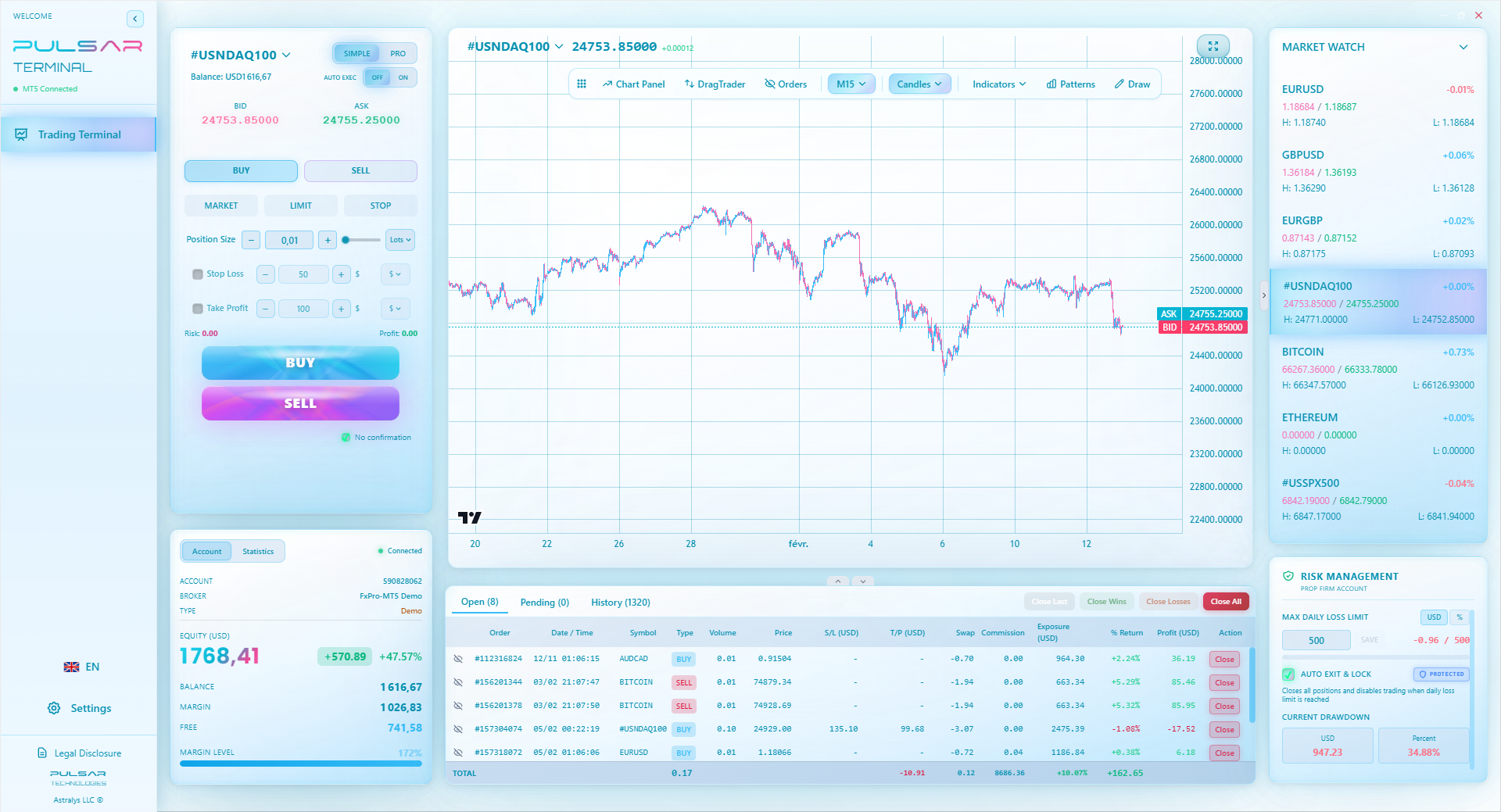
Managing multiple trades and risk on MT5 is complex, but tools like Pulsar Terminal automate advanced order types and prop firm rules directly on your charts.
Pulsar Terminal
The all-in-one MT5 companion: drag-and-drop orders, multi-TP/SL, trailing stop, grid trading, Volume Profile, and prop firm protection. Used by 1,000+ traders daily.
- Verify the FSP Number: Go to the FSCA website, type in the number the broker gives you. Does the name match? Is the license active?
- Read the Client Agreement: I know, it's boring. Skim it for the key sections: fees, withdrawal policy, margin call procedure.
- Calculate the REAL Trade Cost: For your typical trade size, is the standard or raw account cheaper? Use our position size calculator to factor in costs.
- Open a Demo Account: Trade on it for at least two weeks. Is the platform stable during high volatility? Do requotes happen?
- Test Support: Call, email, use live chat. Ask a technical question about XAU/USD rollover times or EUR/USD margin requirements. Gauge their knowledge and speed.
- Plan Your First Withdrawal: Know the steps and how long it will take. Make your first withdrawal a small one, even if you're profitable, just to test the system.

Pro Tip: Start small. Deposit the minimum amount, make a few live trades, and then request a withdrawal of your initial deposit. If that process is smooth, you've found a keeper. If it's a nightmare, you've only lost the minimum.
Choosing from the many forex brokers in South Africa is your first major trade. Do the analysis. The right broker won't make you a profitable trader, but the wrong one will guarantee you're a losing one.
💡 Winston's Tip
Your first withdrawal request is a test. Make it for a small amount, early on. If it's difficult, the big profits you dream of will be impossible to retrieve.
FAQ
Q1Is forex trading legal in South Africa?
Yes, completely legal. But you must use a broker licensed by the Financial Sector Conduct Authority (FSCA) to be protected under South African law. Trading with unregulated offshore brokers is legal but extremely risky, as you have no local recourse if things go wrong.
Q2What is the maximum use I can get?
For retail traders with an FSCA-regulated broker, the maximum is 30:1 on major forex pairs. This is a hard rule from 2021. Some offshore brokers may offer 500:1 or more, but using that level of use is a proven way to blow up your account very quickly.
Q3How are my forex trading profits taxed?
The South African Revenue Service (SARS) views forex trading profits as income from a business or as capital gains. In practice, it's typically treated as taxable income. You need to declare it on your annual tax return. The effective capital gains tax rate is around 5% for individuals. Keep detailed records of all trades, deposits, and withdrawals.
Q4Can I trade with international brokers like IC Markets or Pepperstone?
Yes, many top international brokers like IC Markets and Pepperstone accept South African clients and often have local partnerships for ZAR deposits. However, check which entity you're signing up with. If it's their Australian or Cypriot entity, you're under that country's regulator, not the FSCA. Some have dedicated South African FSCA-regulated entities.
Q5What's the difference between an ECN and a standard broker?
An ECN (Electronic Communication Network) broker typically offers raw spreads from liquidity providers but charges a commission per trade. A standard "market maker" broker builds their profit into the spread and charges no commission. For active traders, the ECN model is often cheaper overall. For casual traders, the standard model is simpler. You must do the math based on your trade size and frequency.
Q6What happens if my broker goes bankrupt?
If it's an FSCA-regulated broker, client funds should be held in segregated accounts at top-tier banks. This means your money is separate from the broker's operating funds and should be returned to you in a bankruptcy proceeding. This is a key reason to choose a regulated broker. With an unregulated broker, your money is likely gone.
Q7Are there any limits on how much money I can send to a broker?
Yes, SARB limits apply. You have a Single Discretionary Allowance (SDA) of R2 million per year you can transfer offshore without a Tax Compliance PIN. For larger amounts intended for investment, you can use the Foreign Investment Allowance (FIA) of R10 million per year, which requires a PIN from SARS.
Prof. Winston's Lesson
Key Takeaways:
- ✓Verify the FSCA FSP number. Always.
- ✓30:1 use is a protective limit, not a ceiling to chase.
- ✓Calculate the total trade cost: spread + commission.
- ✓Test the withdrawal process with a small amount first.
- ✓Taxable income from trading is around 5% capital gains.
How useful was this article?
Click a star to rate
Weekly Trading Insights
Free weekly analysis & strategies. No spam.
About the Author
David van der Merwe
Emerging Markets Trader
Johannesburg-based trader with 11 years in emerging market currencies. Specializes in ZAR pairs, FSCA-regulated trading, and South African market analysis.
Comments
Risk Disclaimer
Trading financial instruments carries significant risk and may not be suitable for all investors. Past performance does not guarantee future results. This content is for educational purposes only and should not be considered investment advice. Always conduct your own research before trading.
You Might Also Like

Cara Trading Forex Sukses: 7 Prinsip dari Trader Profesional
Cara trading forex sukses dengan 7 prinsip trader pro: manajemen modal, disiplin, journal trading, backtest. Data nyata, bukan janji profit palsu.
Jam Trading Forex Terbaik untuk Trader Indonesia: Panduan Lengkap dengan Tabel Waktu
Panduan jam trading forex untuk trader Indonesia. Tabel 4 sesi dunia, jam emas 20:00-00:00, sesi mana yang harus dihindari. Data akurat + tips dari trader berpengalaman.
Top 5 Sàn Forex Uy Tín Nhất 2026: Review Jujur dari Trader Indonesia
Top 5 sàn forex uy tín 2026 untuk trader Indonesia. Review jujur: spread, deposit, withdraw, dukungan lokal. Exness, XM, IC Markets & lebih.
Get Pulsar Terminal
All these calculators are built into Pulsar Terminal with real-time data from your MT5 account. One-click position sizing, automatic risk management, and instant calculations.
Get Pulsar Terminal