


Here's a hard truth: over 90% of traders who claim a welcome bonus never actually withdraw the profits.

David van der Merwe
Emerging Markets Trader ·  South Africa
☕ 10 min read
What you'll learn:
- 1The Welcome Bonus: What You're Really Signing Up For
- 2Top Brokers & Their Bonus Offers for South Africans
- 3Decoding the Fine Print: Your Survival Guide
- 4The 1:500 use & Bonus Danger Zone
- 5The SARS Question: Is Your Bonus Taxable?
- 6What's Better Than a Bonus? Real Value.
- 7Final Verdict: Should You Claim That Bonus?
Here's a hard truth: over 90% of traders who claim a welcome bonus never actually withdraw the profits. The bonus isn't free money, it's a marketing tool with strings attached. In South Africa, where the FSCA allows use up to 1:500, that 'extra credit' can feel like a lifeline. But I've seen more accounts blown up by bonus psychology than saved by it. Let's cut through the hype and find which offers are genuinely useful for a ZAR-based trader.
When a broker flashes a "100% deposit bonus" or a "$30 no-deposit bonus," your brain sees free trading capital. The broker sees a clever customer acquisition cost. The key isn't the bonus amount, it's the turnover requirement - the volume you must trade before withdrawing bonus funds or profits derived from them.
Most bonuses work like this: you deposit R5,000, get a R5,000 bonus, and now have R10,000 in your account. But you can't touch that bonus R5,000. To 'release' it (and any profits made using it), you might need to trade 5 standard lots for every $1 of bonus. That's 25 lots on a R5,000 bonus. At R150 per pip on EUR/USD, that's a massive commitment.
I learned this the hard way early on. I took a 50% bonus from a now-defunct broker, turned my R2,000 into R4,500, and got excited. Then I read the fine print: I needed to trade 3 million units of currency (30 standard lots) before any withdrawal. In my excitement, I overtraded, blew through my real capital trying to hit the target, and lost it all. The bonus was still there, useless. That experience taught me to treat bonuses as a potential discount on trading costs, not as capital.

Warning: A no-deposit bonus is the most restrictive. You're trading with the broker's money, so they set extremely high turnover targets. Often, you can only withdraw profits after trading 5-10 lots per $10 of bonus. It's a demo account with extra steps.

💡 Winston's Tip
A bonus is a line of credit, not capital. Size your positions as if it doesn't exist. Your risk should always be a percentage of your real deposited funds.
“Over 90% of traders who claim a welcome bonus never actually withdraw the profits.”
Let's look at real brokers serving the South African market. Regulation is key - always check for FSCA licensing (FSP number). Here’s the breakdown of forex brokers that offer welcome bonus programs right now.
XM: The Instant Gratification Play
XM is popular here for a reason. Their $30 no-deposit bonus is instant after verification. No deposit needed. Sounds great, right? The catch: you need to achieve a trading volume of 5 lots (500,000 units) to withdraw any profits generated from it. That's a lot of scalping. Their deposit bonus (up to $5,000) has similar volume requirements. The good news? XM is FSCA regulated, accepts ZAR deposits, and their minimum deposit is just $5 (about R90). It's a decent way to test their platform with zero risk to your own cash. I used the $30 bonus to test a scalping strategy on their MT4 platform before committing real money.
AvaTrade: The Straightforward Match
AvaTrade offers a 20% first deposit bonus, up to R10,000. Deposit R5,000, get R1,000 extra. The terms are clearer than most: the bonus amount is locked until you trade a volume of 1 lot for every $1 of bonus. So, a R1,000 bonus (~$55) requires a 55-lot volume. That's steep, but it's a pure match on your own capital. They're solidly regulated by the FSCA (FSP 45984) and offer ZAR accounts. Their minimum deposit is R1,500.
HFM (HotForex): The High-Volume Trader's Bonus
HFM doesn't always advertise a standard welcome bonus. Instead, they run frequent promotions like "100% Credit Bonus" or "30% Rescue Bonus." These are credit bonuses, not cash. You can use them to absorb losses, but you can't withdraw them. They're useful if you're a consistent, high-volume trader who hits a rough patch. Their real advantage is low spreads (from 0.1 pips) on their Zero Spread account. For a trader who understands position sizing and can handle the volume requirements, their offers can effectively lower costs.
The Commission-First Brokers: A Different Value Prop
Brokers like IC Markets and Tickmill rarely offer deposit bonuses. Why? Their business model is built on raw spreads and low commissions. A typical offer from Tickmill might be a "no-deposit bonus contest" for demo accounts, not a live account credit. Their value is in execution. On IC Markets' raw account, you might pay $7 round turn but get a 0.0 pip spread on EUR/USD. Over 100 lots, that's $700 in commission but savings of thousands in spread. Sometimes, no bonus is the best bonus.
“The bonus creates a false sense of security, encouraging larger, riskier positions.”
This is where you save your account. Never, ever click "Accept" without checking these clauses.
1. The Turnover (Trading Volume) Requirement: This is the big one. It's usually stated as a multiple of the bonus. Example: "Trade 5 lots per $1 of bonus credit." Let's do the math.

Example: You get a $100 bonus with a 5-lot per $1 requirement. Volume Required = $100 * 5 = 500 lots. That's 50,000,000 currency units. On EUR/USD, with a standard lot, each pip move is $10. You need to move the market 5000 pips in total traded volume. That's a full-time job.
2. Time Limits: Many bonuses expire. You might have 30, 60, or 90 days to hit that volume target. If you don't, the bonus (and often the profits made from it) vanishes.
3. Withdrawal Restrictions: This is sneaky. Some terms state that you must withdraw your initial deposit before you can withdraw bonus-related profits. Others lock your entire account balance until requirements are met. I once had R15,000 locked for 60 days because I didn't see this clause.
4. Maximum Withdrawal from Bonus: A no-deposit bonus might let you keep only 50% of the profits you make from it. You make R1,000, you can only withdraw R500.
5. Eligible Instruments: The volume might only count on major forex pairs. Trading gold (XAU/USD) or indices might not contribute. Check the list. If you're a XAU/USD trader, a bonus requiring EUR/USD volume is useless.
“The bonus creates a false sense of security, encouraging larger, riskier positions.”
South Africa's FSCA allows use up to 1:500. Combine that with a 100% deposit bonus, and you have a psychological bomb. Here’s how it plays out.
You deposit R2,000. You get a R2,000 bonus. Your platform shows R4,000. With 1:500 use, your buying power is R2,000,000. You feel rich. You take a 0.5 lot trade on EUR/USD (R75 per pip). A 40-pip move against you is a R3,000 loss. But wait, only R2,000 of that balance is your real money. You've just blown your entire deposit, but the platform still shows R1,000 (the bonus). You're in a margin call on your real capital, but the bonus is masking the disaster.
The bonus creates a false sense of security, encouraging larger, riskier positions. It distorts your perception of your true account equity. My rule? If you take a bonus, mentally subtract it from your balance. Use a position size calculator based on your deposited capital only, not the total balance.

Pro Tip: Before accepting any bonus, go to the broker's FAQ or support and ask: "What is the exact lot volume required to withdraw profits from the welcome bonus, and what is the time limit?" Get it in writing. If they can't give a straight answer, walk away.
💡 Winston's Tip
The most valuable 'bonus' any broker offers is reliable order execution with minimal slippage. A saved pip on entry is worth more than a locked bonus.
“Sometimes, no bonus is the best bonus.”
This is a grey area that many traders ignore. In South Africa, forex trading profits are considered income and taxed at your marginal rate (18%-45%). But what about the bonus?
SARS's view is generally that if you receive an economic benefit, it's potentially taxable. A withdrawable cash bonus could be seen as income in the year you receive it. However, most welcome bonuses are not withdrawable cash; they're credit tokens with restrictions. The consensus among tax consultants I've spoken to is that the bonus itself is likely not taxable upon receipt because you don't have unrestricted access to it.
The real tax event happens when you meet the conditions and the bonus converts to withdrawable cash. At that point, it forms part of your trading capital. The profits you then make with that capital are taxable. The crucial step is to keep impeccable records: the bonus offer terms, the statement showing the credit, and the statement showing when the restrictions were lifted. If you're trading seriously, consult a tax professional who understands trading. Don't rely on forum advice for this.
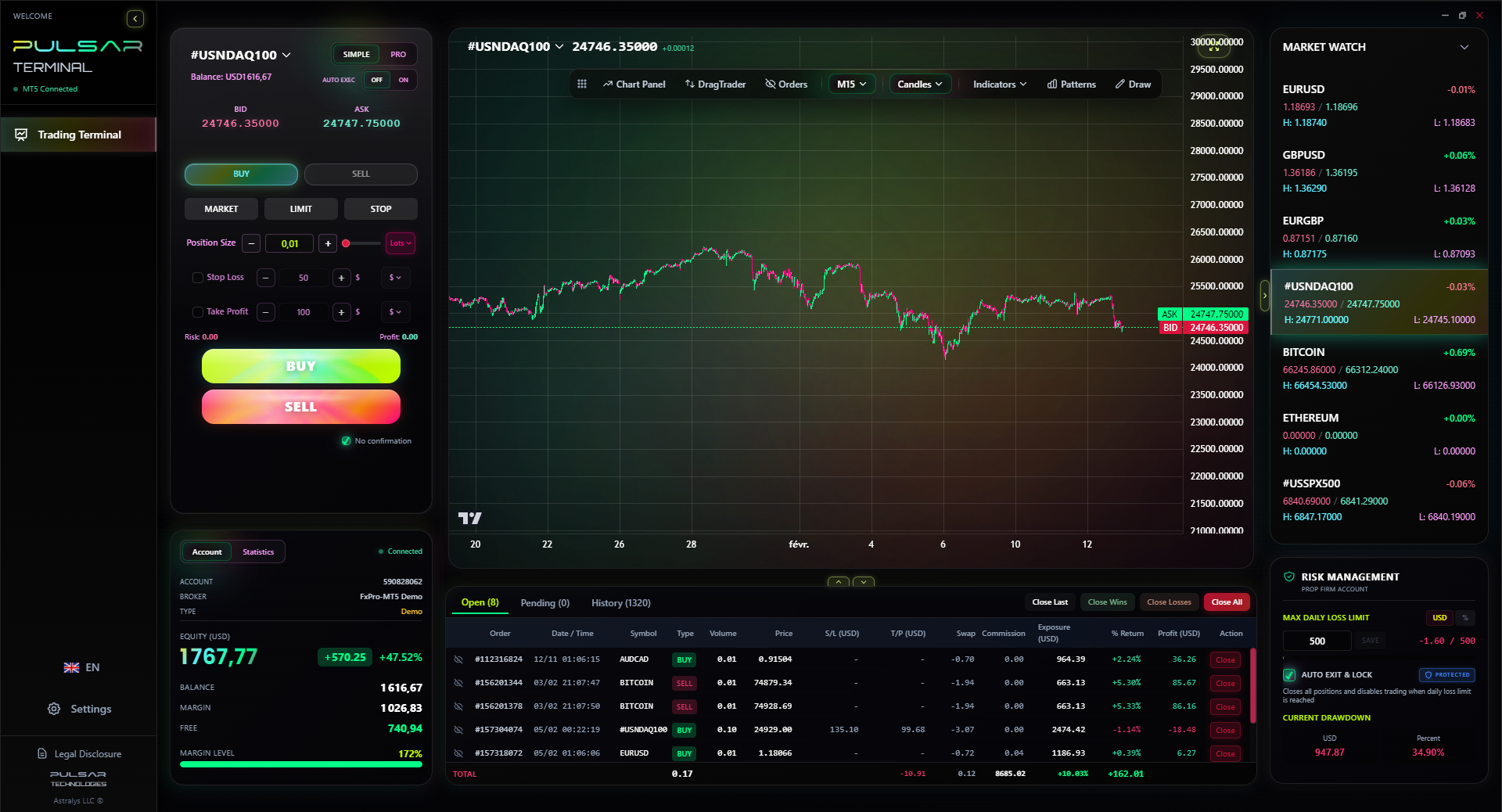
Managing the complex risk of trading with bonus capital is stressful; Pulsar Terminal's visual trade panel lets you set precise stop-loss and take-profit levels based on your real equity, not the inflated bonus balance.
Pulsar Terminal
The all-in-one MT5 companion: drag-and-drop orders, multi-TP/SL, trailing stop, grid trading, Volume Profile, and prop firm protection. Used by 1,000+ traders daily.
“Sometimes, no bonus is the best bonus.”
Chasing bonuses is often a beginner's game. Experienced traders look for value that improves their bottom line every day.
1. Lower Spreads & Commissions: A 0.1 pip saving on EUR/USD might not sound like much. But if you trade 10 lots a month, that's a $100 monthly saving (10 lots * 100,000 units * 0.00001 pip value). Over a year, that's R22,000+ saved - far more valuable than a one-time bonus with strings. Compare brokers like Pepperstone (Razor account) and IC Markets on their raw pricing.
2. Superior Execution & No Requotes: Slippage on news events can cost you 10 pips in a flash. A broker with deep liquidity and straight-through processing saves you real money on every volatile trade. This is where brokers investing in their technology shine.
3. Deposit/Withdrawal Efficiency: A broker that offers instant, fee-free ZAR deposits via PayFast or Ozow is giving you a bonus in time and convenience. Getting your money out in 24 hours without fees is worth its weight in gold.
4. Real Educational Resources: Some brokers, like XM, host regular live webinars with market analysis tailored for South African time zones. That education can make you more money than any bonus.
Sometimes, the best offer is a simple, transparent, low-cost account where you can focus on your trading plan for swing trading or day trading, without bonus-related distractions.
💡 Winston's Tip
If the bonus terms require more than 3 pages of legal text to explain, your time is better spent analyzing a chart. Complexity benefits the issuer, not you.
“Focus on building your skills. That's the only 'welcome bonus' that pays out forever.”
So, should you look for forex brokers that offer welcome bonus in South Africa? It depends entirely on your profile.
Yes, if:
- You are a brand new trader and want to test a broker's platform with a no-deposit offer (like XM's $30). Treat it as an extended demo.
- You are a very high-volume trader (10+ lots per week) and have calculated that the bonus credit will definitively offset your costs after meeting the clear, achievable volume target.
- You fully understand the terms, have written them down, and will base your position sizing solely on your deposited capital.
No, if:
- You are undercapitalized (depositing less than R5,000). The bonus will tempt you into improper risk-taking.
- You don't have the time or strategy to meet high volume requirements.
- The terms are vague, or the broker is not FSCA regulated.
- You're looking for 'free money' to boost a small account. It's a trap.
My personal approach now? I prefer a clean, low-cost account. The one exception was when I used a small no-deposit bonus to objectively test a broker's execution speed and slippage during the London open before moving my main account there. That's a strategic use. The bonus isn't the goal; it's a tool for due diligence. Focus on building your skills, your strategy, and your discipline. That's the only 'welcome bonus' that pays out forever, with no turnover requirements attached.
FAQ
Q1Can I withdraw the welcome bonus itself as cash?
Almost never. Welcome bonuses are nearly always non-withdrawable credit. You can use them to trade, and sometimes you can withdraw the profits you make from trading with them, but only after meeting strict trading volume requirements. The bonus capital itself typically just vanishes from your account once you withdraw or if you fail to meet the terms.
Q2Which South African forex broker has the best no-deposit bonus?
XM's $30 no-deposit bonus is the most accessible and instant for South Africans. However, 'best' is subjective. You need to trade 5 lots to withdraw any profits from it, which is a significant volume for a new trader. It's best used as a platform test, not a profit vehicle. Always check the current terms on their website, as offers change.
Q3Are these bonuses safe with FSCA-regulated brokers?
Safer, yes. An FSCA-regulated broker (like XM or AvaTrade) must adhere to conduct standards. However, the FSCA doesn't guarantee the bonus terms. The safety is in the segregation of your client funds and the broker's operational integrity. The bonus itself is a promotional product with its own risks - mainly the risk of you overtrading to meet its conditions.
Q4How do I calculate the trading volume required for a bonus?
Find the 'turnover requirement' in the terms. It's usually 'X lots per $/€/£ of bonus.' Multiply your bonus amount by that number. Example: $100 bonus * 5 lots per $ = 500 standard lots required. Remember, 1 standard lot = 100,000 units of currency. So 500 lots = 50,000,000 units traded. This is why volume targets are so difficult for most retail traders.
Q5Do professional traders use welcome bonuses?
Rarely. Professional traders prioritize execution speed, liquidity, and low transaction costs. The administrative hassle and forced trading volume of a bonus interfere with their strategic edge. They might use a no-deposit bonus for broker testing, but they avoid deposit bonuses that dictate their trading behavior.
Q6What happens if I try to withdraw before meeting the bonus terms?
Typically, the broker will cancel the bonus and deduct its value (and often any profits attributed to it) from your account balance before processing your withdrawal. In the worst cases, it can void the bonus, lock your account, or only allow you to withdraw your initial deposit, forfeiting all profits. Always check the specific penalty clause.
Q7Is there a welcome bonus for crypto trading?
Some brokers that offer multi-asset trading (like AvaTrade) may extend their deposit bonus to all instruments, including crypto CFDs. However, the volume requirement usually still applies, and trading volatile crypto to hit a target is extremely risky. Dedicated crypto exchanges have different promotions, but this article focuses on forex brokers.
Prof. Winston's Lesson
Key Takeaways:
- ✓Treat bonus funds as $0 in your risk calculations.
- ✓Volume targets of 5+ lots per $1 are designed to be hard to reach.
- ✓FSCA regulation protects your deposit, not your bonus profits.
- ✓Low spreads save more money long-term than most bonuses.
How useful was this article?
Click a star to rate
Weekly Trading Insights
Free weekly analysis & strategies. No spam.
About the Author
David van der Merwe
Emerging Markets Trader
Johannesburg-based trader with 11 years in emerging market currencies. Specializes in ZAR pairs, FSCA-regulated trading, and South African market analysis.
Comments
Risk Disclaimer
Trading financial instruments carries significant risk and may not be suitable for all investors. Past performance does not guarantee future results. This content is for educational purposes only and should not be considered investment advice. Always conduct your own research before trading.
You Might Also Like

Cara Trading Forex Sukses: 7 Prinsip dari Trader Profesional
Cara trading forex sukses dengan 7 prinsip trader pro: manajemen modal, disiplin, journal trading, backtest. Data nyata, bukan janji profit palsu.
Jam Trading Forex Terbaik untuk Trader Indonesia: Panduan Lengkap dengan Tabel Waktu
Panduan jam trading forex untuk trader Indonesia. Tabel 4 sesi dunia, jam emas 20:00-00:00, sesi mana yang harus dihindari. Data akurat + tips dari trader berpengalaman.
Top 5 Sàn Forex Uy Tín Nhất 2026: Review Jujur dari Trader Indonesia
Top 5 sàn forex uy tín 2026 untuk trader Indonesia. Review jujur: spread, deposit, withdraw, dukungan lokal. Exness, XM, IC Markets & lebih.
Get Pulsar Terminal
All these calculators are built into Pulsar Terminal with real-time data from your MT5 account. One-click position sizing, automatic risk management, and instant calculations.
Get Pulsar Terminal