


I remember staring at my screen during the 2022 UK mini-budget chaos.

David van der Merwe
Emerging Markets Trader ·  South Africa
☕ 8 min read
What you'll learn:
- 1Fixed vs. Variable Spreads: What You're Really Paying For
- 2FSCA Regulation: Why It's Your First Filter
- 3Brokers with Low Fixed Spreads for South Africans
- 4Beyond the Spread: The Hidden Costs to Scrutinise
- 5The Rand Advantage: ZAR Accounts & Local Payments
- 6Putting It All Together: Choosing Your Broker
- 7Final Thoughts: The Spread is Just One Part of the Equation
I remember staring at my screen during the 2022 UK mini-budget chaos. GBP/USD was whipping around like a kite in a hurricane. My usual broker's spread on the pair, normally a tidy 1.2 pips, ballooned to over 50 pips in seconds. A planned 15-pip stop-loss on a short swing trade got vaporized before the price even moved against me properly. That was the day I truly understood the value of a fixed spread. For South African traders who hate nasty surprises on their statement, finding a solid forex broker with a low fixed spread isn't just about cost, it's about sanity.
Let's clear this up first. A spread is just the difference between the buy (ask) and sell (bid) price. It's how many brokers make their money. A variable spread changes with market liquidity and volatility. It can be super tight when things are calm, like 0.1 pips on EUR/USD. Sounds great, right? The catch is when news hits or liquidity dries up (like during Asian sessions for ZAR pairs), that spread can widen dramatically. I've seen EUR/ZAR spreads jump from 80 to 300 pips during a local news event.
A fixed spread, on the other hand, stays constant. The broker guarantees it won't change, regardless of what the market is doing. You pay a slightly higher premium during calm times for that certainty. It's like insurance against spread-widening events. For a strategy like news trading or scalping strategy where precise entry and exit points are everything, a fixed spread can be a lifesaver. You know your exact cost from the moment you place the order.

Warning: Some brokers advertise 'fixed spreads' but have a clause allowing 'exceptional market conditions.' Always read the fine print in their product disclosure documents.
The Real Cost Calculation
Don't just look at the spread number in isolation. You need to calculate the effective cost. For a variable spread account with a commission, it's: (Spread in pips) + (Commission per side x 2). For a fixed, commission-free account, the spread is the total cost. A 1.0 pip fixed spread might be cheaper overall than a 0.2 pip variable spread plus a $7 round-turn commission, depending on your trade size. Use a position size calculator to plug in your numbers and see the difference.

💡 Winston's Tip
A fixed spread is a hedge against market chaos. You're paying a small premium for predictability, which is a currency more valuable than pips when volatility strikes.
Trading with an FSCA-licensed broker isn't optional in my book, it's rule number one. The Financial Sector Conduct Authority is our local watchdog. A broker holding an FSP (Financial Services Provider) number and an ODP (OTC Derivatives Provider) license means they have a physical office here, keep your money in segregated accounts, and play by our rules - including the 30:1 use cap for retail traders.
Yes, you can open an account with a flashy offshore broker offering 500:1 use. But if something goes wrong - withdrawals frozen, platform issues - the FSCA can't help you. I learned this the hard way early on with an unregulated 'bucket shop' that vanished with a few hundred dollars of my capital. Poof. Gone.
The peace of mind is worth the slightly stricter rules. Always verify the FSP number on the FSCA's online register. It takes two minutes. Brokers like Exness (FSP 51024) and XM are globally known but also hold this local license, which is a strong combination.
“A 1-pip fixed spread won't save you from a bad trade where you ignored your stop-loss.”
Based on current offerings and my own experience testing platforms, here are the standout FSCA-regulated brokers providing genuine fixed spreads. I'm focusing on the EUR/USD benchmark, but check their spreads on ZAR pairs if that's your focus.
| Broker | FSCA License | Fixed Spread on EUR/USD (from) | Min. Deposit (USD approx.) | Key Notes |
|---|---|---|---|---|
| EasyMarkets | FSP 54018 | 0.7 pips (VIP) / 1.8 pips (Standard) | $25 | True fixed spread pioneer. Spreads guaranteed, even during news. Offers a 'dealCancellation' feature (like a time-limited undo button). |
| AvaTrade | FSP 45984 | 1.0 pips | $100 | Reliable, well-established. Fixed spreads on their standard account. Great for beginners due to simple cost structure. |
| Trade Nation | FSCA Regulated | 1.0 - 1.2 pips | Low (varies) | Transparent pricing. All instruments on fixed spreads. Good customer support for SA traders. |
A Quick Word on Variable Spread Leaders
While this guide is about fixed spreads, some variable spread brokers are so competitive they deserve a mention for cost-conscious traders. Tickmill (FSP 49464) offers raw spreads from 0.11 pips + $3 commission per lot. FP Markets has tight ECN pricing. For a pure, simple commission-free model, Plus500 is popular, but remember their spreads are variable.

Pro Tip: Your trading style dictates the best account type. If you're a high-volume scalping strategy trader, a low-commission variable account might save you more. If you hold swing trading positions for days and worry about overnight gaps, the fixed spread certainty could be worth the premium.
💡 Winston's Tip
Always verify the FSP number. A broker's fancy website means nothing compared to that string of digits on the FSCA register. It's your first line of defence.
Brokers are clever. If they make less on the spread, they might recoup it elsewhere. Here’s your checklist:
- Swap Fees (Overnight Financing): This is the cost to hold a position overnight. It's based on interbank interest rates plus the broker's markup. Check the rates on your preferred pairs. For a long-term swing trading hold, a high swap can eat your profits. A triple swap is charged on Wednesdays to cover the weekend.
- Deposit/Withdrawal Fees: This is huge for us. Does the broker offer ZAR accounts and local EFTs? If you're funding in Rands but trading USD pairs, a broker that converts at a poor rate is skimming from you. I once lost nearly 2% of a deposit just on a bad USD/ZAR conversion by the broker's payment processor.
- Inactivity Fees: If you take a month or two off, will you be charged?
- Platform Fees: Most don't charge for MT4/MT5, but always confirm.
My personal mistake? I funded an international broker with a credit card, attracted by a bonus. The withdrawal fee was a flat $50. On a $500 withdrawal, that's 10% gone. Ouch. Now I only use brokers with free local EFT withdrawals to my South African bank account.
“The goal is to be in this game for the long run, and that starts with choosing a partner that offers stability and a fair deal.”
This is the single biggest practical tip I can give you as a South African trader. Use a broker that offers a ZAR-denominated trading account.
Why? It eliminates currency conversion risk on your capital. You deposit Rands, your profit and loss is displayed in Rands, and you withdraw Rands. The broker handles the conversion internally at the interbank rate when you trade USD pairs. It's almost always better than your bank's rate.
Payment methods matter too. The ideal setup:
- Local EFT/Bank Transfer: Direct into the broker's South African bank account. Usually free, takes 1-2 business days.
- Credit/Debit Card: Instant, but your bank might block it due to exchange controls, labeling it an 'international forex transaction.' You may need to call to authorize it.
- E-wallets (Skrill, Neteller): Fast, but check both the broker's and the e-wallet's fees for depositing and withdrawing Rands.
Warning: Some South African banks are cracking down on transfers to CFD/Forex brokers, even regulated ones. Be prepared to explain the transaction is for a licensed FSCA entity. Having your broker's FSP number handy helps.
So how do you decide? Follow this simple decision tree based on who you are as a trader.
You might prefer a LOW FIXED SPREAD broker if:
- You trade around high-impact news events (like SARB announcements or US Non-Farm Payrolls).
- You use automated strategies (EAs) that require predictable costs.
- You're a beginner and want simple, all-inclusive pricing with no surprise costs.
- You primarily trade exotic pairs or ZAR crosses where spreads are naturally wider and more volatile.
You might prefer a LOW VARIABLE SPREAD + COMMISSION broker if:
- You trade high volumes (lots) frequently, where the lower raw spread saves money.
- You mostly trade major pairs (EUR/USD, GBP/USD) during liquid London/NY sessions.
- You're an advanced trader comfortable with a more complex cost structure.
The Test Drive is Non-Negotiable
Open a demo account. Seriously. Don't just look at numbers on a website. Test the:
- Execution Speed: Is there slippage on your orders?
- Platform Stability: Does it freeze during volatile times?
- Spread Reality: Do the actual spreads match the advertised ones, especially on the ZAR/JPY or USD/ZAR pairs you might want to trade? I demo-traded with a well-reviewed broker for a week before noticing their 'fixed' USD/ZAR spread was 50 pips wider than a competitor's during the SA market open. That's R500 extra cost per standard lot before the trade even moves.
💡 Winston's Tip
Test the spread on the specific pair and time you trade. A broker's 'from' spread is often for EUR/USD at 3am. Your reality trading USD/ZAR at 10am JST may be very different.
“Use a broker that offers a ZAR-denominated account. It eliminates currency conversion risk on your capital.”
Chasing the lowest fixed spread is a smart move, but don't let it blind you to the bigger picture. The most important thing is managing your risk. A 1-pip fixed spread won't save you from a bad trade where you ignored your stop-loss.
Always, always use a stop-loss. Understand what a margin call is before you use use. The FSCA's 30:1 limit is there for a reason - use it wisely. A good broker with a slightly higher spread but rock-solid execution and regulation is infinitely better than a cheap broker that fails you when you need it most.
Start small. Fund your account with money you can afford to lose. Use that position size calculator religiously. The goal is to be in this game for the long run, and that starts with choosing a partner - your broker - that offers stability, transparency, and a fair deal on costs, spread included.
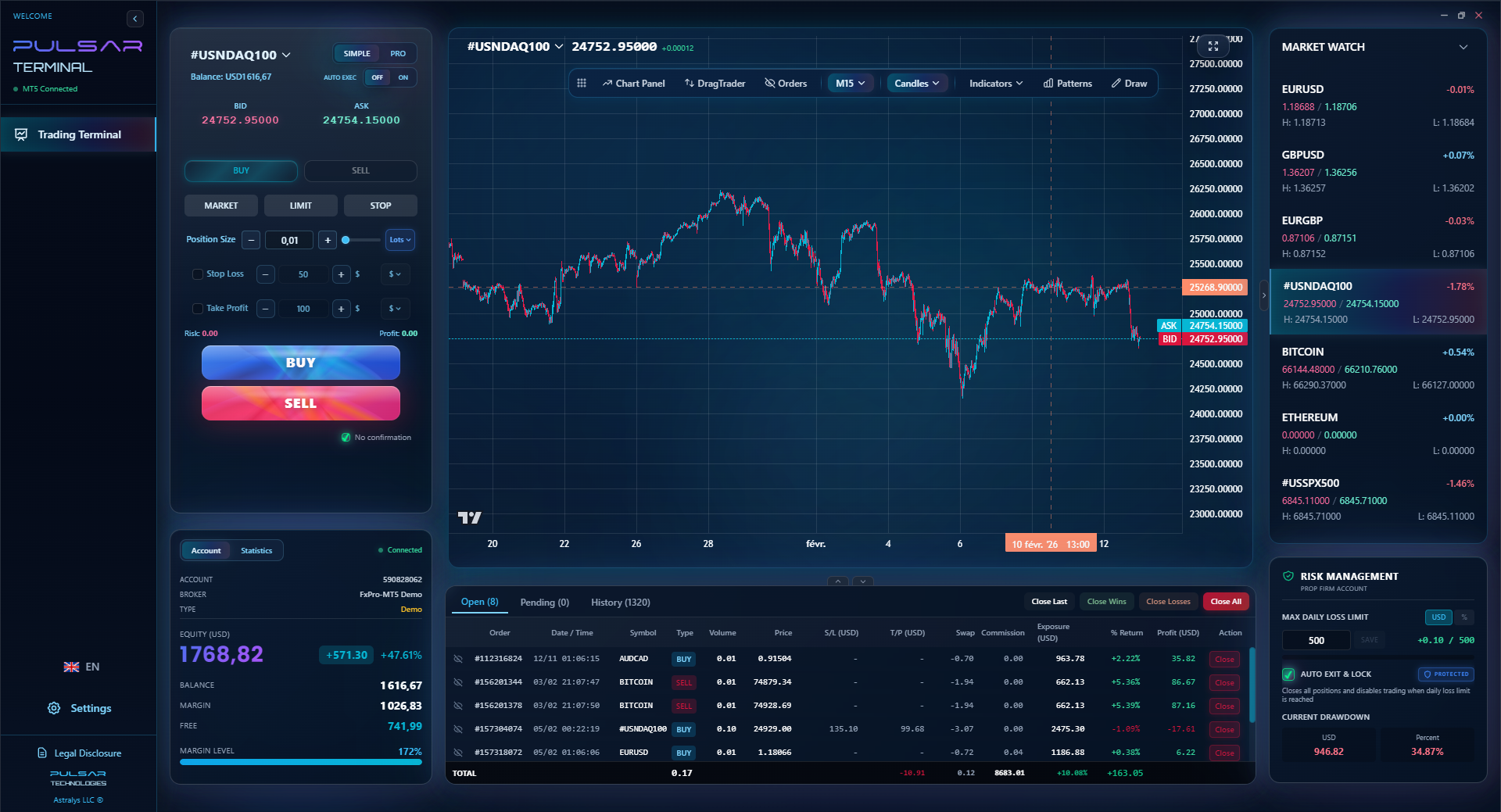
Managing risk with precise stop-loss and take-profit levels is essential with fixed spreads, and Pulsar Terminal's drag-and-drop order tools on MT5 make setting multi-level exits faster and more accurate.
Pulsar Terminal
The all-in-one MT5 companion: drag-and-drop orders, multi-TP/SL, trailing stop, grid trading, Volume Profile, and prop firm protection. Used by 1,000+ traders daily.
FAQ
Q1Is forex trading with fixed spreads legal in South Africa?
Yes, absolutely. Forex trading is legal and regulated by the Financial Sector Conduct Authority (FSCA). Several FSCA-licensed brokers, like EasyMarkets and AvaTrade, offer fixed spread accounts to South African residents legally.
Q2What is a good fixed spread for EUR/USD in South Africa?
A competitive fixed spread for EUR/USD from an FSCA-regulated broker starts around 0.7 to 1.2 pips. Anything consistently under 1.5 pips on a standard account is considered good for a fixed spread. Remember to compare the overall cost, as some variable spread accounts with commissions can be cheaper.
Q3Can I trade with a fixed spread broker using MT4 or MT5?
Yes, most brokers offering fixed spreads, including EasyMarkets and AvaTrade, provide full access to the MetaTrader 4 (MT4) and MetaTrader 5 (MT5) platforms. You get the fixed spread pricing directly within the platform you're familiar with.
Q4Do fixed spread brokers charge commissions?
Typically, no. The broker's cost is built into the fixed spread. This is the main appeal: one simple, predictable cost. Always check the account terms, but genuine fixed spread accounts are usually commission-free.
Q5Will my South African bank allow deposits to a forex broker?
It can be a hurdle. While legal, some SA banks block card payments or EFTs to forex brokers due to exchange control policies. Using a broker with a local ZAR account and South African bank details for EFTs is the smoothest method. You may need to call your bank to authorize an international card payment.
Q6Are fixed spreads better for beginner traders in South Africa?
Generally, yes. Fixed spreads make calculating costs and risk much simpler. There are no surprise cost increases during volatile news, which helps beginners manage their trades and learn without the added variable of a widening spread definition. It provides a more stable learning environment.
Q7What's the difference between a fixed spread and a guaranteed stop-loss?
They are different. A fixed spread is the constant cost to open a trade. A guaranteed stop-loss is an order type (often with a fee) that ensures your position is closed exactly at your specified price, even if the market gaps through it. A fixed spread protects your entry cost; a guaranteed stop-loss protects your exit.
Prof. Winston's Lesson
Key Takeaways:
- ✓Fixed spreads cost more in calm markets but protect you during news volatility.
- ✓Always prioritize FSCA regulation; verify the FSP number online.
- ✓Calculate effective cost: Fixed Spread vs. (Variable Spread + Commission).
- ✓Use a ZAR account and local EFTs to avoid bank conversion fees.
How useful was this article?
Click a star to rate
Weekly Trading Insights
Free weekly analysis & strategies. No spam.
About the Author
David van der Merwe
Emerging Markets Trader
Johannesburg-based trader with 11 years in emerging market currencies. Specializes in ZAR pairs, FSCA-regulated trading, and South African market analysis.
Comments
Risk Disclaimer
Trading financial instruments carries significant risk and may not be suitable for all investors. Past performance does not guarantee future results. This content is for educational purposes only and should not be considered investment advice. Always conduct your own research before trading.
You Might Also Like

Cara Trading Forex Sukses: 7 Prinsip dari Trader Profesional
Cara trading forex sukses dengan 7 prinsip trader pro: manajemen modal, disiplin, journal trading, backtest. Data nyata, bukan janji profit palsu.
Jam Trading Forex Terbaik untuk Trader Indonesia: Panduan Lengkap dengan Tabel Waktu
Panduan jam trading forex untuk trader Indonesia. Tabel 4 sesi dunia, jam emas 20:00-00:00, sesi mana yang harus dihindari. Data akurat + tips dari trader berpengalaman.
Top 5 Sàn Forex Uy Tín Nhất 2026: Review Jujur dari Trader Indonesia
Top 5 sàn forex uy tín 2026 untuk trader Indonesia. Review jujur: spread, deposit, withdraw, dukungan lokal. Exness, XM, IC Markets & lebih.
Get Pulsar Terminal
All these calculators are built into Pulsar Terminal with real-time data from your MT5 account. One-click position sizing, automatic risk management, and instant calculations.
Get Pulsar Terminal