


Here's a number that should make you sit up: about 80% of all trading in our own South African Rand happens offshore.

David van der Merwe
Emerging Markets Trader ·  South Africa
☕ 10 min read
What you'll learn:
- 1What a 'Forex Bull' Really Means (It's Not What You Think)
- 2Spotting a Bull Market from South Africa
- 3Trading the Bull: Local Broker Realities
- 4My Bull Market Playbook: Entry to Exit
- 5The Psychology of the Bull: Don't Get Gored
- 6The ZAR's Unique Bull and Bear Cycles
- 7Building a Bull-Proof South African Trading Plan
Here's a number that should make you sit up: about 80% of all trading in our own South African Rand happens offshore. Think about that. The fate of our currency is largely decided in London, New York, and Singapore. Yet, right here, we have over 190,000 local traders trying to make sense of it. Being a forex bull isn't just about blind optimism; it's about spotting when the world decides our currency, or another, has real strength. I've made my best profits riding these waves, and I've also been flattened by them when I got it wrong. Let's talk about how to do it properly, from a South African screen.
Most new traders hear 'bull market' and picture a chart shooting up to the right forever. In forex, it's more nuanced. A forex bull is someone who believes a specific currency will appreciate in value relative to another. The key word is 'relative.' You're always betting on one currency's strength against another's weakness.
For us in South Africa, this gets interesting. You can be a bull on the US Dollar (USD) against the Rand (ZAR), which is a common trade when global risk sours. That's being bullish on USD/ZAR, hoping the pair goes up (more Rands per Dollar). But you can also be a bull on the Rand itself. That means you'd buy ZAR against a weaker currency, like in the EUR/ZAR pair, hoping the Rand strengthens (the pair goes down).
I learned this the hard way early on. I was convinced the Rand was due for a comeback after a rough patch. I kept saying 'I'm bullish on the Rand.' Then I went and bought USD/ZAR, which is a bet against the Rand. I lost money even as the Rand stabilized, because my trade direction was completely wrong for my belief. My conviction was right, my execution was a mess. Understanding the quote convention is step zero.

Warning: Always double-check which currency is the base and which is the quote. Saying 'I'm bullish on the Rand' is meaningless unless you specify the pair. Bullish on ZAR means you want to sell a pair like USD/ZAR or EUR/ZAR.
“Being a forex bull isn't just about blind optimism; it's about spotting when the world decides a currency has real strength.”
You can't rely on gut feeling or news headlines. Bull markets are built on pillars of concrete data and price action. Here’s what I watch for, especially in our timezone.
The Macro Pillars
First, interest rates. A central bank hiking rates (or expected to) often attracts foreign capital, boosting that currency. When the SARB signals a hawkish stance, it can be a foundational reason for a ZAR bull run. Conversely, if the US Fed is hiking while the SARB holds, USD/ZAR has a powerful bullish driver.
Second, terms of trade. South Africa is a commodity exporter. When gold, platinum, and coal prices are strong, our current account improves. That's fundamental fuel for a stronger Rand. I keep a simple chart of the Gold/ZAR correlation open at all times; it's that important.
The Chart Doesn't Lie
Fundamentals set the stage, but price pays. I look for a clear series of higher highs and higher lows on the daily chart. That's the simplest definition of a bull trend. I then use the 50 and 200-period moving averages as dynamic guides. In a strong bull move, price tends to stay above the 50-period MA, with the 50 above the 200 (a 'Golden Cross').
My biggest lesson? Don't fight the RSI indicator in extreme territory during a powerful trend. In early 2023, USD/ZAR was in a fierce downtrend (a ZAR bull market). The RSI was stuck below 30 for weeks, showing 'oversold.' I kept trying to pick a bottom, thinking a bounce was due. Each short scalp failed. The trend was simply too strong. An oversold RSI in a bull trend for the counter-currency is a sign of momentum, not a reversal signal.

Example: Let's say EUR/ZAR is at 20.5000. You believe the Rand will strengthen (you're a ZAR bull). You'd SELL EUR/ZAR. If it drops to 20.2000, you've made 3000 points (or pips). On a standard lot (R1,000,000), that's a R30,000 profit before costs. Use a position size calculator to work out your exact risk.

💡 Winston's Tip
A true bull market feeds on doubt. If everyone is euphoric and certain, the move is likely near exhaustion. The strongest trends climb a wall of worry.
“I lost money even as the Rand stabilized, because my trade direction was completely wrong for my belief.”
Our local context changes everything. The FSCA's 30:1 use cap for retail traders is a big one. Coming from international forums where traders brag about 500:1, 30:1 feels restrictive. But honestly, it probably saved my account a few times. It forces you to put up more margin, which naturally limits your position size and risk. You can't just YOLO a tiny account into a massive trade.
Broker choice is critical. You want an FSCA-licensed broker for that segregated account safety. Firms like Exness and XM have local operations. But also consider global brokers with tight spreads like IC Markets or Pepperstone, which many South Africans use. Check their ZAR account funding options and fees.
Speaking of fees, they eat bull-market profits. The average EUR/USD spread might be 0.6 pips, but for exotic pairs involving ZAR, spreads can be 10-20 pips or more. That's your immediate cost. Then there's the swap. If you're holding a carry trade overnight (like being short on a high-yielding currency), those daily financing charges add up. I once had a profitable ZAR trade that I held for two weeks, only to see half the gains wiped out by negative swap fees. Always check the swap rate before holding a position long-term.
Bank fees are a silent killer. Depositing to an international broker? Capitec might charge you R250. Withdrawing profits? Another fee. If you're making frequent, small withdrawals, you could be giving 5-10% back to the banks. I consolidate my withdrawals now to make them less frequent and larger, minimizing that bite.
“I lost money even as the Rand stabilized, because my trade direction was completely wrong for my belief.”
This is the practical part. How do I actually trade a bull market setup? I'm not a pure scalping strategy guy in these moves; I prefer a swing trading approach to capture the meat of the trend.
Entry: I wait for the pullback. Bull markets don't go straight up. They climb a wall of worry. I look for price to dip back into a support zone - a previous resistance-turned-support, a key Fibonacci level (like the 38.2% or 50% retrace), or the rising 50-period moving average. I need to see the buying pressure return there. A bullish candlestick pattern (like a hammer or engulfing bar) right at that support is my trigger. My stop-loss goes just below that support zone.
A Real Trade: In late 2024, I was bullish on Gold (XAU/USD) due to geopolitical stress. Price pulled back from $2,050 to near $2,015, which was the 50-period EMA on the 4-hour chart. I bought at $2,018. Stop at $1,998 (20 points risk). I didn't just guess; I used my XAU/USD guide framework for levels.
Exit: This is harder than entry. I use a multi-target approach. I'll take 50% of my position off at the next obvious resistance level (1:1.5 risk-reward). I then move my stop to breakeven on the remainder. The second target is further out, maybe at a 1:3 ratio. I let the last portion run with a trailing stop. The mistake is taking full profit too early out of fear, or letting a winner turn into a loser. Having a pre-defined, partial exit plan removes the emotion.
Managing these multi-level exits manually is a pain. That's where tools come in.
💡 Winston's Tip
Your first profit target should be to recover your risk. Once your stop-loss is at breakeven, you're trading with the market's money. That changes everything psychologically.
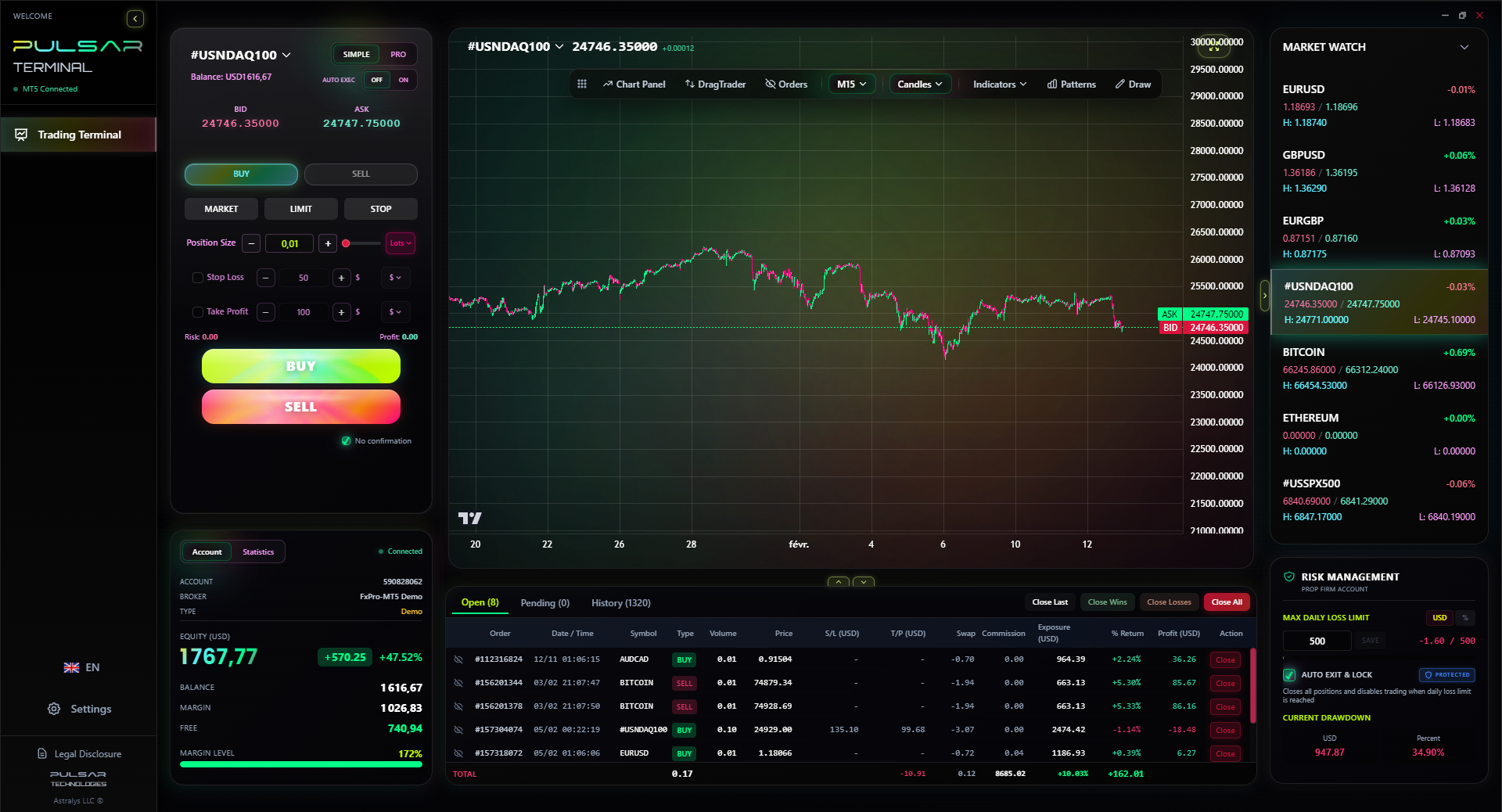
Managing multi-level profit targets and moving stops to breakeven manually is stressful and error-prone, which is why I rely on Pulsar Terminal to automate these rules directly on my MT5 charts.
Pulsar Terminal
The all-in-one MT5 companion: drag-and-drop orders, multi-TP/SL, trailing stop, grid trading, Volume Profile, and prop firm protection. Used by 1,000+ traders daily.
“An oversold RSI in a bull trend for the counter-currency is a sign of momentum, not a reversal signal.”
This is where most fail. A bull market feels easy. Everything you touch turns to gold. That's the danger.
Overconfidence: After a few wins, you start thinking you're a genius. You increase your position size recklessly. You stop waiting for proper setups. The market will humble you. I remember doubling my usual lot size on a 'sure thing' USD/ZAR short in 2022. A surprise SARB comment sent the Rand tumbling 2% in minutes. My oversized position hit my stop-loss and caused a monthly loss in one trade. Stick to your position size calculator rules, no matter what.
FOMO (Fear Of Missing Out): You see a pair rocket up without you. You chase it, entering at a terrible price far from any support. The inevitable pullback stops you out immediately. Then the trend resumes without you. It's brutal. If you miss the initial move, wait for the pullback. There's always another train, but you need to be at the station, not running down the tracks.
Ignoring the Turn: No trend lasts forever. Bull markets end. The signs are there: failing to make new highs, bearish divergence on the MACD indicator or RSI, and a break of the key trendline. Holding on to a bullish belief as the evidence shifts is how you give back all your profits. Be rigid with your stop-losses. The market doesn't care about your opinion.
“An oversold RSI in a bull trend for the counter-currency is a sign of momentum, not a reversal signal.”
Trading the Rand is a different beast. Its cycles are often driven by external 'risk on/risk off' sentiment more than pure South African fundamentals.
ZAR Bull Market (Rand Strengthening): This usually happens when global investors are feeling brave. They pour money into emerging markets like ours, chasing yield. Commodity prices are often rising too. The USD/ZAR chart makes lower lows and lower highs. This is when you want to be short majors against the ZAR, or long on the JSE if you're into equities.
ZAR Bear Market (Rand Weakening): When global panic hits (think Covid, a US recession scare), money flees to safe havens like the US Dollar. The Rand gets sold off hard and fast. USD/ZAR makes higher highs. This is a dangerous time to try and be a ZAR bull. It's often better to step aside or trade the dominant USD bullish trend.
Remember that 80% offshore trading stat? It means the Rand can gap massively when London or New York opens against our local news. I never hold a highly leveraged ZAR position over a major overseas market open unless I'm prepared for a wild ride. A tight spread definition can widen to 50 pips in a heartbeat during volatility, skewing your entry and exit badly.
💡 Winston's Tip
The Rand isn't a currency; it's a volatility index for global risk sentiment. Trade it accordingly, not on local headlines alone.
“If you miss the initial move, wait for the pullback. There's always another train, but you need to be at the station, not running down the tracks.”
Putting it all together. Your plan is your anchor.
- Define Your Bull: What currency are you bullish on, and in which specific pair? Write it down. 'Bullish on USD vs ZAR' or 'Bullish on Gold in USD terms.'
- Check the Alignment: Do the fundamentals (rates, commodities) support it? Does the price chart show the higher highs/higher lows structure?
- Plan the Trade: Where is your entry zone (wait for the pullback)? Where is your hard stop-loss? Where are your profit targets (use at least two)? Write down the pip definition risk per trade.
- Size It Safely: Use the 30:1 use wisely. Risk no more than 1-2% of your capital on any single trade. The FSCA cap helps, but you can still over-use a small account.
- Manage the Trade: Once in, follow your plan. Move stops to breakeven. Take partial profits. Don't micromanage it. Emotional interference is the number one killer of bull market profits.
- Review and Adapt: After every trade - win or lose - journal it. Why did it work? Why did it fail? Was it your analysis, or did your psychology sabotage you? This feedback loop is how you go from being a hopeful bull to a professional one.
The goal isn't to catch every single pip of a bull run. It's to capture a chunk of it consistently, while strictly limiting your losses during the inevitable false starts and corrections. That's how you survive and compound your capital in the long run, right here from Mzansi.
FAQ
Q1Is it legal to be a forex bull and trade in South Africa?
Absolutely. Forex trading is legal and regulated by the Financial Sector Conduct Authority (FSCA). Being a 'forex bull' is just a market view. The key is to use an FSCA-licensed broker or a reputable international broker to ensure your funds are protected in segregated accounts.
Q2What's the maximum use I can use as a South African retail trader?
The FSCA caps use at 30:1 for retail forex traders. This is lower than some international offers, but it's designed to protect you from wiping out your account with a single bad trade. It forces more sensible position sizing.
Q3I'm bullish on the South African Rand. What pair should I trade?
If you believe the Rand will strengthen, you need to sell a pair where ZAR is the quote currency. The most common are USD/ZAR (sell it, hoping it goes down) or EUR/ZAR (sell it). Remember, being bullish on ZAR means you want the pair's price to fall.
Q4What are the biggest hidden costs for a South African forex trader?
Watch out for three things: 1) Wide spreads on ZAR pairs (can be 20+ pips), 2) Overnight swap fees that can erode profits on held positions, and 3) Bank transfer fees for funding/withdrawing. A R250 withdrawal fee on a R1000 profit is a massive 25% hit.
Q5How do I know if a bull trend is ending?
Look for failure: price fails to make a new high, makes a lower low, and breaks below a key trendline or moving average support (like the 50-period MA). Technical indicators like the MACD showing bearish divergence (price makes a high, MACD makes a lower high) are a strong warning sign.
Q6Can I use international brokers like IC Markets or Pepperstone from South Africa?
Yes, many South African traders do. They often offer tighter spreads and advanced platforms. However, ensure you understand their deposit/withdrawal process for ZAR and any applicable fees. Your client money protections may differ slightly from an FSCA-licensed entity.
Q7What's a common mistake new 'forex bull' traders make?
The most common is FOMO - chasing a price that's already run up far from support. They buy at the top of a move just before a pullback, get stopped out, and then watch the trend continue without them. Patience to wait for a pullback is a superpower.
Prof. Winston's Lesson
Key Takeaways:
- ✓Define your bull: Specify the exact currency pair (e.g., Sell USD/ZAR).
- ✓Use the 30:1 use cap as a risk-management tool, not a limitation.
- ✓Wait for the pullback. Never chase a price spike.
- ✓Always plan a multi-target exit: secure profits, then let winners run.
- ✓Bank fees can steal 10%+ of profits. Consolidate withdrawals.
How useful was this article?
Click a star to rate
Weekly Trading Insights
Free weekly analysis & strategies. No spam.
About the Author
David van der Merwe
Emerging Markets Trader
Johannesburg-based trader with 11 years in emerging market currencies. Specializes in ZAR pairs, FSCA-regulated trading, and South African market analysis.
Comments
Risk Disclaimer
Trading financial instruments carries significant risk and may not be suitable for all investors. Past performance does not guarantee future results. This content is for educational purposes only and should not be considered investment advice. Always conduct your own research before trading.
You Might Also Like

Cara Trading Forex Sukses: 7 Prinsip dari Trader Profesional
Cara trading forex sukses dengan 7 prinsip trader pro: manajemen modal, disiplin, journal trading, backtest. Data nyata, bukan janji profit palsu.
Jam Trading Forex Terbaik untuk Trader Indonesia: Panduan Lengkap dengan Tabel Waktu
Panduan jam trading forex untuk trader Indonesia. Tabel 4 sesi dunia, jam emas 20:00-00:00, sesi mana yang harus dihindari. Data akurat + tips dari trader berpengalaman.
Top 5 Sàn Forex Uy Tín Nhất 2026: Review Jujur dari Trader Indonesia
Top 5 sàn forex uy tín 2026 untuk trader Indonesia. Review jujur: spread, deposit, withdraw, dukungan lokal. Exness, XM, IC Markets & lebih.
Get Pulsar Terminal
All these calculators are built into Pulsar Terminal with real-time data from your MT5 account. One-click position sizing, automatic risk management, and instant calculations.
Get Pulsar Terminal