


Most new traders in South Africa think a bull market means 'buy everything' and a bear market means 'panic and sell.' That's a fantastic way to lose your money.

David van der Merwe
Emerging Markets Trader ·  South Africa
☕ 10 min read
What you'll learn:
- 1What Bull and Bear Markets Actually Mean (It's Not What You Think)
- 2How to Spot the Trend in the South African Market
- 3Your Trading Strategy Must Change
- 4The ZAR's Unique Bull & Bear Drivers
- 5Risk Management: It's Not The Same
- 6The Mental Game: Don't Let the Market Break You
- 7Putting It All Together: A Simple Framework
Most new traders in South Africa think a bull market means 'buy everything' and a bear market means 'panic and sell.' That's a fantastic way to lose your money. The truth is, bull and bear markets aren't just about direction, they're about psychology, risk, and completely different trading rules. I've watched too many traders get chewed up trying to force the same strategy in both conditions. Let's set the record straight on what these terms really mean for your ZAR trades and your bottom line.
Forget the textbook definitions. In the real world, a bull market isn't just prices going up. It's a market driven by greed, optimism, and FOMO (fear of missing out). You see it in the rand pairs when global risk appetite is high. USD/ZAR drops, everyone piles into emerging markets, and the news is full of 'rand recovery' stories. The trend is your friend, until it isn't.
A bear market is driven by fear, pessimism, and panic. When global markets tank, the ZAR often gets sold off hard. USD/ZAR spikes, capital flees to safety, and the mood is doom and gloom. This is where most retail traders get destroyed because they keep trying to 'buy the dip' in a market that has no bottom in sight.
The critical thing most South Africans miss? These are market-wide sentiments. A single currency pair can be in a bull trend while the overall market is bearish. You need to separate the pair's trend from the broader mood.

Warning: Don't confuse a short-term correction in a bull market with the start of a bear market. In 2021, I watched USD/ZAR pull back from 14.80 to 14.20. I thought the bear market for the dollar was starting and went all-in short. Two weeks later, it was at 15.50. That mistake cost me R12,000. It was just a correction, not a trend change.

💡 Winston's Tip
A bull market makes you feel smart. A bear market reveals if you actually are. Trade accordingly.
You can't rely on gut feeling. You need concrete rules. Here’s how I classify the market environment, focusing on the ZAR pairs you're actually trading.
The 200-Day Simple Moving Average (SMA) Rule
This is your baseline. It's simple but effective.
- Bull Market Condition: Price is consistently trading above the 200-day SMA on the daily chart, and the SMA itself is sloping upwards. Look at EUR/ZAR or GBP/ZAR during a 'risk-on' period. The price rides above that line.
- Bear Market Condition: Price is consistently trading below the 200-day SMA, and the line is sloping down. Check USD/ZAR during a major risk-off event. It'll be grinding lower beneath that average.
Higher Highs & Higher Lows (And Vice Versa)
This is price action 101.
- Bullish Structure: Each major price peak (high) is higher than the last, and each major pullback (low) is also higher than the last. The trend is intact.
- Bearish Structure: Each low is lower than the last, and each rally (high) fails to make a new high. The downtrend is in control.
Volume and Momentum Confirmation
A real trend has conviction. Use the RSI indicator or MACD indicator to check.
- In a bull trend, you want to see momentum indicators making higher highs alongside price, especially on breakouts.
- In a bear trend, momentum should confirm the new lows. If price makes a new low but the RSI doesn't (divergence), it can be a warning sign the sell-off is exhausting.

Example: In early 2023, USD/ZAR broke decisively below its 200-day SMA around 17.80. The 200 SMA turned flat, then down. Every rally attempt failed to make a higher high. That was your bear market signal for the dollar against the rand. A classic swing trading opportunity for the short side.
“Bull and bear markets aren't just about direction, they're about psychology, risk, and completely different trading rules.”
This is where I see the most failures. Traders use a scalping strategy that works great in a ranging market, then blow up their account when a strong trend hits. Your approach needs to adapt.
Trading a Bull Market (e.g., ZAR Strengthening):
- Primary Bias: Look for opportunities to buy (go long) the ZAR against weaker currencies. Selling USD/ZAR on dips is the classic play.
- Entry Tactics: Buy pullbacks towards support levels or the rising moving average. Be patient. In a strong bull trend, the market will give you chances to get in.
- Mindset: Greed is high, but don't get reckless. Your job is to ride the trend, not predict the top. Use trailing stops to lock in profit as the move extends.
Trading a Bear Market (e.g., ZAR Weakening):
- Primary Bias: Look for opportunities to sell (go short) the ZAR. Buying USD/ZAR on rallies is the standard move.
- Entry Tactics: Sell rallies towards resistance or the declining moving average. These rallies in a bear market are often sharp and fast - they're selling opportunities, not trend reversals.
- Mindset: Fear is the driver. Your goal is to preserve capital and take what the market gives you. Avoid the temptation to 'catch the bottom.' It's like catching a falling knife.
A Personal Mistake: I once tried to scalping strategy USD/ZAR during a massive, news-driven bear move for the dollar. I was buying tiny pullbacks for 5-10 pip gains. It worked three times. On the fourth, the pullback didn't stop. I lost all my previous profits plus 30% more on one bad trade. I was using a range strategy in a trending market. Stupid.
The rand isn't the euro or the yen. It's a commodity currency with a PhD in volatility. Understanding what drives its bull and bear cycles is non-negotiable.
What Drives a ZAR Bull Market (Rand Strengthens):
- Strong Global Commodity Prices: Platinum, gold, coal. When these go up, the ZAR often follows. Watch the XAU/USD guide for clues.
- Risk-On Global Sentiment: When investors are hungry for yield, they flow into emerging markets like SA.
- Positive SA-Specific News: Better-than-expected budget statements, credit rating upgrades (rare, but it happens), political stability.
- A Weak US Dollar: This is a big one. A broad USD bear market often lifts the ZAR.
What Drives a ZAR Bear Market (Rand Weakens):
- Global Risk-Off: The big one. When fear hits, money flies out of SA and back to 'safe havens' like the USD.
- SA Political/Economic Woes: Load-shedding, corruption scandals, fiscal mismanagement. The market hates uncertainty.
- Falling Commodity Prices: Hurts our export income.
- Strong US Dollar: A broad USD bull market crushes most emerging market currencies, and the ZAR is no exception.
The Local Broker Reality: Trading these swings means you need a broker that can handle the volatility without freezing. I've had orders slip by 20 pips during SARB announcements. That's why I stick with brokers with solid local presence and regulation, like those in our Exness review or IC Markets review. The 30:1 use limit from the FSCA? It's there to stop you from blowing up on these exact moves. Use a position size calculator every single time.
💡 Winston's Tip
The rand doesn't care about your opinion. It only responds to capital flows. Trade the flow, not the news headline.
“The fastest way to a margin call is using the same lot size in a volatile ZAR bear market that you used in a calm bull market.”
Your risk parameters should shift with the market's character. A bear market is typically more volatile and punishing than a bull market.
Position Sizing:
- In a clear, steady bull trend, you might justify a slightly larger position size (still within sane limits, always). The trend is supporting you.
- In a bear market, especially a chaotic one, reduce your position size. Volatility will be higher, stop losses are more likely to get hit by wild swings. I often cut my standard position by 30-50% in a nasty bear market.
Stop Loss Placement:
- Bull Market: Place stops below recent swing lows or below key support. The market structure gives you logical levels.
- Bear Market: Place stops above recent swing highs. Be warned: bear market rallies can be vicious and fake-out your stops. Give your trade a bit more room to breathe, which is another reason to trade smaller.
Profit Taking:
- Bull Market: Let your profits run. Consider using a trailing stop to stay in the trend. Partial take-profits at logical resistance levels are smart.
- Bear Market: Take profits more aggressively. Downward moves can be sharp and then reverse suddenly. Don't get greedy waiting for the absolute bottom.

Pro Tip: The fastest way to a margin call is using the same lot size in a volatile ZAR bear market that you used in a calm bull market. Recalculate your risk for every trade, no exceptions.
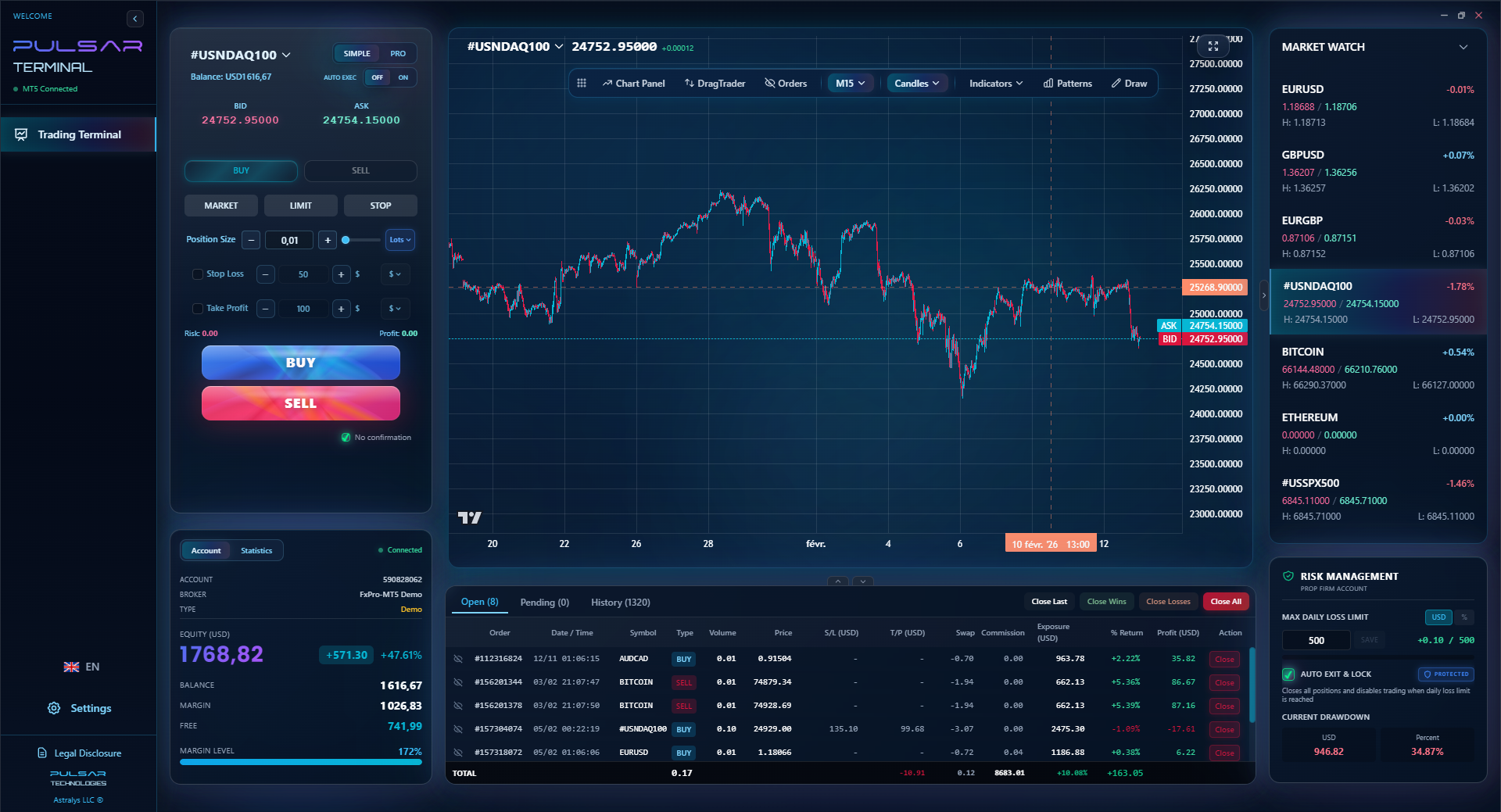
Managing multiple trades with different stop and take-profit levels across bull and bear phases is complex, but Pulsar Terminal's drag-and-drop order system and multi-TP/SL features make it visual and precise directly on your MT5 chart.
Pulsar Terminal
The all-in-one MT5 companion: drag-and-drop orders, multi-TP/SL, trailing stop, grid trading, Volume Profile, and prop firm protection. Used by 1,000+ traders daily.
This is the most important section. Your psychology will be tested differently in each phase.
Bull Market Psychology:
- The Danger: Complacency and overconfidence. You think you're a genius because your buys keep working. You start increasing risk, ignoring your rules. You start chasing price way above any sensible entry.
- The Fix: Stick to your plan. Document every trade. Remember, bull markets end. They always do. Your goal is to make money during the trend, not to prove you're the smartest person in the room.
Bear Market Psychology:
- The Danger: Fear, paralysis, and then desperation. You're scared to enter, then you watch a massive move happen without you. In desperation, you finally jump in... right at the bottom of a sharp rally, just before it rolls over again.
- The Fix: If you're not comfortable trading bear markets, don't. There's no shame in sitting in cash or trading much smaller. Wait for the structure to become clear. Bear markets are for capital preservation first, profit second.
I've been through both. The euphoria of a winning bull run is addictive. The despair of a losing streak in a bear market is crushing. The only thing that saved me was a written trading plan that dictated my actions, not my emotions.
💡 Winston's Tip
Your first loss in a new trend is often your smallest. Cut it fast. Denial is more expensive than any spread.
“You will mislabel markets. That's why your risk management on each trade is infinitely more important than your grand view.”
Let's make this practical. Here’s a step-by-step filter you can use on Monday morning.
- Determine the Broad Market Condition: Look at a daily chart of USD/ZAR and EUR/ZAR. Are they above or below the 200-day SMA? What's the pattern of highs and lows? Write down: 'Primary Trend: Bullish' or 'Primary Trend: Bearish'.
- Check the ZAR Driver: What's the news? Is it risk-on or risk-off? What are commodities doing? This tells you if the local trend makes sense.
- Choose Your Strategy & Pairs:
- If Bullish (ZAR strong): Focus on selling USD/ZAR or buying EUR/ZAR on dips. Review the EUR/USD guide for correlated dynamics.
- If Bearish (ZAR weak): Focus on buying USD/ZAR on rallies. Be selective.
- Adjust Your Risk: Use your position size calculator. Dial down your lot size if volatility is high (check the ATR indicator).
- Set Orders with the Right Mindset: Place logical stops and realistic take-profits. Don't force a trade if the setup isn't there.
Final, Blunt Truth: You will mislabel markets. You'll think it's a bull turn and it's a dead-cat bounce. It happens. That's why your risk management on each individual trade is infinitely more important than your grand view on the market direction. Protect your capital first, figure out the trend second. The market will always be there tomorrow, but only if you still have money in your account.
FAQ
Q1What's the biggest mistake South African traders make in a bull market?
Overleveraging. They see the ZAR strengthening, get a few wins, and think they can ramp up risk. They forget the FSCA's 30:1 limit is a maximum, not a target. Using excessive use in any market is the surest path to blowing up your account.
Q2Can I trade both bull and bear markets with the same broker?
Absolutely, but you need a broker that offers reliable execution during high volatility. During ZAR sell-offs, spreads on rand pairs can widen massively. Look for FSCA-regulated brokers with a reputation for stability, like those we cover in our Pepperstone review or XM review. The raw spread accounts are often best for volatile conditions.
Q3How long do forex bull and bear markets typically last for the ZAR?
There's no set time. A ZAR trend can last for weeks or months. The 2020-2021 USD/ZAR bear market (rand strengthening) lasted over a year. However, within that, there were multi-week counter-trend rallies. Don't get married to a view. Trade the price action in front of you on the charts.
Q4What's a good indicator to confirm a bull or bear market for a beginner?
Start with the 200-period Simple Moving Average on the daily chart. It's not perfect, but it's a clear visual filter. Price consistently above it suggests a bull market for the currency pair. Price consistently below suggests a bear market. Combine it with the basic higher highs/higher lows rule for confirmation.
Q5Should I avoid trading the ZAR altogether in a bear market?
Not necessarily, but you should trade it differently. Reduce your position size significantly, expect wider spreads, and be quicker to take profits. If you're not comfortable with the increased volatility and stress, there's no shame in focusing on more stable major pairs like EUR/USD until conditions calm down.
Q6How do I know if it's a real trend change or just a pullback?
You often don't know in real-time. That's why you use stop losses. A pullback in a bull trend will hold a key support level (like a prior high or the 50-day MA) and then resume upward. A trend change will break that support and then fail to make a new high. Wait for the market to show you the change through price action; don't try to predict it.
Prof. Winston's Lesson
Key Takeaways:
- ✓Use the 200-day SMA as your primary bull/bear filter.
- ✓Cut position size by 30-50% in high-volatility bear markets.
- ✓ZAR trends are driven by global risk sentiment & commodities.
- ✓Let profits run in bull markets, take them quickly in bear markets.
How useful was this article?
Click a star to rate
Weekly Trading Insights
Free weekly analysis & strategies. No spam.
About the Author
David van der Merwe
Emerging Markets Trader
Johannesburg-based trader with 11 years in emerging market currencies. Specializes in ZAR pairs, FSCA-regulated trading, and South African market analysis.
Comments
Risk Disclaimer
Trading financial instruments carries significant risk and may not be suitable for all investors. Past performance does not guarantee future results. This content is for educational purposes only and should not be considered investment advice. Always conduct your own research before trading.
You Might Also Like

Cara Trading Forex Sukses: 7 Prinsip dari Trader Profesional
Cara trading forex sukses dengan 7 prinsip trader pro: manajemen modal, disiplin, journal trading, backtest. Data nyata, bukan janji profit palsu.
Jam Trading Forex Terbaik untuk Trader Indonesia: Panduan Lengkap dengan Tabel Waktu
Panduan jam trading forex untuk trader Indonesia. Tabel 4 sesi dunia, jam emas 20:00-00:00, sesi mana yang harus dihindari. Data akurat + tips dari trader berpengalaman.
Top 5 Sàn Forex Uy Tín Nhất 2026: Review Jujur dari Trader Indonesia
Top 5 sàn forex uy tín 2026 untuk trader Indonesia. Review jujur: spread, deposit, withdraw, dukungan lokal. Exness, XM, IC Markets & lebih.
Get Pulsar Terminal
All these calculators are built into Pulsar Terminal with real-time data from your MT5 account. One-click position sizing, automatic risk management, and instant calculations.
Get Pulsar Terminal