


I was short USD/ZAR at 18.75 when the headline hit my screen: 'South African Reserve Bank holds repo rate at 8.25%'.

David van der Merwe
Emerging Markets Trader ·  South Africa
☕ 11 min read
What you'll learn:
- 1Why the Calendar is Your Most Important Indicator
- 2Decoding the Forex News Hierarchy
- 3The South African Context: FSCA Warnings and Rand Volatility
- 4A Practical News Trading Strategy for ZAR Pairs
- 5Tools and Calendars for the South African Trader
- 6Common Mistakes (And How I Made Them)
- 7Integrating News with Your Trading Style
- 8Putting It All Together: Your News Week
I was short USD/ZAR at 18.75 when the headline hit my screen: 'South African Reserve Bank holds repo rate at 8.25%'. The pair didn't just dip, it fell off a cliff, dropping 150 pips in under three minutes. My profit target was 18.55, but the market blew straight through it to 18.42. That's the raw power of the forex calendar market & news. In South Africa, where our Rand dances to the tune of local politics, global commodities, and Moody's ratings, ignoring the economic diary isn't just lazy, it's a sure way to get your account shredded. Let's talk about how to use it properly.
Forget the RSI or MACD for a second. The economic calendar is the only indicator that tells you what's about to happen, not what just did. In our market, the ZAR is hyper-sensitive. A single speech by the Finance Minister can swing USD/ZAR by 2%. I learned this the hard way in 2019. I was heavily long EUR/ZAR, thinking the technicals were perfect. I completely missed a scheduled announcement from the Public Protector about state capture. The Rand strengthened violently, and I took a 3.5% account loss in one go. A rookie mistake that cost me R14,000.
For South Africans, the calendar isn't just about US Non-Farm Payrolls. It's about our local data. The three big ones? CPI inflation data, the SARB interest rate decision, and the unemployment rate. These are the events that move our market with conviction. A high CPI print (above 5.5%) tells the market the SARB might hike again, which typically strengthens the Rand. Miss that, and you're trading blind.

Warning: Trading during a major South African news event without a plan is gambling. The spread on ZAR pairs can widen from 5 pips to 50 pips in a heartbeat. Your stop-loss might get filled at a horrific price. If you're not comfortable with that volatility, stay out until 30 minutes after the news drops.
Not all news is created equal. You need to know what to watch and what to ignore. I categorize events into three tiers: Market Movers, ZAR-Specific Volatility, and Background Noise.
Tier 1: The Global Market Movers
These move everything, including the ZAR. You must know when they are.
- US Non-Farm Payrolls (NFP): First Friday of every month. This is the king. It sets the tone for the USD for weeks.
- US CPI & Federal Reserve Rate Decisions: Directly impacts global risk sentiment. A hawkish Fed hurts emerging market currencies like the ZAR.
- ECB & BOE Rate Decisions: Major for EUR and GBP pairs, which are popular with local traders.
Tier 2: The Local ZAR Catalysts
This is where you find your edge as a South African trader.
- SARB MPC & Interest Rate Decision: The big one. Watch the statement and the vote split (e.g., 3-2 for a hold).
- South African CPI & PPI: The primary inflation gauges. The market has a consensus forecast. A miss of more than 0.2% will cause a move.
- Budget Speech & Medium-Term Budget Policy Statement (MTBPS): Political and fiscal drama packaged as economics. Can cause multi-day trends.
- Eskom & Load-Shedding Updates: Seriously. An announcement of moving to Stage 6 load-shedding can weaken the ZAR instantly. It's a unique South African risk factor.
Tier 3: The Background Noise
Retail sales, manufacturing data, consumer confidence. These can cause minor blips (10-20 pips) but rarely reverse a trend. I might adjust my swing trading position size around them, but I don't scalp them.

Example: Let's say the consensus for SA CPI is 5.3%. The actual print comes out at 5.7%. That's a 0.4% miss, well outside the margin of error. The immediate reaction will be Rand strength (USD/ZAR down) on expectations of a SARB hike. But you must also check the core CPI number. If that's in line, the move might be short-lived. You need both numbers.

💡 Winston's Tip
The market's reaction to news often tells you more about its underlying mood than the data itself. A 'good' number that sells off suggests a 'buy the rumor, sell the news' setup was in play.
“Trading the rumor and then the news is a fantastic way to get whipsawed out of your money.”
Trading news in South Africa comes with local quirks you won't read about in generic guides. First, regulation. The Financial Sector Conduct Authority (FSCA) is your friend, even when it's issuing warnings. In late 2025, they warned against 'Forex Major', an unlicensed entity. If you're trading with an unregulated offshore bucket shop, you have zero protection when news volatility inevitably causes a margin call or a platform 'malfunction'. Stick with FSCA-regulated brokers like those reviewed on our site (Exness review, IC Markets review). Your money is safer.
Second, understand what drives the Rand. It's a commodity currency. When platinum, gold, or iron ore prices rise, the ZAR often strengthens because our exports are worth more. But it's also a proxy for emerging market risk. When global investors get scared, they pull money out of markets like South Africa first. So, a piece of bad news from China can weaken the ZAR even if our local data is good. You're not just trading economics, you're trading sentiment.
Payment methods matter too. Using a local ZAR bank transfer with an FSCA broker means your deposit and withdrawal reflect the real commercial exchange rate, not some inflated markup from a third-party payment processor. It saves you money on every transaction.
I'm not a fan of the 'straddle' strategy where you buy and sell right before news. The spread widening will kill you. Here's a more surgical approach I've used on USD/ZAR and EUR/ZAR.
The Post-News Retracement Play:
- Identify the Event: A Tier 1 or Tier 2 event with a clear consensus forecast (e.g., SARB rate decision, expected to hold at 8.25%).
- Wait for the Print: Don't trade the initial spike. Let the algos and panicky retail traders fight it out for the first 2-3 minutes. The chart will look like a seismograph.
- Spot the Rejection: After the initial violent move, price will often retrace back to a key level. This is usually the pre-news high or low, or a round number. For example, USD/ZAR spikes down from 18.80 to 18.60 on a hawkish SARB, then pulls back up to 18.70.
- Enter on the Retracement: Place a limit order to enter in the direction of the initial news move after the retracement shows signs of failing. In our example, you'd look to sell USD/ZAR at 18.69-18.71 as the pullback stalls.
- Manage the Trade: Your stop-loss goes just beyond the retracement high (e.g., 18.75). Your target is a re-test of the initial news low (18.60), or even a continuation.
I used this on the November 2023 US CPI print. USD/ZAR initially spiked up, then retraced 50%. I entered short on the retracement, placed a stop 15 pips above the high, and rode it down for a 90-pip gain. The key is patience. Let the amateurs get chopped up in the initial chaos.

Pro Tip: Use a position size calculator religiously for news trades. The volatility is insane. If your normal position size is 1 lot, consider 0.5 lots for a major news event. Protecting your capital is more important than maximizing a single win.
“In South Africa, a speech by the Finance Minister can be more important than a US jobs report for your USD/ZAR position.”
You need a calendar that includes South African events. Most generic ones are US/EU-centric. Here are my go-tos:
- ForexFactory Calendar: The classic. Set the filter to 'South Africa' and set the volatility filter to 'High' and 'Medium'. The 'Deviation' column is critical - it shows how far the actual result was from the forecast.
- Investing.com ZAR Calendar: Excellent for local data. It includes things like electricity production and mining output which can be early indicators.
- Your Broker's Economic Calendar: Brokers like XM or Pepperstone have decent built-in calendars. The advantage is you can often set alerts directly on the platform.
Set alerts on your phone for the 3-4 events per week that matter. Don't try to watch everything. For the SARB decision, I clear my schedule for the hour before and after. It's that important.
Integrating this with your platform is the next step. Seeing the news and the chart reaction simultaneously is key. This is where having a strong trading terminal that works seamlessly with your data feed makes all the difference.
💡 Winston's Tip
Always know the next two High-Impact events on the calendar. A quiet market is often just positioning ahead of them. Don't get caught in a false breakout 30 minutes before CPI.
Let me save you some money by sharing my most expensive lessons with the forex calendar market & news.
Mistake 1: Trading the Rumor, Then the News. Ahead of the 2022 MTBPS, there were leaks about a new wealth tax. I sold USD/ZAR aggressively, expecting Rand strength on fiscal responsibility. The actual speech contained no such tax, but did reveal a larger deficit than expected. The Rand tanked. I got whipsawed. Lesson: Trade the actual data, not the gossip. Enter after the fact, not before.
Mistake 2: Ignoring Revisions. One month, US NFP came in slightly soft, and USD weakened. I went short USD/ZAR. An hour later, the previous month's NFP figure was revised sharply upward. The market reversed completely, erasing my gain and hitting my stop. Lesson: Always check for revisions to previous data. They change the trend, not just the snapshot.
Mistake 3: Overestimating Local News. I once took a large position ahead of SA retail sales data. The number was terrible, but USD/ZAR moved only 20 pips. Why? Because globally, the Fed was speaking, and that drowned out our local noise. Lesson: Context is everything. A minor local event during a major global storm is irrelevant. Check the global calendar first.
Mistake 4: Not Understanding the Spread. I tried a scalping strategy on EUR/ZAR right as CPI data dropped. My platform's normal 8-pip spread blew out to 45 pips. My profitable trade was instantly underwater the moment I entered. Lesson: Know your broker's policy on news spread widening. Some ECN brokers are better than others during events.
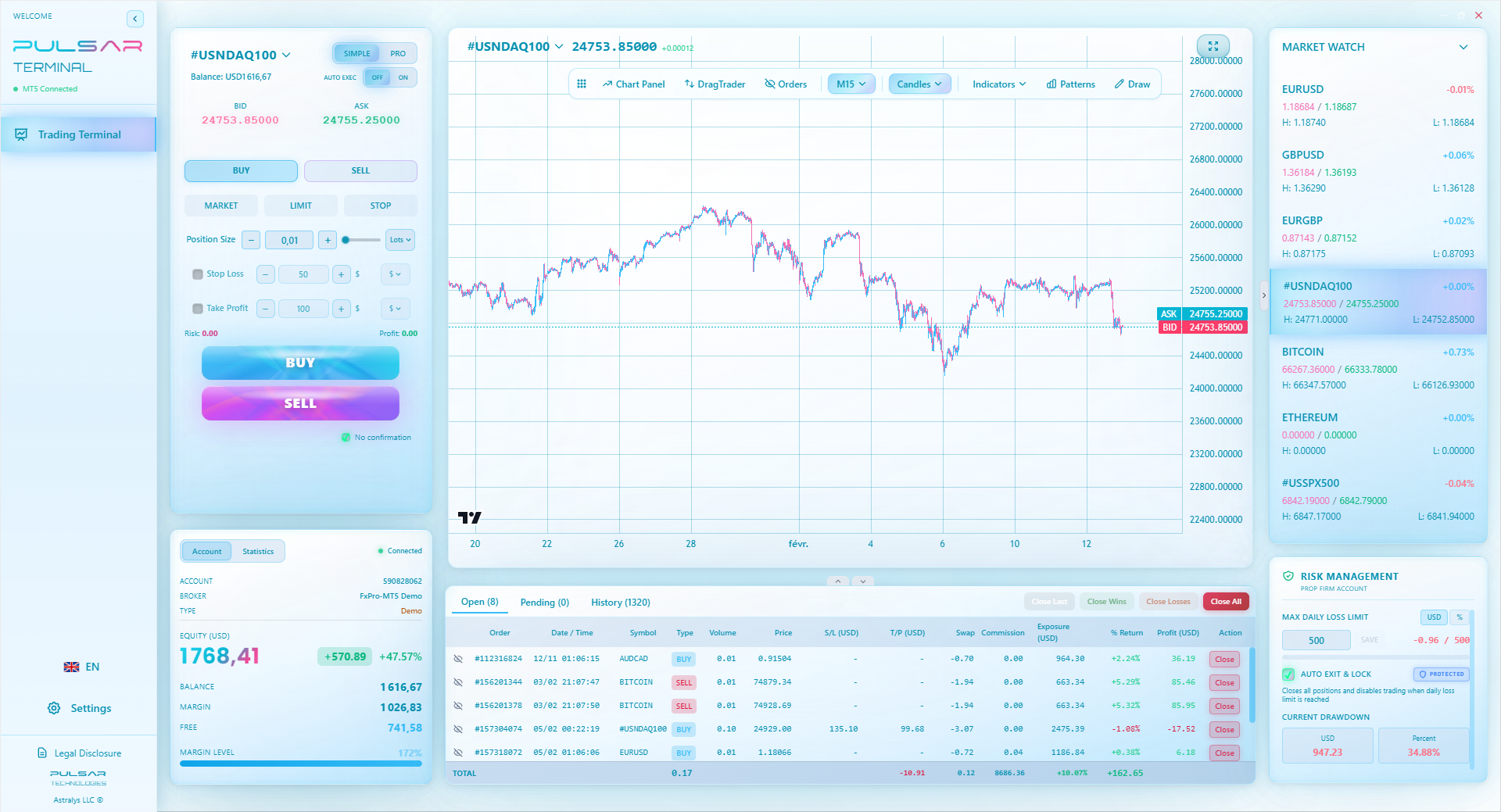
Managing the extreme volatility of news trading requires fast, precise order tools, which is where a platform like Pulsar Terminal, with its drag-and-drop orders and one-click partial closures on MT5, becomes indispensable.
Pulsar Terminal
The all-in-one MT5 companion: drag-and-drop orders, multi-TP/SL, trailing stop, grid trading, Volume Profile, and prop firm protection. Used by 1,000+ traders daily.
“If you don't know when the SARB is speaking, you're not trading the Rand, you're gambling on it.”
How you use the calendar depends entirely on how you trade.
For the Day Trader: News is your primary catalyst. You should be basing your session around high-volatility events. Your job is to capitalize on the increased volume and directionality. Focus on the 15-minute to 1-hour charts after news drops. Avoid the 1-minute chaos.
For the Swing Trader (My Style): News helps me with entry and exit. I use major news events to add to positions or take profits. For example, if I'm in a long-term short USD/ZAR trade and a hawkish SARB meeting occurs, I might use the resulting strength to take 50% of my position off the table. Conversely, if price is nearing a key support level I want to buy at, and a high-impact US news event causes a spike down through that support, that's often a false break and a great entry. My guide on swing trading covers this in more depth.
For the Long-Term Investor: You use news to understand the fundamental trend, not to trade. A string of high CPI prints tells you the SARB's stance. Persistent trade deficit numbers tell you about long-term Rand pressure. You adjust your portfolio allocation over months, not minutes.
Regardless of your style, keep a trading journal. Note the event, the forecast, the actual, and how the pair reacted. Over time, you'll see patterns. You'll learn that, for instance, USD/ZAR often has a 'false move' first on US data before resuming its prior trend. That's gold.
💡 Winston's Tip
Keep a separate 'News Trade' journal. Record the forecast, actual, initial spike direction, and final direction 1 hour later. You'll spot behavioral patterns specific to certain events.
Here’s what a disciplined week looks like for me:
Sunday Evening: Open the calendar. Mark every High-Impact event for the week. Circle the South African ones in red. I physically write them down.
Monday: Usually quieter. Maybe some EU data. I focus on technical setups, aware that positions might be held through Wednesday's US CPI or Thursday's SARB decision.
Tuesday/Wednesday (US CPI/NFP Weeks): These are focus days. I reduce my position size on any unrelated trades. I decide in advance if I will trade the event. If yes, I plan the exact pair (usually EUR/USD or USD/ZAR), my entry zone, stop, and target. I then wait.
Thursday (SARB/ECB Days): I am at my desk 30 minutes before the SARB announcement. Charts are open, but I have no orders in the market. I watch, I assess, I execute my plan after the initial move.
Friday: Review. Did the news play out as expected? Did my strategy work? What was the market's main focus? I update my journal.
The goal isn't to trade every news item. It's to know when the market is going to be volatile so you can either exploit it with precision or sidestep it to protect your capital. For us in South Africa, mastering the local forex calendar market & news is the difference between being a spectator and being a player. Now go check the time of the next MPC statement. Your next trade might depend on it.
FAQ
Q1What is the most important news event for the South African Rand (ZAR)?
Hands down, the South African Reserve Bank (SARB) interest rate decision and the accompanying Monetary Policy Committee (MPC) statement. This happens roughly every two months. The vote split (e.g., 3-2 for a hike) and the language about future inflation risks move USD/ZAR more consistently than any other local event. Always clear your schedule for it.
Q2Can I trade forex news as a beginner in South Africa?
I strongly advise against it. News trading is a specialist skill with extremely high risk due to volatility, spread widening, and slippage. Beginners should use the economic calendar as a warning system - to know when NOT to trade. Focus on learning technical analysis and risk management first. Once you're consistently profitable in normal markets, you can explore news strategies with a tiny portion of your capital.
Q3Why does the spread get so wide during news events?
It's a risk management tool for the broker's liquidity providers. In the seconds after major news, the true market price is chaotic and uncertain. The wide spread protects them from being picked off at stale prices. For you, it means your trade starts significantly in the red. Always check your broker's typical spread during high volatility before attempting a news trade.
Q4Should I use an FSCA-regulated broker for news trading?
Absolutely, yes. News volatility is when things go wrong - requotes, platform freezes, disputed fills. An FSCA-regulated broker like those we review (Exness, IC Markets) is subject to local conduct rules and a complaints process. If you have an issue with an unregulated offshore broker during news, you have virtually no recourse.
Q5How do I know if a news outcome is 'good' or 'bad' for a currency?
You don't judge the headline; you judge it against the market's expectation. Every major event has a consensus forecast (e.g., CPI forecast at 5.0%). If the actual result is HIGHER than forecast (e.g., 5.3%), it's generally bullish for that currency (expecting higher interest rates). If it's LOWER, it's bearish. The 'Deviation' column on ForexFactory shows you this instantly.
Q6Is it better to trade major pairs (like EUR/USD) or ZAR pairs during news?
For global events (US NFP, Fed), EUR/USD is often 'cleaner' with more predictable liquidity. For South African events, you have to trade the ZAR pair (USD/ZAR, EUR/ZAR) as that's where the action is. Just be prepared for wider spreads and more erratic price action on the ZAR pairs. Start by practicing on a demo account.
Q7What's a simple first step to start using the economic calendar?
Go to ForexFactory.com right now. Look at the current week. Filter for 'High' volatility events. Just observe them this week. Don't trade. Watch the price action 15 minutes before and 30 minutes after the event time on a 5-minute chart. This free education will teach you more than any article. Note how the price moves, how it retraces, and how wide the spread gets.
Prof. Winston's Lesson
Key Takeaways:
- ✓Trade the actual data print, not the rumor or leak.
- ✓For ZAR pairs, the SARB decision is your non-negotiable calendar event.
- ✓Always use a position size calculator - volatility can be 5x normal.
- ✓Widening spreads during news can turn a winning idea into a losing trade instantly.
- ✓FSCA regulation is your safety net when news chaos hits.
How useful was this article?
Click a star to rate
Weekly Trading Insights
Free weekly analysis & strategies. No spam.
About the Author
David van der Merwe
Emerging Markets Trader
Johannesburg-based trader with 11 years in emerging market currencies. Specializes in ZAR pairs, FSCA-regulated trading, and South African market analysis.
Comments
Risk Disclaimer
Trading financial instruments carries significant risk and may not be suitable for all investors. Past performance does not guarantee future results. This content is for educational purposes only and should not be considered investment advice. Always conduct your own research before trading.
You Might Also Like

Cara Trading Forex Sukses: 7 Prinsip dari Trader Profesional
Cara trading forex sukses dengan 7 prinsip trader pro: manajemen modal, disiplin, journal trading, backtest. Data nyata, bukan janji profit palsu.
Jam Trading Forex Terbaik untuk Trader Indonesia: Panduan Lengkap dengan Tabel Waktu
Panduan jam trading forex untuk trader Indonesia. Tabel 4 sesi dunia, jam emas 20:00-00:00, sesi mana yang harus dihindari. Data akurat + tips dari trader berpengalaman.
Top 5 Sàn Forex Uy Tín Nhất 2026: Review Jujur dari Trader Indonesia
Top 5 sàn forex uy tín 2026 untuk trader Indonesia. Review jujur: spread, deposit, withdraw, dukungan lokal. Exness, XM, IC Markets & lebih.
Get Pulsar Terminal
All these calculators are built into Pulsar Terminal with real-time data from your MT5 account. One-click position sizing, automatic risk management, and instant calculations.
Get Pulsar Terminal