


I was short USD/ZAR at 18.75 on November 23rd, 2023.

David van der Merwe
Emerging Markets Trader ·  South Africa
☕ 14 min read
What you'll learn:
- 1Why You Can't Just Use a Global Calendar
- 2The Events That Actually Move the Rand
- 3How to Trade the News (Without Blowing Up)
- 4Local Broker Rules You Must Know
- 5Building Your Personalised Trading Calendar
- 6Mistakes I've Made (So You Don't Have To)
- 7Next-Level Calendar Trading
- 8Your Weekly Routine: The Trader's *Indaba*
I was short USD/ZAR at 18.75 on November 23rd, 2023. The SARB was about to announce its interest rate decision. My chart said hold, my gut said cut. They held at 8.25%. The rand ripped higher by over 100 pips in minutes, and I was stopped out for a R4,200 loss before I could blink. That's the power of the local economic diary. For South African traders, a generic global forex calendar is about as useful as a map of Antarctica in the Karoo. You need the local events, the ones that make the rand twitch. This guide is your blueprint for building and using a proper forex calendar South Africa style.
Most new traders pull up a generic economic calendar and think they're set. They'll see the US Non-Farm Payrolls and the ECB rate decision highlighted in red. What they miss are the dozen smaller, local events that actually move their ZAR pairs more violently. The South African market has its own rhythm, driven by unique political risks, commodity cycles, and a central bank that often marches to its own beat.
Global events matter, sure. But for USD/ZAR, EUR/ZAR, or GBP/ZAR, the local catalyst is king. I've seen USD/ZAR sit dead still through a volatile European session, only to explode 200 pips when a local mining production report or a speech from a finance minister hits the wires. Your standard calendar might list this as a low-impact event. In South Africa, it's front-page news.

Warning: Trading ZAR pairs without tracking local events is like driving through Johannesburg with your eyes closed. You might get lucky for a block, but a pothole (or a pothole-sized move) is waiting for you.
The liquidity in ZAR pairs can be thinner than major pairs, especially during off-hours. This means when scheduled news hits, the moves are often sharper and more exaggerated. A 0.2% miss on GDP can trigger a 1.5% move in the currency. You need to know when these landmines are planted.

💡 Winston's Tip
The market's reaction to news is often more important than the news itself. A 'good' number can see the currency sell off if it was already priced in. Watch the price action, not just the headline.
The Big One: SARB Interest Rate Decision
This is our version of the Fed meeting. The South African Reserve Bank (SARB) announces its repo rate every two months. The statement and the MPC's voting split are just as important as the rate itself. Look for hints about inflation outlook and growth concerns. A hawkish hold (rates unchanged but warning of future hikes) can strengthen the ZAR. A dovish hike (raising rates but sounding cautious) can sometimes weaken it. I got caught in 2022 assuming a hike was automatically ZAR-positive. They hiked 50bps, but the governor's tone was worried about growth. USD/ZAR rallied 80 pips from the lows. Lesson learned.
Inflation (CPI) and Producer Price Index (PPI)
CPIX (CPI excluding interest rates on mortgages) is the SARB's preferred gauge. The target band is 3-6%. A print near or above 6% gets the market pricing in hikes, which typically supports the rand. PPI is a leading indicator for future CPI. Watch these releases like a hawk.
Budget Speech and Medium-Term Budget Policy Statement (MTBPS)
This isn't just political theater. The market scrutinizes the national debt trajectory, deficit forecasts, and plans for state-owned enterprises like Eskom. A credible, fiscally conservative budget can be a massive boost for the ZAR. A budget seen as reckless or based on overly optimistic growth forecasts will get punished. Hard.
Mining and Manufacturing Production
South Africa is a commodity economy. Platinum group metals (PGMs), gold, iron ore, and coal. A sharp drop in mining output signals economic trouble and can hit the rand. Manufacturing data shows the health of the broader economy. These are high-impact for ZAR pairs.
Credit Ratings Announcements
While less frequent, watch for reviews from Moody's, S&P, and Fitch. A downgrade deeper into "junk" status, or a negative outlook, can trigger sustained ZAR selling. The market often moves in anticipation in the days before a scheduled review.
Political Events and ANC Conferences
This is the wildcard. Leadership elections within the ANC, key policy announcements, or significant shifts in the political landscape can cause volatility. The market hates uncertainty. During periods of intense political drama, correlation with global risk sentiment can break down, and the ZAR trades on pure local fear or hope.
“Trading ZAR pairs without tracking local events is like driving through Johannesburg with your eyes closed.”
I'm not a fan of trying to predict the news. I'm a fan of preparing for the reaction. Here’s how I structure my trades around the forex calendar South Africa provides.
The Pre-News Setup: I avoid entering new positions 30-60 minutes before a high-impact SARB or CPI release. The spread widens, the price action gets jumpy, and it's just not worth the slippage. Instead, I use this time to set alerts and clean up my charts. If I have a position on, I check my stop loss. Is it far enough away to survive a 100-pip spike against me? If not, I might tighten it or reduce my size. This is basic position size calculator discipline.
The Post-News Play (My Preferred Method): I wait for the initial 5-10 minute volatility bomb to go off. Let the algos and panic traders fight it out. Then, I look for the price to settle into a new range or show a clear rejection of a level. For example, after a SARB hike, if USD/ZAR spikes down but then fails to make a new low and starts consolidating above a key support level, that's a potential signal the selling is exhausted. I might then look for a short-term long entry with a tight stop. This requires patience, but it's saved me from countless whipsaws.
Example Trade: On January 24th, 2024, CPI came in at 5.1% year-on-year, lower than expected. USD/ZAR immediately sold off from 18.92 to 18.82. I waited. It bounced to 18.87, stalled, and then broke below the 18.82 low. That was my signal. I went short at 18.81, targeting a move to 18.70. I took half off at 18.72 and let the rest run with a trailing stop. It eventually hit 18.65. A clean R1,800 profit on a 0.5 lot trade by trading the momentum after the news, not the headline itself.

Pro Tip: Pair a local ZAR event with a global one. If US Retail Sales are strong (USD positive) and SA CPI is weak (ZAR negative), that's a potent cocktail for a USD/ZAR rally. The moves compound. Your EUR/USD guide knowledge helps you gauge the global USD side of the equation.
Trading the news in South Africa isn't just about strategy. You have to play by the local rulebook, and the FSCA (Financial Sector Conduct Authority) has made some big changes.
The 30:1 use Cap: This is the big one for retail traders. Since 2021, the max use you can get on major forex pairs with an FSCA-regulated broker is 30:1. For a standard lot ($100,000), that means a margin requirement of about $3,333. It limits your buying power, but honestly, it's probably saved more accounts than it's hurt. You can't go crazy with size on a small account. If you're used to 500:1 from an offshore broker, this feels restrictive. I think it's a good thing. It forces better position size calculator use.
Client Money Protection: Your funds with a proper FSCA broker (like those we review, such as Exness or IC Markets) must be held in segregated accounts. This means if the broker goes belly up, your money isn't part of their bankruptcy estate. Don't underestimate this.
Offshore Brokers – The Risk: You can still sign up with international brokers not regulated here. They might offer higher use. But if something goes wrong – a dispute, a platform issue, a withdrawal problem – you have virtually no recourse with the FSCA. You're dealing with a foreign regulator. I did this early in my career with a "too good to be true" broker. Getting a $5,000 withdrawal sorted took 11 weeks of endless emails. Never again.
Minimum Deposits: They vary. You can start with as little as $5 with XM or R500 with some local firms. Others like Pepperstone might require $200. Don't focus on the minimum. Focus on the spreads and execution around news time. A broker with a 3-pip spread on USD/ZAR that widens to 15 pips on news will eat your lunch. Look for brokers known for stable execution. The raw spread definition is your biggest cost as a news trader.
💡 Winston's Tip
Your first loss on a news trade is often your smallest. If you're wrong, get out. Don't average down hoping the next headline will save you. It won't.
“I'm not a fan of trying to predict the news. I'm a fan of preparing for the reaction.”
Don't just bookmark a website. You need to internalise the schedule. Here's my system.
- The Quarterly Map: At the start of each quarter, I open the SARB's published meeting schedule and the National Treasury's dates for the MTBPS/Budget Speech. I block these out in my trading journal and on my physical desk calendar in red. These are non-negotiable, no-new-trades days unless I'm already in a swing position.
- The Monthly Ritual: On the last Friday of each month, I look ahead. I note the local CPI/PPI date, mining/manufacturing production, and credit rating review calendars. I also overlay the major global events (US NFP, ECB, Fed). This gives me a sense of which weeks will be busy. A week with both SA CPI and US NFP is a high-alert week.
- The Daily Check: Each morning, I scan the day ahead. I use a calendar that allows filtering for "South Africa" specifically. I ignore anything marked "low impact." For medium and high impact, I note the consensus forecast and the previous reading. My mental game: "If the number comes out at X, the market expects the ZAR to do Y." I'm not betting on X happening; I'm preparing my charts for Y's possible reaction.
Tools: Most good broker platforms have an economic calendar built in. The TradingView calendar is decent and lets you filter by country. Find one you like and stick with it. Consistency is key.

Example: Let's say SARB is meeting on Thursday. My prep on Wednesday involves:
- Checking USD/ZAR key levels: Support at 18.50, Resistance at 19.00.
- Consensus is for a hold at 8.25%.
- My plan: If they hold, watch the statement. Hawkish hold = look for ZAR strength toward 18.50. Dovish hold = could see a pop toward 19.00. If they surprise and cut, I expect a sharp sell-off in ZAR. I will not trade the first 10 minutes. I will wait for a pullback and then consider a short-term long USD/ZAR trade if momentum persists.
This structured approach removes emotion from the news frenzy.
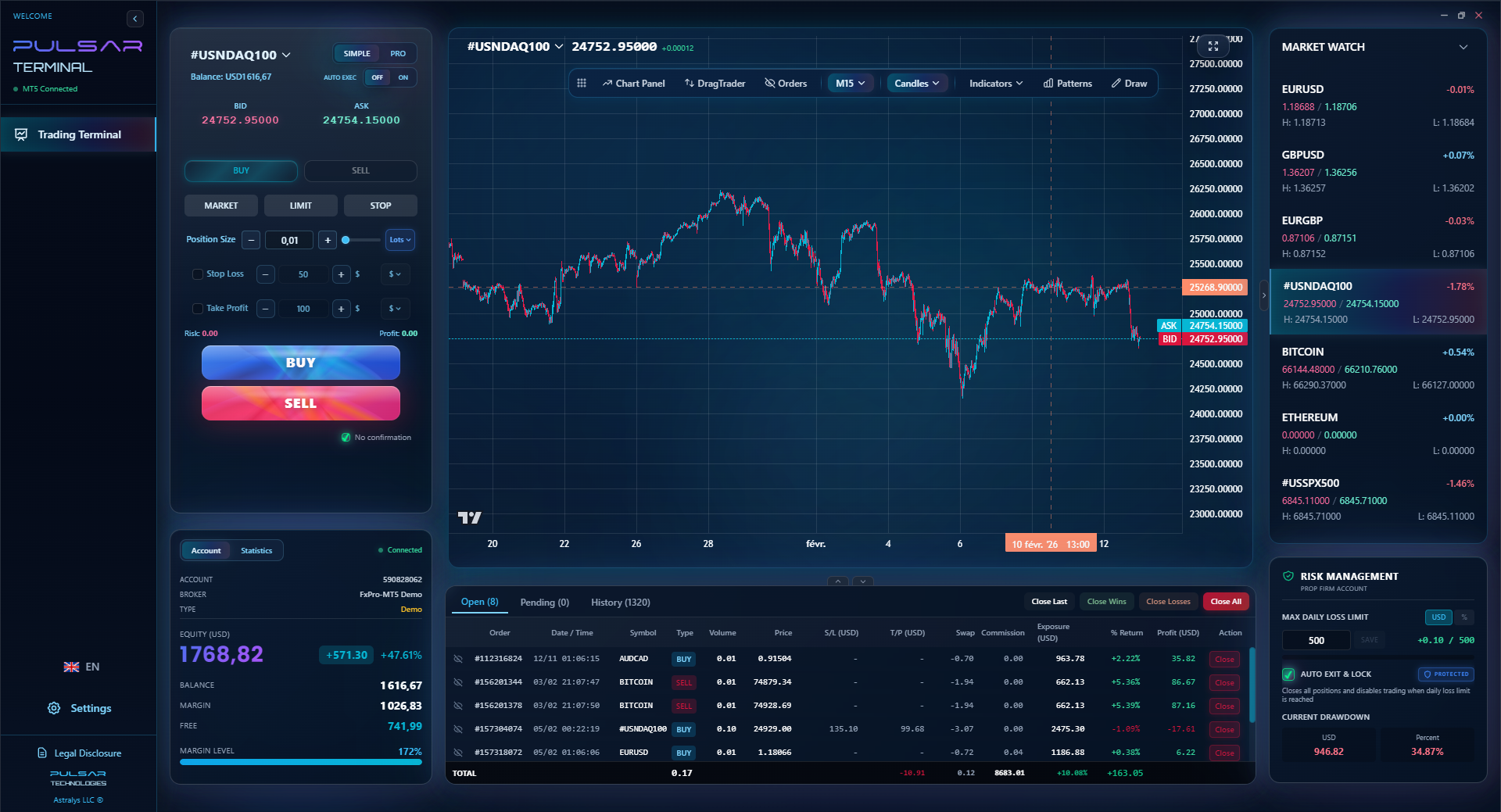
When trading volatile news events on USD/ZAR, managing multiple take-profit levels and a trailing stop manually is stressful; Pulsar Terminal lets you set them all with one drag-and-drop order directly on your MT5 chart.
Pulsar Terminal
The all-in-one MT5 companion: drag-and-drop orders, multi-TP/SL, trailing stop, grid trading, Volume Profile, and prop firm protection. Used by 1,000+ traders daily.
Let's get real. I've lost money so you might not have to. Here are the classic blunders when trading the South African forex calendar.
Pitfall 1: Trading the Rumor, Getting Killed on the Fact. In 2019, there was heavy speculation about a Moody's downgrade. For weeks, every negative headline pushed USD/ZAR higher. I went long, riding the fear. The actual announcement? They changed the outlook to "negative" but held the rating. It was a classic "sell the rumor, buy the fact" event. USD/ZAR gapped down 300 pips on the Monday open. I was holding over the weekend. That was a R8,000 lesson in not being overexposed into a binary event.
Pitfall 2: Ignoring Confluence with Global Markets. You can have a perfect bullish setup for the ZAR from a local perspective, but if the US Dollar is ripping higher globally on a risk-off day (think Russia invades Ukraine), your local news won't matter. USD/ZAR will go up. The rand is still a risk-sensitive, emerging market currency. Always check the XAU/USD guide or the DXY (Dollar Index) to see if you have a global tailwind or headwind.
Pitfall 3: Chasing the Initial Spike. This is the amateur's move. The news hits, USD/ZAR drops 50 pips in 5 seconds. "I missed it!" So you sell immediately, trying to catch the next 50. But often, that initial spike is a liquidity grab. The price reverses and fills the gap, stopping you out. Then it continues in the original direction. I've been that guy, clicking sell in a panic. Now, I set an alert and make a cup of rooibos. Let the market show its hand first.
Pitfall 4: Forgetting About Overnight Swaps. If you're holding a ZAR pair over a major news event that lands after market close or on a weekend, remember the swap/rollover interest. Sometimes, the cost of holding the position (especially if you're short the ZAR, which often has a high interest rate) can eat into your profit even if the move goes your way. Factor it into your risk.
“The calendar is your friend, not your master. It tells you when the market's rhythm is likely to change.”
Once you've mastered the basics, you can start playing with more nuanced ideas.
Trading the Implied Volatility: Before a major event like the Budget Speech, the expected volatility of USD/ZAR options increases. This is often reflected in wider bid/ask spreads on your spot trading platform. One tactic is to place limit orders outside the current range before the news, anticipating a spike that will hit your order. For example, if USD/ZAR is trading at 18.80, you might place a buy limit at 19.10 and a sell limit at 18.50. You're betting on a big move, but not its direction. If one order gets filled, you cancel the other. It's a high-risk, high-reward strategy that requires precise risk management to avoid a double fill in a whipsaw.
Correlation Trades: The South African rand is a proxy for commodity prices and emerging market sentiment. Sometimes, the trade isn't in USD/ZAR directly. If you see strong Platinum or Gold prices (key SA exports) and a benign global risk environment, but USD/ZAR is oddly weak, there might be a convergence play. You could go long USD/ZAR, while simultaneously hedging with a short position in a correlated asset that you think is overextended. This is complex and not for beginners.
Using the Calendar for Swing Trade Entries: I use high-impact events as validation for longer-term swing trades. Let's say I'm fundamentally bearish on USD/ZAR due to a narrowing interest rate differential. I'm waiting for a technical entry. A strong local CPI print that causes a 150-pip rally in the ZAR could be the catalyst that breaks a key resistance level on the daily chart. That's my signal to enter the swing trade, using the news-driven momentum as my tailwind. The news day provides the energy for the breakout. This combines event-driven trading with classic swing trading principles.
💡 Winston's Tip
The rand has a long memory for fiscal irresponsibility. A bad budget can weigh on the currency for months, creating a persistent downtrend. Trade the trend, not just the daily headline.
Success with the forex calendar South Africa demands is about routine. Here’s what my week looks like.
Sunday Evening: Review. I look at the weekly close for USD/ZAR, EUR/ZAR. I scan the upcoming week's calendar. I identify the one or two key events. I plan my trade activity: "Monday-Wednesday, normal trading. Thursday, SARB day – no new positions after 12:00. Friday, US data – be cautious in afternoon."
Pre-Market (7:00 AM SAST): Check for any overnight surprises from Asia or the US. Glance at commodity prices. Confirm the day's event times. I set price alerts for key levels around where news is expected.
Post-Event Review (After News): Win or lose, I review. Did the price react as expected? If not, why not? Was the initial spike faded? I jot down two sentences in my journal. This builds your intuition for next time.
The Mindset: The calendar is your friend, not your master. It tells you when the market's rhythm is likely to change. Your job isn't to bet on the headline. Your job is to manage your risk around the periods of maximum uncertainty and to spot the high-probability opportunities that the news chaos leaves behind. It’s about being prepared, not being a prophet.
Finally, remember that all the calendar watching in the world won't help if your basic execution is flawed. Understanding pip definition value, managing your margin to avoid a margin call, and using indicators like RSI indicator or MACD indicator to gauge post-news momentum are the foundational skills you build upon. The calendar gives you the when. Your strategy and discipline determine the how and the how much.
FAQ
Q1What is the single most important event on the South African forex calendar?
Hands down, the South African Reserve Bank (SARB) interest rate decision and Monetary Policy Committee (MPC) statement. It's held every two months and sets the tone for the ZAR's interest rate outlook, which is a primary driver of currency value. The Budget Speech and CPI data are close seconds.
Q2Can I use high use to trade news if I use an offshore broker?
Technically, yes. Many offshore brokers offer 500:1 use. But I strongly advise against it. Trading high-impact news with extreme use is a fantastic way to lose your entire account in under a minute due to slippage and gap moves. The FSCA's 30:1 cap for local brokers exists for a reason – to protect you from yourself.
Q3What time of day do most South African economic data releases occur?
Most local stats (CPI, PPI, production data) are released between 10:00 AM and 11:30 AM South African Standard Time (SAST). The SARB usually announces its rate decision at 3:00 PM SAST. Always double-check the specific time on your calendar the day before.
Q4How does load-shedding affect trading around news events?
It's a real, practical risk. A power cut during a volatile news release is a nightmare. Your mitigation is: 1) A reliable UPS (uninterruptible power supply) for your router and computer, 2) A mobile data hotspot as a backup internet source, and 3) Having your broker's mobile app ready on your phone (with login saved). Always have a Plan B.
Q5Should I trade ZAR pairs or just stick to majors like EUR/USD?
Start with majors to learn the basics of news trading in a more liquid, predictable environment. Once you're comfortable, then apply those skills to ZAR pairs. The potential rewards can be higher due to bigger moves, but so are the risks from gaps and wider spreads. It's a natural progression.
Q6Where can I find a reliable, free economic calendar for South Africa?
Most broker platforms (MT4/MT5) have a built-in calendar you can filter. For a standalone site, ForexFactory.com is a popular free option – just set the country filter to "South Africa." TradingView's economic calendar is also excellent and visually intuitive.
Q7Is trading the news the best strategy for South African forex traders?
It's a strategy, not the strategy. It suits traders who are disciplined, patient, and good at managing risk quickly. Other approaches like scalping strategy or swing trading can be just as profitable. The key is to know when news is coming so you can adapt your strategy accordingly, whether that means avoiding the market or looking for specific setups.
Prof. Winston's Lesson
Key Takeaways:
- ✓The SARB rate decision moves USD/ZAR 100+ pips 80% of the time.
- ✓Always check global risk sentiment (S&P 500, Gold) before acting on local ZAR news.
- ✓Use the FSCA's 30:1 use cap as a built-in risk manager.
- ✓Place stops 1.5x the average news spike to avoid being stopped out by noise.
How useful was this article?
Click a star to rate
Weekly Trading Insights
Free weekly analysis & strategies. No spam.
About the Author
David van der Merwe
Emerging Markets Trader
Johannesburg-based trader with 11 years in emerging market currencies. Specializes in ZAR pairs, FSCA-regulated trading, and South African market analysis.
Comments
Risk Disclaimer
Trading financial instruments carries significant risk and may not be suitable for all investors. Past performance does not guarantee future results. This content is for educational purposes only and should not be considered investment advice. Always conduct your own research before trading.
You Might Also Like

Cara Trading Forex Sukses: 7 Prinsip dari Trader Profesional
Cara trading forex sukses dengan 7 prinsip trader pro: manajemen modal, disiplin, journal trading, backtest. Data nyata, bukan janji profit palsu.
Jam Trading Forex Terbaik untuk Trader Indonesia: Panduan Lengkap dengan Tabel Waktu
Panduan jam trading forex untuk trader Indonesia. Tabel 4 sesi dunia, jam emas 20:00-00:00, sesi mana yang harus dihindari. Data akurat + tips dari trader berpengalaman.
Top 5 Sàn Forex Uy Tín Nhất 2026: Review Jujur dari Trader Indonesia
Top 5 sàn forex uy tín 2026 untuk trader Indonesia. Review jujur: spread, deposit, withdraw, dukungan lokal. Exness, XM, IC Markets & lebih.
Get Pulsar Terminal
All these calculators are built into Pulsar Terminal with real-time data from your MT5 account. One-click position sizing, automatic risk management, and instant calculations.
Get Pulsar Terminal