


Let's clear this up right now: if you're a South African trader looking at a 'forex card' as a way to fund an international broker, you're about to break the law and lose your money.

David van der Merwe
Emerging Markets Trader ·  South Africa
☕ 13 min read
What you'll learn:
- 1What Exactly Is a South African Forex Card?
- 2The SARB Rules You Absolutely Cannot Ignore
- 3The Real Costs: What They Don't Tell You at the Bank
- 4Local Providers Reviewed: Which Travel Card Is Least Bad?
- 5Forex Card vs. Legally Funding a Trading Account: The Crucial Difference
- 6The Mistakes I've Seen (And Made)
- 7A Practical Guide to Choosing and Using One
- 8The Future: Are Forex Cards Even Worth It Anymore?
Let's clear this up right now: if you're a South African trader looking at a 'forex card' as a way to fund an international broker, you're about to break the law and lose your money. The term is dangerously misleading. In our context, a forex card is a travel product, full stop. It's for taking Rands overseas and spending them as Dollars or Euros, not for placing trades on MetaTrader. I've seen too many students confuse the two and face serious consequences. This guide will walk you through what a South African forex card actually is, the strict SARB rules governing it, the real costs, and the legal ways to get capital to a trading account if that's your goal.
A forex card in South Africa is a prepaid, multi-currency travel card. You load it with South African Rand (ZAR), convert that balance into foreign currencies at a locked-in rate, and then use the card abroad like a debit card. It's not a credit line. It's your own money, pre-converted.
The big advantage? Budgeting and security. You lock in an exchange rate, so you know exactly how much foreign currency you have. If the card gets stolen, your main bank account isn't linked to it. It's a solid tool for managing travel expenses.

Warning: This is the critical bit. A South African-issued forex card is governed by the South African Reserve Bank's (SARB) Exchange Control Regulations. These regulations explicitly prohibit using this card to fund an international trading or brokerage account. Trying to do so is a violation and can lead to your bank freezing the transaction and flagging your account.
Think of it this way: your travel allowance is for tourism, gifts, or maybe a course overseas. Speculative trading isn't on SARB's approved list. For that, you need a different, more formal process which we'll cover later. If you're researching this for trading, you're in the wrong place. Check out our guide on swing trading for strategy instead.

💡 Winston's Tip
A forex card's 'spread' is a 3% silent tax. Always compare the loaded rate to the real mid-market rate before you commit.
Trading with a South African passport means playing by SARB's rules. Ignorance isn't an excuse, and the banks will catch you. Here’s the regulatory framework that makes your forex card a travel-only tool.
The Single Discretionary Allowance (SDA)
This is your key. As a resident, you get up to R1 million per calendar year to use for legal purposes outside the Common Monetary Area (South Africa, Eswatini, Lesotho, Namibia). You can use this for travel, gifts, or even foreign investments. For travel, you need a ticket. This allowance is what you'd use to load a travel forex card. It's also, importantly, the same allowance you can use for the legal funding of a foreign trading account - but not with the card itself.
The 60-Day and 30-Day Rules
You can't buy foreign currency more than 60 days before you travel. When you come back, any leftover cash on the card (or in notes) must be sold back to an Authorised Dealer within 30 days. I learned this the hard way after a trip to the UK. I came back with £150 leftover on my card, forgot about it, and by the time I remembered two months later, the Pound had dipped. I lost a few hundred Rands on the re-conversion. Don't be like me.
The Explicit Prohibition on Trading
This is non-negotiable. SARB directives state that local debit, credit, and virtual cards cannot be used to fund foreign currency accounts at other banks or international online trading accounts. This includes forex, CFD, and crypto trading platforms. The only legal way to fund such an account is via an Electronic Funds Transfer (EFT) from your South African bank, using your SDA, and going through the bank's forex approval process. Any platform telling you to just "use your credit card" is operating outside South African law.

Example: You want to fund a $1,000 trading account with Pepperstone. LEGAL: You apply through your bank (an Authorised Dealer) to convert R18,500 (approx.) from your SDA and EFT it directly to Pepperstone's client money account. ILLEGAL: You try to top up your Standard Bank Shyft card and use those details on Pepperstone's deposit page. The latter will likely be blocked, and it breaches exchange control.
“Trying to fund a broker with a travel card isn't just against the rules; it's a great way to get your bank account frozen.”
Banks advertise convenience, but they make money on the spread and fees. Let's break down what a forex card really costs you, using 2025 figures.
First, the upfront costs. Getting the physical card isn't free. Standard Bank charges a R320 initiation fee and a R600 annual fee. That's R920 before you've even loaded a cent. Other banks have similar structures. Then you load it. Some apps, like Standard Bank's Shyft, charge a 2.5% fee to top up your ZAR wallet with a credit card. That's a nasty bite.
The real killer is the exchange rate margin, or the 'spread'. This isn't the tight 0.6-pip spread you see on EUR/USD with a good broker. When you convert ZAR to USD on your travel card, the bank gives you a rate that's typically 2-4% worse than the interbank mid-market rate. On a R100,000 load, that's R2,000 to R4,000 gone instantly in hidden costs.
Here’s a comparison of ongoing fees for spending/withdrawing:
| Fee Type | Standard Bank Shyft (Example) | International Provider (e.g., Wise) |
|---|---|---|
| Online Purchase Fee | 0.5% of transaction (USD, EUR, GBP) | Usually free at point of sale |
| ATM Withdrawal Abroad | Bank fee + possible ATM operator fee | First $100/month free, then 1.75% + ATM fee |
| Currency Conversion | Built-into margin (2-4%) | Small margin (often <1%) on real rate |
My advice? For smaller amounts, sometimes a good credit card with travel rewards beats the forex card on pure cost after you factor in the fees. For larger amounts, the locked-in rate of a forex card can be worth the peace of mind, even with the margin. Always, always calculate the total cost of ownership.
All major banks offer a version. They're broadly similar, but the devil's in the details.
Standard Bank Shyft: This is an app-based wallet with a virtual card. The big plus is you can create it instantly and manage it from your phone. The 0.5% online transaction fee is clear. The huge negative is the 2.5% top-up fee if you use a card. Always fund it via EFT from your Standard Bank account to avoid that.
Bidvest Bank Mastercard® World Currency Card™: Can be loaded with up to 17 currencies. A solid choice for multi-country trips. Remember, like most of these, it cannot be used within the Common Monetary Area. Don't try to buy petrol in Lesotho with it.
FNB / Absa Multi-currency Cash Passport: These are classic, physical prepaid cards. Reliable and widely accepted. They typically offer 7-8 major currencies. The process is more old-school: you go into a branch or apply online, wait for the card, and load it. Their exchange rate margins are typically in line with the market (i.e., not great).
International Digital Platforms (Wise, Revolut): Here's a curveball. Wise offers fantastic exchange rates, far better than local banks. But there's a catch for South Africans: they won't ship the physical card to a South African address. You can open the account and get a virtual card, but to get the physical card, you need a foreign address. I use my Wise account when I'm overseas for long periods, but I had to get the card sent to a friend in the UK first. It's a hassle, but for frequent travellers, the savings are substantial.
For the average once-a-year holidaymaker, your own bank's offering is the simplest path, despite the costs. For the frequent flyer or digital nomad, navigating the Wise/Revolut route is worth the effort.
💡 Winston's Tip
Set a phone reminder for 25 days after you return: 'Sell Forex Card Balance.' Forgetting the 30-day rule is an expensive amateur mistake.
“The real cost of a forex card isn't the R600 fee, it's the 3% margin hidden in the exchange rate.”
This is where I need to be brutally clear, because this confusion costs people money and legal trouble.
Scenario A: Using a Forex Travel Card Purpose: Tourism, business travel, shopping online on foreign websites. Process: Use your SDA at your bank, load Rands onto the card, convert to foreign currency. Spend it abroad. Legal: Yes, for its intended purpose. Example: Loading $2,000 onto a Bidvest card for a holiday in the USA.
Scenario B: Legally Funding an International Trading Account Purpose: Depositing capital with a broker like IC Markets or Exness for speculative trading. Process: 1. Open account with an international broker. 2. Apply to your South African bank (Authorised Dealer) to convert ZAR to USD/EUR/etc. under your SDA or Foreign Investment Allowance. 3. The bank transfers the funds via SWIFT/EFT directly to the broker's client trust account. 4. You provide the bank with the broker's FSP number and details. Legal: Yes, if done through this formal channel. Example: Applying through FNB to convert R200,000 to USD and wire it to Pepperstone's client money account in Australia.
The systems are completely separate. The travel card system is designed for retail spending. The trading funding system is a formal capital export process. Mixing them up is like trying to use a library card to board an international flight. It might have your name on it, but it's the wrong institution entirely.

Pro Tip: When applying to your bank for a trading account transfer, be prepared. Have your broker's compliance documents ready (license, client money account details). Call it an "investment in foreign securities" or similar. Calling it "forex trading" might raise unnecessary eyebrows with a junior clerk, even though it's legal under the SDA. I speak from tedious experience.
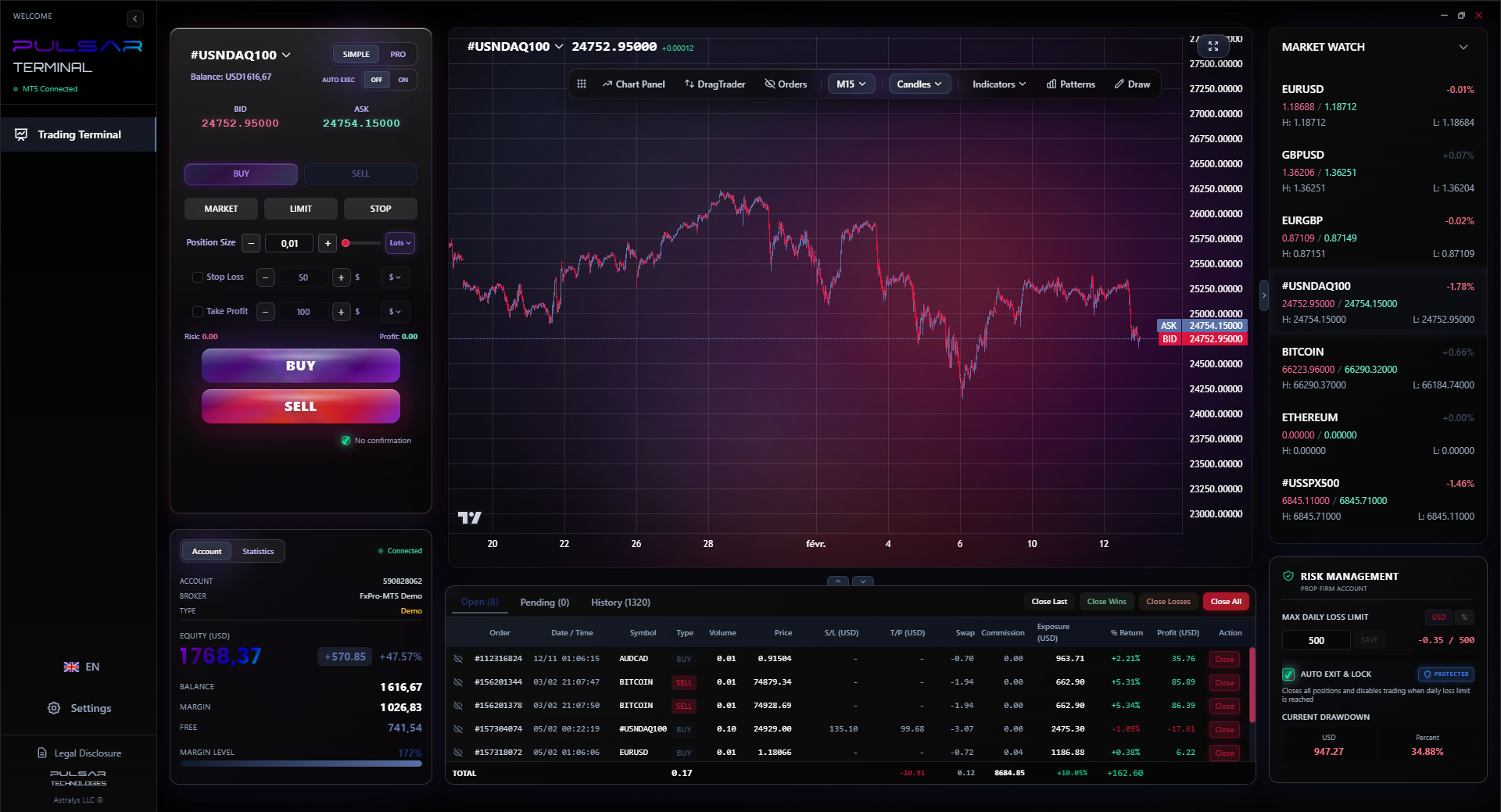
Managing separate pots of money for travel and trading is complex; Pulsar Terminal helps you manage your trading risk with precise tools for position sizing and stop-losses directly on MT5.
Pulsar Terminal
The all-in-one MT5 companion: drag-and-drop orders, multi-TP/SL, trailing stop, grid trading, Volume Profile, and prop firm protection. Used by 1,000+ traders daily.
Let's learn from my errors and the countless horror stories from other traders.
1. The Leftover Currency Trap: I already mentioned my £150 mistake. It's easy to do. Set a calendar reminder for 25 days after you return home to sell back any unused currency. The rate might move against you slightly, but it's better than forgetting and violating the 30-day rule.
2. Assuming It Works Everywhere: Your South African forex card will likely be rejected if you try to use it within the Common Monetary Area (CMA). It's designed for use outside South Africa, Lesotho, Eswatini, and Namibia. Don't get stuck at a lodge in Swaziland with a useless card.
3. Not Checking the Loaded Exchange Rate: You get the rate at the moment you convert on the app. Check it against the mid-market rate on Google or XE.com. If the margin is more than 3%, you're getting a bad deal. Sometimes it's better to load in ZAR and convert little bits as you go, but that introduces exchange rate risk.
4. Using it for Online Subscriptions: This is a grey area. Using your card for a Netflix subscription billed in USD is probably fine. Using it to try and fund a Binance account? That's a violation. The bank's fraud systems are getting smarter at detecting payments to known trading/crypto platforms.
The biggest pitfall of all, which bears repeating, is the trading funding attempt. I had a student who tried to fund a small prop firm account with his travel card. The transaction was blocked, his card was temporarily frozen, and he got a very stern call from his bank's forex compliance department. It took weeks to sort out. The small convenience is never worth the regulatory headache.
“Often, a forex card is a solution to a problem that doesn't exist anymore.”
So you're going on holiday and you've decided a forex card is right for you. Here's my step-by-step, no-BS approach.
Step 1: Compare your bank's offer. Get their full fee schedule. Ask for the exchange rate margin. Don't just ask 'what's the rate?', ask 'what is your margin over the interbank rate for USD/ZAR right now?'
Step 2: Consider the digital-only option. If you're comfortable using your phone for payments (Apple Pay/Google Pay linked to the virtual card), an app like Shyft can save you the initiation and annual card fee. Just make sure your destinations accept tap-to-pay widely.
Step 3: Load strategically. Don't load all your funds at once unless you're sure of the rate and your budget. Load 80% of your budget upfront, and keep the rest in ZAR in the wallet as a buffer. You can convert it later if needed.
Step 4: Have a backup. Always, always travel with at least one traditional international credit card (like a Visa Signature) and some physical cash in the local currency. I keep $200 in cash separate from my wallet for emergencies. Your forex card could get swallowed by an ATM, the network could go down, or a merchant might not accept it.
Step 5: Track your spending. Most bank apps have decent tracking. Monitor your balance closely. The last thing you want is to be declined at a restaurant because you misjudged your daily spending. Treat it like cash in your pocket, not an infinite resource.
Forget using it for anything other than direct purchases and ATM withdrawals. It's not a financial Swiss Army knife. It's a single-purpose tool: spending Rands overseas with a bit more control and security than cash.
💡 Winston's Tip
Your travel card and your trading capital are kept in separate regulatory universes. Trying to bridge them is the fastest way to attract compliance scrutiny.
With the rise of global fintechs and better bank cards, the traditional forex card's value is shrinking.
Many premium South African credit cards now offer zero foreign transaction fees on purchases. They simply convert at the Visa/Mastercard rate, which is very close to the interbank rate. For pure spending, these can be cheaper and simpler than a forex card, and they offer rewards points and purchase protection. The catch? You need a good credit score and the annual fee can be high.
Digital wallets are the other disruptor. While Wise doesn't ship cards here yet, the landscape is changing. The SARB's increased online payment limit to R100,000 per transaction (2024) shows a slow move towards liberalisation. It's not crazy to think that in a few years, integrated global accounts will be more accessible.
For now, the forex card still has a niche: for strict budgeters who need a locked-in rate, for parents sending kids overseas with a controlled allowance, or for people who want absolute separation between their travel money and their main accounts.
But ask yourself this: is the hassle of getting a separate card, loading it, paying fees, and managing yet another PIN really worth it for a week in Mauritius? Often, a simple notification to your bank that you're travelling, paired with your normal debit card and a backup credit card, is all you need. The forex card is a solution to a problem that, for many, doesn't exist anymore. It persists because banks make good money on them, not because they're inherently the best tool.
If your goal is to trade, focus your energy on understanding the legal EFT process and proper position size calculation, not on a travel product with a confusing name.
FAQ
Q1Can I use my South African forex card to deposit money into Forex.com or MetaTrader?
No. It is explicitly prohibited by South African Exchange Control Regulations. South African-issued debit, credit, and forex cards cannot be used to fund international trading accounts. Attempting to do so may result in the transaction being blocked and your account being flagged by your bank.
Q2What is the difference between a forex card and a travel card?
In South Africa, they are the same thing. 'Forex card' is the common marketing term used by banks for a multi-currency prepaid travel card. The name is unfortunate as it causes confusion with foreign exchange trading.
Q3How much foreign currency can I load onto a forex card?
You can load up to the value of your available Single Discretionary Allowance (SDA), which is R1 million per calendar year for adults. For travel, you cannot purchase the foreign currency more than 60 days before your departure date.
Q4What happens to leftover money on my forex card after my trip?
You are required by SARB rules to sell any unused foreign currency back to an Authorised Dealer within 30 days of returning to South Africa. You can do this through your bank's app or branch. If you don't, you're in violation of exchange controls.
Q5Are forex cards safer than carrying cash?
Yes, significantly. If lost or stolen, you can usually freeze the card immediately via an app or phone call. Your liability for fraudulent charges is limited, unlike cash which is gone forever. It also allows you to lock in an exchange rate, removing uncertainty.
Q6Can I use a Wise or Revolut card as a South African resident?
You can open a Wise multi-currency account and get a virtual card. However, as of now, Wise does not ship its physical debit card to South African addresses. You would need an address in a country they service to receive the physical card. Their services are legal for spending, but the same prohibition on funding trading accounts applies.
Q7What is the cheapest way to get foreign currency for travel?
It depends on the amount and your banking products. For small amounts, a bank ATM at your destination using your local debit card might be okay (check fees). For larger amounts, compare the total cost: your bank's forex card margin + fees versus a premium credit card with no foreign transaction fees. Often, the credit card wins on cost for straight purchases, but the forex card wins on budget certainty.
Prof. Winston's Lesson
Key Takeaways:
- ✓A SA forex card is for travel, not trading deposits.
- ✓SARB rules prohibit card funding of trading accounts.
- ✓You must sell unused currency within 30 days of return.
- ✓The hidden cost is a 2-4% margin on the exchange rate.
- ✓Always have a backup payment method when travelling.
How useful was this article?
Click a star to rate
Weekly Trading Insights
Free weekly analysis & strategies. No spam.
About the Author
David van der Merwe
Emerging Markets Trader
Johannesburg-based trader with 11 years in emerging market currencies. Specializes in ZAR pairs, FSCA-regulated trading, and South African market analysis.
Comments
Risk Disclaimer
Trading financial instruments carries significant risk and may not be suitable for all investors. Past performance does not guarantee future results. This content is for educational purposes only and should not be considered investment advice. Always conduct your own research before trading.
You Might Also Like

Cara Trading Forex Sukses: 7 Prinsip dari Trader Profesional
Cara trading forex sukses dengan 7 prinsip trader pro: manajemen modal, disiplin, journal trading, backtest. Data nyata, bukan janji profit palsu.
Jam Trading Forex Terbaik untuk Trader Indonesia: Panduan Lengkap dengan Tabel Waktu
Panduan jam trading forex untuk trader Indonesia. Tabel 4 sesi dunia, jam emas 20:00-00:00, sesi mana yang harus dihindari. Data akurat + tips dari trader berpengalaman.
Top 5 Sàn Forex Uy Tín Nhất 2026: Review Jujur dari Trader Indonesia
Top 5 sàn forex uy tín 2026 untuk trader Indonesia. Review jujur: spread, deposit, withdraw, dukungan lokal. Exness, XM, IC Markets & lebih.
Get Pulsar Terminal
All these calculators are built into Pulsar Terminal with real-time data from your MT5 account. One-click position sizing, automatic risk management, and instant calculations.
Get Pulsar Terminal