


I watched my screen turn red as the GBP/USD chart spiked against me.
Sarah Collins
Trading Strategist ·  United Kingdom
☕ 10 min read
What you'll learn:
I watched my screen turn red as the GBP/USD chart spiked against me. It was 2015, the day of the 'Flash Crash' that took the pound down 6% in minutes. I was long, convinced support would hold. My £5,000 account was leveraged 50:1 (back when you could do that). The margin call came fast. I lost £4,700 in under two minutes. That wasn't bad luck. It was a perfect lesson in why forex CFD trading in the UK is a graveyard for retail money. The FCA says about 80% of you lose. I'm here to explain, with brutal honesty, exactly how that happens and what you can actually do about it.
Let's strip away the jargon. When you're forex CFD trading, you're not buying euros or barrels of oil. You're entering a contract with your broker to exchange the difference in an asset's price from when you open the trade to when you close it.
Think of it like a bet on price direction, but with real, often borrowed, money. If you think the EUR/USD will go up, you buy (go long). If you think it'll drop, you sell (go short). Your profit or loss is the difference in price, multiplied by your position size. This is the core of Contracts for Difference.

Warning: This isn't investing. You don't get dividends, voting rights, or ownership. You get pure, leveraged price speculation. The FCA calls it a 'high-risk' product for a reason. Treating it like anything else is your first step towards that 80% club.
The 'forex' part is just one asset class you can trade via CFDs. While currency pairs like EUR/USD are the most popular, CFDs cover indices (like the FTSE 100), commodities (like XAU/USD), shares, and cryptocurrencies. The mechanics and risks are fundamentally the same.

💡 Winston's Tip
The market's job is to find the price where the most people will be wrong. Your job is to not be one of them. That starts with a stop-loss.
“Your stop-loss is your lifeline. Decide it before you enter, based on the chart, not your account balance.”
The UK has the strictest retail CFD rules in the world, thanks to the Financial Conduct Authority. They're not trying to stop you trading. They're trying to stop you from losing your house.
The use Caps
This is the big one. You cannot get the insane use I had in 2015. The FCA permanently capped it in 2019.
| Asset Class | Maximum use (Retail) |
|---|---|
| Major Forex Pairs (e.g., EUR/USD) | 30:1 |
| Minor Forex Pairs, Major Indices | 20:1 |
| Commodities (like Gold, Oil) | 10:1 |
| Individual Shares | 5:1 |
| Cryptocurrencies | 2:1 |
A 30:1 use means with £1,000, you can control a £30,000 position. It amplifies both gains and losses. Most blow-ups happen because traders use the maximum available use on every trade, leaving no room for error. A 3.4% move against you wipes out your entire margin.
The Non-Negotiables: Negative Balance & Close-Out
These two rules have saved countless UK traders from financial ruin.
Negative Balance Protection means you can never owe your broker money. If a trade goes catastrophically wrong, your loss is limited to the funds in your account. Your balance goes to zero, not to minus £10,000.
The Margin Close-Out Rule is your broker's forced stop-loss. If your account equity falls to 50% of the required margin for your open positions, your broker will start closing your trades, starting with the biggest loser. It's humiliating, but it's a circuit breaker.

Pro Tip: Your broker's margin call level is a last resort. You should have your own, stricter risk management rules. If you're relying on your broker to save you, you've already failed.
Remember, these protections only apply if you're trading with a proper FCA-regulated broker like Pepperstone or IG. If you're lured to an offshore entity by promises of 500:1 use, you forfeit all of this.
“The 80% loss rate isn't an accident. It's the inevitable outcome of predictable, repeated mistakes.”
You don't just need the market to move in your direction. It has to move enough to cover the costs of doing business. Most beginners ignore this, and it's a silent killer.
The Spread: This is the difference between the buy (ask) and sell (bid) price. If EUR/USD is quoted at 1.0850/1.0852, the spread is 2 pips. Your trade starts 2 pips in the red. On a standard account with a £10 per pip position, that's a £20 hurdle before you make a penny.
Overnight Financing (Swap): Hold a position past 10pm UK time (the daily rollover), and you'll pay or receive a fee. It's based on the interest rate differential between the two currencies. Going long on a pair where you're buying the high-interest currency might earn you a tiny credit. More often, you pay. For a swing trading position held for weeks, these costs add up.
Commissions: On 'raw spread' or ECN accounts, you might see spreads from 0.0 pips, but you pay a commission per lot traded. It's just a different way of pricing the same service.
Let me give you a real example from last year. I took a short scalping trade on the FTSE 100 CFD. Entry at 7580, stop at 7585, target at 7572. Risk: 5 points. Reward: 8 points. Not a bad ratio. I got filled, the market dipped to 7573, then reversed. I was stopped out. Net result? Lost 5 points on the trade, plus the spread (1 point). My actual loss was 6 points. The spread turned my 1:1.6 risk-reward into a worse 1:1.33. Over dozens of trades, that difference is catastrophic.
Always, always factor in the spread to your risk calculation. A good position size calculator will help you do this automatically.
“The 80% loss rate isn't an accident. It's the inevitable outcome of predictable, repeated mistakes.”
The 80% loss rate isn't an accident. It's the inevitable outcome of predictable, repeated mistakes.
-
Over-leveraging: This is the king of killers. With £1,000 and 30:1 use, you control £30,000. A mere 0.33% move against you wipes out your margin. The market moves that much on a quiet Tuesday afternoon before lunch. You have no room to breathe. I once tried to 'make back' losses by ramping up use on a sure thing. The sure thing was a false breakout. I turned a £500 losing week into a £2,500 disaster in one afternoon.
-
No Risk Management: This means no stop-loss, or moving your stop-loss further away when the trade goes against you (hoping it'll come back). It's called 'doubling down' in poker, and it's a strategy for going broke. Your stop-loss is your lifeline. Decide it before you enter, based on the chart, not your account balance. Then stick to it.
-
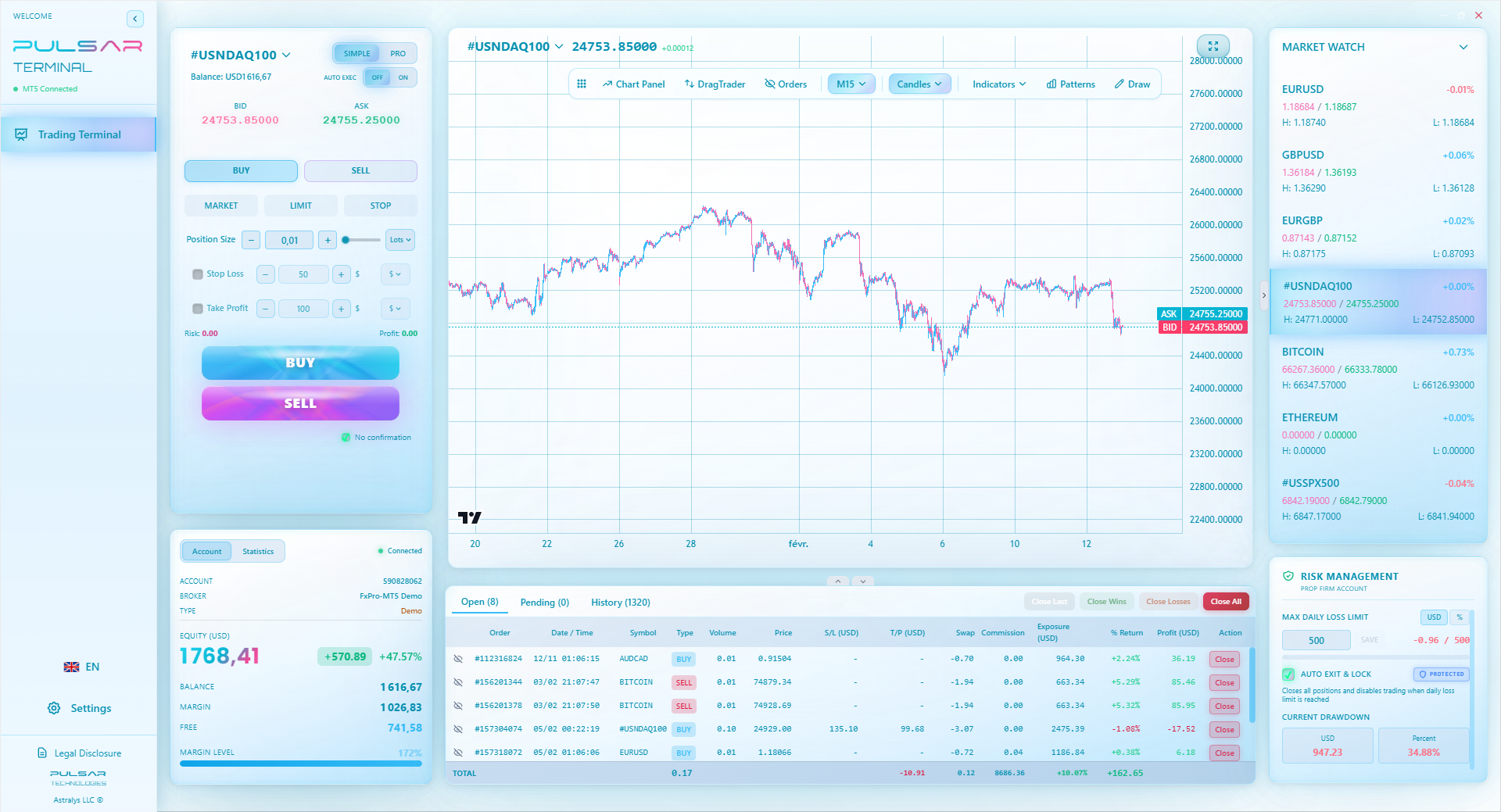
Chasing Losses & Overtrading: You lose £100 on a bad read. The instinct is to immediately jump back in with a £200 trade to recover it. Emotion has taken over. You're now trading your P&L, not the market. This leads to revenge trading, taking low-quality setups, and blowing through your daily loss limit. A prop firm challenge tool that enforces a daily loss limit, like the one in Pulsar Terminal, would have saved me thousands in my early years.
-
Strategy Hopping & Indicator Overload: You try a moving average crossover. It loses three times in a row. You scrap it and load up the chart with RSI, MACD, and three different Bollinger Bands. Now you have six conflicting signals and paralysis. Pick one simple, logical strategy. Test it. Understand its win rate and average profit/loss. Then give it time. Consistency beats complexity every time.
💡 Winston's Tip
If you're calculating your potential profit before your maximum loss, you're a gambler, not a trader. Flip that order.
“Your first deposit is tuition, not investment capital.”
Surviving forex CFD trading isn't about finding a secret indicator. It's about discipline and maths.
The 1% Rule (And I Mean It)
Never, ever risk more than 1% of your account capital on a single trade. If you have a £5,000 account, your maximum risk per trade is £50. This isn't a suggestion. It's law. It means you can withstand 20 consecutive losses and still have 80% of your capital. That gives you the psychological staying power to stick to your plan.
Use a calculator. For a £5,000 account, 1% is £50. If your stop-loss on a GBP/USD trade is 25 pips away, your position size must be such that 25 pips = £50. Since 1 pip on a standard lot of GBP/USD is roughly $10 (≈£8), you'd work backwards. This is where a position size calculator is non-negotiable.
Find Your Edge in Price Action
Forget the lagging indicators for a moment. Learn to read support and resistance, supply and demand zones, and basic candlestick patterns. These tell you where other traders are likely to buy or sell. My most consistent profits have come from simple strategies: fading extreme moves at clear resistance levels, or buying pullbacks to proven support on a higher-timeframe trend.
Journal Every. Single. Trade.
Not just "bought EUR/USD, won." Log:
- Date/Time, Instrument
- Entry, Stop Loss, Take Profit prices
- Reason for entry (e.g., "1H bounce off weekly support")
- Position size and risk (% and £)
- Screenshot of the chart
- Emotional state
After 100 trades, you'll have data. You'll see if you're better at longs or shorts, if your win rate is 40% or 55%, if you consistently break your rules on Fridays. This data is more valuable than any trading course.

Example: My journal revealed I had a 65% win rate on trades held over 4 hours, but only 42% on trades I closed within an hour. I was a terrible scalper. I stopped trying to be one, and my performance improved dramatically.
Managing multiple take-profit levels and trailing stops manually is stressful and error-prone, which is why tools like Pulsar Terminal automate these risk management tasks directly on your MT5 platform.
Pulsar Terminal
The all-in-one MT5 companion: drag-and-drop orders, multi-TP/SL, trailing stop, grid trading, Volume Profile, and prop firm protection. Used by 1,000+ traders daily.
“Your first deposit is tuition, not investment capital.”
Your broker is your gateway. Choosing wrong adds friction, cost, and risk.
Regulation is Non-Negotiable: Only consider FCA-regulated brokers. This guarantees segregated client funds, negative balance protection, and access to the Financial Services Compensation Scheme (FSCS) up to £85,000. Check the FCA register.
Compare Real Costs: Don't just look at the advertised 'typical spread'. Check the spread at 10am on a Tuesday and at 3pm when the US market opens. Check the overnight swap rates if you hold positions. Look for inactivity fees (most good brokers have removed these).
Platform & Execution: MetaTrader 4/5 is the industry standard for a reason. It's stable, has endless customisation, and is supported by tools like Pulsar Terminal that add serious risk management features. Some brokers like IC Markets or XM offer excellent MT4/5 integration with fast execution. Others have great proprietary platforms. Try the demo.
Customer Service: Test them. Send a question about a specific withdrawal method on a Saturday afternoon. See how long they take to reply. You'll need them when there's a problem.
My personal shortlist for different styles:
- For tight spreads and algo trading: Pepperstone or IC Markets.
- For beginners and a great all-round experience: XTB.
- For a massive range of instruments and research: IG or CMC Markets.
Remember, the broker's 'retail client loss' percentage (usually 70-80%+) is displayed for a reason. It applies to their platform too. The tool isn't to blame, but it's a stark reminder of the game you're in.
💡 Winston's Tip
Your trading platform is a tool, not a strategy. A sharper axe doesn't make you a better woodsman. Discipline does.
“Consistency beats complexity every time.”
Forex CFD trading in the UK is legal, regulated, and accessible. It is also incredibly difficult to do profitably over the long term. The odds are structurally stacked against you through use and costs.
It is not a side hustle. It is not a get-rich-quick scheme. It is a skill-based profession that requires years of study, thousands of pounds in 'tuition fees' (lost trades), and a psychological fortitude most people don't possess.
Start with a demo account, but know that trading with pretend money teaches you nothing about managing fear and greed. Move to a live account with the absolute minimum deposit - £100 or £200. Your goal for the first year should not be profit. Your goal should be to lose as little as possible while learning to execute your plan. If you can survive 12 months without blowing up, without breaking your 1% rule, and with a detailed journal, you might have a chance.
The market will always be here. There's no rush. The biggest mistake you can make is funding an account with money you can't afford to lose, convinced you've cracked the code. I've been there. We all have. It's the initiation rite for the 80%. Don't be in a hurry to join us.
FAQ
Q1Is forex CFD trading legal in the UK?
Yes, it is completely legal. However, it is heavily regulated by the Financial Conduct Authority (FCA). You must only use an FCA-authorised broker to get crucial protections like negative balance protection and the FSCS safety net.
Q2What's the minimum deposit to start trading forex CFDs in the UK?
It varies by broker. Some like XTB have no minimum. Others like eToro require $200 (approx £160). You can start with £100 at many brokers. My strong advice is to start with the absolute minimum. Your first deposit is tuition, not investment capital.
Q3Can you make a living from forex CFD trading?
Statistically, it's highly unlikely. The FCA data shows around 80% of retail clients lose money. The few who do make a consistent living treat it like a full-time business: with rigorous risk management, a proven strategy, and significant starting capital to withstand drawdowns. It's not a reliable primary income for the vast majority.
Q4What's the difference between a CFD and a spread bet?
Both are derivatives, but spread betting is unique to the UK and Ireland and is tax-free (no Capital Gains Tax on profits). CFD profits are subject to CGT. Both are subject to the same FCA use limits and risk warnings. The trading mechanics are virtually identical.
Q5What does 'pip' mean in forex trading?
A pip is a 'percentage in point' and is the standard unit for measuring price movement. For most pairs, it's 0.0001 of a price move. If EUR/USD moves from 1.0850 to 1.0851, it has moved 1 pip. Understanding pips is essential for calculating your profit, loss, and position size.
Q6What is a margin call?
A margin call is a warning from your broker that your account equity has fallen close to the minimum required to keep your trades open. Under FCA rules, if it hits 50% of the required margin, they will automatically close your positions (the 'close-out rule'). It's a last-ditch safety mechanism to prevent your account from going negative.
Q7Why are the spreads wider sometimes?
Spreads widen during periods of low liquidity (like weekends, bank holidays) or high volatility (during major news events like Non-Farm Payrolls or central bank announcements). The broker is pricing in higher risk. It's best to avoid opening trades during these times, as your cost of entry is significantly higher.
Prof. Winston's Lesson
Key Takeaways:
- ✓Never risk more than 1% of your account per trade.
- ✓FCA use caps exist for your survival, not to limit you.
- ✓The spread is a guaranteed cost; factor it into every plan.
- ✓A trading journal is your only source of truthful feedback.
- ✓80% lose because they trade emotion, not probability.
How useful was this article?
Click a star to rate
Weekly Trading Insights
Free weekly analysis & strategies. No spam.
About the Author
Sarah Collins
Trading Strategist
London-based trading strategist with 12 years in financial markets. Former analyst at a City of London brokerage. Covers GBP pairs, European markets, and FCA-regulated trading.
Comments
Risk Disclaimer
Trading financial instruments carries significant risk and may not be suitable for all investors. Past performance does not guarantee future results. This content is for educational purposes only and should not be considered investment advice. Always conduct your own research before trading.
You Might Also Like

Cara Trading Forex Sukses: 7 Prinsip dari Trader Profesional
Cara trading forex sukses dengan 7 prinsip trader pro: manajemen modal, disiplin, journal trading, backtest. Data nyata, bukan janji profit palsu.
Jam Trading Forex Terbaik untuk Trader Indonesia: Panduan Lengkap dengan Tabel Waktu
Panduan jam trading forex untuk trader Indonesia. Tabel 4 sesi dunia, jam emas 20:00-00:00, sesi mana yang harus dihindari. Data akurat + tips dari trader berpengalaman.
Top 5 Sàn Forex Uy Tín Nhất 2026: Review Jujur dari Trader Indonesia
Top 5 sàn forex uy tín 2026 untuk trader Indonesia. Review jujur: spread, deposit, withdraw, dukungan lokal. Exness, XM, IC Markets & lebih.
Get Pulsar Terminal
All these calculators are built into Pulsar Terminal with real-time data from your MT5 account. One-click position sizing, automatic risk management, and instant calculations.
Get Pulsar Terminal