


Let's cut the rubbish.

David van der Merwe
Emerging Markets Trader ·  South Africa
☕ 10 min read
What you'll learn:
- 1What Are Forex CFDs, Really? (It's Not What You Think)
- 2The South African Broker Scene: Who Can You Trust?
- 3The Rand Mindset: Your Biggest Enemy Isn't the Market
- 4A No-Nonsense Starter Setup for South African CFD Traders
- 5Risk Management: This Is How You Survive
- 6The Taxman Cometh: SARS and Your CFD Profits
- 7The Final Word: Should You Trade Forex CFDs?
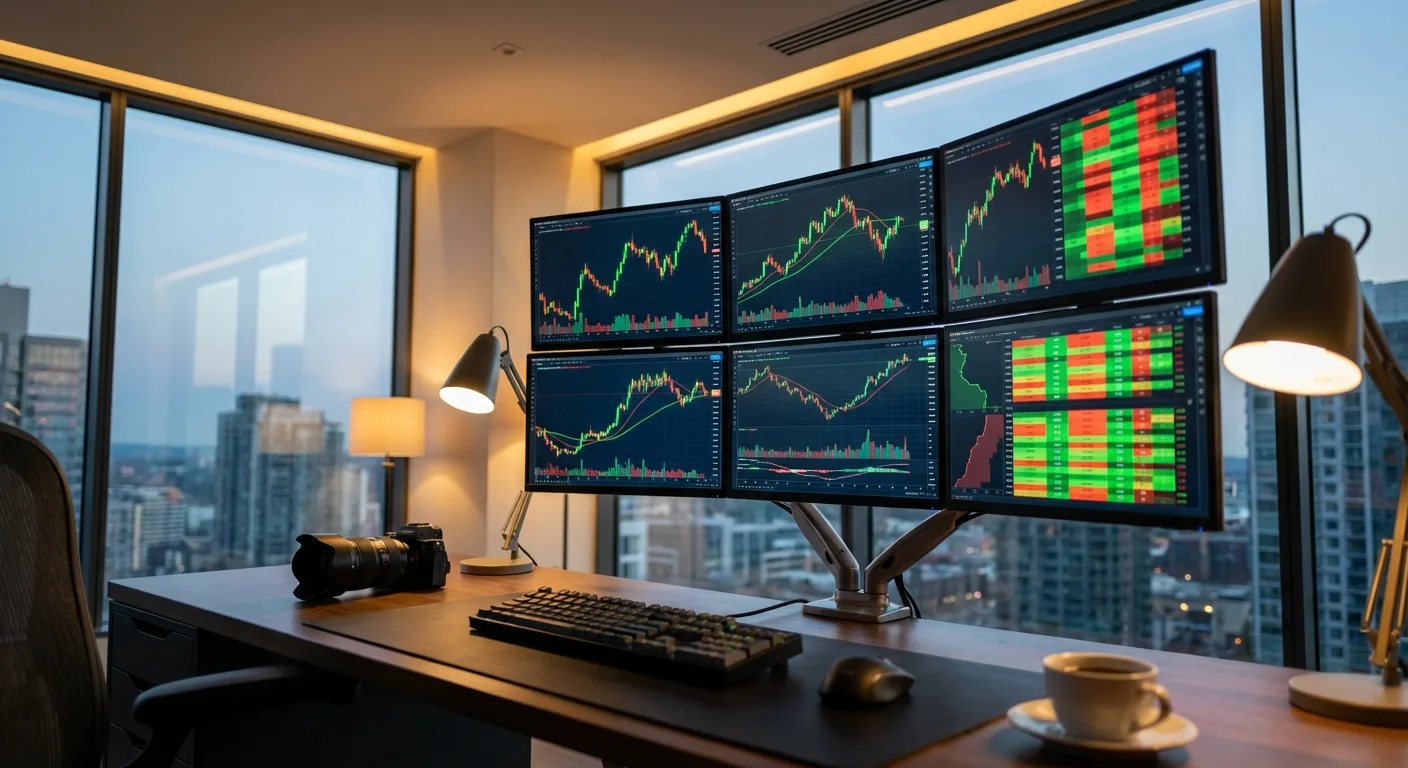
Let's cut the rubbish. Most people who trade forex CFDs in South Africa lose money. It's not a secret, it's a statistical fact. Brokers sell you a dream of financial freedom, but they're often just building a casino where the house always wins. I'm not here to scare you off. I'm here to show you exactly how this game is played, point out the traps laid for South African traders, and give you a fighting chance. If you think this is a get-rich-quick scheme, close this tab now. If you're ready for a brutally honest look at trading forex CFDs from Cape Town to Johannesburg, let's get started.
A Contract for Difference (CFD) on forex is not you buying US dollars or British pounds. You're not taking delivery of a container full of yen. You're making a bet with your broker on whether the price of one currency will go up or down against another. The broker sets the price, provides the use, and you put up a small deposit (margin) to control a much larger position.
This is the core of the opportunity and the danger. That use is a double-edged sword. A 1% move in your favour on a 100:1 leveraged trade is a 100% profit on your margin. Sounds great, right? The flip side is that a 1% move against you wipes out your entire deposit. That's a margin call waiting to happen if you're not careful.

Warning: Many new traders confuse CFDs with owning the actual asset. You have no shareholder rights, you don't earn dividends on currency pairs, and your contract's value is purely derived from the price movement. You're trading a derivative, full stop.
For us in South Africa, this structure has a specific implication. When you trade EUR/USD, your profit or loss is calculated in dollars, but your broker account is likely in ZAR. This means you're exposed to two movements: the forex pair itself AND the USD/ZAR rate. A winning trade in dollars can be shrunk by a strengthening rand when it's converted back. It's a hidden layer of risk most local brokers don't highlight in their shiny adverts.

💡 Winston's Tip
If you can't explain your trade setup in one sentence, you don't have a setup. You have a hope.
This is where you need your head screwed on. The FSCA (Financial Sector Conduct Authority) is our local regulator. Trading with an FSCA-licensed broker gives you some recourse, but don't expect a government bailout if you blow your account. The protection is more about ensuring the broker isn't an outright scam.
Many international brokers like Exness, IC Markets, and Pepperstone accept South African clients. They often offer better spreads, more instruments, and superior trading platforms like MT4/5. However, your money is held offshore. You need to be comfortable with that.
The Spread & Commission Game
South African brokers love to advertise "zero spread" accounts. Nothing is zero. They make money either through a wider spread (the difference between buy and sell price) or a commission per lot. You must calculate the all-in cost. A "zero spread" account with a $7 round-turn commission on a standard lot is often more expensive than a 1.0 spread raw account on a major pair. Use a position size calculator to work this out before you fund an account.
I made this mistake early on. I signed up with a flashy local broker promising tight spreads on USD/ZAR. What I didn't see was the 0.5% currency conversion fee on every deposit and withdrawal. On a R10,000 deposit, that was R50 gone before I even placed a trade. Read the fee schedule. Every word of it.

Pro Tip: Always test a broker's execution during high volatility, like during a US Non-Farm Payroll (NFP) announcement. Do they widen spreads to 20 pips? Do orders get rejected? That's when you see their true colours, not during a calm Tuesday afternoon.
“High use is a trap for new traders. It amplifies losses just as fast as profits.”
Trading psychology is universal, but South Africans have unique baggage. We're conditioned by a volatile currency. Seeing USD/ZAR swing 50 cents in a week feels normal to us. This warps our sense of risk.
You'll be tempted to overtrade USD/ZAR because you 'understand' it. But understanding the news and predicting the price are two different things. I once lost R8,000 on a USD/ZAR long position during a SARB meeting. I was right on the rate hike, but the market had 'priced it in' already, and it sold off on the news. My conviction blinded me to the actual price action.
The other psychological trap is converting every profit back to rand in your head. "That $200 win is... about R3,800! Not bad for a day!" This leads to taking profits too early and letting losses run, because "maybe the rand will weaken again." You must think in the base currency of your trade. Use a stop-loss and take-profit based on the chart, not on a round number in rand value.
Your goal is to be a consistently profitable trader, not to make enough rand today to cover the electricity bill. That kind of pressure will force bad decisions every single time.
💡 Winston's Tip
The market doesn't care about your rent, your car payment, or your ego. Trade the price, not your needs.
Forget the complex systems with 15 indicators. You need price, volume, and one or two tools to gauge momentum. Here’s a bare-bones approach that actually works if you have the discipline.
- Timeframe: Start on the 4-hour chart for direction. This filters out the market noise that will chop you up on lower timeframes. Use the 1-hour or 30-minute chart for your precise entry. Avoid the 5-minute chart like the plague when you're starting; it's a scalping arena for pros with direct market access.
- Tools:
- 200 EMA: Is the price above it (general uptrend) or below it (downtrend)? Only look for long trades above it, short trades below it. Don't fight the trend.
- RSI: Set it to 21 periods, not the default 14. It becomes less twitchy. Use it to spot overbought (above 70) or oversold (below 30) conditions within the trend.
- Horizontal Support/Resistance: Draw lines where the price has reversed before. These are your areas for entries and where to place stops.
A Real Trade Example (That Worked)
In early 2023, EUR/USD was consistently above the 200 EMA on the 4H chart (uptrend). It pulled back to a clear support level at 1.0650. The 21-period RSI dipped near 35 (oversold within an uptrend). I entered a long at 1.0655.
- Stop Loss: Placed at 1.0620 (just below the support zone). Risk: 35 pips.
- Take Profit: Set at 1.0750 (near the next resistance). Reward: 95 pips.
Risk/Reward: ~1:2.7. The trade ran over two days and hit the target. A R10,000 account risking 1% (R100) on this trade would have made about R270. Boring? Maybe. Profitable? Yes. This is the essence of swing trading CFDs.

Example: If your broker's spread on EUR/USD is 1.2 pips, factor that into your risk. My entry was effectively 1.0655 + 0.00012 = 1.0667. My real risk was slightly higher, so I adjusted my position size down using my position size calculator to keep my max loss at 1%.
“A winning trade in dollars can be shrunk by a strengthening rand when it's converted back.”
If you skip this section, you might as well hand your money to a stranger on the street. It would be faster.
The 1% Rule: Never, ever risk more than 1% of your trading capital on a single trade. Not 2%, not 5%. 1%. On a R20,000 account, that's R200. This means if your stop loss is 50 pips away, you can only afford a position size that loses R200 if those 50 pips are hit. This single rule will keep you in the game long enough to learn.
The Daily Loss Limit: Set a hard line. If you lose 3% of your account in a day, you stop. Turn off the platform. Go for a walk. A losing streak clouds your judgment, and you will start revenge trading to win it back. I've broken this rule. In one brutal afternoon, I turned a 2% loss into an 11% account blow-up by placing larger and larger trades to recover. It was stupid, and it hurt.
Use a Trading Journal: Not a fancy one. A Google Sheet. Record every trade: entry, exit, reason, screenshot, and most importantly, how you felt. You'll start to see patterns. You'll see that you lose most when you trade after 10 PM, or when you trade against the trend. This is more valuable than any indicator.
Automation is your friend here. Setting your stop loss and take profit the second you enter the trade removes emotion. Tools that can help you manage multiple positions and set trailing stops are useful for sticking to your plan.
💡 Winston's Tip
Your first profit target should be to survive for six months without blowing up your account. Everything else is secondary.

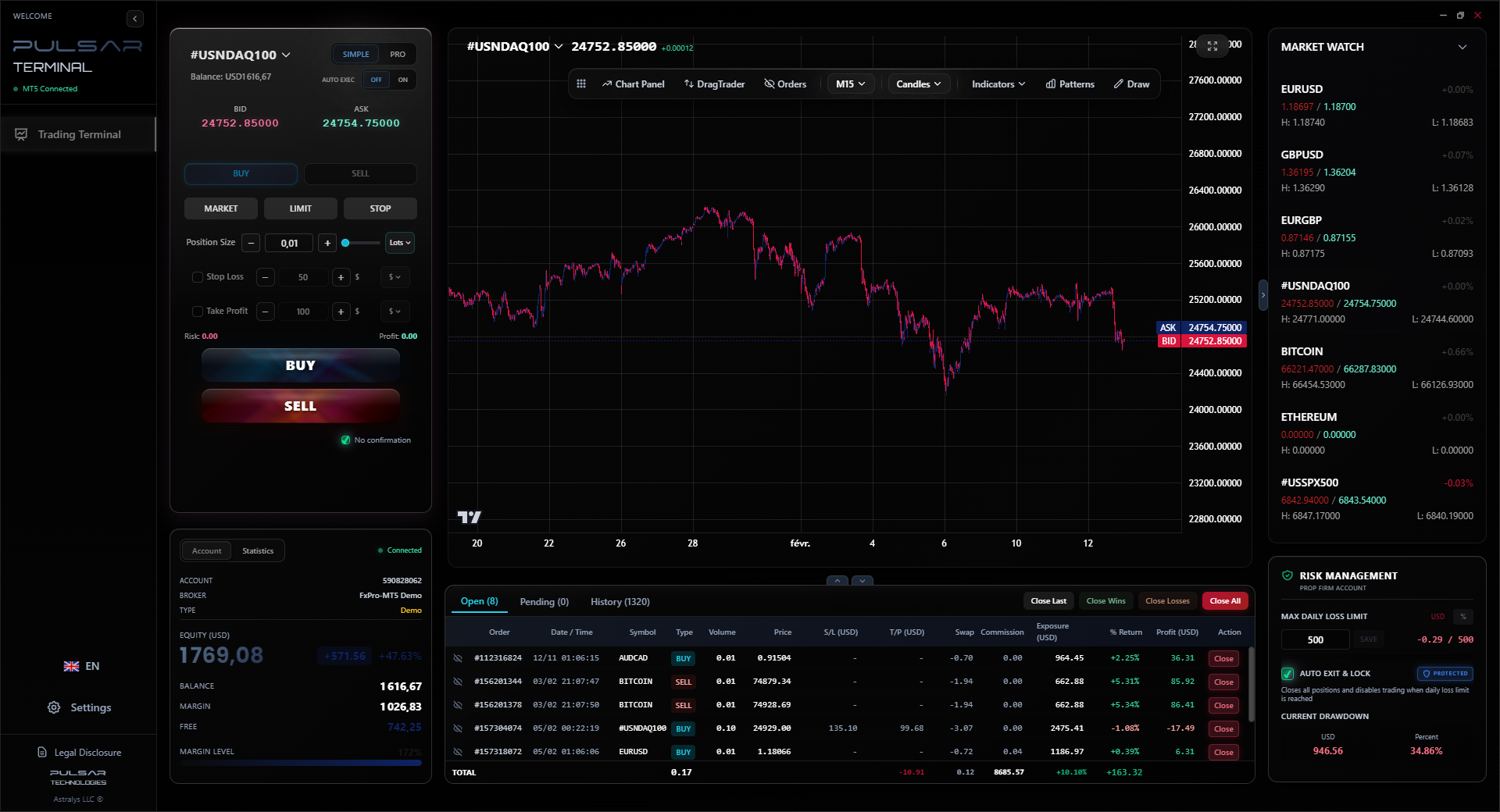
Sticking to your risk management plan is easier when your trading platform automates stop-losses, take-profits, and daily loss limits for you.
Pulsar Terminal
The all-in-one MT5 companion: drag-and-drop orders, multi-TP/SL, trailing stop, grid trading, Volume Profile, and prop firm protection. Used by 1,000+ traders daily.
This isn't exciting, but ignoring it will cost you. In South Africa, profits from trading forex CFDs are generally considered capital gains, not income (unless SARS deems you a professional trader, which is a high bar).
This means your net profit (total profits minus total losses, minus any allowable expenses like platform fees or data costs) is added to your other capital gains for the year. The first R40,000 of your total annual capital gain is exempt. After that, it's included in your taxable income, but only 40% of the gain is taxed at your marginal income tax rate.
Example: You make a net profit of R100,000 from CFD trading in the tax year.
- Annual Exclusion: R100,000 - R40,000 = R60,000 taxable capital gain.
- Inclusion Rate: 40% of R60,000 = R24,000.
- This R24,000 is added to your other income (e.g., your salary). If your marginal tax rate is 36%, you'd pay about R8,640 in tax on that R100,000 profit.
Keep Records: SARS will want to see your statements. Track every trade, every deposit, every withdrawal. Use a separate bank account for your trading activities to make this clean. A good accountant who understands trading is worth every cent.
Warning: Do not try to hide this income. SARS has data-sharing agreements with many offshore jurisdictions now. The administrative headache and potential penalties are not worth the risk.
“The goal isn't to be right on every trade. The goal is to have a positive expectancy over hundreds of trades.”
Look, forex CFDs are a tool. A very sharp, dangerous tool. In the right hands, with rigorous discipline, they can be used to generate returns. In the wrong hands, they are a guaranteed way to destroy capital.
For the average South African looking to grow savings, a low-cost ETF on the JSE or a global index fund is a far smarter, safer bet. You'll sleep better.
But if you're fascinated by the markets, have capital you can truly afford to lose (your 'tuition fee'), and possess monk-like self-control, then you can approach this. Start with a demo account for at least three months. Then fund a live account with the smallest amount possible. Treat it like a serious business, not a lottery ticket.
Remember, the goal isn't to be right on every trade. The goal is to have a positive expectancy over hundreds of trades. Manage your risk, keep your psychology in check, and never stop learning. The market will humble you - it humbles everyone. The question is whether you get up, learn the lesson, and trade smarter, or whether you blow up and become another statistic. The choice is yours.
FAQ
Q1Is forex CFD trading legal in South Africa?
Yes, it is legal. The Financial Sector Conduct Authority (FSCA) regulates the industry. However, you must trade with a licensed provider, either a local FSCA-licensed broker or a reputable international broker that accepts South African clients.
Q2What is the best use for a beginner in South Africa?
The lowest you can get. Seriously. Start with 10:1 or even 5:1. High use (like 100:1 or 500:1) is a trap for new traders. It amplifies losses just as fast as profits. Prove you can be consistently profitable with low use before you even consider increasing it.
Q3How much money do I need to start trading forex CFDs in South Africa?
You can start with as little as R500 or R1000 with some brokers, but it's not advisable. With such a small amount, proper risk management (the 1% rule) becomes almost impossible, and fees eat you alive. A more realistic starter amount that allows for sensible trading is R10,000 to R20,000.
Q4Which currency pairs should a South African beginner trade?
Stick to the major pairs: EUR/USD, GBP/USD, USD/JPY. They have the tightest spreads and highest liquidity. Avoid exotic pairs like USD/ZAR or EUR/TRY when starting. Their spreads are wide and moves can be erratic, making them much harder to trade profitably.
Q5Do I pay tax on losses from forex CFD trading?
You don't pay tax on losses. Your net profit (total gains minus total losses and expenses) is what's potentially taxable. Losses can be carried forward to offset future profits, which is why careful record-keeping is absolutely essential.
Q6Can I become a full-time forex trader in South Africa?
It's possible, but it's an extremely difficult path. You need a substantial capital base (think R500,000+) to generate a liveable income while adhering to strict risk management. Most successful full-time traders have years of experience and have survived multiple market cycles. Don't quit your day job.
Prof. Winston's Lesson
Key Takeaways:
- ✓Never risk more than 1% of capital per trade.
- ✓Major pairs like EUR/USD have the best liquidity.
- ✓Track every trade for both strategy and tax.
- ✓Think in the trade's currency, not ZAR.
- ✓use under 10:1 for beginners.
How useful was this article?
Click a star to rate
Weekly Trading Insights
Free weekly analysis & strategies. No spam.
About the Author
David van der Merwe
Emerging Markets Trader
Johannesburg-based trader with 11 years in emerging market currencies. Specializes in ZAR pairs, FSCA-regulated trading, and South African market analysis.
Comments
Risk Disclaimer
Trading financial instruments carries significant risk and may not be suitable for all investors. Past performance does not guarantee future results. This content is for educational purposes only and should not be considered investment advice. Always conduct your own research before trading.
You Might Also Like

Cara Trading Forex Sukses: 7 Prinsip dari Trader Profesional
Cara trading forex sukses dengan 7 prinsip trader pro: manajemen modal, disiplin, journal trading, backtest. Data nyata, bukan janji profit palsu.
Jam Trading Forex Terbaik untuk Trader Indonesia: Panduan Lengkap dengan Tabel Waktu
Panduan jam trading forex untuk trader Indonesia. Tabel 4 sesi dunia, jam emas 20:00-00:00, sesi mana yang harus dihindari. Data akurat + tips dari trader berpengalaman.
Top 5 Sàn Forex Uy Tín Nhất 2026: Review Jujur dari Trader Indonesia
Top 5 sàn forex uy tín 2026 untuk trader Indonesia. Review jujur: spread, deposit, withdraw, dukungan lokal. Exness, XM, IC Markets & lebih.
Get Pulsar Terminal
All these calculators are built into Pulsar Terminal with real-time data from your MT5 account. One-click position sizing, automatic risk management, and instant calculations.
Get Pulsar Terminal