


You've probably bought a forex chart patterns book, or you're thinking about it.

David van der Merwe
Emerging Markets Trader ·  South Africa
☕ 10 min read
What you'll learn:
- 1Why Most Pattern Books Fail South African Traders
- 2The Three Patterns That Actually Work (Consistently)
- 3Integrating Patterns with South African Trading Reality
- 4Building Your Own Pattern Playbook
- 5Essential Tools Beyond the Book
- 6Common Mistakes (And How to Avoid Them)
- 7Final Verdict on Forex Chart Patterns Books
You've probably bought a forex chart patterns book, or you're thinking about it. You've seen the perfect diagrams, the clean breakouts, the promises of predictable profits. Here's the hard truth: most of those books are written for a generic, idealised market that doesn't exist in Johannesburg or Cape Town. They ignore our 30:1 use cap, the volatility of USD/ZAR, and the real cost of trading through an FSCA-regulated broker. I've spent over a decade and a small fortune testing every pattern in the book, literally. Let me save you the time and money.
The classic forex chart patterns book presents a sterile world. It shows a head and shoulders on EUR/USD with a textbook neckline break. What it doesn't show is the 1.6 pip spread you paid with your broker, the swap fee that ate into your weekend hold, or the fact that our use is capped at 30:1, meaning your position size can't be as aggressive as some books suggest.
These books are often written by academics or analysts who haven't placed a live trade in years. They treat patterns like immutable laws of physics. In reality, a pattern is just a story of crowd psychology, and the South African trading crowd has its own unique fears and greed. A double top on the JSE might play out perfectly, while the same pattern on GBP/JPY gets swallowed by London liquidity. The biggest failure? They never teach you how to manage the trade after entry. Spotting the pattern is only 20% of the work.

Warning: If your chart patterns book doesn't have a chapter dedicated to position sizing and stop-loss placement relative to spread costs, throw it away. It's theoretical nonsense that will lose you money.
I learned this the expensive way. Early on, I took a perfect-looking ascending triangle setup on AUD/USD. The book said to buy the breakout. I did, with a nice 2% risk. What the book didn't say was that the breakout often retraces to test the breakout level. Mine retraced 15 pips, hit my overly tight stop (placed right below the trendline like the book said), and then rocketed up 80 pips without me. I lost R1200 to learn that breakouts aren't clean. A proper position size calculator would have shown me I needed a wider stop, which meant a smaller position.

💡 Winston's Tip
A pattern isn't valid until the market acknowledges it with a clear break of a defined level. Your job is to wait for that vote, not to predict it.
Forget the esoteric crap. After years of screen time, I've found only three patterns provide a reliable edge often enough to build a strategy around. And they all work because they represent clear shifts in market structure.
1. The Flag/Pennant (The Momentum Pause)
This is your bread and butter for scalping strategy or short-term swings. A sharp price move (the flagpole) followed by a tight, sloping consolidation. The psychology is simple: profit-taking meets new buyers/sellers before the trend resumes. On majors like EUR/USD, I look for these on the 15-minute and 1-hour charts. My rule: the consolidation should not retrace more than 50% of the initial move.
Real Trade: On a volatile USD/ZAR session driven by a SARB announcement, I spotted a bearish flag on the 1H chart after a 450-pip drop. Entry on the break of the flag's lower trendline at 18.7250. Stop at 18.7650 (40 pips). Target was a 1:1.5 risk-reward. Price sailed down to 18.6550, a 90 pip gain. The key? The flag formed quickly (under 12 candles). Slow flags often fail.
2. The Head and Shoulders (The Trend Reversal)
The most reliable reversal pattern, but only when you trade it correctly. Most books tell you to enter on the neckline break. That's late and often gets you a bad fill. I enter on a failure of the right shoulder to reach the head's high, placing a sell order just below the right shoulder's low with a stop above the head. This improves your risk-reward dramatically.
3. The Double Top/Bottom (The Exhaustion Play)
Especially potent on GBP pairs and gold (XAU/USD). The second peak failing to break the first shows the buyers/sellers are exhausted. Confirmation comes with a break of the swing low between the two tops. This pattern is great for swing trading over several days.

Pro Tip: Combine patterns with a momentum indicator like the RSI indicator for confluence. A head and shoulders top with RSI showing divergence? That's a high-probability setup. A flag pattern with RSI holding above 50 during the consolidation? Even better.
“Spotting the pattern is only 20% of the work. The other 80% is managing the trade and your own psychology.”
Knowing a pattern is useless if you can't execute it within our local constraints. Here’s how to adapt.
use & Margin: The FSCA's 30:1 cap is a blessing in disguise. It forces sane position sizing. A typical pattern trade might have a 25-pip stop. At 30:1 on a standard lot ($100,000), that's about $83 risk per pip. A 25-pip stop means a R2075 risk (about 2% on a R100k account). You can't over-use yourself into oblivion on a single pattern trade. Use this to your advantage.
Broker Spreads & Execution: Your pattern's profit target must be significantly larger than the spread. If you're trading with a broker like XM offering 0.6 pips on EUR/USD, a 10-pip scalp might work. If you're with a broker averaging 1.8 pips, you need a wider target. Always check the live spread before entering. A "breakout" that happens during wide spreads at 10 PM is often fake.
Local Pairs - USD/ZAR: This is where classic patterns get wild. USD/ZAR moves in huge swings. A 100-pip stop is normal. A head and shoulders pattern might span 2000 pips. You can't trade it the same way as EUR/USD. You must use wider timeframes (4H, Daily) and much smaller position sizes. The emotional volatility mirrors the price volatility.
Tax Implications: Remember, your profitable pattern trades are taxable income. Keep a detailed journal - not just of the pattern, but of entry, exit, profit in Rands, and broker fees. It makes life much easier come tax season.
Don't just read a forex chart patterns book, create your own annotated playbook. This is non-negotiable.
- Screenshot Everything: When you see a pattern forming, take a screenshot. Mark your planned entry, stop, and target.
- Record the Outcome: After the trade closes (win or lose), take another screenshot. Annotate what happened. Did it follow the textbook? Did the spread affect it? Was news involved?
- Note the Conditions: What was the session? London open? US afternoon lull? What was the overall trend on the higher timeframe?
- Calculate the Real Numbers: Don't just note pips. Note the Rands. "Head and Shoulders on GBP/USD, 1H chart. Entered 1.2750, stopped 1.2780 (-30 pips). Loss: R-950. Spread was 1.2 pips on IC Markets."
After 100 such entries, you'll have your own, living forex chart patterns book tailored to your psychology, your broker, and your market. You'll see which patterns you're good at and which you consistently misread. I found I was terrible at wedges but excellent at catching flags. I stopped trading wedges. My profitability improved immediately.

Example: My playbook entry for a Flag pattern:
- Instrument: EUR/USD
- Timeframe: 15M
- Session: London Open
- Pattern: Bullish Flag after 20-pip rise
- Entry: 1.0875 (break of upper flag trendline)
- Stop: 1.0860 (15 pips)
- Target: 1.0905 (30 pips)
- Actual Outcome: Target hit in 45 minutes. Profit: 30 pips. Minus 0.9 pip spread = 29.1 pips net.
- Rands: ~R480 profit on my position size.
- Lesson: Flags during high-volume sessions work fast.
💡 Winston's Tip
The best pattern traders are also the best losers. They know exactly how much they'll risk before they see the pattern, and they never argue with the price.
“Your goal isn't to memorise every pattern. It's to master two or three that resonate with you and fit the South African trading environment.”
A book gives you knowledge. Tools give you an edge. For a pattern trader in South Africa, these are critical.
A Reliable Platform: You'll live on MT4 or MT5. Learn to use its drawing tools perfectly. Being able to quickly draw clean trendlines is a basic skill. The platform's speed and reliability from your ISP in Durban or Pretoria matters more than any fancy indicator.
A Trade Journal: This is your most important tool. I use a simple spreadsheet: Date, Pair, Pattern, Entry, Stop, Target, Exit, P&L (Pips), P&L (R), Notes. Review it weekly.
Economic Calendar: A perfect pattern will be obliterated by a SARB interest rate decision or US NFP. Know when high-impact news is due. Don't trade patterns that are due to resolve during major news events.
Broker Choice: Your broker is a tool. For pattern trading, you need tight spreads and fast execution. Brokers like Pepperstone or Exness offer raw spreads that make small-stop patterns viable. If you're trading larger swings, a broker with a wider spread but better swap rates might be better. Choose based on your pattern style.
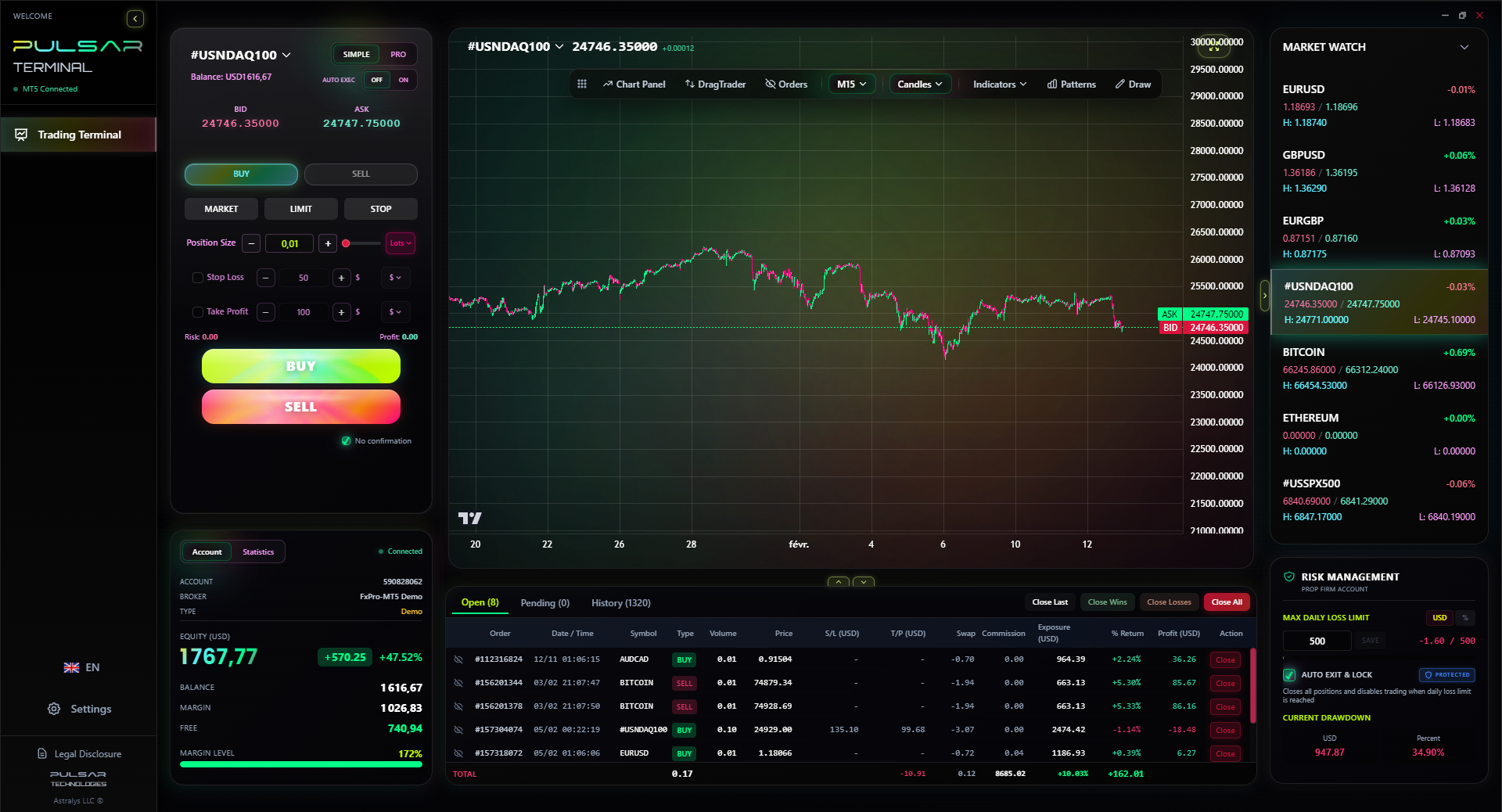
Manually drawing and managing pattern trades is slow; Pulsar Terminal's drag-and-drop orders and multi-target system let you execute your pattern strategy directly on MT5 with precision and speed.
Pulsar Terminal
The all-in-one MT5 companion: drag-and-drop orders, multi-TP/SL, trailing stop, grid trading, Volume Profile, and prop firm protection. Used by 1,000+ traders daily.
I've made all of these. Learn from my losses.
Mistake 1: Seeing Patterns Everywhere (Pareidolia). Your brain wants to find order. You'll start seeing heads and shoulders in random noise. Fix: Wait for a clear, obvious pattern. If you have to force the trendlines, it's not valid.
Mistake 2: Ignoring the Higher Timeframe Trend. Trading a flag pattern in the direction of the daily trend has a much higher success rate than trading against it. A bullish flag on the 1H chart is far more powerful if the daily chart is also bullish. Always check the bigger picture.
Mistake 3: Placing Stops Too Tight. You place your stop just beyond the pattern's boundary to be "efficient." Market noise takes you out, then the pattern completes perfectly. Fix: Give your stop room. Factor in the average spread definition and the pair's average volatility. A 15-pip stop on GBP/JPY is suicide.
Mistake 4: Not Taking Partial Profits. The book shows the full move. Reality often sees price reverse from your target. Fix: Use a multi-target approach. Take 50% off at your first target (1:1 risk-reward), move your stop to breakeven, and let the rest run. This locks in profit and removes stress.
Mistake 5: Revenge Trading After a Failed Pattern. A textbook pattern fails. You lose money. You immediately jump into the next pattern you see, trying to win it back. This is how you blow an account. Fix: After a loss, walk away. The charts will be there tomorrow. A failed pattern is just as valuable a lesson as a winning one.
“A failed pattern is just as valuable a lesson as a winning one. Journal it with the same ruthless detail.”
Should you buy one? Yes, but only one. Get a classic like Bulkowski's "Encyclopedia of Chart Patterns" or Murphy's "Technical Analysis of the Financial Markets." Use it as a reference guide, not a holy text. Study the patterns, understand the psychology behind them, and then immediately start testing them in a demo account with your chosen South African broker's real spreads and conditions.
The real education doesn't come from the book. It comes from the screen time, the journal entries, and the painful lessons learned when a "sure thing" pattern collapses. Your goal isn't to memorise every pattern. It's to master two or three that resonate with you and fit the South African trading environment - our costs, our regulations, and our unique market rhythms.
, a forex chart patterns book is a map. But you're the one driving the car through the chaotic, potholed streets of the live market. The map can show you the general direction, but it can't teach you how to handle a skid on a wet road or avoid a taxi that's suddenly changed lanes. That skill, the skill of execution and risk management, is what separates a student from a professional. Start building that skill today, one well-planned, well-managed pattern trade at a time.
FAQ
Q1What is the single best forex chart patterns book for a beginner in South Africa?
For a complete beginner, I'd recommend starting with the free basics on sites like BabyPips to understand what a chart is, then getting John Murphy's "Technical Analysis of the Financial Markets." It's complete and explains the 'why' behind patterns. Don't buy advanced books until you can draw a trendline and define a pip definition in your sleep.
Q2How does the FSCA's 30:1 use limit affect pattern trading?
It forces better risk management. Many pattern books assume you can use 100:1 or 500:1 use to maximise small moves. At 30:1, you need to be more selective. It discourages micro-scalping tiny patterns and encourages focusing on higher-probability setups on slightly higher timeframes where the expected move is larger relative to your stop. It's a good constraint.
Q3Can I make a living just trading chart patterns in South Africa?
It's incredibly tough. Pattern recognition is a component of a strategy, not the whole strategy. You need impeccable risk management, discipline, and a large enough capital base to withstand drawdowns. Most successful traders I know use patterns as a trigger, but their edge comes from position sizing, portfolio management, and psychological control. Don't quit your day job expecting patterns to pay the bills.
Q4Why do my pattern trades keep getting stopped out before the pattern completes?
Two main reasons. First, your stops are too tight. You're not accounting for normal market volatility or the broker's spread. Widen them. Second, you might be trading on too low a timeframe (like 1-minute or 5-minute charts) where noise dominates. Move up to the 15-minute or 1-hour chart where patterns have more room to breathe and are less likely to be fakeouts.
Q5Are automated pattern recognition tools on MT4/MT5 any good?
They're a decent starting point for scanning, but they're notoriously bad at context. A tool might flag a "double top" based on two similar highs, but it won't know if there was major news between them or if the volume was weak. Use them as an alert system, but always do your own manual analysis. Never let a robot draw your trendlines for you.
Q6How do I handle USD/ZAR when trading patterns?
With extreme caution and much wider parameters. USD/ZAR is an exotic pair with high volatility and often large spreads. Use daily or 4-hour charts for patterns, not hourly. Your stop-losses must be in the hundreds of pips. Because of this, your position size must be much smaller to keep your risk in check. It's a different beast altogether compared to majors like EUR/USD.
Q7What's more important: a perfect pattern or overall market trend?
The overall trend, every single time. A perfect-looking head and shoulders bottom in a strong, established downtrend is a low-probability trade. It's called a "continuation pattern" for a reason. Always, always check the direction of the higher timeframe (the daily chart) before taking a pattern trade on a lower timeframe. Trading with the trend is your greatest ally.
Prof. Winston's Lesson
Key Takeaways:
- ✓Master 2-3 patterns, not 20.
- ✓Always factor in the real spread cost.
- ✓Use the 30:1 use cap as a risk-management tool.
- ✓Your trade journal is your real 'patterns book'.
How useful was this article?
Click a star to rate
Weekly Trading Insights
Free weekly analysis & strategies. No spam.
About the Author
David van der Merwe
Emerging Markets Trader
Johannesburg-based trader with 11 years in emerging market currencies. Specializes in ZAR pairs, FSCA-regulated trading, and South African market analysis.
Comments
Risk Disclaimer
Trading financial instruments carries significant risk and may not be suitable for all investors. Past performance does not guarantee future results. This content is for educational purposes only and should not be considered investment advice. Always conduct your own research before trading.
You Might Also Like

Cara Trading Forex Sukses: 7 Prinsip dari Trader Profesional
Cara trading forex sukses dengan 7 prinsip trader pro: manajemen modal, disiplin, journal trading, backtest. Data nyata, bukan janji profit palsu.
Jam Trading Forex Terbaik untuk Trader Indonesia: Panduan Lengkap dengan Tabel Waktu
Panduan jam trading forex untuk trader Indonesia. Tabel 4 sesi dunia, jam emas 20:00-00:00, sesi mana yang harus dihindari. Data akurat + tips dari trader berpengalaman.
Top 5 Sàn Forex Uy Tín Nhất 2026: Review Jujur dari Trader Indonesia
Top 5 sàn forex uy tín 2026 untuk trader Indonesia. Review jujur: spread, deposit, withdraw, dukungan lokal. Exness, XM, IC Markets & lebih.
Get Pulsar Terminal
All these calculators are built into Pulsar Terminal with real-time data from your MT5 account. One-click position sizing, automatic risk management, and instant calculations.
Get Pulsar Terminal