


I lost R2,300 in a single morning because I picked the wrong account type.

David van der Merwe
Emerging Markets Trader ·  South Africa
☕ 10 min read
What you'll learn:
I lost R2,300 in a single morning because I picked the wrong account type. It was early 2021, just after the FSCA's new 30:1 use rule came in. I was trading EUR/ZAR on a Standard account, thinking the wider spreads were fine. A volatile news spike hit, the spread on my pair ballooned to 15 pips, and my stop-loss was triggered way earlier than I'd calculated. The loss wasn't from a bad call, it was from a bad account choice. That painful lesson taught me that in South Africa, your broker's account types aren't just a menu, they're your first line of risk management. Let me walk you through what I've learned about Forex.com's offerings specifically for us.
This is the most critical starting point, and it's confusing. You'll see websites claiming Forex.com is FSCA-regulated, and others saying it's not. Here's the straight talk from my experience and research.
Forex.com is a global brand owned by StoneX Financial. It holds top-tier licenses from the UK's FCA, the US CFTC, and others. However, for a South African resident, the key regulator is the Financial Sector Conduct Authority (FSCA). Their rules protect you, especially the 30:1 use cap for retail traders that's been in place since 2021.
When I last checked the official FSCA FSP register in early 2024, I could not find 'Forex.com' or 'StoneX Financial Ltd' listed with a local license. This suggests they are servicing South African clients under one of their other international licenses (like the FCA). This isn't necessarily illegal, but it means the FSCA's specific protections, like the use cap, may not be automatically applied by the broker. You must check your account terms.

Warning: If you open an account with Forex.com from South Africa, you will likely be onboarded to their UK (FCA) entity. The FCA also has strong protections, but their retail use rules differ. You must explicitly request that your account adheres to the South African 30:1 limit if that's what you require. Don't assume it's automatic.
The bottom line? Forex.com is a legitimate, well-established broker. But as a South African, you're trading in a regulatory grey area. You're relying on their international reputation rather than direct FSCA oversight. For some traders, that's acceptable given the platform's quality. For others, a locally FSCA-licensed broker like one of those we've reviewed, such as Exness or XM, might feel safer.

💡 Winston's Tip
Never choose an account type based on what's 'recommended.' Choose based on your own trade journal data. If you trade 10 lots a month, the Raw account math will work. If you trade 0.1 lots a month, stick with Standard.
“The loss wasn't from a bad call, it was from a bad account choice.”
Forex.com offers a few core live account structures. The names can vary slightly depending on which regional site you're on, but the essence is the same. Forget the marketing fluff, here’s what they actually mean for your trading.
The Standard Account (The Default)
This is the one most beginners get steered towards. No commissions. The broker makes money from the spread, which is the difference between the buy and sell price. On major pairs like EUR/USD, they advertise spreads starting from 0.7 pips. Sounds good, right?
Here's my experience: that's the starting spread during high-liquidity London/New York overlap. I've seen it sit around 1.2-1.5 pips during Asian hours. On exotic pairs or during news events, it can widen significantly. That's what cost me on EUR/ZAR. This account is simple but can get expensive if you're a high-volume trader or like trading exotics.
The Raw Spread Account (The Active Trader's Choice)
This is the account I switched to after my costly lesson. It gives you raw, interbank spreads that can go as low as 0.0 pips on EUR/USD. The catch? You pay a commission on each trade. The standard rate is $10 USD per 100k lot (round turn).
Let's do the math they don't show you upfront. If the Raw spread is 0.1 pips and the Standard spread is 1.2 pips, the difference is 1.1 pips. On a standard lot, 1 pip on EUR/USD is $10. So, the spread cost on the Standard account is ~$12. On the Raw account, it's $1 (for the 0.1 pip spread) + $10 commission = $11 total. On this trade, the Raw account is actually cheaper.

Example:
- Standard Account: Entry on 1 lot EUR/USD. Spread = 1.2 pips. Cost = 1.2 * $10 = $12.
- Raw Spread Account: Entry on 1 lot EUR/USD. Spread = 0.1 pips. Cost = (0.1 * $10) + $10 commission = $11.
The more you trade, and the larger your positions, the more the Raw account makes sense. It provides transparent, predictable costs.
The DMA Account (For the Pros)
This is for serious volume. We're talking a recommended $25,000 minimum. It offers direct market access and a tiered commission structure that drops as your monthly volume increases. If you're trading 50+ lots a month, it's worth looking at. For most retail traders in SA, this is overkill.
The MT4/MT5 Accounts
These aren't fundamentally different account types in terms of pricing. They are simply Standard or Raw Spread accounts that are connected to the MetaTrader platform instead of Forex.com's own Advanced Trading platform. Your choice here is about the trading software, not the cost structure.
“In South Africa, your broker's account types aren't just a menu, they're your first line of risk management.”
The advertised $100 minimum deposit is just the door fee. The real costs live in the details, especially when you're funding in Rands.
Deposits & Withdrawals: Forex.com doesn't charge fees for most deposit methods. But here's the kicker for us: your account base currency will be USD, GBP, or EUR. If you deposit ZAR from your South African bank account, Forex.com (or their payment processor) will convert it to USD at their own rate, plus a 0.5% conversion fee. You lose on the exchange rate spread twice – once on the way in, once on the way out.
I funded my account with R20,000 in 2023. After conversion, I got about $1,050 in my account. When I withdrew $1,100 a few months later, I received about R20,800 back. The net effect of the conversions and minor market moves meant I effectively paid a hidden fee on my capital. It's not huge, but it's a drag on returns.
Inactivity Fees: Watch out for this. If your account is dormant (no trades) for 12 months, they charge an inactivity fee. It's a common broker practice, but it catches people out.
The use Reality: As a South African, you should be trading at 30:1 max on major forex pairs due to FSCA guidelines. On a $1,000 account, that's about $30,000 in exposure. If Forex.com offers you higher use (like 200:1) because you're on their FCA entity, just say no. Using excessive use is the fastest way to a margin call. Always use a position size calculator to keep your risk in check.
💡 Winston's Tip
The 0.5% currency conversion fee is a silent performance drag. If you deposit R10,000, you start with R50 less in buying power before you even place a trade. Factor this into your risk calculations.
“If Forex.com offers you higher use because you're on their FCA entity, just say no.”
This isn't about which account is 'best.' It's about which one fits your trading personality and wallet. Let me make it simple.
Choose the Standard Account if:
- You're a true beginner, still learning what a pip is.
- You trade infrequently (a few times a month).
- Your average trade size is small (mini or micro lots).
- You value simplicity over absolute lowest cost.
- You primarily trade major currency pairs during active hours.
Choose the Raw Spread Account if:
- You trade frequently (daily or weekly).
- Your trade sizes are larger (standard lots).
- You trade exotic pairs or instruments where spreads vary wildly.
- You are a scalper and need the tightest possible entry costs.
- You want transparent, predictable fees (spread + commission).
A personal rule: I don't even consider the Standard account anymore. Even on a small $500 trade, I prefer knowing my exact cost upfront. The Raw account forces that discipline. When I'm swing trading a pair like XAU/USD (gold), the spread can be volatile. The Raw account gives me more consistency.
Here’s a quick comparison I wish I had seen years ago:
| Feature | Standard Account | Raw Spread Account |
|---|---|---|
| Best For | Beginners, Casual Traders | Active Traders, Scalpers |
| Pricing Model | Variable Spread (No Commission) | Raw Spread + Commission |
| Avg. EUR/USD Spread | 0.7 - 1.5 pips | 0.0 - 0.3 pips |
| Commission | None | $10 per 100k lot (round turn) |
| Cost on 1 Lot Trade | ~$7 - $15 (via spread) | ~$0 - $3 (spread) + $10 (comm) = $10 - $13 |
| Cost Certainty | Low (spread varies) | High (commission is fixed) |
“If Forex.com offers you higher use because you're on their FCA entity, just say no.”
Your account type grants you access to Forex.com's platforms. This is where they genuinely shine.
MetaTrader 4 & 5 (MT4/MT5): The global standard. If you use Expert Advisors (EAs) or custom indicators, you'll be on MT4 or MT5. Connection in South Africa is generally stable. I've had fewer disconnection issues with Forex.com's MT5 servers than with some other international brokers. Their dedicated MT4/MT5 accounts are just Standard accounts linked to that platform.
Forex.com's Advanced Trading Platform: This is their in-house web and desktop platform. It's excellent. The charting is powerful, the news feed is integrated, and the order entry is slick. For discretionary trading without EAs, I often prefer it over MT5. It works flawlessly from Johannesburg.
TradingView Integration: This is a big plus. You can connect your Forex.com account directly to TradingView and execute trades from their world-class charts. If you're a TradingView fan, this feature alone is a major reason to consider Forex.com.
Mobile Apps: Both the Forex.com and MT4/MT5 mobile apps are solid. I've managed trades and set alerts from my phone with no issues, crucial when load-shedding hits the home Wi-Fi.

Pro Tip: Don't sleep on the demo account. Open a demo for each account type (Standard and Raw). Trade your usual strategy for a week on each. Compare your final 'costs' (spread impact on demo Standard vs. commission on demo Raw). The data won't lie.
💡 Winston's Tip
Demo test both account types with your real strategy. The difference in 'slippage' and fill quality between Standard and Raw accounts can be more important than the spread or commission.
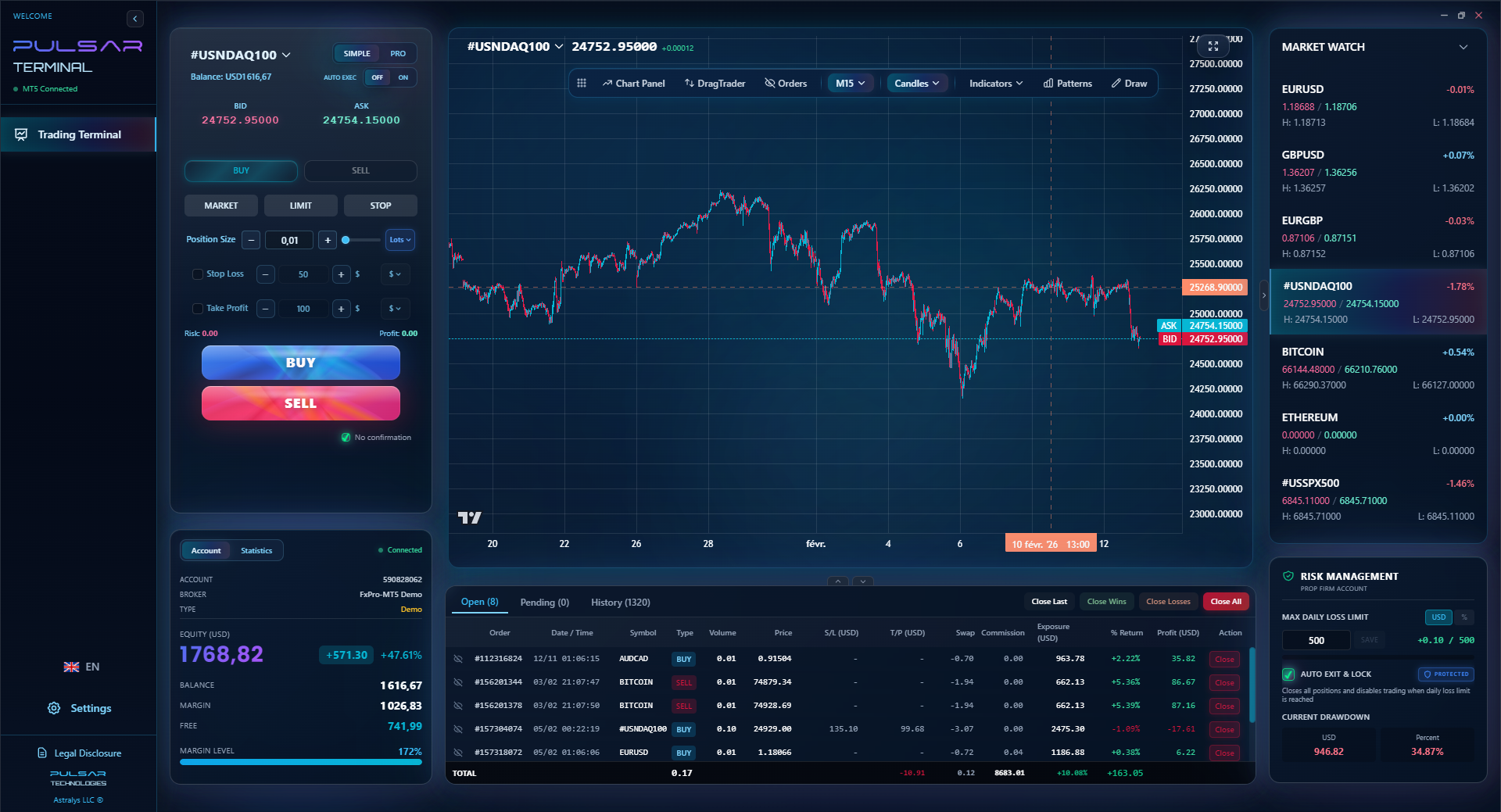
Managing complex trades across Forex.com's platforms is easier with tools that let you set multiple take-profits and trailing stops with a single click, directly on your MT5 charts.
Pulsar Terminal
The all-in-one MT5 companion: drag-and-drop orders, multi-TP/SL, trailing stop, grid trading, Volume Profile, and prop firm protection. Used by 1,000+ traders daily.
“I treat Forex.com as a premium tool for specific jobs, not my only trading home.”
Forex.com is a superb international broker. But is it the best fit for every South African? Not necessarily. You have to weigh the pros and cons in our local context.
The Forex.com Advantages:
- Platform Quality: Their Advanced Platform and TradingView link are top-tier.
- Market Access: Huge range of instruments beyond forex (indices, commodities, crypto).
- Reputation: Long-standing, publicly traded company (StoneX).
- Raw Spreads: Genuinely competitive pricing for active traders.
The Drawbacks for South Africans:
- No Direct FSCA License: You're not protected under the FSCA's ombud.
- ZAR Conversion Fees: The 0.5% fee on currency conversion eats into your capital.
- Limited Local Payments: No direct EFT, Ozow, or instant EFT options. You're using international card or bank transfer.
- Customer Support: No local phone number. You're dealing with overseas support, which can mean time-zone delays.
When to Look at a Local Broker: If you want to fund and withdraw in Rands with no conversion fees, need a local support line, and want the absolute certainty of FSCA regulation (and its 30:1 use enforcement), then a broker like IC Markets (which has a strong SA presence) or Pepperstone might be a better fit. They often offer similar Raw/Standard account structures but with local banking.
My Verdict: I keep a funded Forex.com Raw Spread account for its platforms and execution when I'm trading strategies that benefit from their tools. But I don't keep all my capital there. I treat it as a premium tool for specific jobs. For a South African just starting out, the currency conversion and regulatory grey area make it a less-than-ideal first choice. Get your feet wet with a fully FSCA-licensed broker first. Once you're consistently profitable and your strategy demands a platform like Forex.com's, then make the move with your eyes wide open.
FAQ
Q1What is the minimum deposit for a Forex.com account in South Africa?
The official minimum deposit is $100 USD. However, when depositing South African Rand (ZAR), this amount will be converted to USD, and you should factor in the exchange rate and a 0.5% conversion fee. Realistically, you should consider depositing at least R2,000 to have meaningful trading capital after conversion.
Q2Can I get 30:1 use with Forex.com as a South African trader?
It's not automatic. Forex.com services South African clients primarily under its UK (FCA) regulation, which has different use rules. You must explicitly request that your account be set to adhere to the South African FSCA's 30:1 retail use limit. Do not assume your account will default to this setting.
Q3Which Forex.com account type has the lowest trading costs?
It depends on your trade size and frequency. For small, infrequent trades, the commission-free Standard account can be cheaper. For active traders or those trading standard lots, the Raw Spread Account usually offers lower total costs because you pay a small raw spread plus a fixed $10 commission, which is often less than the wider variable spread of the Standard account.
Q4Does Forex.com accept South African Rand (ZAR) deposits?
You can initiate a deposit in ZAR from your South African bank account, but Forex.com will convert it to USD, EUR, or GBP (your chosen account currency) at their exchange rate, plus a 0.5% conversion fee. They do not offer ZAR-denominated trading accounts.
Q5What is the difference between a Forex.com MT5 account and a Standard account?
An 'MT5 account' is typically a Standard account that is set up to be used on the MetaTrader 5 platform. The core pricing model (commission-free with variable spreads) is the same as the Standard account accessed through Forex.com's own platform. The difference is the trading software you use, not the account fee structure.
Q6Are there any hidden fees I should know about?
The main 'hidden' cost for South Africans is the dual currency conversion fee (around 0.5% each way) when funding and withdrawing. Also, be aware of the inactivity fee charged if your account has no trading activity for 12 consecutive months. Always read the full schedule of fees on their website.
Q7Is Forex.com better than local South African brokers?
"Better" is subjective. Forex.com offers superior trading platforms (like its Advanced Platform and TradingView integration) and direct market access. Local FSCA-licensed brokers often offer easier ZAR funding, local customer support, and automatic adherence to SA use rules. Forex.com is a premium international tool; local brokers offer more convenience and regulatory certainty for residents.
Prof. Winston's Lesson
Key Takeaways:
- ✓Verify FSCA status directly; don't trust third-party lists.
- ✓Raw accounts save active traders money despite the $10 commission.
- ✓Factor in the 0.5% FX fee on all ZAR deposits.
- ✓Use a demo to compare real costs between account types.
- ✓use above 30:1 is a risk, not a privilege.
How useful was this article?
Click a star to rate
Weekly Trading Insights
Free weekly analysis & strategies. No spam.
About the Author
David van der Merwe
Emerging Markets Trader
Johannesburg-based trader with 11 years in emerging market currencies. Specializes in ZAR pairs, FSCA-regulated trading, and South African market analysis.
Comments
Risk Disclaimer
Trading financial instruments carries significant risk and may not be suitable for all investors. Past performance does not guarantee future results. This content is for educational purposes only and should not be considered investment advice. Always conduct your own research before trading.
You Might Also Like

Cara Trading Forex Sukses: 7 Prinsip dari Trader Profesional
Cara trading forex sukses dengan 7 prinsip trader pro: manajemen modal, disiplin, journal trading, backtest. Data nyata, bukan janji profit palsu.
Jam Trading Forex Terbaik untuk Trader Indonesia: Panduan Lengkap dengan Tabel Waktu
Panduan jam trading forex untuk trader Indonesia. Tabel 4 sesi dunia, jam emas 20:00-00:00, sesi mana yang harus dihindari. Data akurat + tips dari trader berpengalaman.
Top 5 Sàn Forex Uy Tín Nhất 2026: Review Jujur dari Trader Indonesia
Top 5 sàn forex uy tín 2026 untuk trader Indonesia. Review jujur: spread, deposit, withdraw, dukungan lokal. Exness, XM, IC Markets & lebih.
Get Pulsar Terminal
All these calculators are built into Pulsar Terminal with real-time data from your MT5 account. One-click position sizing, automatic risk management, and instant calculations.
Get Pulsar Terminal