


I lost R4,200 in about 30 seconds.

David van der Merwe
Emerging Markets Trader ·  South Africa
☕ 9 min read
What you'll learn:
- 1What Exactly is the Forex.com API?
- 2The South African Regulatory Reality (It's Not What You Think)
- 3The Hidden Cost: Your Rand is Not Welcome Here
- 4Real API Costs (Beyond the Spread)
- 5Who Should Actually Use This API? (Spoiler: Probably Not You)
- 6Practical Alternatives for South Africans
- 7Common API Pitfalls That Will Blow Your Account
- 8Final Verdict for South African Traders
I lost R4,200 in about 30 seconds. Not on a bad trade, but on a stupid technical mistake. I was testing a custom script with a broker's API, got a decimal place wrong in my order size, and watched my account get liquidated before I could hit cancel. That's the reality of trading with an API. For South Africans looking at the Forex.com API, the promise of automated trading is seductive. But the real story isn't about fancy code, it's about hidden fees, regulatory gaps, and the brutal math of converting ZAR to USD every time you want to play.
Let's cut through the jargon. An API (Application Programming Interface) is basically a set of rules that lets your software talk to Forex.com's servers. Instead of clicking buttons on MT5, you write code that says "buy 0.1 lots of EUR/USD at market." The Forex.com API is how you connect automated trading systems, custom indicators, or portfolio management tools directly to your live trading account.
There are two main parts you need to know about. The first is the trading API, which handles orders, positions, and account info. The second is the market data API, which streams live prices. For South African traders, this sounds like a dream - automate your scalping strategy or manage complex swing trading setups while you sleep. But here's the catch: the API doesn't make you a better trader. It just makes your mistakes faster and more expensive.
Forex.com offers its API primarily through its proprietary platform environment and supports common protocols. The key thing to remember is that it's a tool for execution, not a magic profit generator. If your strategy is flawed, automating it just means you'll lose money systematically instead of emotionally.
This is the most critical section for any local trader. Forex.com is NOT regulated by the Financial Sector Conduct Authority (FSCA). Let me repeat that. They operate under international licenses from bodies like the UK's FCA or ASIC in Australia. For you, this means one thing: if something goes wrong, your recourse is complicated, expensive, and overseas.
The FSCA caps use for retail traders at 30:1. This is a safety rule. When you use Forex.com's global entity, you might have access to higher use - perhaps 200:1. That's not a benefit, it's a trap. I've seen too many guys blow accounts because they used 100:1 use on a volatile pair, only to get a margin call from a tiny move against them. The API makes this even riskier, as an automated system can pile on margin without a second thought.

Warning: Trading with an offshore broker like Forex.com means you voluntarily step outside the FSCA's consumer protection framework. Your funds are not held in a South African trust account. In a dispute, you're looking at international arbitration, not a quick call to the FSCA ombudsman.
Why This Matters for API Users
When you're coding, you assume the broker's system will behave predictably. Regulatory differences can affect everything from order execution speed during news events to how your stop-loss is triggered. A glitch or a "technical outage" during a major ZAR move could wipe out your automated strategy, and you'll have very little local ground to stand on when complaining.

💡 Winston's Tip
An API is a magnifying glass. It makes a good strategy more efficient and a bad strategy more fatal. Never automate a strategy you haven't traded manually for a full year.
“The Forex.com API is a powerful, professional-grade tool. For the vast majority of South African retail traders, it's a solution in search of a problem.”
Here's a cost most tutorials ignore. Forex.com does not offer ZAR as a base account currency. Your account must be in USD, GBP, or EUR. Every single deposit and withdrawal involves a currency conversion.
Let's run the numbers with a real example from last year. I deposited R20,000. My bank (FNB) charged a R250 fee for the international payment. The USD/ZAR rate offered by the broker's payment processor had a spread of about 1.5% baked into it - that's a R300 loss right there. So, before I even placed a trade, R550 was gone. That's over 2.7% of my capital, vanished. When I withdrew $500 profit, another conversion hit me. That 0.5% conversion fee Forex.com mentions is just their cut; your bank's spread is the real killer.

Example: Deposit: R20,000 Bank Fee: -R250 Implied FX Spread (1.5%): -R300 Usable Capital: ~R19,450 Immediate Loss: 2.75%
For API trading, where you might make frequent small deposits to test strategies, these fees compound brutally. It completely changes your risk math. A strategy that needs a 2% buffer now needs a 5% buffer just to break even on deposits and withdrawals. This makes using a position size calculator absolutely non-negotiable, as your true starting equity is lower than you think.
Everyone looks at the spread. On a Forex.com Raw Spread account, you can get EUR/USD from 0.0 pips plus a $10 per lot commission. That's clean. But API trading introduces other costs.
1. Infrastructure Cost: Your code needs to run somewhere, 24/5. A reliable virtual private server (VPS) hosted near the broker's servers (often in London or New York) will cost you at least $20-$50 a month. That's R400-R1000. If your home internet dips, your bot misses trades.
2. Development & Debugging Cost: My R4,200 mistake I mentioned earlier? That was a debugging cost. You will have losing trades because of your code, not the market. A misplaced decimal on a pip definition can be catastrophic. Testing with small amounts isn't always realistic because of the minimum trade sizes.
3. Data Cost: While basic price feeds might be free, low-latency, institutional-grade data streams cost money. If you're serious about high-frequency strategies, this is a major expense.
4. Opportunity Cost: The hours you spend coding, testing, and fixing could have been spent learning price action or mastering the MACD indicator on a demo account. I spent three months building a complex grid trader, only to find it underperformed a simple trend-following strategy on XAU/USD.
“Your edge in the market should come from your trading insight, not your ability to write a HTTP POST request.”
I'm not saying don't use it. I'm saying be brutally honest about which category you fall into.
You might be a candidate if:
- You are a proficient programmer (Python, C#, Java) with a live-tested, profitable manual strategy you want to systematize.
- You understand network latency, error handling, and have a dedicated VPS.
- Your trading capital is significant enough that the ZAR conversion and infrastructure fees are a rounding error (think R500,000+).
- You fully accept that the first R10,000 you 'invest' in the project will likely be lost to coding errors and live-testing losses.
You should avoid it like the plague if:
- You're still searching for a 'holy grail' strategy.
- You think API trading will finally make you disciplined.
- Your account size is under R50,000. The fees will eat you alive.
- You can't read a broker's full API documentation without getting a headache.
For most South African traders, a better path is to use a strong platform like MT5 with Expert Advisors (EAs). The automation is there, but it's contained within a safer, more controlled environment. Brokers like IC Markets or Pepperstone, who also have strong API offerings, are FSCA-regulated, which is a huge plus for peace of mind.
💡 Winston's Tip
The first rule of API trading: Your code must survive a disconnection. Always assume the internet will fail at the worst possible moment and program defensively.
Before you dive into the Forex.com API rabbit hole, consider these steps first.
- Master a Platform First: Get exceptionally good at MT5 or TradingView. Learn to code simple indicators or scripts there. The RSI indicator might be boring, but knowing how to code an RSI divergence alert is a foundational skill.
- Use an FSCA-Regulated Broker with an API: Some international brokers with FSCA licenses offer APIs. You get the local protection and the automation tools. Do your homework.
- Start with a Trade Copier: Services exist that can copy trades from one MT5 account to another. This lets you 'automate' by manually trading a small master account while a larger account copies it. It's crude, but it works and has no coding risk.
- Demo, Demo, Demo: Run your automated strategy on a demo account for at least three months, through different market conditions (risk-on, risk-off, high volatility). Track every trade in a spreadsheet. If it's not profitable here, the API won't save it.

Pro Tip: If you're determined to code, start by using the API to pull your trade history and analyze your performance. Build a personal dashboard before you ever let it place a live trade. This teaches you the connection without risking capital.
“Before I even placed a trade, R550 was gone. That's over 2.7% of my capital, vanished.”
These aren't theories, these are scars.
- No Rate Limiting: Your code sends 100 order requests in a second due to a loop error. The broker's system executes them all. You're now over-leveraged and get liquidated.
- Poor Error Handling: The API connection drops. Your code doesn't reconnect gracefully or check existing positions. It starts trading as if nothing is open, doubling your risk.
- Assuming Order Fill: You send a market order but don't confirm the fill price before calculating your stop-loss. Slippage on EUR/USD during news means your stop is already in loss territory.
- Ignoring the Rollover: You build a grid bot that holds positions for days. You forget to account for swap fees (overnight financing). After a month, your small profits are completely erased by negative swaps.
- Testing in a Vacuum: You backtest using perfect, clean historical data. Live data has gaps, spikes, and latency. Your beautiful strategy falls apart because it never accounted for a 2-second delay in price feed.
The common thread? The market doesn't care about your elegant code. It will find the one flaw you didn't think of. Manual trading punishes psychological weakness. API trading punishes logical incompleteness.
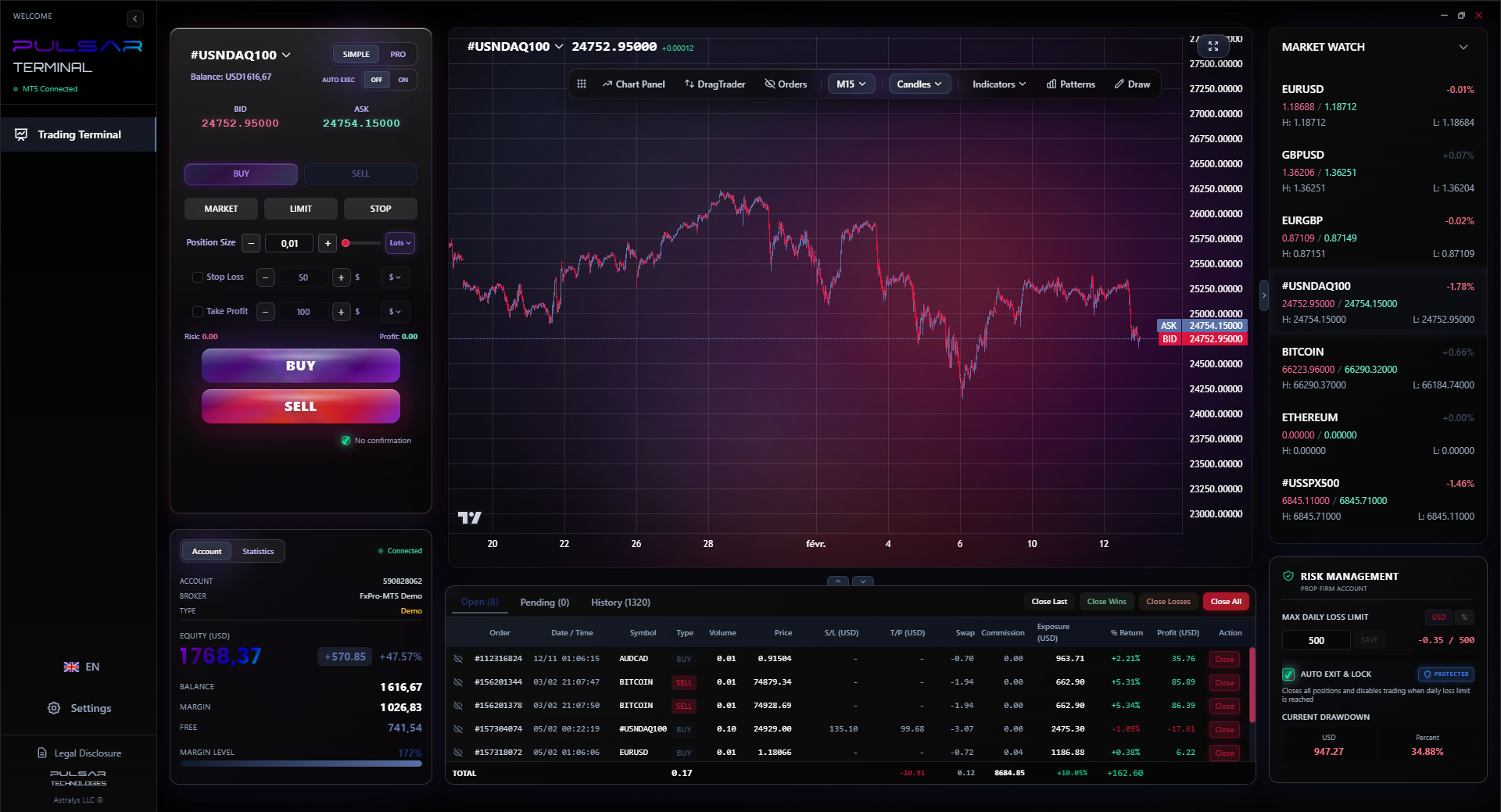
If you're looking for sophisticated automation and risk management without the peril of coding a full API integration, Pulsar Terminal offers drag-and-drop order systems, automated trailing stops, and prop firm challenge safeguards directly on your MT5 platform.
Pulsar Terminal
The all-in-one MT5 companion: drag-and-drop orders, multi-TP/SL, trailing stop, grid trading, Volume Profile, and prop firm protection. Used by 1,000+ traders daily.
The Forex.com API is a powerful, professional-grade tool. For the vast majority of South African retail traders, it's a solution in search of a problem. The regulatory disconnect, the ZAR conversion tax, and the high technical barrier create a triple hurdle that makes consistent profitability even harder than it already is.
I've used it. I've made money with it on specific, boring arbitrage strategies. I've also lost more money fixing it than I ever made. Your edge in the market should come from your trading insight, not your ability to write a HTTP POST request.
Focus on finding a real edge first. Use an FSCA-regulated broker where possible. Keep your systems simple. Once you have a years-long track record of manual profitability, then maybe - just maybe - consider automation. But by then, you'll probably realize that sitting at the screen, feeling the market's pulse, was where the real edge was all along. The API just becomes a way to execute the boring stuff you already know works.
If you do proceed, start with a broker that offers a sandbox/test environment. Fund your live account with money you can afford to lose to both market moves and your own bugs. And for goodness sake, always use a position size calculator in your code - never hardcode trade values.
FAQ
Q1Can I fund my Forex.com account directly in South African Rands (ZAR)?
No. Forex.com does not offer ZAR as a base account currency. You must deposit in USD, GBP, or EUR. Your South African bank will convert your Rands, and you will lose money on the exchange rate spread and bank fees, often totaling 2-3% of your deposit.
Q2Is Forex.com legal and safe for South African traders?
It is legal to use, but it is not regulated by the South African FSCA. It is regulated by overseas bodies like the UK FCA. This means you do not have the direct protection of South African financial laws. Your funds are held offshore, and dispute resolution would be international.
Q3What use can I get with Forex.com from South Africa?
If you open an account with Forex.com's international entity, you may see use offers up to 200:1. However, the FSCA's retail use limit is 30:1. Using higher use is extremely risky and is a common reason for rapid account blow-ups, especially with automated trading.
Q4What's the minimum deposit to start using the Forex.com API?
The minimum deposit for a standard Forex.com account is $100 (about R1,800+). However, to practically use the API for live trading, you need significantly more capital to absorb testing losses, conversion fees, and infrastructure costs. I wouldn't consider it with less than $2,000.
Q5Are there FSCA-regulated brokers that offer similar APIs?
Yes. Some international brokers have obtained FSCA licenses and offer API access. This provides a better balance of automation capability and local regulatory safety. It's worth researching these options before committing to an entirely offshore setup like Forex.com.
Q6Do I need to be a programmer to use a trading API?
Absolutely yes. You need a solid understanding of programming, network connections, and error handling. Using pre-built 'bot' software with an API is very dangerous if you don't understand the code, as you can't fix it when it breaks (and it will break).
Prof. Winston's Lesson
Key Takeaways:
- ✓Forex.com is not FSCA-regulated. You lose local protection.
- ✓ZAR conversion fees can cost you 2-3% before you even trade.
- ✓API errors lose money faster than bad market decisions.
- ✓Use an API only after a year of proven manual profitability.
How useful was this article?
Click a star to rate
Weekly Trading Insights
Free weekly analysis & strategies. No spam.
About the Author
David van der Merwe
Emerging Markets Trader
Johannesburg-based trader with 11 years in emerging market currencies. Specializes in ZAR pairs, FSCA-regulated trading, and South African market analysis.
Comments
Risk Disclaimer
Trading financial instruments carries significant risk and may not be suitable for all investors. Past performance does not guarantee future results. This content is for educational purposes only and should not be considered investment advice. Always conduct your own research before trading.
You Might Also Like

Cara Trading Forex Sukses: 7 Prinsip dari Trader Profesional
Cara trading forex sukses dengan 7 prinsip trader pro: manajemen modal, disiplin, journal trading, backtest. Data nyata, bukan janji profit palsu.
Jam Trading Forex Terbaik untuk Trader Indonesia: Panduan Lengkap dengan Tabel Waktu
Panduan jam trading forex untuk trader Indonesia. Tabel 4 sesi dunia, jam emas 20:00-00:00, sesi mana yang harus dihindari. Data akurat + tips dari trader berpengalaman.
Top 5 Sàn Forex Uy Tín Nhất 2026: Review Jujur dari Trader Indonesia
Top 5 sàn forex uy tín 2026 untuk trader Indonesia. Review jujur: spread, deposit, withdraw, dukungan lokal. Exness, XM, IC Markets & lebih.
Get Pulsar Terminal
All these calculators are built into Pulsar Terminal with real-time data from your MT5 account. One-click position sizing, automatic risk management, and instant calculations.
Get Pulsar Terminal