


You want to trade forex from Nigeria.

Olumide Adeyemi
West African Trading Pioneer ·  Nigeria
☕ 9 min read
What you'll learn:
You want to trade forex from Nigeria. You've seen the ads, the flashy cars, the 'mentors' promising millions. But which forex companies in Nigeria are actually legit? The truth is, most of what you see locally is either a scam, a bucket shop, or a marketing front for an unregulated broker. I've traded from Lagos for over a decade, and I've seen it all. This isn't about hype. It's about finding a platform that won't disappear with your money when you try to withdraw.
Let's cut through the noise. The 'forex companies' you see advertised on billboards and Instagram? Nine times out of ten, they're not brokers. They're signal sellers, 'academies', or Introducing Brokers (IBs) for offshore platforms. Their business model is to sign you up, collect a commission from your trades (win or lose), and move on. The actual trading happens on a platform owned by a company in Cyprus, Australia, or the Seychelles.
This creates a weird gap. You're dealing with a local face, but your money and legal protection are held by a foreign entity. When things go wrong - a disputed withdrawal, a platform glitch - that local 'company' often has zero power to help you. I learned this the hard way in 2017. I deposited ₦500,000 with a 'highly recommended' Lagos-based IB. When their offshore broker had 'liquidity issues', my local contact vanished. Poof. Gone. The money was unrecoverable.
Your first job is to separate the marketing from the mechanics. A real forex company for you, a Nigerian trader, is the licensed entity that holds your deposit and executes your trades. Everything else is just middlemen.
“Your first job is to separate the marketing from the mechanics.”
Nigerian traders are targeted more than most. Here’s your scam radar.
The Guarantee Gang
Anyone guaranteeing profits, offering a 'risk-free' trial, or promising specific monthly returns (e.g., 'Make 20% monthly!') is lying. Forex is risk. Period. I once sat in a webinar where a 'guru' guaranteed to turn ₦200k into ₦2 million in 6 months. It was pure emotional salesmanship, and people lost everything.
The Registration Red Flag
A proper broker will ask for rigorous KYC (Know Your Customer): a valid ID, proof of address (like a utility bill), sometimes a bank statement. If a 'company' lets you sign up and deposit with just an email and phone number, run. They are either not regulated or planning to make withdrawals impossible by later demanding documents you can't provide.
The Withdrawal Warning
This is the ultimate test. Read reviews, specifically searching for 'withdrawal' + 'Nigeria' + [broker name]. If you see multiple complaints about delays, hidden fees converting back to Naira, or accounts being frozen after a profitable run, steer clear. A legitimate process should take 1-5 business days for most methods.

Warning: Be extremely wary of brokers that only accept deposits via bank transfer to a personal Nigerian account (e.g., 'John Doe, GTBank'). This is a massive red flag. You should always deposit directly to the broker's corporate account in their regulated jurisdiction.

💡 Winston's Tip
Your broker is a utility, not a partner. If they make funding or withdrawing difficult, they've failed their one job. Replace them.
“If a 'company' lets you sign up and deposit with just an email and phone number, run.”
Forget the local branding. You need an internationally recognized broker with a solid reputation that accepts Nigerian clients. Here’s the breakdown based on my experience and that of traders I mentor.
| Broker | Why It Works for Nigeria | The Catch |
|---|---|---|
| Exness | Hugely popular here. Offers local deposit/withdrawal channels (bank transfer, cards, some local processors). Spreads are tight on majors. | Can be seen as a 'market maker' for smaller accounts. Their VIP/Premium tiers are where conditions improve significantly. Read our full Exness review for details. |
| IC Markets | A true ECN/STP broker. Raw spreads, great execution. Accepts Nigerian clients without issue. My primary platform for raw spreads. | Minimum deposit is $200, which is higher than some. Withdrawals to Nigerian banks work but can take 3-5 days. Check our IC Markets review. |
| XM | Well-regulated, offers a ton of educational resources (useful for beginners). Consistent in accepting Naira deposits via local bank transfer. | Spreads aren't the absolute lowest. More of a retail-friendly broker than a pure raw spread provider. Our XM review has the specifics. |
| Pepperstone | Top-tier Australian regulation, excellent execution. Great for serious traders who value reliability over flashy bonuses. | Might be less flexible with local payment methods than Exness. You'll likely use international cards or wire transfers. See the Pepperstone review. |
The key is funding. Exness often has the smoothest Naira on-ramp. But if you can manage an international debit/credit card or a USD wire transfer, your options open up to brokers like IC Markets and Pepperstone, which I prefer for their transparency.

Pro Tip: Never deposit more than you can afford to lose on a first test. Fund your new account with the minimum, place a few small trades, and then immediately request a partial withdrawal. If the withdrawal arrives smoothly and in a reasonable time, you've passed the first major test.
“If a 'company' lets you sign up and deposit with just an email and phone number, run.”
This is your biggest practical hurdle. The CBN's policies make direct USD transactions tricky. Here's how traders are moving money.
1. International Debit/Credit Cards (Visa/Mastercard): This is often the best way. Deposit in USD/GBP/EUR, your bank handles the conversion. For withdrawals, the broker sends USD back to your card. The catch? Your Nigerian bank might block the transaction, flagging it as 'international forex'. You must call your bank's customer service before you deposit to pre-authorize transactions with your broker's name.
2. Broker-Local Payment Partners: Brokers like Exness integrate with local payment processors. You get instructions to pay Naira to a Nigerian company, and they credit your trading account in USD. It's convenient, but watch the exchange rate they use. It's often 2-5% worse than the official market rate, which is a hidden cost.
3. Cryptocurrency (USDT): A growing number of savvy traders use this. You buy USDT on a local P2P platform, send it to the broker's crypto wallet, and it's converted to trading capital. Withdrawals are the reverse. It's faster and bypasses banks, but introduces crypto volatility risk during transfer and requires you to be comfortable with wallets.
I use a combination. For speed, I'll use a card. For larger amounts, I swallow the fee and use the broker's local partner for deposits. Always, and I mean always, use a position size calculator to ensure your trade size reflects the true cost of getting that capital into your account.
💡 Winston's Tip
The spread isn't just a cost; it's a headwind. If you're trading a pair with a 3-pip spread, you start every race 3 meters behind the start line. Choose your battles wisely.
“Your strategy must account for two Nigerian realities: unreliable electricity and currency volatility.”
Your strategy must account for two Nigerian realities: unreliable electricity/internet and currency volatility. Overnight swing trading on the 4H or Daily chart is more forgiving than trying to scalping the 1-minute chart during a blackout.
Focus on high-probability, lower-frequency setups. I trade primarily the London and New York session overlaps on EUR/USD and GBP/USD. I use the MACD indicator on the 4H chart for trend direction and the RSI indicator on the 1H for entry timing. A typical trade might target 50-80 pips and last 12-48 hours.
Let me give you a real, recent example. On March 15th, I saw EUR/USD holding strong support on the 4H chart. The MACD was hinting at a bullish crossover, and the 1H RSI was dipping into oversold territory (below 30). I bought at 1.0875. I set my stop loss 30 pips away at 1.0845. My first take-profit was at 1.0925 (50 pips), and I let a runner go with a trailing stop. The trade hit the first TP in about 8 hours. The runner eventually got stopped out for an extra 25 pips. Total gain: 75 pips. Not glamorous, but consistent. This method doesn't require me to stare at the screen all day.

Example: On that EUR/USD trade, my position size was 0.5 lots. A 75-pip win on EUR/USD with that size is $375. After accounting for the spread and the funding costs to get that money into my account, my real net was closer to $340. That's the math you must do.
“Your strategy must account for two Nigerian realities: unreliable electricity and currency volatility.”
Prop trading firms are exploding in popularity here. The pitch is seductive: pass a challenge, trade their capital, keep most of the profits. For Nigerian traders starved of capital, it feels like a golden ticket.
But listen closely. Most of these firms are not Nigerian. They're overseas businesses targeting emerging markets. Their 'challenges' are designed for you to fail. The rules are brutal: tiny daily loss limits, unrealistic profit targets within a short time, and rules against news trading. They profit from the thousands who pay the challenge fee (often $200-$500) and fail.
If you attempt this, treat the fee as a high-cost educational expense. Do not mortgage your future for it. The strategy needed to pass is ultra-conservative, focusing on not hitting the daily loss limit above all else. You're not trading to win; you're trading not to lose. This is a specific skill. Some tools, like certain trading terminals, offer features that can automatically enforce these strict daily loss limits, which is almost a necessity to have a fighting chance.
I tried a popular firm's challenge in 2022. I passed Phase 1, only to blow the daily loss limit in Phase 2 on a single GBP/USD spike during the UK inflation report. I lost the $300 fee. The lesson? If you're not already a consistently profitable trader with your own money, a prop firm challenge is just a very expensive lottery ticket.
💡 Winston's Tip
A strategy that requires constant screen attention in a country with regular power outages is not a strategy. It's a prayer.
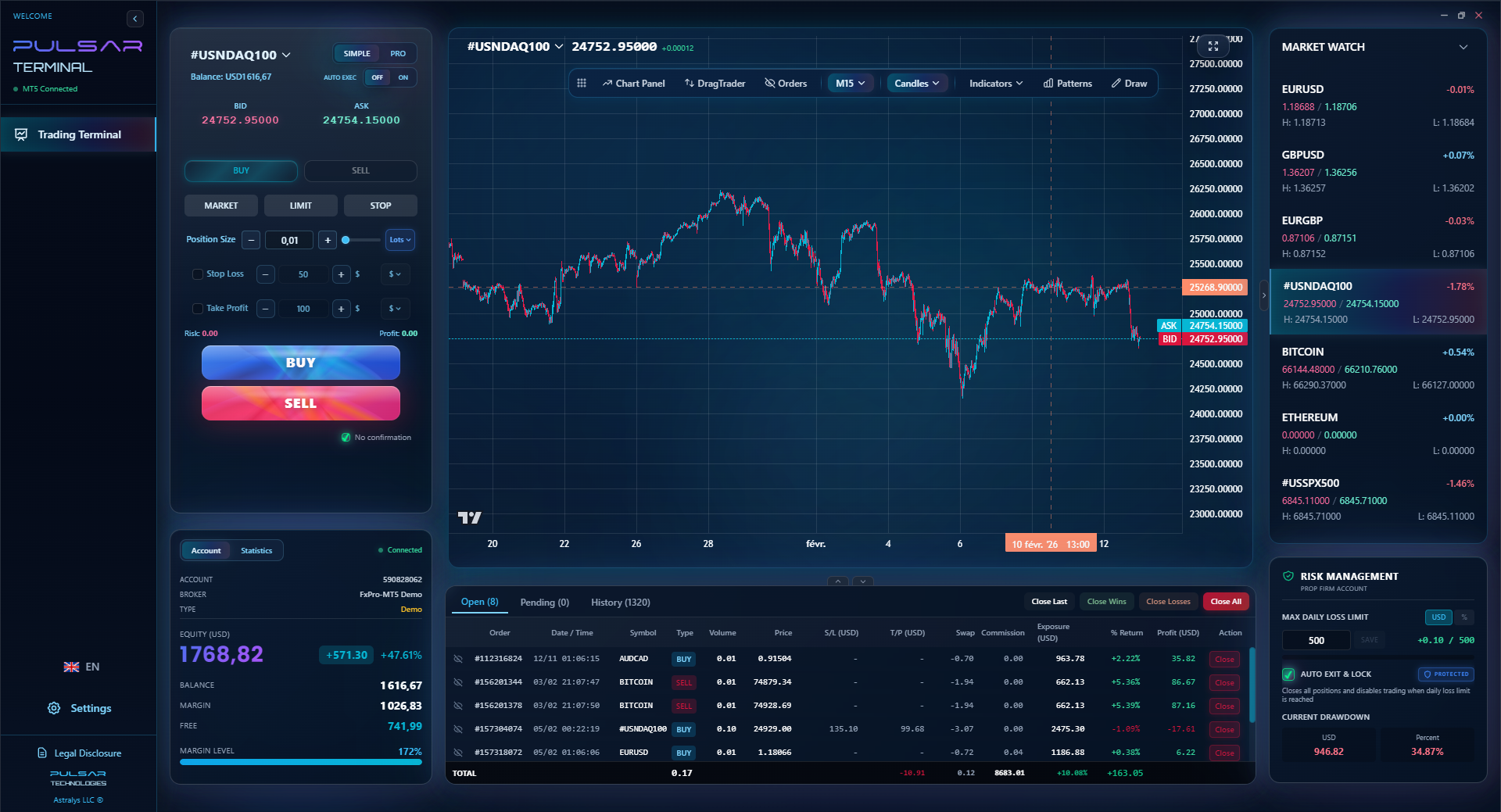
Managing the brutal daily loss limits of a prop firm challenge requires robotic discipline, which is exactly what automated trade management tools in platforms like Pulsar Terminal are built for.
Pulsar Terminal
The all-in-one MT5 companion: drag-and-drop orders, multi-TP/SL, trailing stop, grid trading, Volume Profile, and prop firm protection. Used by 1,000+ traders daily.
“If you're not already a consistently profitable trader with your own money, a prop firm challenge is just a very expensive lottery ticket.”
- Choose a Real Broker: Pick one from the list above. Start with Exness if you want easy Naira funding, or IC Markets if you can fund via card. Open a demo account first. Live with it for two weeks.
- Test the Withdrawal: Deposit the absolute minimum (e.g., $50). Trade it lightly for a week. Then, withdraw it all. If it comes back to your Nigerian account without drama, you've found a keeper.
- Start Small & Simple: Fund your live account with an amount you can afford to lose. Trade micro lots (0.01). Focus on one or two major pairs like EUR/USD or XAU/USD. Avoid exotic pairs with huge spreads.
- Protect Your Capital: Your first goal is survival, not riches. Use stop losses on every single trade. Never risk more than 1-2% of your account on a trade. Understand what a margin call is so you never experience one.
- Ignore the Noise: Unfollow every Instagram 'forex millionaire' showing off rented cars. Your journey is a slow grind of disciplined risk management. That's the only real path forward from Nigeria.
FAQ
Q1Is forex trading legal in Nigeria?
Yes, trading forex with international brokers is legal for individuals. However, the Central Bank of Nigeria (CBN) restricts banks from facilitating payments for margin forex trading, which is why funding your broker can be tricky. You are not breaking the law by trading, but your bank might block the transaction.
Q2Which broker is best for Nigerian beginners?
Exness is often the easiest for beginners due to its straightforward Naira deposit options and low minimum deposit. However, 'best' depends on your goals. For raw spreads and growth, IC Markets is superior. Always test withdrawals with a small amount first.
Q3How much money do I need to start forex trading in Nigeria?
You can start with as little as $10-$50 with some brokers. Realistically, to trade properly with sensible risk management (using micro lots), a starting capital of $200-$500 is more practical. This allows you to withstand normal market swings without being wiped out by a single loss.
Q4Why do my withdrawals keep getting delayed?
Delays usually come from three places: 1) Your broker's internal processing (should be 1-2 days). 2) Your Nigerian bank scrutinizing and clearing the incoming foreign currency (can add 3-7 days). 3) Using a payment method with weekly batch processing. Always use the same method for withdrawal as you did for deposit to avoid complications.
Q5Can I use my Nigerian bank account for forex trading?
You use it to send and receive Naira, but not to hold trading capital. Your trading capital is held in USD, EUR, or GBP with your offshore broker. Your bank account is the on-ramp and off-ramp for converting to and from Naira.
Q6Are there any SEC-regulated forex brokers in Nigeria?
The Nigerian SEC does not currently license or regulate offshore margin forex brokers. The 'forex companies' you see locally are typically marketing outfits or IBs. Your regulatory protection, if any, comes from the broker's home regulator (e.g., CySEC, ASIC, FSA).
Q7What is the biggest mistake Nigerian forex traders make?
Two tied for first: 1) Trusting a local 'company' without verifying the actual broker behind it. 2) Trading with money they cannot afford to lose, leading to panic and revenge trading. The pressure from using rent money or business capital is a guaranteed path to blowing your account.
Prof. Winston's Lesson
Key Takeaways:
- ✓Verify the broker, not the local IB.
- ✓Test withdrawals before large deposits.
- ✓Use international cards for best funding.
- ✓Swing trade, don't scalp, around blackouts.
- ✓Prop firm fees are often tuition, not tickets.
How useful was this article?
Click a star to rate
Weekly Trading Insights
Free weekly analysis & strategies. No spam.
About the Author
Olumide Adeyemi
West African Trading Pioneer
One of Nigeria's most active forex trading educators. 8 years of experience trading from Lagos. Specializes in low-capital strategies and prop firm challenges for African traders.
Comments
Risk Disclaimer
Trading financial instruments carries significant risk and may not be suitable for all investors. Past performance does not guarantee future results. This content is for educational purposes only and should not be considered investment advice. Always conduct your own research before trading.
You Might Also Like

Cara Trading Forex Sukses: 7 Prinsip dari Trader Profesional
Cara trading forex sukses dengan 7 prinsip trader pro: manajemen modal, disiplin, journal trading, backtest. Data nyata, bukan janji profit palsu.
Jam Trading Forex Terbaik untuk Trader Indonesia: Panduan Lengkap dengan Tabel Waktu
Panduan jam trading forex untuk trader Indonesia. Tabel 4 sesi dunia, jam emas 20:00-00:00, sesi mana yang harus dihindari. Data akurat + tips dari trader berpengalaman.
Top 5 Sàn Forex Uy Tín Nhất 2026: Review Jujur dari Trader Indonesia
Top 5 sàn forex uy tín 2026 untuk trader Indonesia. Review jujur: spread, deposit, withdraw, dukungan lokal. Exness, XM, IC Markets & lebih.
Get Pulsar Terminal
All these calculators are built into Pulsar Terminal with real-time data from your MT5 account. One-click position sizing, automatic risk management, and instant calculations.
Get Pulsar Terminal