


You're searching for forex company names ideas because you think branding is the first step.

David van der Merwe
Emerging Markets Trader ·  South Africa
☕ 9 min read
What you'll learn:
- 1Why Picking a Name is a Dangerous Distraction
- 2What Actually Matters More Than the Name
- 3Practical Naming Considerations (When You're Actually Ready)
- 4The Real Costs (And They're Not the Name)
- 5Classic Pitfalls: How Naming Egos Lead to Blow-Ups
- 6A Step-by-Step Guide (For When You're Truly Ready)
- 7The Final Word: Survive First, Name Later
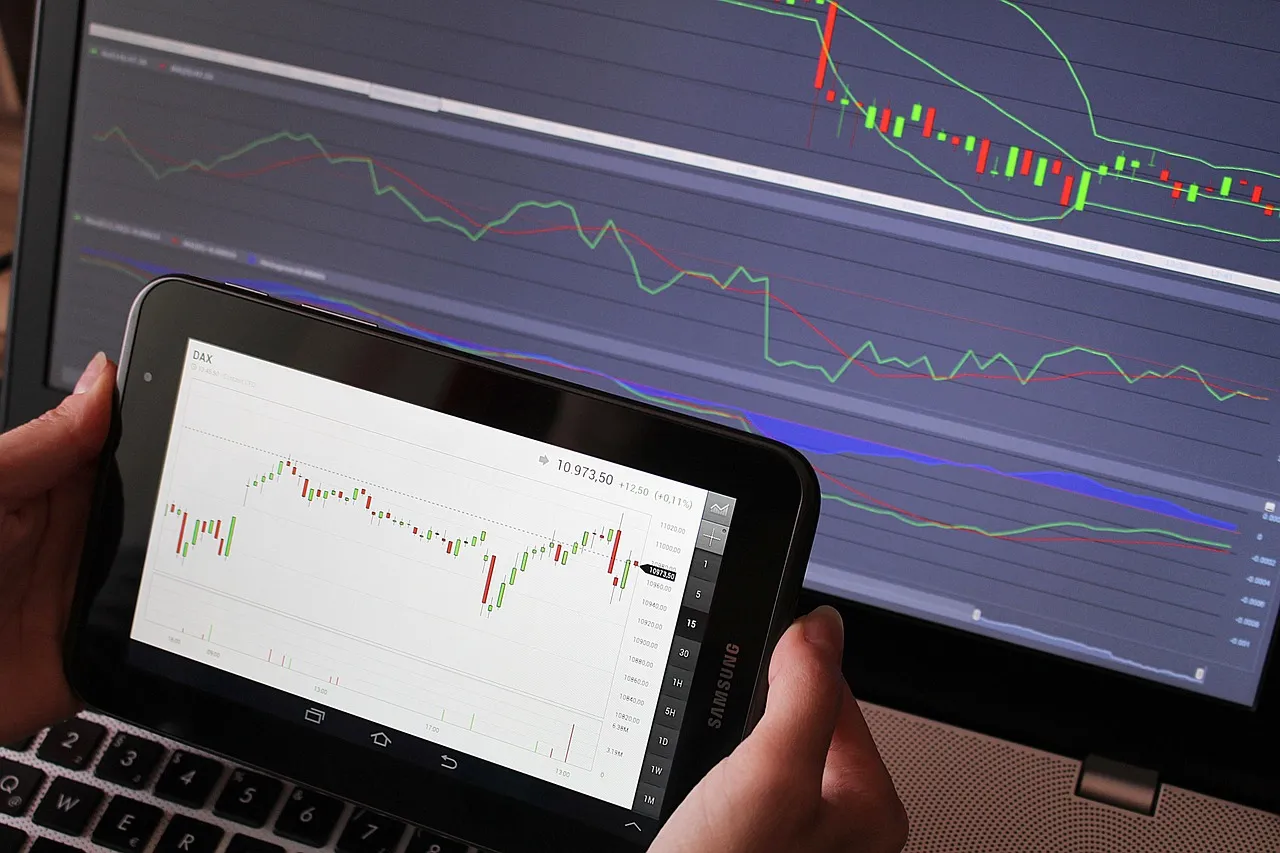
You're searching for forex company names ideas because you think branding is the first step. Let me stop you right there. The FSCA reports that over 80% of retail traders lose money. A slick name like 'Alpha Lion Capital' or 'ZAR Forex Pros' doesn't move that needle one bit. I've seen more traders go bust because they focused on business cards instead of their risk per trade. Here's the hard truth: your company name is the last 1% of the work, after you've survived the first 99% of losing.
When you're starting out, the excitement of naming your venture feels like progress. It's not. It's procrastination dressed up as productivity. Your brain would rather brainstorm 'forex company names ideas' than stare down a losing streak on USD/ZAR and stick to your 1% risk rule. I know because I did it. Back in 2012, I spent two weeks workshopping names with friends, designing a logo, and ordering pens. My trading account? I blew it in three days because I was over-leveraged on a gold trade, ignoring my own rules. The fancy pens just wrote the confirmation of my loss.
New traders believe a professional-sounding name attracts clients or instills confidence. In reality, in South Africa's retail space, no serious investor cares about your trading company's name. They care about your track record, your risk management framework, and your regulatory status. The FSCA doesn't approve a license based on how catchy your name is. They scrutinize your capital, your operational procedures, and your compliance officers. Focusing on the name first is like painting the hull of a ship you haven't built yet, while ignoring the massive hole in your risk management plan.

Warning: The most common path to failure is spending time on peripherals (names, websites, social media) before proving you can consistently protect capital. Your first 'company' should be a demo account or a small live account. Name it 'Test Account Number 1' and get to work.
“A slick name like 'Alpha Lion Capital' doesn't move the 80% failure rate needle one bit.”
Before you type a single 'forex company names ideas' into Google, get these pillars locked down. If these aren't solid, your company is a name on a tombstone.
Your Legal and Regulatory Foundation
This isn't sexy, but it's everything. In South Africa, you fall under the Financial Sector Conduct Authority (FSCA). Are you planning to manage client funds? That requires a Category II FSP license, and the barriers are high: minimum operational capital, fit-and-proper tests for key individuals, and a mountain of compliance. Most solo traders operate as sole proprietors or (better) a private company (Pty Ltd) for liability protection. The name of that Pty Ltd is far less important than its registration documents and tax compliance with SARS. I incorporated my first company as 'Winston Trading (Pty) Ltd.' Boring. Effective. It separated my personal and trading liabilities the day I got a margin call I couldn't meet from my personal funds.
Your Unbreakable Trading Plan
Your company's real 'name' is its trading plan. This is the document that dictates every action. It must specify:
- Your edge: What setup do you trade? (e.g., London Breakout on EUR/USD)
- Your position sizing: Is it a fixed percentage of capital? Use a position size calculator for this, every single time.
- Your entry/exit rules: No ambiguity.
- Your maximum daily/weekly loss limit. This is non-negotiable.
A plan with a 2% max risk per trade and a 5% max weekly loss limit, followed religiously, will do more for your 'brand' than any clever name. Your reputation will be 'the consistent one,' not 'the one with the cool logo.'
Your Track Record
You need a verifiable, audited track record. This means using a platform that generates statements, like a reputable broker such as IC Markets or Pepperstone. Three months of profitable statements is a start. Twelve months is credible. Anyone can make up a name; few can produce a year of consistent results. I learned this after my first prop firm interview. They didn't ask about my company name. They grilled me on my Sharpe ratio, my maximum drawdown, and my worst losing day.

💡 Winston's Tip
Your first company should be a journal, not a PTY LTD. Name it 'The Book of Lessons' and fill it with every trade, especially the losers.
“Focusing on the name first is like painting the hull of a ship you haven't built yet, while ignoring the massive hole in your risk management plan.”
Okay, let's say you have a 12-month profitable track record, your PTY LTD is registered, and you're considering taking the next step. Now we can talk about 'forex company names ideas' with purpose. The goal here is to be appropriate, not clever.
1. Clarity Over Creativity: Avoid vague terms like 'Quantum' or 'Elite.' In finance, clarity builds trust. Consider including what you do: 'Capital Management,' 'Asset Management,' 'Trading Solutions.' If you specialize, hint at it: 'Currency Strategies,' 'ZAR Advisory.'
2. Check Availability, Thoroughly:
- Company Name: Search the CIPC (Companies and Intellectual Property Commission) database. Your chosen name must be unique.
- Domain: Check for .co.za and .com availability.
- Trademark: A basic search on the trademark registry can save future headaches.
3. Think About Your Long-Term Niche: Are you aiming for high-net-worth individuals, or a scalping strategy education service? A name like 'Johannesburg Wealth Partners' signals one thing; 'FX Pulse Analytics' signals another.
4. Keep it Pronounceable and Spellable: If people can't say it or type it easily, you've lost them. Avoid excessive 'X's and 'Z's unless it's culturally relevant.

Example: Let's compare two approaches for a South African trader specializing in gold and major pairs:
- Bad Idea: 'Apex Vortex Trading (Pty) Ltd.' (Sounds like a video game clan, not a financial entity).
- Better Idea: 'Mzanzi Precious Metals & Forex (Pty) Ltd.' (Clear, locally resonant ('Mzanzi'), and describes the focus).
“Focusing on the name first is like painting the hull of a ship you haven't built yet, while ignoring the massive hole in your risk management plan.”
Registering a company name with CIPC costs about R175. That's the cheapest part of this journey. The real expenses come after, and they'll crush you if you're not prepared.
- FSCA Licensing (If applicable): Application fees, compliance officer salaries, and minimum capital requirements can run into hundreds of thousands of Rands.
- Professional Indemnity Insurance: If you advise others, you need this. It's expensive.
- Technology & Data: Real-time data feeds, advanced charting software (beyond free MT5), a VPS for running trades 24/7. This can easily be R1,500+ per month.
- Accounting & Legal: SARS compliance, annual financial statements. Don't try to do this yourself.
Here's a brutal personal number: In my first year of operating with a registered company, my trading was net profitable by R120,000. My business costs (legal, accounting, software, data, VPS) were R95,000. My net take-home was R25,000. I almost quit. The 'business' of trading almost killed the 'trading' part. I was so focused on looking professional that I forgot to be profitable. Your first R100,000 in profits should go straight back into your trading capital, not a fancy office or an over-designed website.
💡 Winston's Tip
If you wouldn't confidently explain your company's name to an FSCA inspector during an audit, it's the wrong name. Keep it simple and defensible.

“Your first R100,000 in profits should go straight back into your trading capital, not a fancy office.”
I've seen this movie too many times. A trader has three good months. They immediately register 'Invictus Capital Global,' get a logo of a lion, and start posting 'fund manager' content on LinkedIn. Their psychology shifts from 'risk-averse trader' to 'CEO of Invictus.' This is lethal.
The Ego Trap: Now, taking a 50-pip loss feels like a personal failure to the 'CEO.' They skip their stop-loss to avoid being 'wrong,' turning a small loss into a margin call. The identity of 'fund manager' is more important than the discipline of a trader.
Promising What You Can't Deliver: A grandiose name implies grand results. You might feel pressured to take bigger risks to generate the 20% annual returns your new 'brand' seems to promise. Stick to your 10% target with low drawdown. Consistency is king.
Attracting the Wrong Attention: A name that sounds like a large hedge fund can attract regulatory scrutiny you're not ready for, or clients with expectations you can't meet. Start small, start boring. Let your performance, not your name, do the talking.

Pro Tip: Use a working name for years. Operate as 'John Doe Trading' while your PTY Ltd, registered as something bland like 'JD Financial Services (Pty) Ltd,' sits dormant. Once you have a multi-year track record and clear offering, you can brand the public-facing name. This separates your trading ego from your business entity.
“Your first R100,000 in profits should go straight back into your trading capital, not a fancy office.”
If you've passed the three-year mark, have a strong track record, and are clear on your offering, here's the sequence.
- Develop Your Operational Plan: Document everything. Your trade execution process, your back-office operations, your client reporting (if any). This is your business blueprint.
- Consult a Financial Services Lawyer: Don't use a general attorney. Spend the R5,000-R10,000 on a specialist who knows the FSCA handbook inside out. They will tell you what license you need, if any.
- Register the Legal Entity: With your lawyer, register your (Pty) Ltd with CIPC. Choose a simple, descriptive legal name.
- Open Business Banking & Brokerage Accounts: All funds must flow through the company. This separates personal and company assets, which is critical for liability.
- Now, Brand It: Develop your public-facing brand name, logo, and website. This is the last step, not the first. At this point, brainstorming 'forex company names ideas' has a clear goal and a solid foundation.
- Get Your Tech Stack Right: This is where performance happens. A reliable broker like Exness or XM for execution, and tools that manage risk. For example, if your strategy uses complex order types or requires strict daily loss limits for a prop firm challenge, manual management is a risk.
This final point on tech is critical. As your operation scales, manual trade management becomes your biggest risk point.
💡 Winston's Tip
The most valuable name you'll ever have is the one on your verified, multi-year performance statement. Build that first.

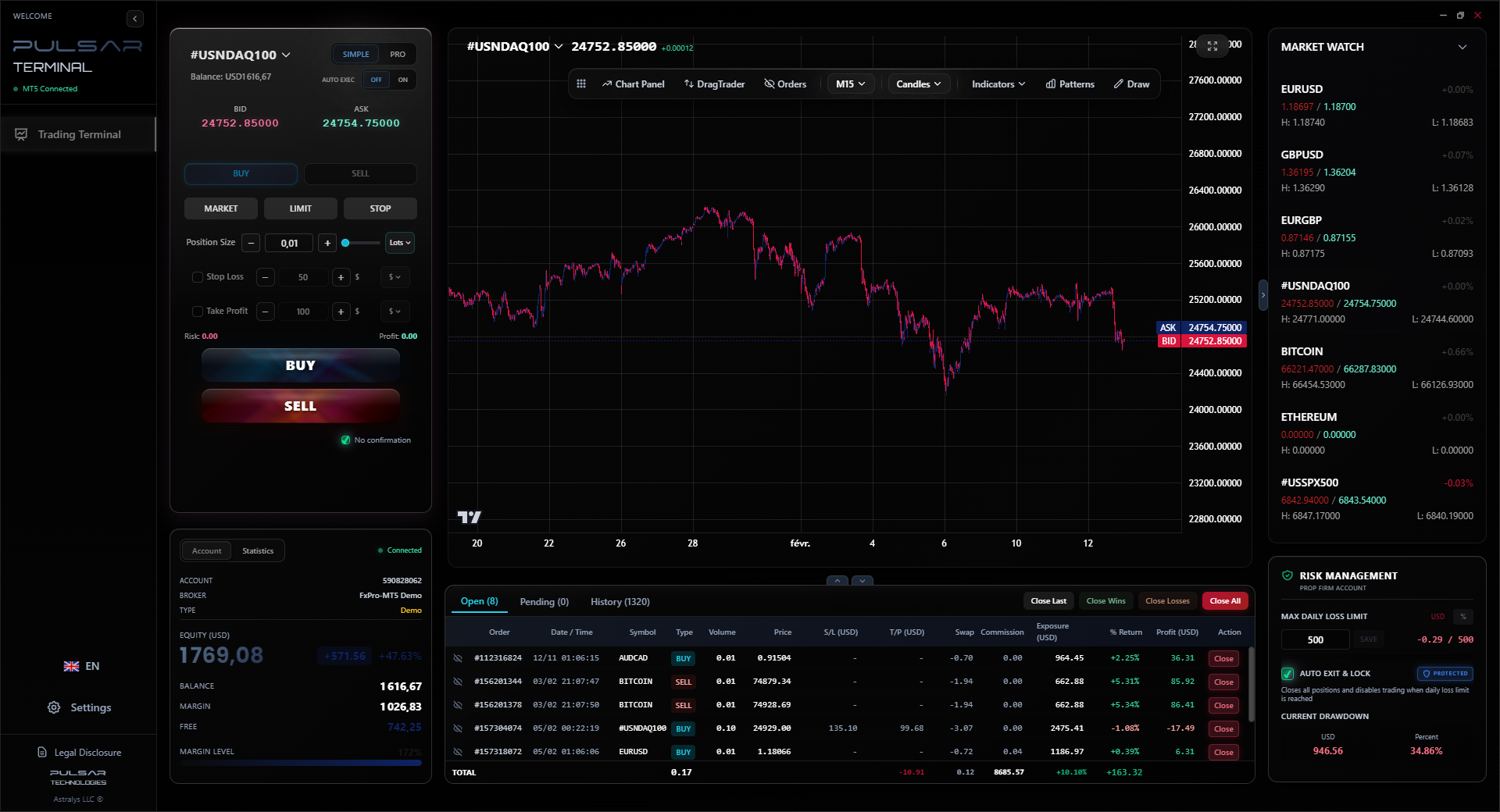
When you're managing a company account, manual errors on entries or stops are unacceptable; Pulsar Terminal's drag-and-drop orders and automated multi-TP/SL rules execute your business plan flawlessly on MT5.
Pulsar Terminal
The all-in-one MT5 companion: drag-and-drop orders, multi-TP/SL, trailing stop, grid trading, Volume Profile, and prop firm protection. Used by 1,000+ traders daily.
“The survivors have boring stories. They focused on the pip value of their trades, not the font on their business card.”
The South African trading landscape is littered with cool company names attached to dead accounts. 'Velocity Forex,' 'Cape Alpha,' 'Rand Guardian' - I've seen them all in forum signatures of traders who disappeared after a few months.
The survivors have boring stories. They focused on the pip value of their trades, not the font on their business card. They obsessed over their spread costs, not their LinkedIn headline. They used a MACD indicator or RSI indicator correctly for years before telling anyone they were a 'trader.'
Your mission for the first two years is not to build a company. It's to not blow up. It's to take the 80% failure rate statistic and make sure you're in the 20%. Do that with a R10,000 account named 'My Learning Fund.' Do that with a demo account called 'Practice.' Once you've navigated multiple market cycles - seen the ZAR volatility during a SONA speech, traded through a XAU/USD flash crash, kept your head during a wild EUR/USD news spike - then you've earned the right to think about a company name.
Until then, the best 'forex company names ideas' are the ones you don't waste your time on. Put that energy into your next trade review instead. Your future clients, when you eventually have them, will thank you for it.
FAQ
Q1What are some good, simple forex company name ideas for South Africa?
Focus on clarity and legality. For your legal PTY LTD, use something like '[Your Surname] Financial Services (Pty) Ltd.' For a public brand, consider combining a local reference with your specialty: 'Highveld Trading Strategies,' 'Cape Forex Analytics,' 'SA Rand Focus.' Avoid overpromising words like 'Global' or 'Wealth' until you have the track record to back it up.
Q2Do I need an FSCA license to start a forex trading company?
It depends. If you are only trading your own capital, you generally do not need a license. The moment you accept funds from others to manage, or give specific investment advice for a fee, you likely require a Category II Financial Services Provider (FSP) license from the FSCA. The application is complex and costly. Always consult a financial services lawyer before taking any client money.
Q3How much does it cost to start a forex company in South Africa?
The company registration itself is cheap (~R175 with CIPC). The real costs are operational: professional indemnity insurance (if advising), accounting fees, legal fees for compliance, advanced trading software/data (R1,500+/month), and most importantly, your operational capital. To run a legitimate business, have at least R50,000-R100,000 set aside for non-trading business expenses in the first year.
Q4Should I name my company after a trading strategy?
Be cautious. If you name your company 'Scalping Pros SA,' you lock yourself into that niche. What if you pivot to swing trading in a few years? A more flexible name allows your business to evolve. It's better to be known for your results than to be constrained by your name.
Q5Is it better to use 'Forex' or 'FX' in the company name?
From a search and clarity perspective, 'Forex' is more commonly understood by the general South African public. 'FX' is industry shorthand. I'd lean towards 'Forex' for broader recognition, but neither is a deal-breaker. More important is that the rest of the name clearly signals trust and professionalism.
Q6Can I use 'Capital' or 'Asset Management' in my name if I'm small?
Legally, you can, but you should consider the perception. These terms set a high expectation of scale and sophistication. If you're a solo trader, using 'Trading' or 'Solutions' might be more appropriate and less likely to attract scrutiny or clients with unrealistic expectations about the size of your operation.
Prof. Winston's Lesson
Key Takeaways:
- ✓80%+ of retail traders lose money. A name won't fix that.
- ✓Legal registration (PTY LTD) costs ~R175. Compliance costs 100x that.
- ✓Build a 12-month track record before even thinking of a brand.
- ✓Your trading plan is your real company name.
How useful was this article?
Click a star to rate
Weekly Trading Insights
Free weekly analysis & strategies. No spam.
About the Author
David van der Merwe
Emerging Markets Trader
Johannesburg-based trader with 11 years in emerging market currencies. Specializes in ZAR pairs, FSCA-regulated trading, and South African market analysis.
Comments
Risk Disclaimer
Trading financial instruments carries significant risk and may not be suitable for all investors. Past performance does not guarantee future results. This content is for educational purposes only and should not be considered investment advice. Always conduct your own research before trading.
You Might Also Like

Cara Trading Forex Sukses: 7 Prinsip dari Trader Profesional
Cara trading forex sukses dengan 7 prinsip trader pro: manajemen modal, disiplin, journal trading, backtest. Data nyata, bukan janji profit palsu.
Jam Trading Forex Terbaik untuk Trader Indonesia: Panduan Lengkap dengan Tabel Waktu
Panduan jam trading forex untuk trader Indonesia. Tabel 4 sesi dunia, jam emas 20:00-00:00, sesi mana yang harus dihindari. Data akurat + tips dari trader berpengalaman.
Top 5 Sàn Forex Uy Tín Nhất 2026: Review Jujur dari Trader Indonesia
Top 5 sàn forex uy tín 2026 untuk trader Indonesia. Review jujur: spread, deposit, withdraw, dukungan lokal. Exness, XM, IC Markets & lebih.
Get Pulsar Terminal
All these calculators are built into Pulsar Terminal with real-time data from your MT5 account. One-click position sizing, automatic risk management, and instant calculations.
Get Pulsar Terminal