


Here's the truth nobody in Nigeria wants to hear: the forex competition isn't against other traders.

Olumide Adeyemi
West African Trading Pioneer ·  Nigeria
☕ 14 min read
What you'll learn:
- 1What 'Forex Competition' Really Means (Hint: It's Not What You Think)
- 2Nigeria's Regulatory Battlefield: The 2025 Game Changer
- 3The Broker Wars: Spreads, use & The Nigerian Trader
- 4Trading Psychology: The Only Competition That Matters
- 5Strategies That Give You a Real Edge (Not Gimmicks)
- 6Technology & Tools: Leveling the Playing Field
- 7The Prop Firm Arena: A Different Kind of Competition
- 8Building a Long-Term Winning Mindset
Here's the truth nobody in Nigeria wants to hear: the forex competition isn't against other traders. It's against yourself, your broker's spread, and a regulatory system that's finally waking up. I've watched traders blow accounts chasing 'competitions' while missing the real game entirely. The 2025 SEC changes just flipped the board. This isn't about beating the market - it's about surviving long enough to let the market pay you. I'll show you how the broker wars, new laws, and actual trading psychology create the only competition that matters.
When Nigerians hear 'forex competition,' they picture trading contests with prize money. That's the shiny distraction. The real competition is invisible: brokers fighting for your deposit, regulators trying to control a wild market, and you fighting your own impulse to overtrade.
I entered a broker-sponsored contest back in 2019. Prize was $5,000. I placed 2nd. Know what I learned? The winners were all using insane use on exotic pairs during low liquidity hours. Pure gambling. They got lucky once, then blew their winnings within months. The real winners were the brokers who collected spreads from hundreds of desperate contestants.
The actual forex competition that affects your P&L every day has three layers:
- Broker vs. Broker: Who offers the tightest EUR/USD spread? Who has realistic use for Nigerian accounts? This war benefits you if you know what to look for.
- You vs. The House: Every pip of spread, every swap charge, every slippage on news - that's the house edge. Your first job is to minimize this, not outsmart the ECB.
- Regulator vs. Chaos: The SEC's 2025 move to regulate platforms changes everything. It's not about restricting you; it's about cleaning out the bucket shops pretending to be brokers.

Warning: Any 'competition' that rewards highest percentage return in a week is teaching you terrible habits. Real trading is about consistent small wins, not lottery tickets.
Your goal isn't to win a contest. It's to survive the daily grind where 90% of participants fail. I learned this the hard way after a 2022 loss where I chased 'high score' in a demo contest, then applied the same reckless strategy with real money. Lost 30% of my account in two days trying to beat imaginary opponents.

💡 Winston's Tip
The broker offering the highest use is like a bar offering the strongest drink: they profit most from your lack of control. Your first competition is choosing a sensible partner.
Let's cut through the legal jargon. For years, Nigeria's forex scene was the Wild West. You could open an account with an offshore broker in minutes, use was crazy high, and if something went wrong? Good luck. The CBN was focused on big-picture currency stability, not protecting Joe from Lagos from scam brokers.
The Investments and Securities Act (ISA) 2025 changed the game. Suddenly, the SEC has teeth to bite any platform operating without registration. This isn't about stopping you from trading. It's about forcing brokers to either get serious about compliance or get out.
What This Means For Your Broker Choice
Before 2025, you might have picked a broker offering 1:2000 use from some island regulation. Now, that broker either registers with SEC (meaning they follow Nigerian rules) or they're operating illegally. Many international brokers are scrambling right now.
I had a painful lesson in 2023 with a broker that suddenly 'restricted' Nigerian clients during a major Naira volatility event. Couldn't close positions for hours. No local regulator to complain to. The new rules aim to prevent exactly that.
The Tax Man Cometh
Everyone forgets the 10% capital gains tax until it's too late. FIRS wants their cut on your profits. The competition here is between your trading discipline and your urge to hide earnings. Keep a trading journal not just for analysis, but for tax time. I use a simple spreadsheet tracking every closed trade - entry, exit, profit in USD, converted to Naira at trade date. When you scale up, this isn't optional.

Pro Tip: Open a separate savings account for your tax liability. Every time you make a profitable withdrawal, move 10% into that account immediately. Future you will thank present you when FIRS comes knocking.
The regulatory competition creates stability. Yeah, it might mean slightly higher compliance costs for brokers (which they pass on through slightly wider spreads), but it also means fewer outright scams. That's a trade-off worth making.
“A 20% return with a 5% drawdown beats a 100% return with a 40% drawdown every single time. Survival math doesn't care about your ego.”
This is where the rubber meets the road. Nigerian traders are spoiled for choice, but choice without understanding is dangerous. Let's break down the real numbers from the broker competition.
| Broker Feature | Pre-2025 'Wild West' | 2025+ Realistic Reality |
|---|---|---|
| Typical use Offered | 1:1000 to 1:2000 (Insane) | 1:100 to 1:400 (Still high, more sane) |
| EUR/USD Spread | Advertised '0.0' (with huge commission) | 0.6 - 1.2 pips realistic average |
| Minimum Deposit | As low as $1 (marketing gimmick) | $20-$100 for serious accounts |
| Local Support | Email-only, slow response | Some offering phone support in Lagos/Abuja |
That 1:2000 use? It's a trap. I used it once on a scalping strategy on GBP/JPY. Made 2% in an hour, felt like a genius. Next trade, a 10-pip move against me wiped out 5% of my account. The competition among brokers to offer the highest use is about attracting inexperienced traders who blow up fast.
The real competition you should care about is spread consistency. I track my actual filled spreads, not the advertised ones. Here's real data from my journal last month:
- Broker A (Advertised: 0.8): Actual average on EUR/USD during London session: 1.1 pips
- Broker B (Advertised: 1.0): Actual average: 0.9 pips (better execution)
That 0.2 pip difference doesn't sound like much, but on 100 standard lots per month, that's $200 extra cost. That's the real broker competition.
Naira-denominated accounts are becoming a bigger battleground. Why? Because depositing in Naira means you skip the CBN's restrictions on using official FX windows for trading. Brokers like HFM offering ₦4,000 minimum deposits are targeting the massive young, mobile-first demographic. But remember: if the account is in Naira, but the asset (EUR/USD) is in dollars, your broker is doing the conversion at their rate. Check that rate against the official NAFEX rate - sometimes there's a hidden 1-2% fee there.
My advice? Ignore the use arms race. Focus on brokers with transparent pricing, good execution during African trading hours (7 AM - 4 PM WAT when London is active), and responsive support. I've had good experiences with IC Markets for raw spreads and XM for their educational support for beginners, though you must always do your own due diligence.
Forget the charts for a minute. Your biggest opponent sits between your ears. I've mentored traders who could perfectly explain the MACD indicator divergence but would panic-sell the moment a trade went 5 pips against them.
The psychological competition has stages:
Stage 1: Against Impatience You see a setup. It's not perfect, but you're bored. You enter early. This loses me money more than any bad analysis. The fix? I have a physical checklist next to my screen. All 4 conditions must be ticked before I can even think about clicking buy. It sounds childish, but it works.
Stage 2: Against Greed You're in profit. Your plan says take 50 pips. Price is at 48 pips... and still going. You move your target. Price reverses, hits your original 50, keeps going, and you end up with 12 pips. I've done this dozens of times. The competition is between your disciplined plan and the 'what if' monster.
Stage 3: Against Ego This is the killer. You have three losing trades in a row. Your analysis must be right next time. You increase position size to 'make it back fast.' This is how accounts get nuked. The real competition is admitting you're wrong and stepping away.

Example: My worst psychological blow-up was in 2020. Lost $800 on USD/ZAR. Tried to revenge trade on EUR/TRY with double the size. Lost another $1,200 in 45 minutes. Total loss: $2,000. All because I couldn't accept the first loss and walk away. The competition was lost before the second trade opened.
The tool that saved me? A proper position size calculator. It forces math on emotion. If I risk 1% per trade on a $5,000 account, that's $50. No matter how 'sure' I am, the calculator says 'your stop loss is here, position size is this.' It removes the emotional variable.
This internal competition never ends. Even after 12 years, I have days where I have to shut down the platform and go for a walk. The traders who 'win' aren't the ones with the highest IQ; they're the ones with the highest emotional discipline.
💡 Winston's Tip
Your trading journal is your mirror. If you can't bear to look at your losing trades and analyze them coldly, you've already lost the psychological competition.
“The SEC's 2025 rules aren't a wall stopping traders; they're a filter cleaning out the sharks so the real swimmers have a chance.”
So how do you actually compete in a market where big banks have supercomputers? You don't play their game. You play where they aren't.
The Nigerian Time Zone Advantage
This is huge and underused. The London session (7 AM - 4 PM WAT) is the most liquid forex session. Major banks are active, spreads are tight. For a Nigerian trader waking up at 6 AM, you're perfectly positioned to catch the open. The competition here is against European traders who are still half-asleep.
My most consistent strategy is London Open Breakout. I watch the first hour's range (7-8 AM WAT). After that hour, if price breaks above the high with momentum, I go long. Stop loss below the low of that first hour. I aim for 1.5x the height of that range. It's simple, it uses our geographic advantage, and it doesn't require staring at screens all night.
Focus on Pairs You Understand
Every new trader wants to trade exotics: USD/NGN? NGN isn't directly tradable retail. So they jump to USD/ZAR or EUR/TRY. Massive spreads, unpredictable moves. The competition in EUR/USD is fierce, but that's good - it means liquidity is high and spreads are low. You have a better chance in a fair fight with tight spreads than a chaotic fight where the spread alone is 50 pips.
I keep a EUR/USD guide printed on my desk. It reminds me of key support/resistance levels, typical daily ranges, and major news times. Specializing beats generalizing every time.
Swing Trading vs. The Scalping Madness
Scalping is glamorized, but it's a broker's dream. You're paying spreads constantly. Swing trading, holding for days, means you pay the spread once. The competition for a swing trader is patience. You set your trade, set your alerts, and walk away. Let the market come to you.
In 2023, my best trade was a XAU/USD swing. Bought at $1812, rode it for three weeks, sold at $1950. $138 per ounce profit. Did I catch the exact top? No. But I banked a solid return while others were churning their accounts on 5-minute charts. The competition isn't about frequency; it's about net profitability over quarters, not days.
The myth is that hedge funds have all the tech advantage. Truth? The basic tools for success are free or cheap. The competition is about who uses them consistently, not who has the fanciest software.
Free Essentials You Must Use:
- Economic Calendar (FXStreet, ForexFactory): News is the great equalizer. A major CPI miss moves markets for everyone.
- TradingView Free Charts: Better than most broker platforms for analysis.
- Position Size Calculator (already mentioned, but it's that important).
Where technology creates a real edge is in trade management. This is where most Nigerian traders fail. They enter a trade, then watch it like Netflix, making emotional decisions every tick.
Automated trade management is your secret weapon. Setting a trailing stop, moving to breakeven at a certain profit level, taking partial profits - these actions should be planned in advance, not decided in the heat of the moment.
I manually used to trail my stops. It was stressful. I'd move it too early and get stopped out before a big move, or too late and give back too much profit. Now, I plan the logic at entry: 'If price moves 50 pips in my favor, move stop to breakeven. At 80 pips, trail by 30 pips.' Then I can walk away. The competition is won in the planning phase, not the execution phase.
The RSI indicator is a classic example of a tool everyone has but few use correctly. They see RSI above 70 and sell immediately. But in a strong trend, RSI can stay overbought for weeks. The tool isn't wrong; the user's interpretation is. The competition is in skill application, not tool ownership.
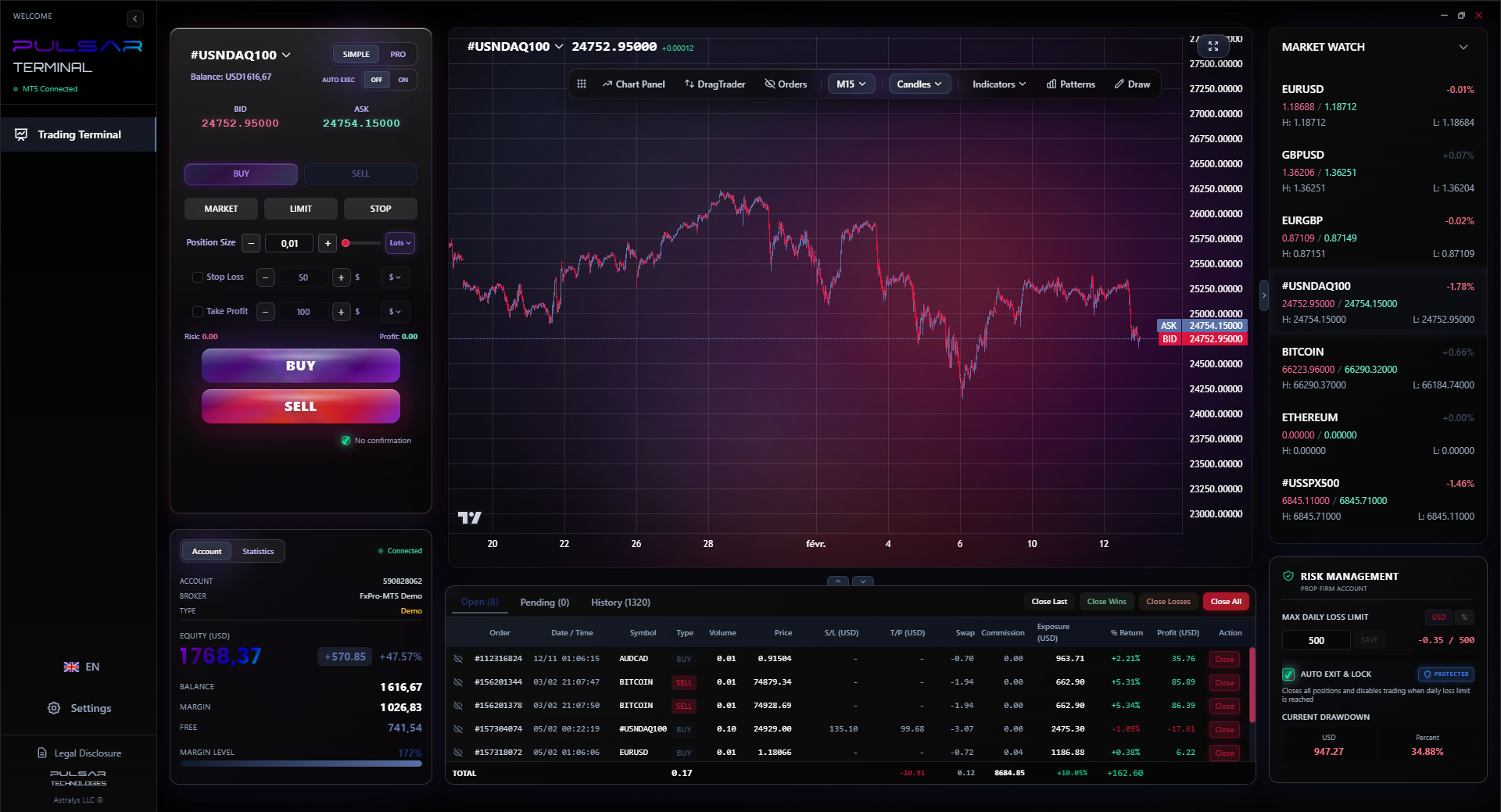
Managing multiple trades and strict prop firm rules manually is a nightmare; Pulsar Terminal automates trailing stops, breakeven moves, and daily loss limits directly on your MT5, turning discipline from a struggle into a setting.
Pulsar Terminal
The all-in-one MT5 companion: drag-and-drop orders, multi-TP/SL, trailing stop, grid trading, Volume Profile, and prop firm protection. Used by 1,000+ traders daily.
“Your most dangerous opponent has never seen a candlestick chart. He lives in your amygdala and his name is Panic.”
Prop firm challenges are the ultimate forex competition for many Nigerians. Pass a test, get a funded account, keep most of the profits. Sounds great. The pass rate is abysmal for a reason.
These firms aren't charities. They design rules that exploit common trading weaknesses. The 5% daily loss limit? That's to prevent the 'revenge trade' spiral. The 10% total loss limit? That's to ensure you have solid risk management from day one.
The competition here is against the rulebook, not the market. You need a strategy that consistently makes small gains with very controlled losses. This is where obsessive focus on the spread definition and pip definition matters. On a $100,000 prop account, a 10-pip stop loss is $1,000. That's 1% of your account gone on one trade if you're trading 1 standard lot.
I attempted a prop firm challenge in 2024. Failed the first phase. Why? I hit the 5% daily loss limit on a single USD/CAD trade that spiked on unexpected oil news. My mistake? I had my stop loss too tight, trying to be 'efficient.' The competition punished my greed for a better risk/reward ratio.
The second attempt, I passed. My strategy? I traded only during the most liquid hours (London overlap), used wider stops (20-25 pips), and aimed for smaller, more frequent wins. My profit target was just 1% per day. It was boring. It worked. The competition in prop firms isn't about brilliance; it's about robotic discipline.
The biggest threat in this arena is the margin call. Prop firms use aggressive margin policies. A few losing trades in a row can trigger it even if you're far from the total loss limit. You must understand their specific margin rules cold. This is a competition of reading comprehension as much as trading skill.
💡 Winston's Tip
The 10% tax on profits is the cheapest lesson in discipline you'll ever get. If your trading can't survive taking 10% off the top, it was never profitable to begin with.
Winning the forex competition isn't an event. It's a lifestyle. It's the sum of daily habits over years. The traders who last aren't the ones with one amazing year; they're the ones who survive three bad months in a row without blowing up.
Your Weekly Competition Checklist:
- Review Trades: Every Sunday, I look at every closed trade. Not just profit/loss, but: Did I follow my plan? Was my entry trigger valid? Did I manage the exit well?
- Journal Emotions: I note how I felt. 'Felt impatient Tuesday, entered early.' This builds self-awareness.
- Check Broker Stats: Am I getting the spreads I was promised? Is execution slow during news? This is holding your broker accountable in their competition.
- Plan the Week Ahead: Major news events? Central bank speeches? I mark them in my calendar and decide in advance: will I trade through them or stay out?
The long-term competition is about capital preservation. A 20% return with a 5% max drawdown is infinitely better than a 100% return with a 40% drawdown. Why? Because after that 40% drawdown, you need a 67% return just to get back to breakeven. The math is brutal and unforgiving.
Finally, the competition extends beyond the screen. Your health, sleep, and stress management affect your trading more than any indicator. I trade worse when I'm tired. I've learned to stop at 2 PM WAT if I'm not sharp. The market will be there tomorrow. The goal is to be there tomorrow too, with your capital intact and your mind clear.
The forex competition in Nigeria is fiercer than ever, but the path to winning is clearer than ever. It's not about being the smartest person in the room. It's about being the most disciplined, the most patient, and the most resilient. That's a competition you can actually win.
FAQ
Q1Is forex trading legal in Nigeria in 2025?
Yes, individual forex trading is legal. The big change in 2025 is the SEC now requires online forex platforms to register with them under the Investments and Securities Act. This aims to protect traders from unregulated brokers, not stop trading.
Q2What is the tax on forex profits in Nigeria?
Profits are subject to a 10% capital gains tax, payable to the Federal Inland Revenue Service (FIRS). You must declare this income in your annual tax return. Keep detailed records of all trades for this purpose.
Q3Which broker has the lowest spreads for Nigerian traders?
Spreads vary. Brokers like Fusion Markets and FP Markets advertise very low or 0.0 pip spreads on majors, but usually charge a commission (e.g., $2.25 per side). For standard accounts, expect average EUR/USD spreads between 0.6 and 1.2 pips. Always check actual filled spreads, not just advertised ones.
Q4What is a safe use level for a beginner in Nigeria?
Ignore the 1:2000 offers. They are dangerous. Start with no more than 1:10 or 1:20 to learn proper position sizing and risk management. Even experienced traders rarely need more than 1:100. High use is the fastest way to lose your entire deposit.
Q5How do I choose a broker under the new SEC rules?
Prioritize brokers who are transparent about their regulatory status. Check if they mention SEC registration or are regulated by other reputable authorities (like FCA, ASIC, CySEC). Avoid any broker that cannot clearly state who regulates them. Local Naira deposit options are a plus, but verify their conversion rates.
Q6Can I really make money trading forex in Nigeria?
Yes, but the statistics are against you. Approximately 90% of retail traders lose money. The ones who succeed treat it as a skilled profession, not a get-rich-quick scheme. They focus on risk management, continuous education, and psychological discipline over years, not weeks.
Q7What is the best trading strategy for Nigerians?
There's no single 'best' strategy. However, strategies that align with the London session (7 AM - 4 PM WAT) play to your geographic advantage. Swing trading or day trading during high-liquidity hours is often more sustainable than trying to scalp all night. Find a simple strategy, back-test it, and master it before trying anything complex.
Prof. Winston's Lesson
Key Takeaways:
- ✓use above 1:100 is usually a liability, not a tool.
- ✓Track your actual filled spreads, not the broker's marketing.
- ✓10% capital gains tax requires careful record-keeping.
- ✓Prop firm challenges test discipline, not trading genius.
- ✓The London session (7AM-4PM WAT) is your geographic edge.
How useful was this article?
Click a star to rate
Weekly Trading Insights
Free weekly analysis & strategies. No spam.
About the Author
Olumide Adeyemi
West African Trading Pioneer
One of Nigeria's most active forex trading educators. 8 years of experience trading from Lagos. Specializes in low-capital strategies and prop firm challenges for African traders.
Comments
Risk Disclaimer
Trading financial instruments carries significant risk and may not be suitable for all investors. Past performance does not guarantee future results. This content is for educational purposes only and should not be considered investment advice. Always conduct your own research before trading.
You Might Also Like

Cara Trading Forex Sukses: 7 Prinsip dari Trader Profesional
Cara trading forex sukses dengan 7 prinsip trader pro: manajemen modal, disiplin, journal trading, backtest. Data nyata, bukan janji profit palsu.
Jam Trading Forex Terbaik untuk Trader Indonesia: Panduan Lengkap dengan Tabel Waktu
Panduan jam trading forex untuk trader Indonesia. Tabel 4 sesi dunia, jam emas 20:00-00:00, sesi mana yang harus dihindari. Data akurat + tips dari trader berpengalaman.
Top 5 Sàn Forex Uy Tín Nhất 2026: Review Jujur dari Trader Indonesia
Top 5 sàn forex uy tín 2026 untuk trader Indonesia. Review jujur: spread, deposit, withdraw, dukungan lokal. Exness, XM, IC Markets & lebih.
Get Pulsar Terminal
All these calculators are built into Pulsar Terminal with real-time data from your MT5 account. One-click position sizing, automatic risk management, and instant calculations.
Get Pulsar Terminal