


Most traders think correlation is a fancy academic concept.

David van der Merwe
Emerging Markets Trader ·  South Africa
☕ 11 min read
What you'll learn:
- 1What Are Forex Correlation Pairs? It's Not Just Theory
- 2The 5 Key Correlations Every South African Trader Must Know
- 3How to Actually Use This: 3 Practical Trading Applications
- 4The Real Costs & FSCA Rules: Trading Correlations in SA
- 5My Trading Journal: The Mistakes That Cost Me Real Money
- 6Building Your First Simple Correlation System
- 7Advanced Tools & Your Next Steps
Most traders think correlation is a fancy academic concept. I used to be one of them. Then I lost R50,000 in a single week because I was unknowingly doubling down on the same market bet. Understanding forex correlation pairs isn't optional for the serious South African trader, it's the difference between gambling and strategic positioning. This guide will show you how to use these relationships to protect your capital, confirm trades, and avoid the expensive mistakes I made.
Let's cut through the jargon. A forex correlation pair simply tells you how likely two currency pairs are to move in the same direction (positive correlation) or opposite directions (negative correlation) over a given period. We measure this with a correlation coefficient that ranges from +1 to -1.
A reading of +1 means they move in perfect lockstep. A reading of -1 means they move perfectly opposite. Zero means no relationship at all. In the real world, you're looking for strong correlations, typically above +0.8 or below -0.8, to base decisions on.
Why does this matter to you in South Africa? Because our market is uniquely exposed to global commodity flows and risk sentiment. When the US dollar strengthens (USD/ZAR rises), it doesn't happen in a vacuum. It affects EUR/USD, GBP/USD, and gold (XAU/USD) in predictable ways. Trading without this map is like driving from Joburg to Cape Town without checking if the N1 is closed.

Example: Let's say EUR/USD and GBP/USD have a 3-month correlation of +0.89. That's very strong. If EUR/USD rallies 100 pips, there's a high probability GBP/USD will also rally, maybe around 80-90 pips. If it doesn't, that's a major warning sign something is wrong with your analysis.

💡 Winston's Tip
A correlation above +0.80 or below -0.80 is tradable. Between -0.50 and +0.50, it's just market noise. Ignore it.
1. USD/ZAR and Global Risk Sentiment (DXY, EUR/USD)
This is your foundation. The Rand is a classic risk-sensitive, emerging market currency. When global investors are fearful, they flee to the US dollar. This means USD/ZAR (the pair you're likely watching) often has a strong positive correlation with the US Dollar Index (DXY) and a strong negative correlation with EUR/USD.
- Negative Correlation with EUR/USD: When EUR/USD goes down (dollar strength), USD/ZAR usually goes up. I learned this the hard way. In March 2023, I was short EUR/USD and also short USD/ZAR, betting on Rand strength. I was taking opposite sides of the same dollar move. When the Fed hinted at more hikes, the dollar ripped. My EUR/USD short made money, but my USD/ZAR short lost R32,000. They cancelled each other out, and I was left with just broker fees.
2. USD/ZAR and Gold (XAU/USD)
Gold is priced in dollars. When the dollar weakens, gold often rises (and vice versa). Since a weaker dollar often means a stronger Rand (lower USD/ZAR), you'll frequently see USD/ZAR and gold have a negative correlation. They don't move in perfect opposition every day, but the relationship is a powerful backdrop. For a deeper look at trading gold, our XAU/USD guide breaks down the specifics.
3. The Commodity Bloc: AUD, CAD, NZD (and ZAR by extension)
The Australian, Canadian, and New Zealand dollars are driven by commodity exports. The South African Rand often gets lumped in with this "commodity bloc" sentiment. Watch AUD/USD and USD/CAD. In times of strong global growth and high commodity demand, these pairs (and ZAR) can show similar strength against the USD.
4. EUR/USD and GBP/USD (The "Cable" Cousins)
This is one of the most stable positive correlations, often above +0.80. They are both major European currencies facing similar macroeconomic currents. If you're in a long EUR/USD trade and GBP/USD is tanking, you need to ask why. It's a great divergence signal.
5. USD/CHF and EUR/USD (The "Mirror")
Historically, these two have a very strong negative correlation (often below -0.90). The Swiss Franc is seen as a safe-haven, like the dollar, but one that moves inversely to the Euro. It's less directly critical for ZAR trading, but watching it can give you an extra layer of confirmation on Euro moves.

Warning: Correlations change. Sometimes they break down completely during a unique crisis or central bank intervention. The 3-month correlation is a good baseline, but always check the 1-week and 1-month readings to see if the relationship is holding.
“Trading without understanding correlation is like betting on both teams to win the same rugby match and wondering why you broke even.”
1. Hedging (The Smart Way to Reduce Risk)
This is the premier use case. You don't hedge to make money; you hedge to reduce catastrophic loss. Let's say you have a strong fundamental view that the Rand will weaken (USD/ZAR long). But you're worried about a sudden, broad-based dollar sell-off.
You could take a small, opposing position in a negatively correlated pair. Instead of a R100,000 position on USD/ZAR, you go R80,000 long USD/ZAR and R20,000 long EUR/USD (which is negatively correlated to USD/ZAR). If the dollar crashes, your USD/ZAR trade loses, but your EUR/USD trade gains, cushioning the blow. It's insurance. Your profit potential is lower, but so is your ulcer potential.
2. Trade Confirmation and Filtering
This saved my account more than once. In early 2024, my technical setup screamed to go long GBP/USD. The chart was perfect. But when I checked, EUR/USD was languishing and starting to break down. Their strong positive correlation was diverging. I passed on the trade. An hour later, a hawkish Fed comment hit the wires and GBP/USD dropped 70 pips. The correlation acted as a sanity check. I now won't enter a major trade without checking its main correlated pair.
3. Avoiding Accidental Over-Exposure
This was my R50,000 mistake. I was feeling bullish on the dollar. I went short EUR/USD (1 lot). Then I saw a setup on USD/JPY and went long (1 lot). Then I saw USD/CAD looking weak and went long (0.5 lots). I thought I had three separate trades. In reality, I was long the US dollar in three different markets. I wasn't diversified at all. When the dollar reversed, all three positions went against me simultaneously. A quick glance at a correlation matrix would have shown me I was 2.5 times more exposed to the dollar than I thought. Always use a position size calculator and consider your net exposure across correlated pairs.
💡 Winston's Tip
The most expensive lesson is the 'accidental hedge' - thinking you have two trades when you have one. Always calculate your net dollar exposure.
Trading multiple pairs for correlation strategies increases your cost base. You need to be sharp on the numbers.
Broker Costs (The Direct Hit):
- Spreads: If you're trading EUR/USD and GBP/USD together, you're paying two spreads. On a standard account, that could be 1.2 pips on EUR/USD and 1.5 pips on GBP/USD. That's 2.7 pips of cost before the market moves. This is why many serious correlation traders use raw spread accounts from brokers like IC Markets or Pepperstone, where spreads can be 0.1 pips plus a small commission.
- Commissions: On a raw account, you pay per lot. If your strategy involves frequent hedging or scaling, these commissions add up fast. Do the math: $7 commission per round turn on 2 lots is $14 per trade cycle.
Bank & Regulatory Reality (The Silent Killer): This is where many local guides are silent. Moving money to and from your international broker isn't free.
- SARB & FSCA Framework: You must use an FSCA-licensed broker for protection. The FSCA's 30:1 use cap for retail traders is a blessing in disguise for correlation trading - it prevents you from over-leveraging your hedged positions into oblivion.
- Bank Fees (2025): To fund your broker, you'll make an international payment. Using 2025 pricing from major banks:
- Outgoing Payment Fee: Around R250 (SHA/BEN) to R500 (OUR).
- Endorsement Commission: ~R2,070.
- Payment Commission: ~R920.
If you're withdrawing profits, you'll pay incoming payment fees too (~R350). If you're constantly moving money in and out to adjust correlation strategies, these fees will eat you alive. The lesson? Fund your account with enough capital to trade your system without constant, small withdrawals.
Tax Implication: Remember, each closed trade (whether part of a hedge or not) is a taxable event for SARS. Profitable hedging reduces your net profit, and thus your tax liability, which is a good thing. But it makes your bookkeeping more complex. Keep careful records.
“The R50,000 I lost wasn't a market loss; it was a tuition fee for ignoring the interconnected web of currencies.”
Mistake 1: The Double-Down Disaster (Loss: R32,000) As mentioned, short EUR/USD at 1.0850 and short USD/ZAR at 18.40. I thought I was "diversified." Correlation coefficient at the time: -0.82. When DXY rallied, EUR/USD fell to 1.0750 (I made +100 pips). USD/ZAR rallied to 18.90 (I lost -500 pips). The pip loss on ZAR was far greater due to its volatility. The net loss was brutal.
Lesson: Volatility matters. A 100-pip move in EUR/USD is not equivalent to a 100-pip move in USD/ZAR. You must adjust position sizes for volatility, not just correlation direction. A proper position size calculator that accounts for volatility (like using ATR) is non-negotiable.
Mistake 2: Chasing a Broken Correlation (Loss: R18,000) USD/CHF and EUR/USD had a -0.93 correlation for months. I automated a simple mean-reversion strategy: if they deviated too far from their normal spread, I'd buy one and sell the other. It worked until the SNB unexpectedly intervened in the Franc. The correlation shattered instantly. My "hedged" pair became two losing positions moving in the same direction against me. The stop-losses I had were too tight for such an event.
Lesson: Correlations break. Your risk management must account for the strategy failing, not just the individual trades failing. Wider stops, or a hard rule to exit all correlation trades if the coefficient breaks a key level, are essential.

Pro Tip: Don't just look at the correlation number. Look at a chart of the two pairs overlaid. Your eyes will spot weakening correlations or changing volatility long before a single number tells you.
💡 Winston's Tip
When a long-standing correlation breaks, don't argue with it. Exit and watch. The market is telling you a new story.
Start small. Don't try to trade a matrix of 10 pairs.
Step 1: Pick Your Focus Pair. For us, it's often USD/ZAR.
Step 2: Find Its Two Key Partners.
- A Strong Negative Correlate: EUR/USD is the prime candidate. This is your main hedge/confirmation tool.
- A Risk Sentiment Gauge: Gold (XAU/USD) or the AUD/USD. This tells you if the market is in "risk-on" or "risk-off" mode, which drives ZAR flows.
Step 3: Create Your Dashboard. Have one chart window with USD/ZAR, EUR/USD, and XAU/USD. Watch how they interact at key times: London open, US data releases.
Step 4: Define Your Rules. Here's a dead-simple starter rule set:
- To CONFIRM a Long USD/ZAR Trade: Look for EUR/USD to be breaking support or XAU/USD to be falling. All three should be telling the same "strong dollar" story.
- To HEDGE a Long USD/ZAR Trade: If you're long USD/ZAR but EUR/USD is stubbornly strong, consider a small long EUR/USD position (10-20% of your ZAR position size) as insurance.
- EXIT SIGNAL: If you are long USD/ZAR and EUR/USD suddenly rallies strongly through a key level, re-evaluate your ZAR trade immediately. The correlation is warning you.
Step 5: Manage the Trade. This is where tools matter. Managing a hedge - adjusting one position while keeping the other - manually on MT5 is clunky. You need to be able to move stops and take partial profits on one leg without losing track of the other.
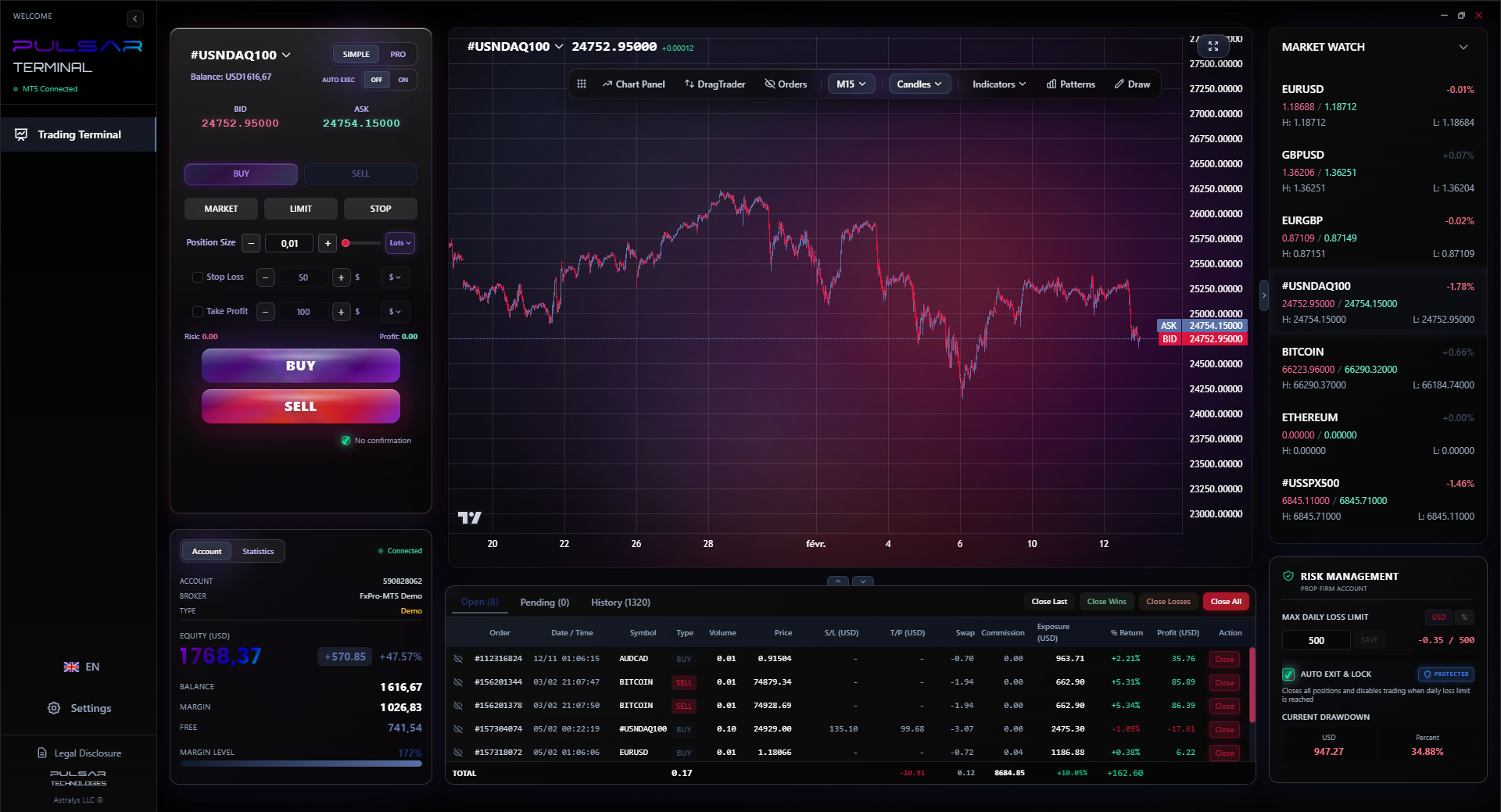
This process of managing multiple related orders is exactly why I started using tools that sit on top of MT5. Having a single dashboard where I can see my net exposure and drag stops for both trades is a game-saver.
Manually managing a hedge across two charts in MT5 is clunky and error-prone, which is why a tool that lets you visualize and control all related orders from one ticket is essential.
Pulsar Terminal
The all-in-one MT5 companion: drag-and-drop orders, multi-TP/SL, trailing stop, grid trading, Volume Profile, and prop firm protection. Used by 1,000+ traders daily.
“A hedge isn't there to make you money. It's there to let you sleep when your main trade is under pressure.”
Once you're comfortable with the basics, you can deepen your analysis.
Correlation Matrices: Most trading platforms can generate these. They're a table showing the correlation between multiple pairs. Don't get overwhelmed. Focus on the row for USD/ZAR and see which pairs have the highest positive or negative numbers.
Rolling Correlations: This is a chart of the correlation coefficient over time. It visually shows you when the relationship is strengthening, weakening, or breaking. A rolling correlation dropping from -0.9 to -0.5 is a bright red flag.
Trading Non-Forex Correlations: The biggest one for South Africans? The JSE Top 40 vs. USD/ZAR. Often, when the Top 40 falls (foreigners selling SA assets), they repatriate dollars, pushing USD/ZAR higher (negative correlation). It's not perfect, but it's a crucial macro check.
Your Action Plan:
- For the next week, don't place a single trade. Just watch USD/ZAR, EUR/USD, and Gold on the same screen.
- Note how they move together at 10:00 AM (SAST) when Europe gets going, and at 4:00 PM when the US comes in.
- Paper trade a simple hedge: for every R10,000 you'd risk on a USD/ZAR trade, risk R2,000 on a correlated EUR/USD trade in the opposite direction. See how it feels.
- Read up on swing trading principles to understand the longer-term timeframes where correlations are most reliable.
The goal isn't to become a correlation scientist. The goal is to stop fighting the same market force with two different trades, and to start seeing the interconnected web you're actually trading in. It turns noise into a narrative.
FAQ
Q1Where can I find a free forex correlation matrix?
Many financial websites like Investing.com or Myfxbook offer free, updated correlation matrices. Your trading platform (like MT4/5) might also have a built-in correlation indicator or tool you can use directly on your charts.
Q2How often do forex correlations change?
They're dynamic. Major correlations (like EUR/USD vs. USD/CHF) can persist for years, but they can weaken or invert during major crises or shifts in central bank policy. Always check the 3-month and 1-month readings. A sharp change in the 1-week correlation can signal a short-term divergence or a potential breakdown.
Q3Is trading correlated pairs a good strategy for beginners?
I'd advise against starting with it. Beginners should master single-pair analysis, risk management, and psychology first. Once you're consistently managing one trade, then introduce correlation as a confirmation filter. Using it for complex hedging is an intermediate-to-advanced skill.
Q4What's the best time frame to use for correlation analysis?
It depends on your trading style. For day trading and scalping, check 1-hour and 4-hour correlations. For swing trading, the daily and weekly correlations are most relevant. The longer the time frame, the more stable and significant the correlation tends to be.
Q5Can I use correlation to predict the direction of USD/ZAR?
Not predict, but strongly infer. If EUR/USD, GBP/USD, and AUD/USD are all falling sharply, it indicates broad US dollar strength. In that environment, the odds of USD/ZAR rising are significantly increased. It adds probability to your prediction but doesn't guarantee it.
Q6Do I need a special account to trade correlation strategies?
Q7How does SARB policy affect forex correlations involving the ZAR?
Massively. If the SARB intervenes directly in the market to support or weaken the Rand, it can temporarily sever the ZAR's typical correlation with global risk sentiment. The ZAR will move on the intervention, while other risk pairs (like AUD) may not. Always be aware of the SARB MPC meeting schedule.
Prof. Winston's Lesson
Key Takeaways:
- ✓Check correlation before every trade; it's your strategic sanity check.
- ✓Hedge with 10-20% of your main position size for cost-effective insurance.
- ✓Correlations break: always have a plan for when the relationship fails.
- ✓Factor in bank fees (R250-R500 per transfer) or they'll erode your profits.
How useful was this article?
Click a star to rate
Weekly Trading Insights
Free weekly analysis & strategies. No spam.
About the Author
David van der Merwe
Emerging Markets Trader
Johannesburg-based trader with 11 years in emerging market currencies. Specializes in ZAR pairs, FSCA-regulated trading, and South African market analysis.
Comments
Risk Disclaimer
Trading financial instruments carries significant risk and may not be suitable for all investors. Past performance does not guarantee future results. This content is for educational purposes only and should not be considered investment advice. Always conduct your own research before trading.
You Might Also Like

Cara Trading Forex Sukses: 7 Prinsip dari Trader Profesional
Cara trading forex sukses dengan 7 prinsip trader pro: manajemen modal, disiplin, journal trading, backtest. Data nyata, bukan janji profit palsu.
Jam Trading Forex Terbaik untuk Trader Indonesia: Panduan Lengkap dengan Tabel Waktu
Panduan jam trading forex untuk trader Indonesia. Tabel 4 sesi dunia, jam emas 20:00-00:00, sesi mana yang harus dihindari. Data akurat + tips dari trader berpengalaman.
Top 5 Sàn Forex Uy Tín Nhất 2026: Review Jujur dari Trader Indonesia
Top 5 sàn forex uy tín 2026 untuk trader Indonesia. Review jujur: spread, deposit, withdraw, dukungan lokal. Exness, XM, IC Markets & lebih.
Get Pulsar Terminal
All these calculators are built into Pulsar Terminal with real-time data from your MT5 account. One-click position sizing, automatic risk management, and instant calculations.
Get Pulsar Terminal