


Let's cut through the noise.

David van der Merwe
Emerging Markets Trader ·  South Africa
☕ 11 min read
What you'll learn:
- 1The ZAR Forex Reality Check: It's Not What You See on Instagram
- 2Picking a SA Forex Broker: Regulation is Your First Trade
- 3The Silent Account Killers: Spreads, Swaps, and Slippage
- 4Building a Strategy That Works for SA Traders
- 5Risk Management: The Only 'Secret' You Need to Know
- 6A Trade From My Journal (The Good, The Bad, The Ugly)
- 7Your First 100 Days: A Survival Roadmap

Let's cut through the noise. Most of what you hear about forex currency trading in South Africa is marketing fluff designed to sell you a dream. The reality? It's a brutal, zero-sum game where the house (and the big banks) have a massive edge. I've been trading for over 12 years, and I've seen more accounts blown than I care to remember, including some of my own early disasters. But here's the controversial part: it's absolutely possible to build a real, sustainable edge from South Africa. This isn't about getting rich quick. It's about understanding the unique ZAR landscape, the real costs, and the psychological grind. I'll show you exactly how, with the specific numbers, brokers, and mistakes that matter.
Trading USD/ZAR or EUR/ZAR from your couch in Joburg feels empowering. The truth is, you're stepping into a ring with institutional players who have faster data, lower costs, and algorithms you can't even comprehend. Your first job isn't to win. It's to not get knocked out in the first round.
The South African market adds its own twists. Liquidity for ZAR pairs can dry up faster than a dam in the Karoo, especially around local public holidays or during unexpected political news. This means spreads can widen violently. I remember trying to exit a short USD/ZAR position during a mini budget speech a few years back. The spread ballooned from 25 pips to over 80 in seconds. My stop-loss got filled at a much worse price than I'd set, turning a small planned loss into a proper haircut. That's the local market keeping you humble.
Then there's the cost of doing business. You're not just fighting the market's direction. You're fighting the spread, the commission, and the overnight swap rates. For a ZAR-based account trading major pairs, your break-even point is further away than you think. A 2-pip spread on EUR/USD sounds cheap, but if your strategy only aims for 10-pip profits, you've already given up 20% of your potential gain before you even start. You need a strategy with a high enough win rate or a large enough average win to cover these relentless fees. Using a position size calculator religiously is non-negotiable here. It's the only way to know your true risk per trade in Rands, not just pips.
This is where most new traders make their first and most expensive mistake. Choosing a broker because they have a flashy ad on Facebook or offer a 100% deposit bonus is a surefire path to trouble. In South Africa, the Financial Sector Conduct Authority (FSCA) is the key regulator. A broker licensed here must adhere to strict capital requirements and client fund segregation rules. It's your first layer of protection.
The Offshore vs. Local Dilemma
You'll face a choice: a locally regulated broker or an international one. Local brokers are convenient for ZAR deposits and withdrawals, and you have the FSCA to complain to. The downside? Their spreads on major forex currency pairs can be higher. International brokers like IC Markets or Pepperstone often have razor-thin spreads due to their massive global volume. They're typically regulated by top-tier bodies like ASIC (Australia) or CySEC (Cyprus). The catch? Funding your account. You'll need to use international wire transfers (costly) or sometimes cryptocurrency, and you're converting your Rands into USD or EUR to deposit.

Warning: Avoid unregulated or poorly regulated brokers like the plague. If they're based in some offshore island with no reputable oversight, your funds are not safe. Withdrawal problems are the number one complaint with these outfits.
Here’s a quick comparison based on my experience and constant monitoring:
| Broker Type | Pros | Cons | Best For |
|---|---|---|---|
| FSCA-Regulated | Easy ZAR deposits, local support, FSCA protection. | Often higher spreads, smaller product range. | Beginners who value security and simplicity. |
| Top-Tier Int'l (e.g., IC Markets) | Ultra-low spreads, vast instrument selection, advanced platforms. | Funding/withdrawal fees in ZAR, no FSCA recourse. | Active traders, scalpers, those needing best execution. |
| Global with Local Presence (e.g., XM) | Blend of international pricing and local payment options. | Might not be FSCA-regulated specifically. | Traders wanting a balance of cost and convenience. |
My personal setup? I use an international broker for my main trading because the cost savings on spreads over hundreds of trades a year are substantial. I just factor the occasional wire transfer fee into my business costs. For testing new strategies with smaller amounts, I sometimes use a local FSCA broker for quicker access.

💡 Winston's Tip
Your first R10,000 in the market is tuition fees, not investment capital. Expect to pay for your education.

“Trading from SA can feel isolating. You're not in London or New York. This is actually an advantage.”
Let's talk about the three thieves that steal from your account every day, especially in ZAR terms.
1. The Spread: This is the difference between the buy and sell price. It's how many brokers make their money. On EUR/USD with a good international broker, you might pay 0.1 pips. On USD/ZAR with a local broker, 25-50 pips is common. That's R250-R500 per standard lot before you're in profit! You must know the typical spread definition for your chosen pair and broker, and check it during your planned trading hours.
2. Swap Rates (Overnight Financing): If you hold a position past 5 PM New York time (which is late night for us), you pay or receive interest. For ZAR pairs, this is huge. The South African interest rate is often higher than USD or EUR rates. If you're buying USD/ZAR (going long USD, short ZAR), you are effectively borrowing ZAR to buy USD. Since ZAR has a higher interest rate, you PAY the interest difference. It can be a significant daily cost that erodes profits on longer-term trades. I once held a USD/ZAR long swing trade for three weeks. The profit was decent, but when I calculated the swap fees paid, it had eaten nearly 30% of my gains.

Example: Let's say the swap rate for holding USD/ZAR long is -$5 per lot per night. You hold for 10 nights. That's -$50, or about R900 (at ZAR 18/$), gone from your trade's result before it even closes.
3. Slippage: This is when your order is filled at a different price than you expected, common during high volatility or low liquidity. News events, like SARB interest rate announcements, are prime time for slippage on ZAR pairs. A limit order might get skipped, a stop-loss can get filled much worse. The only defense is to avoid trading during these wild times or use guaranteed stop-losses (which cost extra).
Forget the fancy, overly complex systems. In the South African context, simplicity and robustness are key. You need a method that can handle the occasional ZAR volatility and doesn't rely on micro-scalping if your broker's spreads are wide.
Focus on the Majors (and maybe Gold): While trading USD/ZAR feels patriotic, your edge might be clearer on major pairs like EUR/USD or GBP/USD where global liquidity is immense and spreads are tiny. These markets are more technically predictable. I spend most of my time on EUR/USD and XAU/USD (gold). Gold often moves inversely to the USD and is a fantastic hedge when global uncertainty hits, something we're no strangers to here.
Timeframes That Make Sense: If you have a day job, don't try to be a 1-minute chart scalper. You'll get chopped up. Swing trading on the 4-hour or daily charts, where you check charts once or twice a day, is far more sustainable. It also reduces the number of trades you take, which cuts down on cumulative spread costs.
Indicator Stack, Not Clutter: I use two, maybe three indicators max. A trend filter (like a 50 and 200-period EMA) and a momentum oscillator like the RSI indicator or MACD indicator. My rule: price action is king. The indicators are just there for confirmation. I look for the RSI to show oversold conditions in an uptrend (a pullback) as a potential buy signal, not just an oversold RSI in a crashing market.
The Psychology of Isolation: Trading from SA can feel isolating. You're not in London or New York. This is actually an advantage. You're removed from the noise. Use it. Stick to your plan. One of my most profitable years came when I ignored financial TV and most online forums and just focused on my charts and my rules.
💡 Winston's Tip
If you wouldn't know what to do if your internet dropped for 5 minutes mid-trade, your plan isn't strong enough.
“Your stop-loss is not a suggestion. It's a pre-planned exit where you admit the trade idea was wrong.”
This is the chapter that separates the survivors from the statistics. I don't care how good your strategy is. If your risk management is poor, you will blow up. It's a matter of when, not if.
The 1% Rule (or Even Less): Never, ever risk more than 1% of your trading capital on a single trade. For beginners, make it 0.5%. Let's say you have a R20,000 account. 1% is R200. That R200 is your maximum allowed loss on the trade. This dictates your position size calculator input. If your stop-loss is 50 pips away on USD/ZAR, you can only afford to trade a position size where 50 pips of loss equals R200.
Stop-Losses are Sacred: Your stop-loss is not a suggestion. It's a pre-planned exit where you admit the trade idea was wrong. Placing it based on a logical chart level (like below a swing low) is better than an arbitrary number. And never, ever move your stop-loss further away to avoid a loss. That's how a R200 loss becomes a R2000 disaster.
Profit-Taking and Trailing Stops: Have a profit target, but also know how to trail a stop to lock in profits. If a trade moves 1.5x your risk in your favor, consider moving your stop to breakeven. Now you're playing with the market's money. Letting a winning trade turn into a loser is one of the most demoralizing things in trading.

Pro Tip: Your trading platform's tools are basic. For professional-level order management like automatic trailing stops, breakeven moves, and multi-part take profits, you need a helper app. Managing these manually under pressure is almost impossible.
The dreaded margin call happens when your losses eat up your usable margin. Staying under 5-10% margin usage per trade, thanks to the 1% risk rule, makes a margin call a near impossibility. It's a safety net for your sanity.

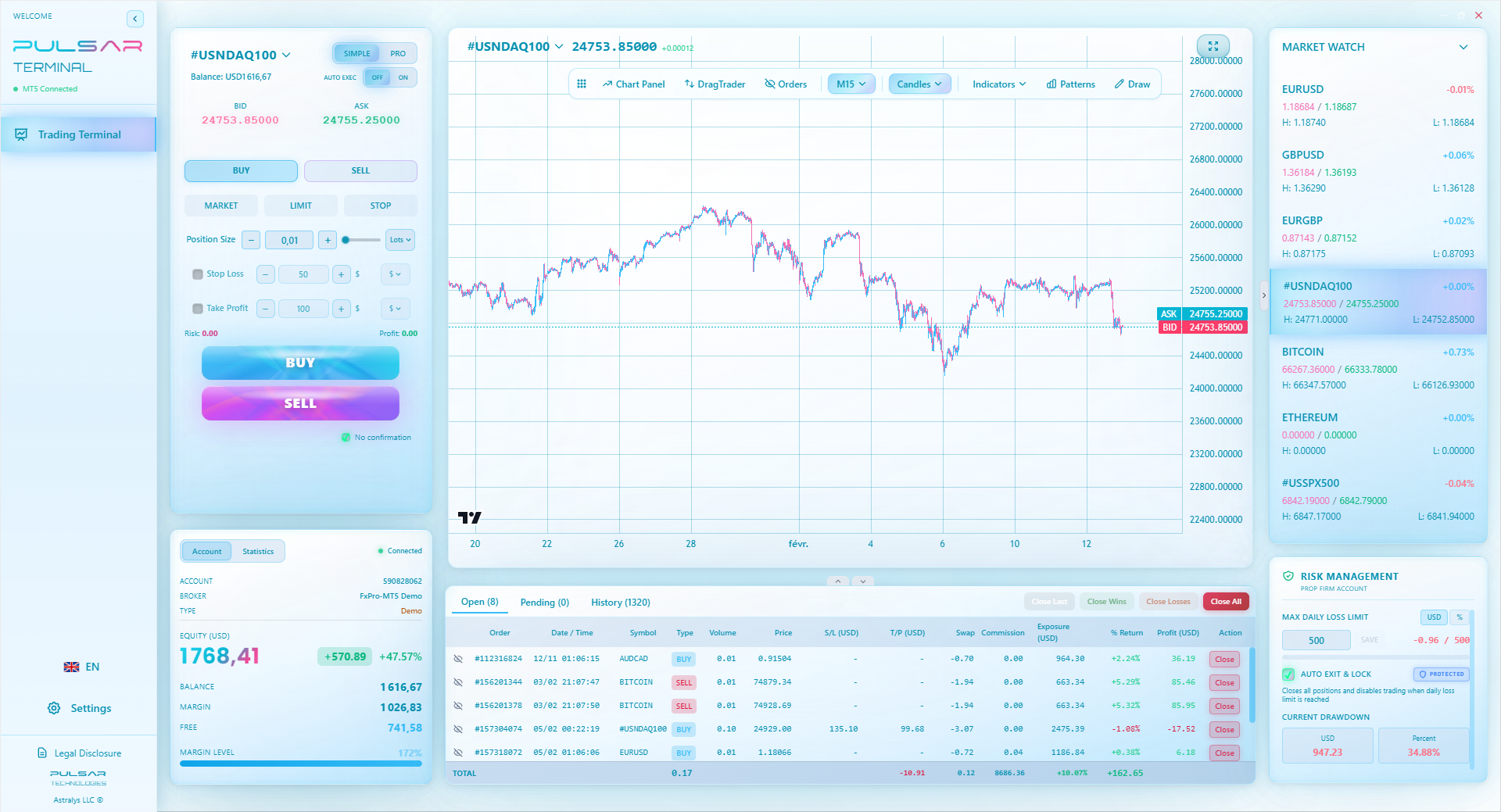
Manually moving stops and take-profits under pressure is where most plans fail, which is why automating those rules with a tool like Pulsar Terminal is a game-saver for MT5 traders.
Pulsar Terminal
The all-in-one MT5 companion: drag-and-drop orders, multi-TP/SL, trailing stop, grid trading, Volume Profile, and prop firm protection. Used by 1,000+ traders daily.
Let's get real with numbers. Here's a recent trade that encapsulates the lessons.
Instrument: EUR/USD (I was avoiding ZAR volatility that week). Setup: Price was in a clear daily uptrend, pulling back to a key support zone and the 50-day EMA. The RSI indicator dipped near 40 (bullish within a trend). Entry: Buy limit order at 1.0825. Filled on 15 March. Stop-Loss: Placed at 1.0785 (40 pips risk). Initial Take-Profit: Set at 1.0905 (80 pips target, 2:1 Risk/Reward). Capital at Risk: 1% of my account. My position size was 0.25 lots, making the 40-pip risk equal to $100.
The trade went in my favor quickly. It hit 1.0905 within two days, taking half my position off for a nice profit. Here's where I got greedy and broke my own rule. Instead of trailing my stop for the remaining half, I moved my TP to 1.0950, wanting more. The market reversed. It came all the way back down and took out my original stop-loss on the second half. I gave back most of the profits from the first half.
Final Result: Profit on first half: $100 (80 pips on 0.125 lots). Loss on second half: $100 (40 pips on 0.125 lots). Net result: Zero. R0. Zilch.
Two weeks of analysis, patience, and perfect entry... wiped out by poor exit management. I broke my trailing stop rule. That trade cost me nothing in money but was priceless in education. The system worked. I failed the system. This happens to everyone. The key is to journal it, feel the sting, and recommit to the rules next time.
💡 Winston's Tip
The most important price on your chart isn't the current one. It's the price where you've decided you're wrong.
“The system worked. I failed the system. This happens to everyone.”
- Education & Demo: Don't deposit real money for at least 3 months. Pick a broker like Exness or XM that offers a proper, unlimited demo account. Treat the virtual money like it's real. This is your training ground.
- Find One Pair: Start with one major forex currency pair. EUR/USD is perfect. Learn its personality, its average daily range, when it's most active (London/N.Y. overlap).
- Backtest a Simple Strategy: Take a simple strategy like the EMA pullback I mentioned. Go back on your demo charts for 6 months and mark every setup. See how it would have performed. Write down the results.
- Forward Test on Demo: Now trade that strategy live on demo for a month. Keep a detailed journal. Entry, exit, reason, emotion. Are you sticking to the plan?
- Go Live Small: If your demo results are consistently profitable over 100+ trades (not just 10 lucky ones), fund a small live account. Start with an amount you can afford to lose completely. Your goal in the first live year is not profit. It's to execute your plan flawlessly. If you end the year break-even but with disciplined execution, you are a massive success.
- Ignore the Noise: Unsubscribe from the 'gurus' promising 100% returns. Your journey is a marathon of consistent, small gains and controlled losses. That's how real trading businesses are built.
FAQ
Q1Is forex currency trading legal in South Africa?
Yes, it is completely legal. The key is to use a broker that is regulated by a reputable authority. The Financial Sector Conduct Authority (FSCA) is the local regulator, but many South Africans also use brokers regulated by international bodies like ASIC (Australia) or CySEC (Cyprus).
Q2What is the minimum amount needed to start forex trading in South Africa?
Technically, some brokers allow you to start with as little as $10 or R100. Practically, this is a terrible idea. With such a small amount, proper risk management is impossible, and fees will eat you alive. A more realistic minimum to apply serious strategies is R5,000 - R10,000. This allows you to risk small percentages per trade and survive the inevitable losing streaks.
Q3Which currency pairs are best for South African beginners?
Avoid USD/ZAR at the beginning. The spreads are wide and the volatility is high. Start with a major pair like EUR/USD or GBP/USD. The spreads are incredibly tight (often below 1 pip), liquidity is massive, and you'll find more reliable technical analysis and educational material focused on these global pairs.
Q4How are my forex profits taxed in South Africa?
The South African Revenue Service (SARS) views forex trading as a form of investment. Your net profits (total profits minus total losses and allowable expenses like data fees) are considered taxable income. It's crucial to keep careful records of all your trades, deposits, and withdrawals. Consult with a tax professional who understands trading.
Q5Can I make a living from forex trading in South Africa?
A very small percentage of traders do, but it takes years of dedication, a significant starting capital base (think R500,000+ to generate a meaningful monthly income at low risk percentages), and iron-clad discipline. For 99% of people, it should be approached as a serious part-time business or a skill-building investment activity, not a primary income source for a long, long time.
Q6What's the biggest mistake new SA traders make?
Underestimating the total cost of trading (spreads + swaps + commissions) and over-leveraging. They see a R10,000 account, use 50:1 use, and open a position that risks 20% of their capital on one trade. One bad move and their account is crippled. Slow, small, and steady is the only way to learn.
Prof. Winston's Lesson
Key Takeaways:
- ✓Risk max 1% per trade. 0.5% is better.
- ✓Wide ZAR spreads demand larger profit targets.
- ✓Swap rates can eat 30% of swing trade profits.
- ✓Demo trade for 3 months minimum.
How useful was this article?
Click a star to rate
Weekly Trading Insights
Free weekly analysis & strategies. No spam.
About the Author
David van der Merwe
Emerging Markets Trader
Johannesburg-based trader with 11 years in emerging market currencies. Specializes in ZAR pairs, FSCA-regulated trading, and South African market analysis.
Comments
Risk Disclaimer
Trading financial instruments carries significant risk and may not be suitable for all investors. Past performance does not guarantee future results. This content is for educational purposes only and should not be considered investment advice. Always conduct your own research before trading.
You Might Also Like

Cara Trading Forex Sukses: 7 Prinsip dari Trader Profesional
Cara trading forex sukses dengan 7 prinsip trader pro: manajemen modal, disiplin, journal trading, backtest. Data nyata, bukan janji profit palsu.
Jam Trading Forex Terbaik untuk Trader Indonesia: Panduan Lengkap dengan Tabel Waktu
Panduan jam trading forex untuk trader Indonesia. Tabel 4 sesi dunia, jam emas 20:00-00:00, sesi mana yang harus dihindari. Data akurat + tips dari trader berpengalaman.
Top 5 Sàn Forex Uy Tín Nhất 2026: Review Jujur dari Trader Indonesia
Top 5 sàn forex uy tín 2026 untuk trader Indonesia. Review jujur: spread, deposit, withdraw, dukungan lokal. Exness, XM, IC Markets & lebih.
Get Pulsar Terminal
All these calculators are built into Pulsar Terminal with real-time data from your MT5 account. One-click position sizing, automatic risk management, and instant calculations.
Get Pulsar Terminal