


Here's a hard truth most 'gurus' won't tell you: over 70% of South African traders who jump straight into live markets blow their first account within three months.

David van der Merwe
Emerging Markets Trader ·  South Africa
☕ 8 min read
What you'll learn:
- 1What Exactly Is a Forex Demo Account App?
- 2Why Every South African Trader Needs One (Yes, Even You)
- 3How to Choose the Right Demo App for South Africa
- 4The Dangerous Gap: Going From Demo to Live
- 5Beyond the Basics: Advanced Demo Drills
- 6A Look at Top FSCA Broker Demos in 2024
- 7The Final Lesson: Knowing When to Stop the Demo
Here's a hard truth most 'gurus' won't tell you: over 70% of South African traders who jump straight into live markets blow their first account within three months. I was almost one of them. The single tool that changed my trajectory wasn't a secret indicator, it was a properly used forex demo account app. In a market where the average daily volume is pushing $21 billion, that virtual playground is where you learn to swim before the sharks smell blood.
Let's cut through the marketing fluff. A forex demo account app is a simulated trading platform funded with virtual money. It's not a game, though. It connects to live or delayed market prices, meaning every spread, every slippage, and every margin call you experience mirrors the real deal. The only thing that isn't real is the money.
For us in South Africa, this is critical. Our market has specific rules, like the FSCA's 30:1 use cap for retail traders. A good demo app from an FSCA-licensed broker will enforce that same cap. You're not just learning to trade; you're learning to trade within the exact regulatory sandbox you'll operate in later.
I made my first 'demo' mistake back in 2015. I used an app from an unregulated broker offering 500:1 use. When I switched to a real FSCA broker like IC Markets, my entire 'winning' strategy fell apart because I was used to risk parameters that were illegal here. The demo environment must match your future reality.
You might think, "I've watched a few videos, I'm ready." Trust me, you're not. The psychological gap between theory and execution is a chasm. A forex demo account app bridges it.
Getting a Feel for the Rand
Trading pairs like USD/ZAR or EUR/ZAR is a different beast to the majors. The spreads are wider - often 5 pips on USD/ZAR and 14 on EUR/ZAR with a broker like Pepperstone. A demo lets you feel the impact of that cost without watching your real Rands evaporate. You learn how much the price needs to move just for you to break even.
Testing Your Mental Game
This is the big one. Can you hold a losing trade according to your plan? Can you take profits without greed kicking in? On a demo, the stakes are fake, but the emotions are surprisingly real. It's a safe space to fail. I once took 17 losing trades in a row on a demo testing a new scalping strategy. It was frustrating, but it cost me nothing. On a live account, that streak would have destroyed my confidence and my capital.

Warning: The biggest danger of a demo is developing bad habits because 'it's not real money.' Never risk more than 2% of your virtual capital on a single trade. Use a position size calculator from day one, even with fake cash. Discipline is a muscle you need to train.

💡 Winston's Tip
A demo account is a laboratory, not a casino. Have a hypothesis for every trade you place. 'I am buying here because the 4-hour trend is up and price is retesting the 50 EMA.' If you can't state your reason, don't click.
“The single tool that changed my trajectory wasn't a secret indicator, it was a properly used forex demo account app.”
Not all demo accounts are created equal. Picking the wrong one is like practicing cricket with a tennis ball - you develop skills that don't translate.
1. Regulation is Non-Negotiable: Only use demo apps from brokers licensed by the Financial Sector Conduct Authority (FSCA). This ensures the spreads, execution, and use (capped at 30:1) reflect what you'll get live. You can check any broker's status on the FSCA's public register.
2. Platform Matters: Most brokers offer demos on MetaTrader 4, MetaTrader 5, or their own app. Think about your future. If you plan to use advanced tools, an MT5 demo is better. Brokers like XM and Exness offer full-featured MT5 demos.
3. Look for Realistic Conditions:
- Virtual Capital: $10,000 or $50,000 is standard. Avoid demos offering $1,000,000. It encourages insane position sizing you can't replicate.
- Expiry: Some demos expire after 30 days. Look for ones that don't, or at least offer long durations.
- Data Feed: It should be a live, real-time feed. Delayed data makes practicing scalping pointless.
4. Test the Specific Assets: Make sure the demo offers the pairs you care about, especially the ZAR crosses. If you want to trade gold, check that XAU/USD is available too (here's a good XAU/USD guide for context).
This is where most traders fail. They kill it on demo, deposit real Rands, and then everything goes wrong. Why? Two reasons: psychology and imperfect execution.
On demo, a 20-pip loss on EUR/USD is a number. On a live account, that's real money - maybe your grocery budget. That pressure causes hesitation, revenge trading, and broken rules. The spread that was 1.1 pips on demo might momentarily widen to 2.5 pips during news on live, turning a would-be winner into a loser. You haven't felt slippage until it costs you.

Pro Tip: To bridge the gap, do a 'live simulation.' After your demo practice, open a micro live account with the absolute minimum deposit (some brokers like Fusion Markets allow $0). Trade with 0.01 lots only. The amounts are tiny, but the money is real. This hybrid phase is essential for acclimatization.
I learned this the hard way. On demo, I perfected a breakout strategy on EUR/USD. My first live trade with $500, the breakout happened, but my market order filled 3 pips above my intended price due to volatility. That 'invisible' cost was enough to trigger my stop-loss. The demo never showed me that.
“On demo, a 20-pip loss is a number. On a live account, that's your grocery budget.”
Don't just randomly trade. Use your forex demo account app for structured, scientific testing.
1. Strategy Backtesting: Have a written trading plan with clear entry, exit, and risk rules. Use the demo to execute it for at least 50-100 trades. Record every trade in a journal: entry price, exit price, reason, emotional state. The goal isn't profit, it's consistency.
2. Indicator Testing: Want to try the MACD indicator or RSI indicator? Test them in isolation on the demo. See how they behave during South African market hours (7am-5pm SAST) versus London or New York overlap. Do false signals increase?
3. Risk Management Fire Drills: This is crucial. Force yourself into scenarios:
- Scenario: You're down 3% of your demo capital in a day. Rule: Stop trading. Can you walk away?
- Scenario: A trade goes 20 pips against you but hasn't hit your stop. Rule: Do you move your stop? (Spoiler: No, you don't).
4. Platform Mastery: Learn to set trailing stops, multiple take-profit orders, and complex alerts. Managing these features under pressure is a skill. Tools that automate this, like attaching a trailing stop directly to an order, can remove emotional hiccups later.

Example: Let's say you're testing a 2% risk rule on a $10,000 demo account. That's $200 risk per trade. If your stop-loss is 50 pips away on USD/ZAR, your position size must be calculated so that 50 pips = $200. A position size calculator is your best friend here. Doing this manually 100 times on demo engrains the discipline.
💡 Winston's Tip
The most valuable data from your demo isn't your profit/loss. It's your journal. Record your emotional state for each trade. You'll find your worst losses happen when you feel 'bored' or 'owed a win.'
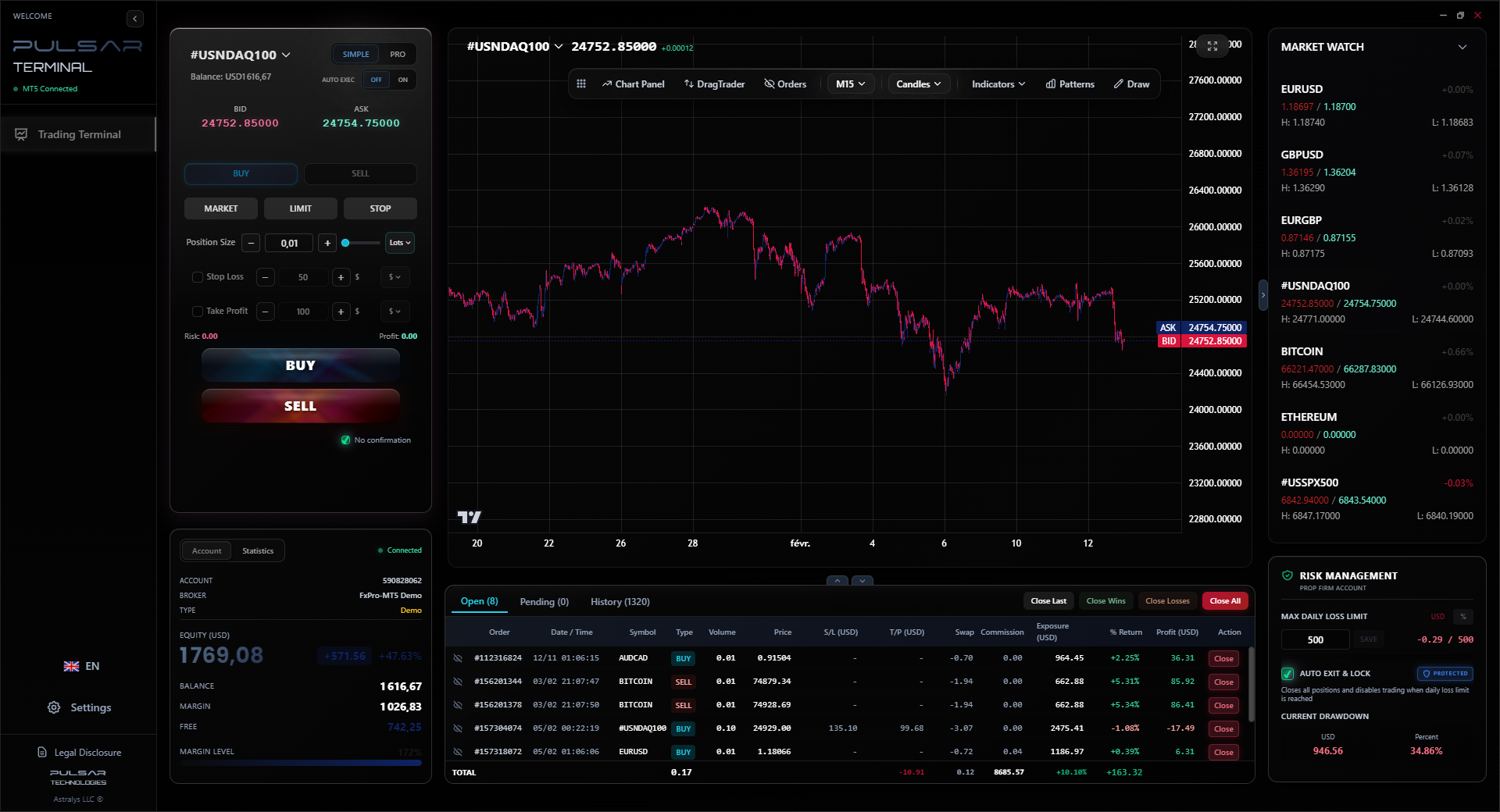
Mastering complex order types like multi-take-profit levels and trailing stops on a demo is key, and Pulsar Terminal lets you build and test these advanced setups directly on your MT5 platform.
Pulsar Terminal
The all-in-one MT5 companion: drag-and-drop orders, multi-TP/SL, trailing stop, grid trading, Volume Profile, and prop firm protection. Used by 1,000+ traders daily.
Here’s a quick, honest comparison of what a few major players offer. Remember, you can open multiple demos to shop around.
| Broker | FSCA Licensed? | Demo Platform | Key Demo Feature for SA Traders | Realistic Spread on Demo? (EUR/USD) |
|---|---|---|---|---|
| IC Markets | Yes | MT4, MT5, cTrader | Raw spread model mirrors live. Good for testing low-cost scalping. | Yes (~0.1-0.6 pips on Raw) |
| Pepperstone | Yes | MT4, MT5, TradingView | Demo includes ZAR pairs with realistic wide spreads. | Yes (Razor account ~0.0 pips + comm) |
| Exness | Yes | MT5, Exness App | Demo doesn't expire. Easy to use for long-term practice. | Mostly (can be slightly tighter than live) |
| XM | Yes | MT4, MT5 | $100,000 virtual capital, good for testing different account types. | Fair (standard account ~1.7 pips) |
My personal go-to for strategy testing is Pepperstone's MT5 demo on the Razor account. Seeing the commission deducted from each trade on the demo forced me to factor in true costs from the start, something I'd ignored with other brokers.
“Every mistake I make now, I try to make first on a demo. It's the cheapest tuition you'll ever pay.”
The demo account has a shelf life. If you've been on demo for 18 months, you're likely procrastinating. If you're profitable and consistent over 3-6 months (at least 100 trades), it's time to graduate.
The signs you're ready:
- Your trading journal shows consistent adherence to your plan.
- You're emotionally detached from individual wins and losses.
- You can calculate your position size in your sleep.
- You've survived at least two simulated 'drawdown' periods on the demo.
Start small. Deposit an amount you can afford to lose completely - not your rent, not your savings. Trade micro lots. The goal of your first live R10,000 account isn't to get rich. It's to validate your demo results with the final, unpredictable variable: you.
I'll leave you with this: my most expensive lesson cost me R8,000 in 2017. It was a simple margin call on a GBP news event. I had never let a trade get that far on demo, so I never experienced the forced liquidation. Every mistake I make now, I try to make first on a demo. It's the cheapest tuition you'll ever pay in this game.
FAQ
Q1Are forex demo account apps really free in South Africa?
Yes, 100% free. Reputable FSCA-licensed brokers offer them as a client acquisition tool. You never deposit money or pay fees. Be wary of any 'demo' that asks for payment upfront - it's a scam.
Q2How much virtual money should I start with on a demo?
Start with a realistic amount, like $10,000 or $50,000. Starting with $1,000,000 teaches terrible habits, like over-leveraging. You'll size trades in a way that's impossible to replicate with your real capital.
Q3Can I test ZAR currency pairs on a demo?
Absolutely, and you should. Choose a broker like Pepperstone or Exness that offers USD/ZAR, EUR/ZAR, and GBP/ZAR on their demo. This lets you practice with the wider spreads and unique volatility of these pairs.
Q4My demo trades always win, but I lose live. Why?
This is the classic demo trap. On demo, you often get perfect fills at the click price. Live trading has slippage, requotes, and emotional pressure. The fix is to trade micro lots on a small live account to bridge the psychological gap.
Q5Do demo accounts expire?
It depends on the broker. Some expire after 30 days, others (like Exness) can last indefinitely. If yours expires, just open a new one. It's a good chance to test a different broker's conditions.
Q6Is trading on a demo account with 100:1 use useful if SA limits me to 30:1?
No, it's counterproductive. It builds a false sense of risk. Always use a demo from an FSCA broker that enforces the 30:1 retail use cap. You need to practice with the same constraints you'll face.
Q7Can I use a demo to pass a prop firm challenge?
A demo is the perfect place to practice the strict rules of a prop firm challenge (daily loss limits, max drawdown). You can refine your strategy to fit their specific targets without paying the challenge fee repeatedly.
Prof. Winston's Lesson
Key Takeaways:
- ✓Use only FSCA-regulated broker demos to practice under real 30:1 use limits.
- ✓Test ZAR pairs on demo to understand their wider spreads (5-14 pips).
- ✓Conduct at least 100 demo trades with a journal before going live.
- ✓Bridge the gap with a micro live account trading 0.01 lots.
- ✓A demo's purpose is consistency, not profit.
How useful was this article?
Click a star to rate
Weekly Trading Insights
Free weekly analysis & strategies. No spam.
About the Author
David van der Merwe
Emerging Markets Trader
Johannesburg-based trader with 11 years in emerging market currencies. Specializes in ZAR pairs, FSCA-regulated trading, and South African market analysis.
Comments
Risk Disclaimer
Trading financial instruments carries significant risk and may not be suitable for all investors. Past performance does not guarantee future results. This content is for educational purposes only and should not be considered investment advice. Always conduct your own research before trading.
You Might Also Like

Cara Trading Forex Sukses: 7 Prinsip dari Trader Profesional
Cara trading forex sukses dengan 7 prinsip trader pro: manajemen modal, disiplin, journal trading, backtest. Data nyata, bukan janji profit palsu.
Jam Trading Forex Terbaik untuk Trader Indonesia: Panduan Lengkap dengan Tabel Waktu
Panduan jam trading forex untuk trader Indonesia. Tabel 4 sesi dunia, jam emas 20:00-00:00, sesi mana yang harus dihindari. Data akurat + tips dari trader berpengalaman.
Top 5 Sàn Forex Uy Tín Nhất 2026: Review Jujur dari Trader Indonesia
Top 5 sàn forex uy tín 2026 untuk trader Indonesia. Review jujur: spread, deposit, withdraw, dukungan lokal. Exness, XM, IC Markets & lebih.
Get Pulsar Terminal
All these calculators are built into Pulsar Terminal with real-time data from your MT5 account. One-click position sizing, automatic risk management, and instant calculations.
Get Pulsar Terminal