


I lost R12,000 in under an hour trading USD/ZAR.

David van der Merwe
Emerging Markets Trader ·  South Africa
☕ 11 min read
What you'll learn:
- 1Understanding USD/ZAR: It's Not Just Another Pair
- 2The Rules: FSCA, SARB, and Your Money
- 3The Real Costs: Brokers, Banks, and Hidden Fees
- 4Trading Strategies: What Actually Works on This Pair
- 5Risk Management: This is Your Survival Kit
- 6Picking a Broker in South Africa: Key Questions
- 7Mistakes I've Made (So You Don't Have To)
- 8Getting Started: Your First USD/ZAR Trade
I lost R12,000 in under an hour trading USD/ZAR. It was 2018. The pair was grinding sideways, and I got cocky. I loaded up on a long position at R13.85, convinced a breakout was coming. I used way too much use. Then, out of nowhere, a rumor about a cabinet reshuffle hit the wires. The rand didn't just weaken, it fell off a cliff. My stop-loss at R13.95 got skipped in the gap, and I was filled at R14.22. Poof. Gone. That trade taught me more about the forex dollar to rand market than any book ever could. It's a beast. Let's talk about how to not get eaten by it.
Trading USD/ZAR isn't like trading EUR/USD. You're not just trading currencies; you're trading South Africa's political mood, its credit rating, and the global price of a dozen commodities. It's an exotic pair, which means higher volatility and wider spreads. Forget the 1-2 pip spreads you see on majors. Here, 5-10 pips is normal, and during news events, it can blow out to 50 pips or more. That spread is your first enemy, and it'll eat into your profits if you're not careful with your position size calculator.
The rand is a classic risk-on, risk-off currency. When global investors are feeling brave, money flows into emerging markets like South Africa, strengthening the ZAR (USD/ZAR goes down). When panic hits, they pull money out and buy dollars, sending USD/ZAR soaring. Local factors are just as brutal: Eskom load-shedding stages, mining strikes, budget speeches, and corruption headlines can all cause violent moves. I've seen the pair move 300 pips in a day on a single political comment. You need a stomach for this.

Warning: Never, ever leave a USD/ZAR trade unattended around major South African news times (like SARB interest rate announcements or the Medium-Term Budget Policy Statement). The slippage can bankrupt an account faster than you can say 'jislaaik'.

💡 Winston's Tip
The spread on USD/ZAR is a silent tax. If your strategy relies on 5-pip profits, you've already lost. Your edge must be significantly larger than the cost of entry and exit.
Let's get the boring but critical stuff out of the way. Trading forex is legal here, but there are fences you can't climb.
The Regulatory Players
You have two main bosses: the Financial Sector Conduct Authority (FSCA) and the South African Reserve Bank (SARB). The FSCA looks after the brokers and tries to keep them honest. A broker doesn't have to be FSCA-regulated to take you on as a client, but if they are, it's a good sign. It means they should be segregating client funds and not running a Ponzi scheme from a back room in Sandton. I stick with FSCA-regulated or top-tier international brokers like IC Markets or Pepperstone that have a solid reputation.
The SARB is a different animal. They control the flow of money in and out of the country. This is where your allowances come in.
Your Allowances: The R11 Million Question
As a South African resident, you get an annual discretionary allowance to move money offshore. For 2024/2025, the total is R11 million. It's split into two parts:
- Single Discretionary Allowance (SDA): R1 million. No tax clearance needed. Use this for travel, online shopping, or funding a small trading account.
- Foreign Investment Allowance (FIA): R10 million. This requires a Tax Compliance Status (TCS) PIN from SARS. You can't touch this without proving you're tax compliant.

Pro Tip: If you're funding an international broker, keep records of every transfer. The bank will ask for the purpose. "Investment in foreign securities via a licensed broker" is usually fine. Transfers over R1 million need an Approval of International Transfer (AIT) from SARS. It's a hassle, but non-compliance is a bigger one.
“The spread is your first enemy, and it'll eat into your profits if you're not careful.”
This is where many new traders get a nasty surprise. The advertised cost isn't the full story.
Broker Costs on USD/ZAR: Expect a minimum spread of around 5 pips on a good day with a raw account. Commission-based accounts might show a tighter raw spread (sometimes under 1 pip) but charge a commission per lot. Let's do the math.
| Broker Type | Avg. USD/ZAR Spread | Commission (per lot) | Effective Cost for 1 Lot |
|---|---|---|---|
| Standard Account | 8 pips | $0 | $80 (8 pips * $10 per pip) |
| Raw/ECN Account | 2 pips | $35 round-turn | $55 ((2 pips * $10) + $35) |

Example: On a standard account, if you buy 1 lot at R18.5000 and the spread is 8 pips, the price needs to move to R18.5800 just for you to break even. That's a big hill to climb.
Banking Fees Are a Killer: Funding your broker isn't free. If you're using a local FSCA broker, you'll pay in ZAR. If you're using an international one, you'll pay in USD or EUR. Your bank will charge you a forex conversion fee and a wire fee. I've seen Capitec charge R250 for an outgoing payment, and Standard Bank's Shyft can take $15 for an incoming transfer. These fees murder small accounts. This is one reason I started with a larger chunk of capital – the fees as a percentage of my deposit were less painful.
Swap Rates (Overnight Financing): This is critical for swing trading. Because South African interest rates are typically higher than US rates, you generally PAY to hold a USD/ZAR long position overnight and EARN a small amount for holding a short position. Check your broker's swap calculator before holding a trade for days.
💡 Winston's Tip
Your annual SARB allowance is for moving capital. Your monthly profits from trading are considered income. Keep records. SARS will want their share, and 'I forgot' isn't a valid deduction.
Forget the fancy stuff you see on YouTube. USD/ZAR responds to a different set of signals.
Play the Ranges (Until You Can't)
USD/ZAR often moves in well-defined ranges for weeks, especially when there's no major news. I've made consistent money buying near support and selling near resistance. The key is using tighter stops because the breakouts, when they come, are vicious. I use basic horizontal lines and the RSI indicator to spot overbought/oversold conditions within the range. A classic setup for me was buying at R18.20 and selling at R18.80 throughout late 2023.
Trend Trading the Big Moves
When a fundamental story takes over (like a global risk-off wave or a local credit downgrade), the pair can trend for months. This is where you make real money. I use the 50 and 200-day Exponential Moving Averages to confirm the trend direction. In a strong uptrend, I only look for buy opportunities on pullbacks. My most profitable trade ever was holding a short from R19.40 down to R16.80 in 2020 during the pandemic panic rebound. I used a trailing stop, which locked in over R25,000 in profit as it fell.
News Trading: For the Brave and Well-Capitalized
This is high-risk casino stuff, but it can pay. You need a direct news feed (like Reuters Eikon) and lightning-fast execution. I don't recommend it for most. I tried it once ahead of a SARB decision, got the direction right (they hiked), but the spike and immediate reversal triggered my stop before the trend continued. I lost R2,500 in 90 seconds. Lesson learned.
Pro Tip: Combine fundamental bias with technical entries. If the market is fearful and commodities are down, your bias should be to look for USD/ZAR longs. Then, use a chart pattern or indicator like the MACD indicator on the 4-hour chart to find a precise entry point. Don't fight the fundamental tide.
“On my losing R12,000 trade, I was leveraged at about 1:50. Stupid.”
This is the only reason I'm still trading after 12 years. With USD/ZAR's volatility, poor risk management is a guaranteed account destroyer.
1. use is Poison. The FSCA limits use for retail clients to 1:30 on major forex pairs. For exotic pairs like USD/ZAR, some brokers apply even lower limits, like 1:20. Use even less. I never use more than 1:10 on this pair. On my losing R12,000 trade, I was leveraged at about 1:50. Stupid. On a R100,000 account, a 1:10 use means you're controlling R1,000,000. A 1% move against you (1000 pips) is a R10,000 loss. That's painful but survivable. At 1:50, that same move wipes you out.
2. Position Sizing is Everything. Never risk more than 1-2% of your account on a single trade. On a R50,000 account, that's R500-R1,000 risk per trade. If your stop-loss is 50 pips away from your entry, your position size must be small enough that a 50-pip loss equals R500. Use a position size calculator every single time. No exceptions.
3. Stop-Losses and the Art of the Trailing Stop. You must use a hard stop-loss. Period. Place it at a level that, if hit, proves your trade idea wrong. More importantly, learn to trail your stop to lock in profits. When I caught that big downtrend from R19.40, I moved my stop to breakeven once I was up 100 pips, then trailed it below the daily swing lows. This is manual work, but it's how you turn a 300-pip win into a 2000-pip win.
4. Beware the Margin Call. With high volatility, your equity can swing wildly. If your used margin gets too close to your equity, your broker will start closing positions. Keep your margin usage below 20-30% to give yourself a buffer.
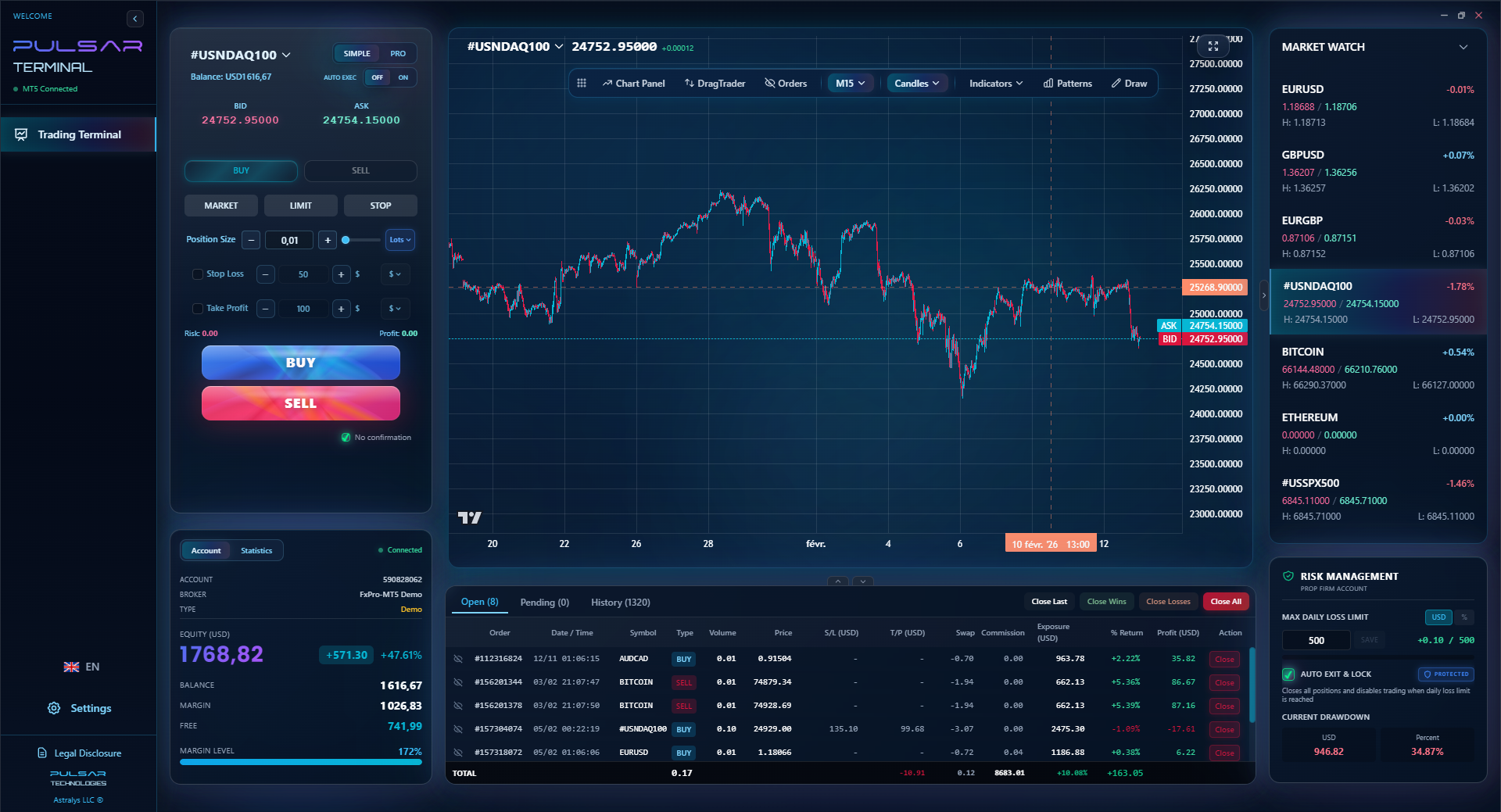
Manually trailing stops on volatile pairs like USD/ZAR is stressful and easy to mess up, which is why I use Pulsar Terminal to automate it directly on my MT5 charts.
Pulsar Terminal
The all-in-one MT5 companion: drag-and-drop orders, multi-TP/SL, trailing stop, grid trading, Volume Profile, and prop firm protection. Used by 1,000+ traders daily.
Don't just go for the one with the flashiest ads. Ask these questions:
- Are you FSCA regulated? (Get their FSP number and check it on the FSCA website).
- What are your REAL spreads on USD/ZAR during London and New York opens? Ask for a screenshot or historical data.
- What's your minimum deposit? It can range from $0 (like Exness) to $200. Start with an amount you can afford to lose.
- What platforms do you offer? MT4/MT5 are industry standard. Does the broker offer decent tools for them?
- How do I deposit/withdraw in ZAR? What are the fees, and how long does it take? Local EFT should be fast and cheap.
I've had good execution experiences with brokers like IC Markets and Pepperstone for their raw accounts. For beginners, XM offers a decent no-commission account with smaller minimum trades, which is great for learning position sizing without getting killed on commission.
Remember, the cheapest broker isn't always the best. Reliability during news events and the speed of withdrawals are worth paying a slightly higher spread for.
💡 Winston's Tip
The most reliable indicator for USD/ZAR isn't on your chart. It's the JSE Top 40 index and the S&P 500. If they're in freefall, don't even think about selling dollars.
“If your stop is hit, you're wrong. Get out. Averaging down is the #1 account killer.”
Let me save you some money and heartache.
1. Averaging Down on a Loser. This is the #1 account killer. You buy at R18.00, it drops to R18.20, you buy more to 'lower your average'. It drops to R18.50, you're now in a massive losing position with double the size. The rand can keep going against you for a long, long time. If your stop is hit, you're wrong. Get out.
2. Trading Around Budget Speeches or SARB Meetings Without a Plan. These events cause chaos. Either stay out completely, or have a rock-solid plan with wide stops. I've seen the pair whip 150 pips in both directions in minutes after a speech.
3. Ignoring Global Risk Sentiment. You can have the perfect technical setup for a USD/ZAR short, but if the S&P 500 is crashing and investors are fleeing to dollars, your trade will blow up. Always check the broader market mood.
4. Scalping USD/ZAR with a Standard Account. The wide spreads make this nearly impossible to do profitably. By the time you're in and out, the spread has taken most of your potential profit. If you want to scalp, you need a raw/ECN account.
5. Not Accounting for Swap. Holding a long position over a weekend can cost you a decent amount in fees. It adds up over time and turns winning trades into losers if you're not careful.
Here's a conservative, step-by-step approach for your first real trade.
- Open a Demo Account: Pick a broker from the list above. Trade the demo for at least 2 months. Get a feel for the volatility and practice your risk management.
- Fund a Live Account: Start small. Deposit an amount you are 100% comfortable losing - maybe R5,000 to R10,000. This is tuition money.
- Find a Setup: Wait for the pair to be in a clear range on the 4-hour chart. Let's say it's bouncing between R18.00 and R18.50.
- Plan Your Trade:
- Direction: Look to BUY near R18.05 (support).
- Stop-Loss: Place at R17.95 (10 pips/1.0 cent risk).
- Take-Profit: Aim for R18.45 (40 pips target).
- Risk: Decide to risk 1% of your R10,000 account = R100.
- Position Size: Your risk is 10 pips. R100 / 10 pips = R10 per pip. On USD/ZAR, 1 standard lot is roughly $10 per pip (depending on rate). So, you can trade 0.1 lots (a mini lot), which risks about $1 (roughly R18) per pip. 10 pips * R18 = R180 risk. That's a bit over 1%. Adjust to 0.07 lots to get closer to your R100 risk. Use your position size calculator.
- Execute and Manage: Place the trade. If it hits your profit target, great. If it hits your stop, you're out for a small, planned loss. No drama.
The goal of your first 20 trades isn't to get rich. It's to survive, follow your plan, and learn the rhythm of the forex dollar to rand market. Good luck, and trade safe.
FAQ
Q1Is forex trading legal in South Africa?
Yes, absolutely. It's regulated by the Financial Sector Conduct Authority (FSCA). However, you must use a licensed financial services provider (broker) and comply with the South African Reserve Bank's (SARB) exchange control regulations when moving money offshore.
Q2What is the average spread for USD/ZAR?
It varies by broker and account type. On a standard account, expect 5-10 pips as a minimum. On a raw/ECN account, the raw spread can be 1-3 pips, but you'll pay a commission. Always check the broker's live account specifications.
Q3How much money do I need to start trading USD/ZAR?
You can start with a few thousand rand, but I'd recommend at least R10,000 for a beginner. This allows for proper position sizing and can withstand the volatility and costs (like spreads and bank fees) without being wiped out by a single bad trade. Many brokers have minimum deposits as low as $10 (roughly R180).
Q4What moves the USD/ZAR exchange rate?
Three main things: 1) Global risk sentiment (fear strengthens USD, weakens ZAR), 2) US Dollar strength (driven by US Fed policy, data), and 3) South African-specific factors (SARB interest rates, political stability, Eskom performance, commodity prices, and credit ratings).
Q5What's the difference between the SDA and FIA allowances?
The Single Discretionary Allowance (SDA) is R1 million per year you can move without tax clearance. The Foreign Investment Allowance (FIA) is an additional R10 million, but it requires a Tax Compliance Status PIN from SARS. Together, they make up your total R11 million annual allowance.
Q6Can I use use when trading USD/ZAR?
Yes, but it's limited and dangerous. FSCA rules cap use for retail clients. For a major pair like EUR/USD, it's 1:30. For exotic pairs like USD/ZAR, brokers often apply lower limits (e.g., 1:20). I strongly advise using far less - no more than 1:10 - due to the pair's high volatility.
Q7Should I trade USD/ZAR or stick to majors like EUR/USD?
Prof. Winston's Lesson
Key Takeaways:
- ✓Never risk more than 2% of your capital on a USD/ZAR trade.
- ✓Use use of 1:10 or less on this volatile pair.
- ✓A 5-pip spread means you need a 10-pip move just to break even.
- ✓Always have a stop-loss. No debate.
- ✓Global risk sentiment trumps all technical setups.
How useful was this article?
Click a star to rate
Weekly Trading Insights
Free weekly analysis & strategies. No spam.
About the Author
David van der Merwe
Emerging Markets Trader
Johannesburg-based trader with 11 years in emerging market currencies. Specializes in ZAR pairs, FSCA-regulated trading, and South African market analysis.
Comments
Risk Disclaimer
Trading financial instruments carries significant risk and may not be suitable for all investors. Past performance does not guarantee future results. This content is for educational purposes only and should not be considered investment advice. Always conduct your own research before trading.
You Might Also Like

Cara Trading Forex Sukses: 7 Prinsip dari Trader Profesional
Cara trading forex sukses dengan 7 prinsip trader pro: manajemen modal, disiplin, journal trading, backtest. Data nyata, bukan janji profit palsu.
Jam Trading Forex Terbaik untuk Trader Indonesia: Panduan Lengkap dengan Tabel Waktu
Panduan jam trading forex untuk trader Indonesia. Tabel 4 sesi dunia, jam emas 20:00-00:00, sesi mana yang harus dihindari. Data akurat + tips dari trader berpengalaman.
Top 5 Sàn Forex Uy Tín Nhất 2026: Review Jujur dari Trader Indonesia
Top 5 sàn forex uy tín 2026 untuk trader Indonesia. Review jujur: spread, deposit, withdraw, dukungan lokal. Exness, XM, IC Markets & lebih.
Get Pulsar Terminal
All these calculators are built into Pulsar Terminal with real-time data from your MT5 account. One-click position sizing, automatic risk management, and instant calculations.
Get Pulsar Terminal