


Here's a hard truth most new traders ignore: 80% of the time, the market just chops around.

Olumide Adeyemi
West African Trading Pioneer ·  Nigeria
☕ 9 min read
What you'll learn:
- 1What Actually Moves the Market Here? (It's Not Just US Data)
- 2The Three Types of Forex Events You Must Know
- 3Your Game Plan: Before, During, and After the News
- 4How to Not Blow Up: Managing News Volatility
- 5Essential Tools: Calendars and What to Watch On-Chart
- 6The 5 Most Common Nigerian Trader Mistakes (I've Made Them All)
- 7Putting It All Together: A Real Trade Example
Here's a hard truth most new traders ignore: 80% of the time, the market just chops around. It's the other 20%, driven by major forex events, where fortunes are made and lost in minutes. In Nigeria, where we're hypersensitive to dollar liquidity and CBN policy, understanding these events isn't just smart, it's survival. I've seen accounts blow up on Naira devaluation rumours and others 5x on a single MPC announcement. Let's talk about how you can be in the second group.
You'll hear a lot about Non-Farm Payrolls and the Fed. Sure, they matter globally. But if you're trading with Naira in your account or watching USD/NGN pairs, local events hit harder and faster. The Central Bank of Nigeria's (CBN) Monetary Policy Committee (MPC) meetings are our version of the Fed. A surprise hike or cut can send the parallel market rate swinging by 50 Naira in a day. I learned this the hard way in early 2023. I was long USD/NGN, focused on US CPI, and got absolutely blindsided by a CBN rate hike I didn't see coming. Wiped out two weeks of gains in an hour.
Then there's FAAC allocations. When federal money hits state accounts, dollar demand can spike. Oil price reports from NNPC directly impact our external reserves. Even political statements about "unifying exchange rates" can cause panic buying or selling. You need a calendar with both global and hyper-local events. Ignoring the local context is the fastest way to turn a good trade into a donation.

Warning: Nigerian forex events often have a 'rumour phase' and an 'official phase'. The big move usually happens on the rumour. By the time the CBN Governor is on TV, the smart money has already taken profit.
Not all news is created equal. I bucket them into three categories, based on how I trade them.
Tier 1: Market Shakers
These are the big ones. They cause sustained, directional moves with high volatility. For us, that's:
- CBN MPC Rate Decisions & Statements: The main event. The tone of the Governor's speech is often as important as the number.
- US Non-Farm Payrolls & Federal Reserve Meetings: Moves EUR/USD and GBP/USD, which affects all cross pairs.
- Major Naira Devaluation/Rate Unification Announcements: These are rare but catastrophic if you're on the wrong side.
I treat these like a hurricane warning. I reduce my overall position size dramatically or stay out entirely unless I have a very specific, pre-planned strategy.
Tier 2: Market Movers
These cause a clear move, but it's often more technical and tradable. Think:
- US/UK/EU CPI (Inflation) Data: Core for swing trading trends.
- Nigeria's Inflation Data (NBS): Confirms or contradicts CBN policy direction.
- Oil Inventory Data (EIA): Moves CAD and, by extension, impacts Nigeria's reserve outlook.
These are my bread and butter. The volatility is high but not insane. I can set wider stops and ride a trend.
Tier 3: Noise Makers
PMI data, consumer sentiment, mid-level speeches. They might cause a 10-15 pip wiggle, but rarely reverse a trend. I mostly ignore these unless I'm scalping and need intraday momentum.

💡 Winston's Tip
The market's reaction to news is more important than the news itself. A 'good' number that causes selling is, by definition, bad for your long trade. Trade the price, not the headline.
“In Nigeria, where we're hypersensitive to dollar liquidity and CBN policy, understanding forex events isn't just smart, it's survival.”
Trading news without a plan is gambling. Here's the simple framework I've used for years.
Before the Event (The Prep):
- Know the Expectation: What are analysts forecasting? A 50bps hike? 5.1% inflation? This is your baseline.
- Plan for Three Outcomes: Better than expected, as expected, worse than expected. Sketch what each might do to your chart. For example, if USD/NGN is at 1450:
- Strong Naira Data (Better than expected): Could drop to 1420 support.
- As Expected: Maybe a chop between 1440-1460.
- Weak Naira Data (Worse): Could rally to test 1480 resistance.
- Set Alarms: 5 minutes before the release. Close all distracting tabs.
During the Event (Execution): This is the dangerous part. The spread will widen massively. Your market order might fill 20 pips away from where you clicked. I have one rule here: No market orders. Only use pending orders placed before the news, or wait for the initial spike/crash to settle (usually 1-3 minutes).
After the Event (The Follow-Through): The initial move is often emotional. The next 15 minutes to 2 hours show the real direction. This is where I look for a retracement back to a key level (like the pre-news high or a Fibonacci level) and then an entry in the direction of the breakout. This patience has saved me from countless fakeouts.

Pro Tip: On platforms like Exness or IC Markets, switch to a raw spread account for news trading. The spreads might still widen, but it's nothing compared to the massive markups on standard accounts during volatility.
Volatility isn't your enemy, it's your fuel. But you need a bigger fuel tank. Here’s how to manage it.
Position Size is Everything: This is non-negotiable. If your normal trade uses 2% of your capital, cut it to 0.5% or 1% for a Tier 1 event. The moves are bigger, so your potential loss is bigger. Use a position size calculator religiously. In 2024, I got greedy on a US CPI play and used my full 2% size. The number was wild, the whipsaw was wilder, and I hit my stop loss for a 2% loss in 90 seconds. A stupid, preventable mistake.
Wider Stops are Not Optional: Your 10-pip stop loss that works in the Asian session will get vaporized. For major news, I place my stop at least 1.5 to 2 times the Average True Range (ATR). If the ATR is 50 pips, my stop needs to be 75-100 pips away. This gives the trade room to breathe.
Beware of Slippage and Requotes: Your broker is not your friend during news. They're protecting themselves. You might get a 'requote' (your price is no longer valid) or severe slippage. This is another reason for pending orders. If you're with a broker known for terrible news execution (do your research on XM or Pepperstone reviews for this specifically), maybe just don't trade the first minute.
The Margin Call Trap: High volatility can lead to a rapid drawdown. If you're over-leveraged, a quick move against you can trigger a margin call before you even have a chance to react. Keep your margin usage below 20% around major events.
💡 Winston's Tip
Your first loss is often your smallest. If a news trade immediately goes against you and hits your stop, do NOT re-enter out of frustration. The market is telling you your initial read was wrong. Listen.
“Trading news without a plan is gambling. The disciplined, boring way is how you profit from chaos.”
You can't trade what you don't see. Here's my setup.
Economic Calendars:
- ForexFactory.com: The classic. Filter for 'High' impact events. Set it to your timezone (WAT).
- Your Broker's Calendar: Often integrated into their platform. IC Markets and Pepperstone have good ones.
- Investing.com Nigeria Edition: Crucial for local MPC dates, inflation releases, and FAAC news.
On-Chart Indicators for News: Forget complicated systems. I use two things:
- Volume: See if the spike in price is accompanied by a spike in volume. High volume confirms the move is real. Low volume suggests it might be a fakeout.
- Simple Support/Resistance: Draw key horizontal lines from the pre-news session. Where did the price bounce or break? That's your new trading level.
I avoid lagging indicators like the MACD or RSI right after news. They'll be completely out of sync. Price action and volume tell the story for the first hour.
Let me save you some money and heartache.
- Trading Without a Local Calendar: You're watching for US data but miss the CBN selling dollars to BDCs. The market moves against you, and you have no idea why.
- Chasing the Initial Spike: You see USD/NGN jump 100 pips on a rumour and FOMO in at the top. It immediately reverses 80 pips. Wait for the pullback.
- Overleveraging for a 'Sure Thing': No news trade is a sure thing. I once put 5% of my account on what seemed like a lock (ECB hike). A simultaneous geopolitical headline spiked the opposite direction. I was down 5% in a blink.
- Ignoring the 'Sell the Fact' Reaction: Sometimes, even a good number causes a reverse move because it was already 'priced in.' The market buys the rumour, sells the fact. This happens a lot with our MPC meetings.
- Not Having an Exit Plan: You get in a good trade, up 60 pips. Then greed sets in. 'It'll go further!' You watch it retrace all the way to your breakeven. Decide your take-profit before you enter. A tool that lets you set multiple TP levels can help lock in partial profits automatically.
💡 Winston's Tip
Create a pre-news checklist: Position size halved? Stops widened? Phone on silent? Distractions removed? This 60-second ritual prevents impulsive, costly mistakes.
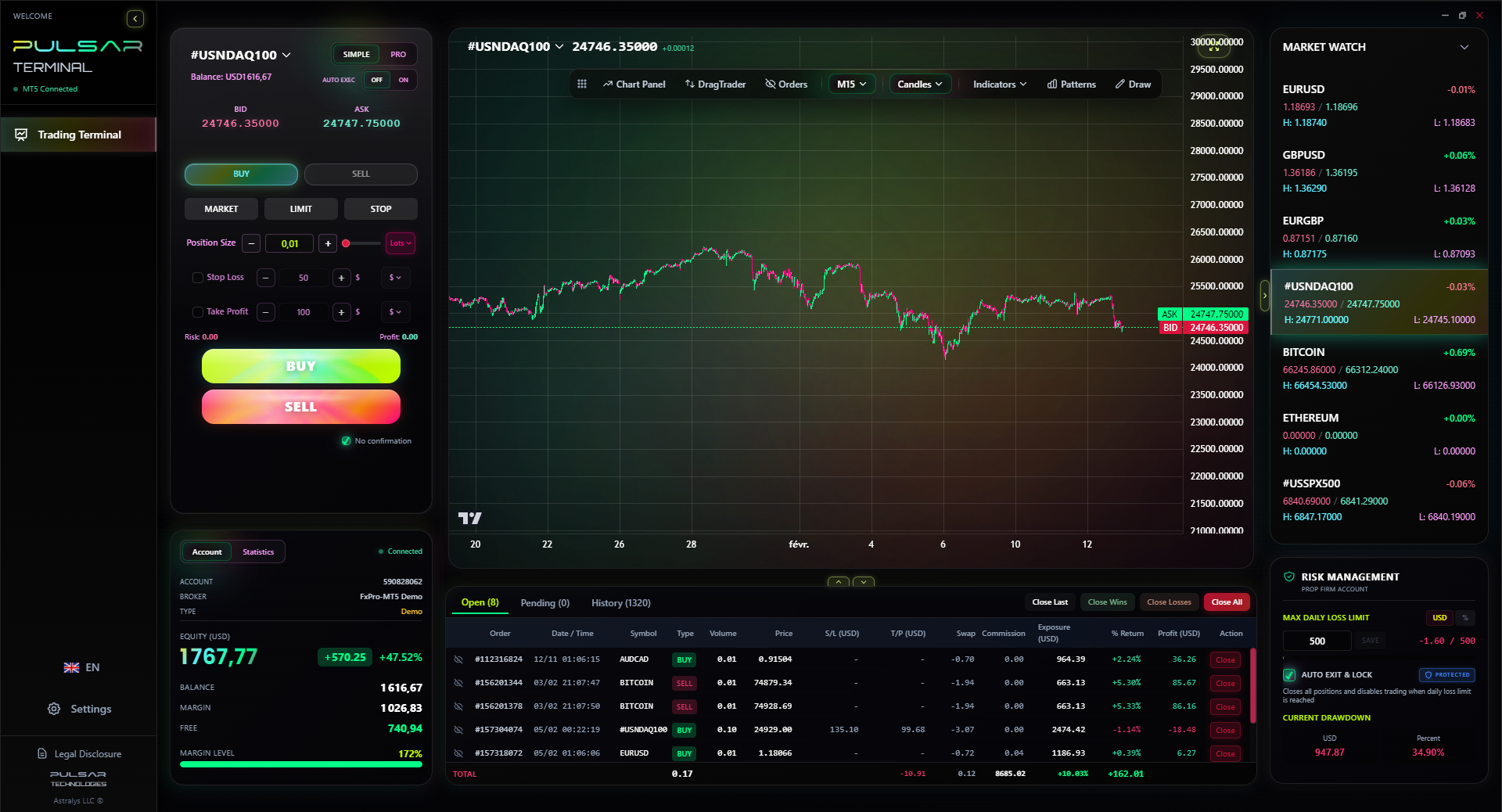
When trading volatile news, having a clear exit plan with multiple take-profit levels is critical, and Pulsar Terminal lets you set and manage these complex orders directly on your MT5 chart with a simple drag-and-drop.
Pulsar Terminal
The all-in-one MT5 companion: drag-and-drop orders, multi-TP/SL, trailing stop, grid trading, Volume Profile, and prop firm protection. Used by 1,000+ traders daily.
“Your first loss is often your smallest. If a news trade immediately goes against you, the market is telling you your read was wrong. Listen.”
Let's walk through a hypothetical, but very realistic, scenario using a major pair like EUR/USD.
The Event: US CPI Data. Expected: 3.1% Previous: 3.2%. Release in 2 hours.
My Prep:
- Chart Time: 1-Hour. Price is in a slow uptrend, trading at 1.0850.
- Key Levels: Support at 1.0820 (previous low). Resistance at 1.0880.
- Plan:
- CPI > 3.2% (Hot): Strong USD. Look for a break below 1.0820. Might sell a retest of that level.
- CPI between 3.0%-3.2% (As expected): Choppy. I stay out.
- CPI < 3.0% (Cool): Weak USD. Look for a break above 1.0880. Might buy a retest.
- Position Size: Normal size is $10 per pip. For this news, I cut it to $5 per pip.
- Order: I place a BUY STOP at 1.0885 (above resistance) and a SELL STOP at 1.0815 (below support). Both with 50-pip stop losses and 80-pip take-profits.
The Release: CPI prints at 2.9% (Cool). Price instantly spikes to 1.0890. My Buy Stop is triggered at 1.0885.
What Happens Next: It spikes to 1.0910, then pulls back to 1.0888 (my entry zone +3 pips). This is the retest. It holds, then resumes climbing. It hits my take-profit at 1.0965. I'm out for an 80-pip gain.
Why This Worked: I had a plan for all outcomes. I used pending orders to avoid slippage. I used a sensible position size. I didn't chase. I waited for the retest confirmation. This is the disciplined, boring way to profit from chaos.
FAQ
Q1What's the single most important forex event for a Nigerian trader?
Hands down, the Central Bank of Nigeria's Monetary Policy Committee (MPC) meeting. It sets interest rates and gives the CBN Governor's view on the Naira. This directly impacts USD/NGN rates, inflation expectations, and liquidity. A surprise here moves markets more than any US data.
Q2Should I trade right when the news is released?
Generally, no. The first 60-90 seconds are chaos with massive spreads and slippage. It's better to either have your pending orders already set (as in the example), or wait for the initial explosive move to finish and then trade the 'follow-through' in the next 5-15 minutes once liquidity returns.
Q3How much wider should my stop loss be for news?
At a minimum, 1.5 times the 14-period Average True Range (ATR) on the 1-hour or 4-hour chart. If the ATR is 30 pips, your stop should be at least 45 pips away from entry. For a huge event like NFP or an MPC decision, 2x the ATR is safer.
Q4Can I use the RSI or MACD to trade news?
Not right after the release. These are lagging indicators and will be completely out of whack. For the first hour post-news, focus purely on price action, volume, and key support/resistance levels. You can bring in the RSI indicator or MACD indicator later to confirm the new trend's strength.
Q5Is it better to trade major pairs (EUR/USD) or exotic pairs (USD/NGN) during news?
Q6What's the 'sell the fact' reaction?
It's when the market rallies in anticipation of good news (the rumour), and then immediately sells off once the good news is officially released (the fact). Traders who bought early take profit, causing a reversal. This happens often when an event is highly anticipated and the outcome matches expectations exactly.
Prof. Winston's Lesson
Key Takeaways:
- ✓Local MPC meetings move USD/NGN more than US NFP.
- ✓Cut position size by 50-75% for Tier 1 news events.
- ✓Use pending orders, not market orders, at release time.
- ✓Wait for the post-news retracement before entering.
- ✓A 50-pip stop loss will get vaporized by major news.
How useful was this article?
Click a star to rate
Weekly Trading Insights
Free weekly analysis & strategies. No spam.
About the Author
Olumide Adeyemi
West African Trading Pioneer
One of Nigeria's most active forex trading educators. 8 years of experience trading from Lagos. Specializes in low-capital strategies and prop firm challenges for African traders.
Comments
Risk Disclaimer
Trading financial instruments carries significant risk and may not be suitable for all investors. Past performance does not guarantee future results. This content is for educational purposes only and should not be considered investment advice. Always conduct your own research before trading.
You Might Also Like

Cara Trading Forex Sukses: 7 Prinsip dari Trader Profesional
Cara trading forex sukses dengan 7 prinsip trader pro: manajemen modal, disiplin, journal trading, backtest. Data nyata, bukan janji profit palsu.
Jam Trading Forex Terbaik untuk Trader Indonesia: Panduan Lengkap dengan Tabel Waktu
Panduan jam trading forex untuk trader Indonesia. Tabel 4 sesi dunia, jam emas 20:00-00:00, sesi mana yang harus dihindari. Data akurat + tips dari trader berpengalaman.
Top 5 Sàn Forex Uy Tín Nhất 2026: Review Jujur dari Trader Indonesia
Top 5 sàn forex uy tín 2026 untuk trader Indonesia. Review jujur: spread, deposit, withdraw, dukungan lokal. Exness, XM, IC Markets & lebih.
Get Pulsar Terminal
All these calculators are built into Pulsar Terminal with real-time data from your MT5 account. One-click position sizing, automatic risk management, and instant calculations.
Get Pulsar Terminal