


Most new traders think the key to trading news is just watching the calendar and hitting buy or sell the second a number prints.

David van der Merwe
Emerging Markets Trader ·  South Africa
☕ 11 min read
What you'll learn:
Most new traders think the key to trading news is just watching the calendar and hitting buy or sell the second a number prints. I did too. I blew up my first decent account that way, losing about R8,000 in 30 seconds on a US Non-Farm Payrolls report. The truth is, knowing which forex events to trade is less about reaction and more about preparation. It's about setting traps for the volatility, not chasing it. Let's set the record straight on how to actually use an economic calendar without getting steamrolled.
If you're trading from South Africa, you have a front-row seat to some of the most predictable chaos in the markets. Trading around major events isn't about gambling on the outcome. It's about understanding that these moments create massive, short-term imbalances between buyers and sellers. That imbalance is pure opportunity if you have a plan.
For us trading in ZAR, it's doubly important. A US Federal Reserve announcement can send the USD/ZAR pair whipping 200-300 pips in an hour. That's a move worth paying attention to. But the real reason to focus on specific forex events to trade is efficiency. You don't have to stare at charts all day. You can plan your week around 2-3 key events, set your orders, and manage your risk precisely. It turns trading from a guessing game into a tactical operation.

Warning: Trading the immediate news spike (the first 5-15 seconds) is a specialist's game requiring a direct market access (DMA) account and incredibly fast execution. For most retail traders using brokers like Exness or IC Markets, you're better off trading the reaction to the news, not the news itself.
“Trading around major events isn't about gambling on the outcome. It's about understanding that these moments create massive, short-term imbalances between buyers and sellers.”
These are the market movers. When these reports hit, liquidity can dry up, spreads can widen massively, and price can jump 50-100 pips in a blink. You either trade these with a very specific strategy or you stay out completely. No in-between.
Central Bank Decisions & Press Conferences
This is the king of all events. It's not just about the interest rate change (which is often priced in), but the tone of the statement and the press conference. A single dovish comment from the Fed Chair can crush the USD. For us, the South African Reserve Bank (SARB) repo rate announcement is local prime time. I've seen USD/ZAR move 150 pips on a 25bps surprise.
My Experience: In November 2023, the SARB held rates but their statement was unexpectedly hawkish, talking about persistent inflation. I had a buy limit order placed 50 pips below the pre-announcement price on USD/ZAR, expecting a 'hold' to weaken the Rand temporarily. The hawkish tone caused an immediate Rand strengthening. My order didn't get filled, and I missed the move, but I also didn't lose money. The lesson? Sometimes the best trade is the one you don't take.
US Non-Farm Payrolls (NFP)
The first Friday of every month. It's a beast. This report on US job creation sets the tone for the USD for the next month. The actual number vs. the forecast is key, but also watch the wage growth data. High wage growth = inflation fears = potential Fed hikes = USD strength.
Consumer Price Index (CPI) & Inflation Data
Inflation is all central banks care about right now. A hot US CPI print will send the USD soaring. A cool print will sink it. The Eurozone and UK CPI are equally huge for the EUR and GBP. For ZAR pairs, our local CPI is important, but it often gets overshadowed by global risk sentiment.
Gross Domestic Product (GDP)
The big growth scorecard. A strong GDP print suggests a healthy economy, which can support a stronger currency. However, sometimes a too-strong GDP can spark inflation fears, making the market reaction tricky. It's often better to see how price reacts in the 30 minutes after the release rather than trying to guess the direction.

Pro Tip: For these Tier 1 events, I never have an open position. I use pending orders (buy stops and sell stops) placed above and below the current price to catch a breakout in either direction. This is called an order block strategy. I then cancel the order that doesn't get hit. This requires a solid understanding of support and resistance to place the orders correctly.

💡 Winston's Tip
The market's reaction to news is more important than the news itself. A 'good' number that causes selling is, by definition, bad for price. Trade what you see, not what you think.
“Sometimes the best trade is the one you don't take.”
These events might not cause a 100-pip explosion, but they build the narrative. They tell you if the economy is heating up or cooling down, which directly influences what the central bank might do next. These are fantastic for confirming a trend or warning you of a potential reversal.
- Retail Sales: A measure of consumer health. Strong sales = strong economy.
- Purchasing Managers' Index (PMI): My personal favourite. It's a forward-looking indicator of business activity. A reading above 50 means expansion, below 50 means contraction. I watch the US, Eurozone, and UK PMIs like a hawk. A miss here can precede a longer-term trend change.
- Employment Data (ex-NFP): Things like JOLTs Job Openings or national unemployment rates.
- Central Bank Member Speeches: When a voting member gives a speech, the market dissects every word for clues on future policy. A sudden shift in rhetoric from one member can cause a short-term spike.
These are the events I use to add to existing swing trades. If I'm long on EUR/USD based on the weekly chart and a strong EU PMI print comes out, it confirms my bias. I might use that momentum to add a small position to my trade, always recalculating my risk with my position size calculator.
“Sometimes the best trade is the one you don't take.”
Trading from SA gives you an edge on ZAR pairs if you pay attention to local events. The key ones are:
- SARB Repo Rate Announcement: As mentioned, this is huge. The decision (hold, hike, cut), the Monetary Policy Committee (MPC) statement, and the Governor's press conference are all market-moving. Watch USD/ZAR, EUR/ZAR.
- South African CPI & PPI: Our local inflation data directly influences SARB's thinking. A high print increases hike odds, which can temporarily strengthen the Rand.
- Budget Speech & Medium-Term Budget Policy Statement (MTBPS): This is about fiscal policy. A budget seen as fiscally irresponsible (widening deficit) can hammer the Rand. Markets hate uncertainty.
- Eskom & Load-Shedding Updates: It sounds crazy, but serious Eskom crises that threaten business operations can cause a sell-off in the Rand. It's a pure risk sentiment play.
- Commodity Prices: The Rand is a commodity currency. Sharp moves in gold (XAU/USD), platinum, and coal prices flow through to our terms of trade and affect ZAR strength.
A Local Mistake I Made: In early 2024, I was short USD/ZAR ahead of the Budget Speech, expecting a market-friendly plan. The speech was a mess, with worrying deficit projections. The Rand sold off hard. I was stopped out for a 1.5% account loss (about R2,250 on a R150k account) in minutes. I learned that with local events, the market often reacts to the mood and perception more than the raw numbers. Now, I simply reduce my position size or stay flat ahead of the MTBPS.
💡 Winston's Tip
Your first loss is often your smallest. If a news trade immediately goes against you, don't double down. The market is telling you your initial read was wrong. Get out.
“With local events, the market often reacts to the mood and perception more than the raw numbers.”
Okay, you know the events. How do you actually trade them? Here are two core approaches.
The Pre-News Breakout (Order Block)
This is my go-to for Tier 1 events like the Fed or NFP.
- Identify the Range: 1-2 hours before the news, mark the clear high and low of the consolidation range on the 15-minute or 5-minute chart.
- Place Pending Orders: Place a Buy Stop order 2-5 pips above the range high, and a Sell Stop order 2-5 pips below the range low. Attach your stop-loss and take-profit to each order.
- Manage the Trade: The second the news hits and price rockets, one of your orders will be triggered. Immediately cancel the other pending order. You are now in a trade with the initial momentum.
- The Risk: The dreaded fakeout. Price triggers your buy stop, runs 20 pips, then reverses and hits your stop-loss. It happens. Your job is to ensure your risk (stop-loss distance) is small enough that a fakeout doesn't hurt you badly.
The Post-News Retracement Play
This is safer and suits swing trading styles. You wait for the initial manic spike (or drop) to happen and settle. Often, price will retrace back to a key level before continuing in the direction of the news.
- Wait for the Storm: Let the first 15-30 minutes of volatility pass. Don't trade.
- Find the Level: Look on the 1-hour chart. Where is price retracing to? Is it the 50% Fibonacci level of the initial move? Is it a previous support/resistance level that's now been broken?
- Enter on Confirmation: Place a limit order at that retracement level, or wait for a bullish/bearish candlestick pattern (like a pin bar or engulfing candle) to form at that level before entering.
This strategy requires more patience but often offers a better risk-to-reward ratio, as your stop-loss can be placed just beyond the retracement level.

Example: EUR/USD is at 1.0850 before the US CPI. The report is hot, and USD spikes. EUR/USD drops to 1.0780 in 10 minutes. It then starts to retrace back up. The 38.2% Fib retracement of the 70-pip drop is at 1.0807. You wait. Price gets to 1.0805, forms a bearish engulfing candle on the 15-minute chart, suggesting the retracement is over. You go short at 1.0805, with a stop at 1.0820 (above the 50% Fib level). Your target is a new low below 1.0780.
“With local events, the market often reacts to the mood and perception more than the raw numbers.”
This is the most important section. Trading news is high-risk. Your broker's spread can widen from 0.5 pips to 20 pips in a second. Slippage can be brutal. Here’s your survival checklist:
- No Open Positions Before Major News: If you have a swing trade on, consider moving your stop-loss to breakeven or closing it entirely before a Tier 1 event. I’ve been stopped out of good long-term trades by unnecessary news volatility too many times.
- Use a Position Size Calculator Religiously: If your normal risk is 1% of your account per trade, consider lowering it to 0.5% for news trades. The volatility is higher, so your stop-loss might need to be wider. A smaller position size keeps your total risk in check.
- Expect Slippage: Your order might not get filled at the price you want, especially with market orders. Use limit and stop-limit orders where possible.
- Beware the Margin Call: A huge, fast move against you can drain your account balance quickly if you’re over-leveraged. With the FSCA use cap of 30:1, this is somewhat mitigated, but it’s still possible. Don’t max out your use on a news trade.
- Have an Exit Plan Before You Enter: Know where you’ll get out if you’re wrong (stop-loss) and where you’ll take profit. Do not make these decisions while the market is screaming at you.
Automating some of this risk management is a game-saver. Setting a trailing stop or a breakeven order manually in the heat of the moment is stressful.
💡 Winston's Tip
Volatility is not your enemy; it's your raw material. But you need the right tools to shape it. A plan without precise execution is just a wish.
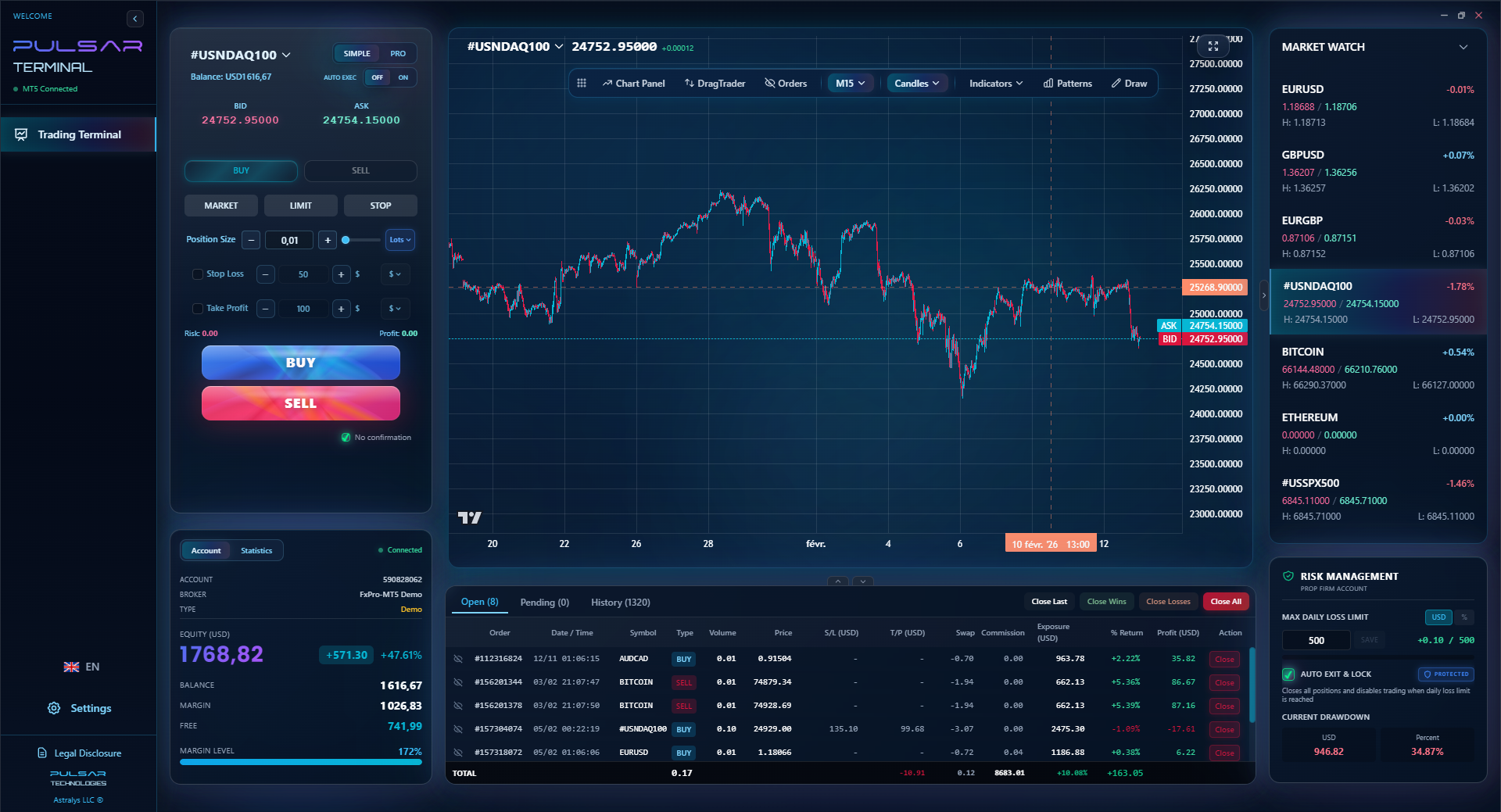
Managing multiple orders and setting precise stops during volatile news events is critical, and Pulsar Terminal's drag-and-drop order tools and automated breakeven/trailing stop functions make it seamless directly on your MT5 chart.
Pulsar Terminal
The all-in-one MT5 companion: drag-and-drop orders, multi-TP/SL, trailing stop, grid trading, Volume Profile, and prop firm protection. Used by 1,000+ traders daily.
“You don’t have to trade every event. Some weeks, the setup just isn’t there. It’s okay to sit on your hands and preserve capital.”
Here’s how I structure my week around the forex events to trade.
Sunday Evening:
- Open my economic calendar (I use Forex Factory).
- Scan the week ahead. Circle every Tier 1 event in red. Circle relevant Tier 2 events in yellow.
- Note the local SARB events or data.
Monday-Wednesday:
- Trade normally, but be aware of any Tier 2 events that could affect my open positions.
- Start forming a bias for the big Tier 1 events later in the week (e.g., Is the market expecting a hawkish or dovish Fed?).
Thursday/Friday (Big News Days):
- Morning of the event: Review the charts for the affected currency pairs. Identify key support/resistance levels and consolidation ranges.
- 1 Hour Before: No new trades. Set my pending orders for the breakout strategy if I’m using it. Double-check my position size.
- 15 Minutes Before: Walk away. Do not stare at the screen. The anticipation will make you do stupid things.
- News Release to 30 Minutes After: Monitor the trade if I’m in one. Cancel any unused pending orders. If I’m using the retracement strategy, I start watching for levels.
Remember: You don’t have to trade every event. Some weeks, the setup just isn’t there. It’s okay to sit on your hands and preserve capital. The market will always be there next week.
FAQ
Q1What's the best forex pair to trade during news events?
The major pairs like EUR/USD, GBP/USD, and USD/JPY are the most liquid and typically have the most predictable, trend-based reactions to major US or Eurozone news. For South African traders, USD/ZAR is incredibly reactive to both US news and local SARB events, but be warned: its spreads can widen dramatically and it can be more volatile (gap-prone) around news.
Q2How long before a news event should I place my orders?
For pending orders (like stop-orders for a breakout), I place them 30-60 minutes before the release. This gives the market time to settle into its pre-news consolidation range. Placing them too early might see you caught in pre-news wobbles. Placing them seconds before is too stressful and you might mess up the price.
Q3Is it safe to trade news with a small account (under R5000)?
It's risky, but possible with extreme caution. You must use a micro or cent account to control your position size. The main danger is the widened spread; a 10-pip spread on a major news event can eat a huge percentage of your potential profit or loss on a small trade. Focus on the post-news retracement strategy with very tight stop-losses, and always, always use a position size calculator. Consider building your account with regular swing trading first.
Q4What time do most major forex news events happen in SA time?
Most key US data (like NFP, CPI) is released at 15:30 SAST. The European Central Bank (ECB) and Bank of England (BoE) announcements are usually around 14:15 SAST. The Federal Reserve announcements are typically at 20:00 SAST. The SARB usually announces the repo rate at 15:00 SAST. Always double-check your calendar the day before.
Q5Can I use the RSI or MACD to trade news?
Not for the initial reaction. Lagging indicators like the RSI indicator and MACD indicator are useless during the first few minutes of a news spike - they'll be completely out of date. They can be helpful after the event, once the market has settled, to identify if the new move is overbought or oversold on a longer time frame for a potential retracement play.
Q6Why did the price go down on good news? That makes no sense!
This is called 'buy the rumour, sell the news.' Often, the market has already priced in a positive outcome. When the 'good' news is merely 'as expected' or slightly worse than the whisper number, traders who bought in anticipation sell to take profits, causing the price to fall. It's why trading the actual headline number is so dangerous.
Prof. Winston's Lesson
Key Takeaways:
- ✓Trade the market's reaction, not the headline number.
- ✓Use pending orders to capture breakouts, not market orders to chase them.
- ✓Always cut your position size in half for high-volatility news trades.
- ✓For ZAR pairs, the SARB's tone matters more than the rate decision itself.
How useful was this article?
Click a star to rate
Weekly Trading Insights
Free weekly analysis & strategies. No spam.
About the Author
David van der Merwe
Emerging Markets Trader
Johannesburg-based trader with 11 years in emerging market currencies. Specializes in ZAR pairs, FSCA-regulated trading, and South African market analysis.
Comments
Risk Disclaimer
Trading financial instruments carries significant risk and may not be suitable for all investors. Past performance does not guarantee future results. This content is for educational purposes only and should not be considered investment advice. Always conduct your own research before trading.
You Might Also Like

Cara Trading Forex Sukses: 7 Prinsip dari Trader Profesional
Cara trading forex sukses dengan 7 prinsip trader pro: manajemen modal, disiplin, journal trading, backtest. Data nyata, bukan janji profit palsu.
Jam Trading Forex Terbaik untuk Trader Indonesia: Panduan Lengkap dengan Tabel Waktu
Panduan jam trading forex untuk trader Indonesia. Tabel 4 sesi dunia, jam emas 20:00-00:00, sesi mana yang harus dihindari. Data akurat + tips dari trader berpengalaman.
Top 5 Sàn Forex Uy Tín Nhất 2026: Review Jujur dari Trader Indonesia
Top 5 sàn forex uy tín 2026 untuk trader Indonesia. Review jujur: spread, deposit, withdraw, dukungan lokal. Exness, XM, IC Markets & lebih.
Get Pulsar Terminal
All these calculators are built into Pulsar Terminal with real-time data from your MT5 account. One-click position sizing, automatic risk management, and instant calculations.
Get Pulsar Terminal