


For years, I believed the forex exchange market was a get-rich-quick scheme.

Olumide Adeyemi
West African Trading Pioneer ·  Nigeria
☕ 11 min read
What you'll learn:
For years, I believed the forex exchange market was a get-rich-quick scheme. Just follow a signal, buy low, sell high, and watch the dollars (or should I say, pounds) roll in. I lost a lot of money learning that was a lie. The truth is, the forex market is a brutal, rewarding, and deeply misunderstood arena, especially for us trading from Nigeria. This guide isn't about painting a pretty picture. It's about stripping away the hype and showing you how the market actually works, the unique hurdles we face with the Naira, and the hard lessons I wish someone had told me before I placed my first trade.
Let's cut through the jargon. The forex exchange market is just the global marketplace where currencies are traded. It's where the value of your Naira is set against the US Dollar, the British Pound, or the Euro. Unlike the Nigerian Stock Exchange with its opening bell, forex runs 24 hours a day, five days a week. It's the largest, most liquid financial market in the world, with over $7 trillion traded daily. That liquidity is a double-edged sword. It means you can get in and out of trades easily, but it also means you're up against the world's biggest banks and hedge funds.
For us in Nigeria, trading forex is fundamentally about speculating on the value of our own currency against others. When you hear 'USD/NGN is at 1500', that's the forex market in action. While you can't directly trade that pair with most international brokers, you're trading proxies like GBP/USD or EUR/USD, always with an eye on how global events will trickle down to affect the Naira's purchasing power. The first mental shift you must make is understanding you're not just trading charts, you're trading the economic health of nations.

Warning: Many 'gurus' sell forex as a simple puzzle to solve. It's not. It's a probability game. You will have losing trades. The goal isn't perfection, it's consistent profitability over hundreds of trades.
“The forex market is a brutal, rewarding, and deeply misunderstood arena, especially for us trading from Nigeria.”
Trading from Nigeria comes with a unique set of challenges you won't see in most generic guides. Ignoring these is a surefire way to blow your account.
The Naira Problem and Funding
Your biggest initial hurdle is funding your trading account. With strict capital controls, getting your Naira converted to USD, EUR, or GBP to send to an international broker is a mission. You'll likely rely on peer-to-peer (P2P) platforms or domiciliary account transfers. This adds cost (the spread on the P2P rate) and complexity. Every deposit and withdrawal becomes a mini-project. I learned this the hard way in 2019. I had a great trade on EUR/USD lined up, but my deposit took 3 days to clear. By the time it hit my broker, the move was over. I missed a 120-pip rally.
Broker Selection is Critical
You need a broker that accepts Nigerian clients, offers reliable P2P deposit options, and has a solid reputation. I've had accounts frozen with shady brokers promising the world. Do your homework. Look for brokers with strong regulation. I've had reliable experiences with brokers like IC Markets for their raw spreads and Exness for their local deposit options, but you must check their current terms for Nigeria. Never, ever trade with an unregulated entity. It's not worth the risk.
The 'Maga Must Pay' Mentality
There's a toxic culture in some circles that glorifies reckless trading. The idea of 'blowing an account' as a rite of passage is nonsense. Real trading is about preservation first. Using a proper position size calculator before every single trade is non-negotiable. I didn't do this early on. I once risked 5% of my account on a 'sure thing' in gold (XAU/USD). The trade went against me by $15, and I lost $500 in a day. That loss took me two months of disciplined trading to recover. It was a stupid, expensive lesson.

💡 Winston's Tip
The market's job is to find the most efficient price. Your job is to not get in its way. Most losses come from fighting the obvious trend.
“Real trading is about preservation first. Blowing an account is not a rite of passage, it's a failure of discipline.”
Forget the 1000% monthly return screenshots. Let's talk about building something that lasts. A strategy is just a set of rules that tells you when to enter, when to exit, and how much to risk.
Start with Price Action
Before you load up on indicators, learn to read the raw price chart. Support and resistance, trend lines, and basic candlestick patterns. These are the foundation. All an indicator like the RSI or MACD does is mathematically interpret price action with a lag. I spent my first year drowning in indicators, my chart looked like a rainbow. I was paralyzed. When I stripped it back to just price and volume, things started to click.
Choose Your Timeframe Personality
Are you patient or impulsive? If you're glued to the screen and hate waiting, maybe scalping (1-minute to 15-minute charts) is for you. But be warned, the spread costs add up fast. If you have a day job and can check a few times a day, swing trading on the 4-hour or daily charts is more sustainable. I'm a swing trader by nature. Trying to scalp made me anxious and overtrade.
The Holy Trinity: Entry, Exit, Risk
Your strategy must define all three.
- Entry: Is it a bounce off a key support level? A breakout from consolidation?
- Exit: Where is your profit target? Where is your stop-loss? Your stop-loss is not a suggestion. It's a pre-planned ejector seat.
- Risk: Never risk more than 1-2% of your account on a single trade. This is the golden rule. Use that position size calculator religiously.

Pro Tip: Backtest your strategy. Don't just imagine it works. Take your rules and apply them to old charts. See how they would have performed over 50 or 100 trades. This removes emotion and shows you the cold, hard probability of your system.
“Real trading is about preservation first. Blowing an account is not a rite of passage, it's a failure of discipline.”
This is where 90% of traders fail. Your brain is your worst enemy. I've been there.
Fear & Greed: You take a small profit out of fear, only to watch the trade run another 100 pips without you. Or, you let a losing trade run because greed tells you it will turn around, turning a small loss into a margin call. My most painful lesson was in early 2021. I was in a profitable GBP/USD trade. Hit my first target, moved my stop to breakeven. Price retraced slightly, touching my breakeven stop. I got stopped out. Then, it immediately rallied to my full profit target. I let the frustration of a 'missed win' cloud my judgment. I revenge-traded, entered again without a signal, and took a full 2% loss. I turned a breakeven trade into a losing day because of emotion.
Overtrading: This is the silent account killer. Boredom is not a trading signal. No clear setup? Stay out. The market will always be there tomorrow. Some of my most profitable months have had the fewest trades.
Confirmation Bias: You want a trade to work, so you only see the data that supports your bias. You ignore the clear resistance level overhead. You have to learn to prove yourself wrong. Before entering, write down three reasons why the trade could fail. If you can't find any, you're not looking hard enough.
💡 Winston's Tip
A trading plan is useless without the discipline to follow it. The gap between knowing and doing is where most money is lost.
“Your brain is your worst enemy. I've turned breakeven trades into losing days because of frustration and revenge.”
Your broker's platform is just the starting point. Survival depends on your toolkit and discipline.
Non-Negotiable Risk Management
This is your armor.
- Stop-Loss Orders: Always, always use them. A stop-loss is an admission that you can be wrong. And you will be.
- Take-Profit Orders: Have a predefined exit point for profit. Don't get greedy.
- Risk-Reward Ratio: Aim for a ratio where your potential profit is at least 1.5 to 2 times your potential loss. If you risk 50 pips, your target should be 75-100 pips away. This means you can be wrong more than half the time and still break even or profit.
Beyond the Basic Platform
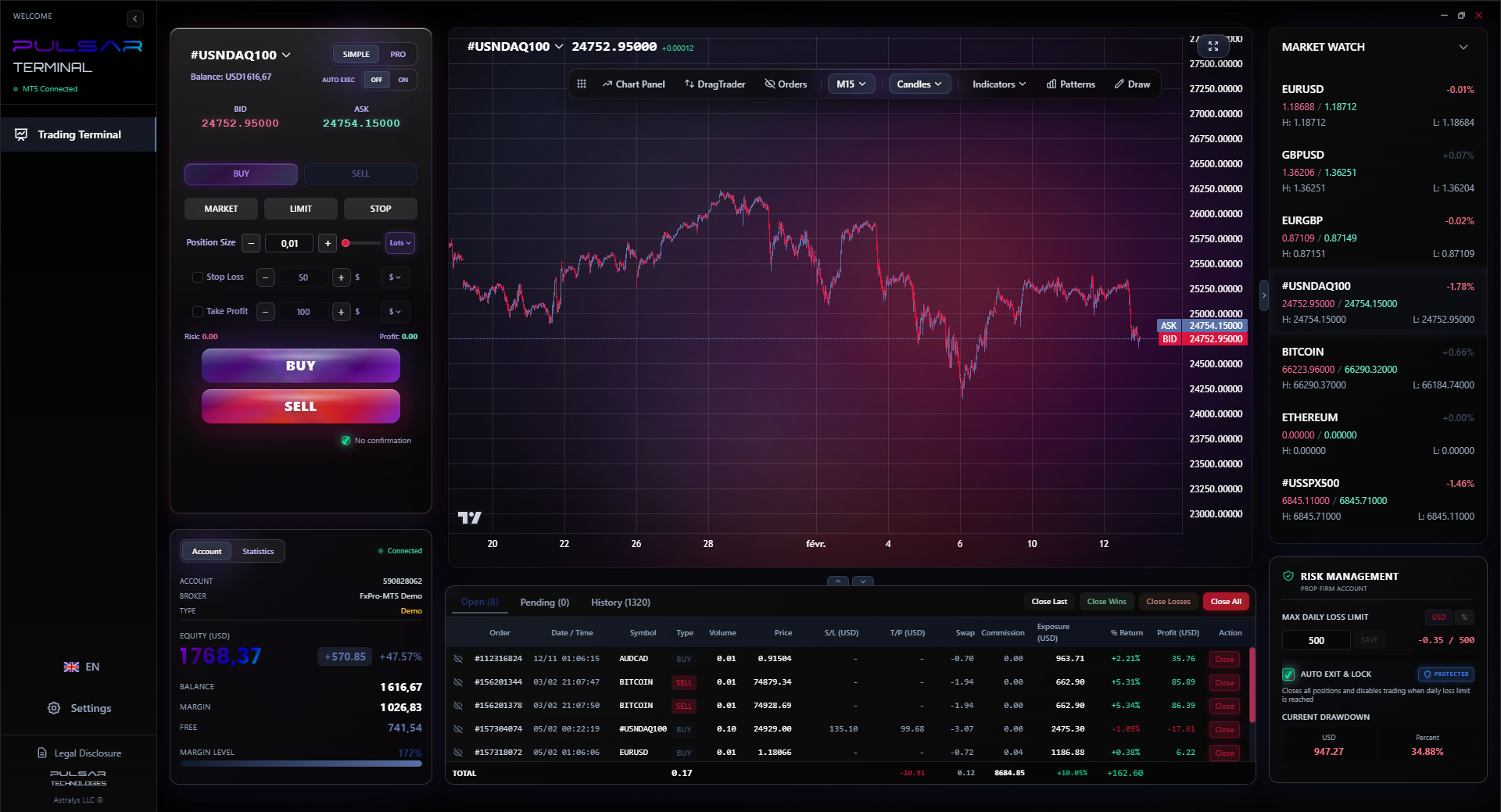
MetaTrader 4 or 5 is standard, but they can be clunky. This is where advanced trading terminals come in. Imagine being able to set a trailing stop that automatically follows price, or place a grid of orders to average into a trend, all with a few clicks instead of manual hassle. For prop firm traders, having a tool that can automatically enforce your daily loss limit is a lifesaver - it removes the emotional decision to 'just trade one more' after a bad loss.
A Simple Risk Management Table
| Concept | What It Is | My Rule of Thumb |
|---|---|---|
| Per-Trade Risk | Amount of capital risked on one trade | Never more than 1-2% of account balance |
| Daily Loss Limit | Max loss allowed in a single day | Stop trading after a 3-5% account loss |
| Position Sizing | Calculating lot size based on stop-loss | Use a calculator every time |
| Maximum Open Trades | How many trades you have running at once | 2-3 max, to avoid correlated risk |
Managing multiple trades and complex exits manually on MT5 is error-prone; a tool that automates trailing stops, breakeven moves, and grid orders turns your plan into disciplined, automatic action.
Pulsar Terminal
The all-in-one MT5 companion: drag-and-drop orders, multi-TP/SL, trailing stop, grid trading, Volume Profile, and prop firm protection. Used by 1,000+ traders daily.
“Your brain is your worst enemy. I've turned breakeven trades into losing days because of frustration and revenge.”
The forex space in Nigeria is riddled with predators. Here’s how to spot them.
The Signal Seller Guru: They flash screenshots of massive wins, often on a demo account or using unrealistic lot sizes. They charge ₦50,000 for a 'lifetime signal group'. The signals are usually late, generic, or just plain bad. If their system is so profitable, why are they selling it for chicken change?
The Fund Manager/Prop Firm 'Helper': They offer to manage your account or 'help' you pass a prop firm challenge for a fee. This often ends in them taking reckless risks with your money to chase their bonus. You get the loss, they disappear.
The Broker with Too-Good-To-Be-True Offers: 'Trade with 1:1000 use! Get a 200% deposit bonus!' High use is a trap for new traders, magnifying losses. Bonuses always come with impossible withdrawal conditions. Stick with well-reviewed, regulated brokers like XM or Pepperstone that offer transparent terms.
The Educational Course That Teaches Nothing: The course is just 10 hours of explaining what a pip is and motivational fluff, sold for ₦200,000. Real education is available for much less, or even free, from reputable sources. Don't pay for hype.
Warning: If anyone guarantees profits or downplays the risk, run. They are lying. The only guarantee in forex is that you can lose your money.
💡 Winston's Tip
Your first profit target should always be to get your risk off the table. Move your stop to breakeven at the first logical opportunity. Now you're trading with the house's money.
“If anyone guarantees profits or downplays the risk, run. The only guarantee in forex is that you can lose your money.”
Okay, you're still here. Let's map out a sane path forward.
- Educate with Realism: Spend 3-6 months learning before you risk a kobo. Read books, watch reputable traders (not hype men), and understand economics. Babypips.com is a free, excellent starting point.
- Open a Demo Account: This is your training ground. Pick a broker you're considering (IC Markets, Exness, etc.) and practice for at least 3 months. Your goal is not to make fake money, but to execute your plan consistently without emotion. Can you follow your rules 20 trades in a row?
- Develop & Backtest Your Plan: Write down your strategy. Then, test it on old data. See its win rate and average profit/loss.
- Start Live with Micro-Lots: When you fund a live account, start small. Trade the smallest possible position size (0.01 lots, often called a micro lot). The goal of your first $100-$500 account is not to get rich. It's to experience real emotion - the gut punch of a loss, the thrill of a win - and learn to manage it without catastrophic financial damage.
- Keep a Trading Journal: This is mandatory. Record every trade: entry, exit, reason, emotion, screenshot. Review it weekly. Your journal will tell you more about yourself than any guru ever could.
The forex exchange market isn't a shortcut. It's a skilled profession. It took me two years of losses and frustration to find my footing. But if you approach it with respect, discipline, and a relentless focus on learning from your mistakes, it can be more than just a side hustle. It can be a legitimate way to build financial independence on your own terms. Just remember, the market doesn't care about your rent or your dreams. It's your job to care for your capital.
FAQ
Q1Is forex trading legal in Nigeria?
Yes, forex trading is legal in Nigeria. Individuals are free to trade with international brokers. However, the Central Bank of Nigeria (CBN) has regulations on currency exchange and repatriation of funds, which affects how you deposit and withdraw from trading accounts. Always use licensed and reputable brokers.
Q2How much money do I need to start forex trading in Nigeria?
You can start with as little as $50 (around ₦75,000) with some brokers offering micro accounts. However, I strongly advise starting with a minimum of $200-$500. This allows for proper position sizing and can withstand a few losing trades without wiping you out. Remember, the goal of a small account is learning, not getting rich.
Q3What is the best currency pair for Nigerian beginners?
Start with major pairs like EUR/USD or GBP/USD. They have the lowest spreads and high liquidity, meaning price moves are smoother and more predictable than with exotic pairs. Avoid pairs directly involving the Naira on international platforms, as they are often illiquid and have wide spreads.
Q4How do I withdraw my profits in Naira?
You typically withdraw in the currency of your account (USD, EUR). Your broker will send the funds to your domiciliary account or a P2P platform wallet. You then convert to Naira via your bank or a P2P exchange at the prevailing rate. Factor in transfer fees and exchange rate spreads when calculating your final profit.
Q5Can I trade forex with my phone in Nigeria?
Absolutely. Most brokers like XM and Pepperstone offer full-featured mobile apps for MetaTrader. You can analyze, execute, and manage trades. However, for serious analysis and strategy development, a computer with a larger screen is highly recommended.
Q6What's the biggest mistake new Nigerian traders make?
Two tied for first: 1) Using excessive use (like 1:500) which turns a small move against you into a total loss, and 2) Trading without a clear plan and stop-loss. They treat it like gambling, not a business. Emotional trading and a lack of risk management wipe out most accounts within the first few months.
Q7Are forex trading profits taxable in Nigeria?
The tax situation for individual retail forex traders in Nigeria is complex and not explicitly defined. It's generally considered personal investment income. However, tax laws change. You should consult with a qualified Nigerian tax professional for advice specific to your situation. Do not rely on hearsay.
Prof. Winston's Lesson
Key Takeaways:
- ✓Risk only 1-2% per trade. Always.
- ✓Backtest your strategy for 100 trades minimum.
- ✓A 1:1.5 risk-reward ratio is your survival baseline.
- ✓The trend is your friend 60% of the time.
How useful was this article?
Click a star to rate
Weekly Trading Insights
Free weekly analysis & strategies. No spam.
About the Author
Olumide Adeyemi
West African Trading Pioneer
One of Nigeria's most active forex trading educators. 8 years of experience trading from Lagos. Specializes in low-capital strategies and prop firm challenges for African traders.
Comments
Risk Disclaimer
Trading financial instruments carries significant risk and may not be suitable for all investors. Past performance does not guarantee future results. This content is for educational purposes only and should not be considered investment advice. Always conduct your own research before trading.
You Might Also Like

Cara Trading Forex Sukses: 7 Prinsip dari Trader Profesional
Cara trading forex sukses dengan 7 prinsip trader pro: manajemen modal, disiplin, journal trading, backtest. Data nyata, bukan janji profit palsu.
Jam Trading Forex Terbaik untuk Trader Indonesia: Panduan Lengkap dengan Tabel Waktu
Panduan jam trading forex untuk trader Indonesia. Tabel 4 sesi dunia, jam emas 20:00-00:00, sesi mana yang harus dihindari. Data akurat + tips dari trader berpengalaman.
Top 5 Sàn Forex Uy Tín Nhất 2026: Review Jujur dari Trader Indonesia
Top 5 sàn forex uy tín 2026 untuk trader Indonesia. Review jujur: spread, deposit, withdraw, dukungan lokal. Exness, XM, IC Markets & lebih.
Get Pulsar Terminal
All these calculators are built into Pulsar Terminal with real-time data from your MT5 account. One-click position sizing, automatic risk management, and instant calculations.
Get Pulsar Terminal