


Ever stared at your trading screen, watching the USD/NGN rate jump around, and wondered what on earth is actually making it move? You're not alone.

Olumide Adeyemi
West African Trading Pioneer ·  Nigeria
☕ 10 min read
What you'll learn:
- 1What Is a Forex Exchange Rate, Really?
- 2What Actually Moves Forex Rates? (The Nigerian Context)
- 3How to Trade Forex Exchange Rates from Nigeria
- 4Mistakes I Made (So You Don't Have To)
- 5A Practical Framework for Analysing Rates
- 6Managing Risk in a Volatile Naira Environment
- 7The Future of Forex Trading for Nigerians
Ever stared at your trading screen, watching the USD/NGN rate jump around, and wondered what on earth is actually making it move? You're not alone. We all know the forex exchange rate is the price of one currency against another, but in Nigeria, it feels personal. It's not just a number on a chart; it's the price of your phone, your generator fuel, and your future. I've spent over a decade trying to decode these movements, and I've made every mistake you can think of along the way. This isn't theory. This is what I've learned from getting burned and, eventually, getting it right.
Let's strip it back. A forex exchange rate is simply the price tag for swapping one currency for another. When you see USD/NGN at 1,500, it means one US Dollar costs 1,500 Nigerian Naira. That's it. But here's where it gets tricky for us: that price is never still.
It's a constant auction, a global shouting match between banks, governments, corporations, and speculators like you and me. Every time you hear 'the Naira is falling,' it means in that global auction, people are willing to pay more and more Naira to get their hands on a single Dollar. The demand for Dollars has outstripped the supply of Naira people are offering.
I used to think of it as a score, like a football match. I was wrong. It's more like the temperature in a crowded room - constantly shifting based on how many people are in there, what they're doing, and whether someone just opened a window. Understanding this dynamic is the first step to moving from a passive observer to an active participant. You stop asking 'why is it going up?' and start asking 'who is buying, and why?'

Warning: Don't confuse the official CBN rate with the parallel market (black market) rate. As a retail trader, you're almost always dealing with a derivative of the parallel market rate through CFDs. The rate on your broker's platform reflects international liquidity, not the rate you'd get at the bureau de change down the street. This disconnect is a major source of confusion.
“The forex exchange rate tells you the current mood, not the textbook equation.”
Textbook lists interest rates and GDP. In Nigeria, you need a different list. The global factors matter, but local realities often shout louder.
The Big Three: Interest Rates, Inflation, and Oil
The Central Bank of Nigeria's (CBN) monetary policy decisions are huge. When the CBN hikes the Monetary Policy Rate (MPR), it's trying to make holding Naira more attractive. In theory, this should strengthen the Naira. I remember in 2022, watching a 150-basis-point hike. USD/NGN dipped briefly, then soared. Why? Because the market was more focused on the reason for the hike - runaway inflation - than the hike itself. Inflation, especially when it's in double digits, erodes the purchasing power of the Naira daily. No one wants to hold a currency that's melting in their pocket.
Then there's oil. Our lifeblood. When Brent crude prices climb, Nigeria earns more Dollar revenue. This should boost USD supply and strengthen the Naira. But it's not automatic. I learned this the hard way in 2020. Oil prices crashed, and so did the Naira, obviously. But when they recovered, the Naira didn't bounce back proportionally. Why? Because of existing Dollar shortages, backlogged demand, and issues with actually getting the petrodollars into the system. The forex exchange rate tells you the current mood, not the textbook equation.
The Silent Killers: Sentiment and Speculation
This is the invisible hand that slaps you. Market sentiment towards emerging markets, fear of devaluation, and pure speculation can move rates faster than any data release. News of a cabinet reshuffle or a delay in a key policy can trigger a sell-off. You have to read the room. Tools like the RSI indicator can help gauge if a move is overextended, but nothing beats understanding the local news cycle.

Example: Let's say you're trading GBP/NGN. The Bank of England raises rates by 0.5%. At the same time, Nigerian inflation data comes in hotter than expected. The GBP/NGN rate might rocket not just because GBP is stronger, but because Naira is perceived as weaker. You're trading two stories at once.

💡 Winston's Tip
The market's job is to transfer money from the impatient to the patient. In Nigeria, impatience is fueled by necessity. Fight it. Your edge is your calm.
“I lost nearly ₦200,000 in one week trading out of patriotism. The market doesn't care about your feelings.”
Trading the Naira pairs directly (like USD/NGN) can be tricky due to limited liquidity and wide spreads with international brokers. Most Nigerian traders access the market through major and cross pairs.
Your Gateway Pairs
You're not really trading the Naira's value against the Euro directly. You're trading EUR/USD and mentally translating the Dollar's movement back to Naira. If you believe the Naira will weaken, you might buy USD/JPY or USD/CHF, because a stronger Dollar in those pairs aligns with your view. It's a proxy war. My bread and butter for years has been EUR/USD and XAU/USD (Gold). Gold often acts as an alternative to the Dollar, so when I'm bearish on the Naira (and by extension, need Dollar strength), I watch Gold for inverse clues.
Choosing Your Battlefield: Strategy
Your strategy must fit the volatility. Naira-related sentiment can cause sharp, news-driven spikes. Scalping these moves requires lightning-fast execution and a broker with tight spreads, like IC Markets or Pepperstone. Swing trading, waiting for trends driven by fundamental policy shifts, might suit a calmer temperament. I failed at scalping Naira volatility because my internet wasn't stable enough. I switched to swing trading based on CBN meeting cycles and found my groove.
The Brokerage Bridge
Your broker is your bridge to the market. Regulation is non-negotiable. You need a broker that accepts Nigerian clients reliably and processes withdrawals without drama. I've had good experiences with Exness for its local deposit options and XM for its educational resources when I was starting. Always check their specific terms for Nigerian residents. The stated spread on exotic or minor pairs can eat your profits if you're not careful.
“I lost nearly ₦200,000 in one week trading out of patriotism. The market doesn't care about your feelings.”
Let me be a cautionary tale. These errors cost me real money.
1. Trading Anger, Not Analysis: When the Naira hit a new low, I'd get angry and immediately short EUR/NGN (betting on Naira strength) out of sheer patriotism. This is a terrible strategy. The market doesn't care about your feelings. I lost nearly ₦200,000 in one week in 2021 doing this. The rate kept climbing. My account didn't.
2. Ignoring the Spread on Exotics: I once bought USD/NGN on a platform with a 500-pip spread. A 500 pip spread! The rate needed to move massively just for me to break even. It never did. I was down from the moment I clicked 'buy.' Now I stick to majors where spreads are often below 1 pip.
3. Overleveraging on 'Sure Things': A friend 'with a CBN contact' swore a new policy would strengthen the Naira. I used 1:100 use on a huge USD/NGN short position. The 'policy' was delayed. A slight uptick triggered a margin call. I lost 40% of my account in a day. There are no sure things. Use a position size calculator every single time.
4. Chasing the Parallel Market Rate: I'd see a rate on the street and think my broker's price was 'wrong' and due for a correction. The markets are different. Don't expect them to converge on your schedule.

Pro Tip: Keep a trading journal. Not just entries and exits, but your emotional state. Write down why you took the trade. Reviewing mine, I saw the word 'surely' appeared before most of my losses. 'Surely it can't go higher.' That word is now banned from my trading desk.
💡 Winston's Tip
If you can't articulate your trade thesis in one simple sentence ('I'm buying USD/JPY because rising US yields are outpacing Japan's'), you don't have a thesis. You have a hope.
“Volatility isn't your enemy, it's your landscape. You just need the right gear.”
You need a system to filter the noise. Here's mine.
Step 1: The Fundamental Bedrock (Weekly)
- CBN Watch: Mark MPC meeting dates on your calendar. Read the communique, not just the headline rate decision. Watch for changes in CRR or liquidity management.
- Oil Price Dashboard: Have a Brent crude chart open. Correlate sharp moves with Naira pairs after a 1-2 day lag.
- Inflation & Reserves: Track monthly inflation data and weekly external reserve figures from the CBN website. Falling reserves often precede pressure.
Step 2: The Technical Picture (Daily)
Don't overcomplicate this. I use three tools:
- A Simple Moving Average: The 200-period SMA on the daily chart to define the long-term trend. Are we above or below?
- MACD Indicator: To gauge momentum and potential trend changes. A bearish crossover on USD/NGN might signal a potential (temporary) Naira strengthening move.
- Key Support & Resistance: Draw horizontal lines at recent highs and lows. These are the battle lines.
Step 3: The Sentiment Gauge (Real-time)
- Follow reputable financial news on Bloomberg or Reuters for emerging market headlines.
- Check the volatility. Is the market jumpy? If so, wider stops are needed.
Combine these. If fundamentals are Naira-negative (high inflation), the trend is up (price above 200 SMA), and MACD is bullish, you have confluence. That's a stronger signal than any one piece alone.
“Volatility isn't your enemy, it's your landscape. You just need the right gear.”
Volatility isn't your enemy, it's your landscape. You just need the right gear.
Position Sizing is Your Life Jacket: This is the most important thing you'll do. Never risk more than 1-2% of your account on a single trade. On a ₦500,000 account, that's ₦5,000-₦10,000. Use your stop-loss distance to calculate your lot size. If your stop is 50 pips away on EUR/USD, and 1 pip = ₦100, then a 50-pip loss would be ₦5,000. That's your 1% risk. This math keeps you in the game after a losing streak. I use a position size calculator to automate this.
Stop-Losses: Non-Negotiable. Your stop-loss is a pre-planned admission that you're wrong. Place it at a level that, if hit, invalidates your trade idea. Not based on how much money you're willing to lose. Technical levels (below support, above resistance) are good places.
Beware of Gaps: Naira pairs can 'gap' over the weekend if major news breaks. If you're holding a trade over the weekend, your stop-loss won't protect you from the gap. Either close before Friday or use a broker that offers guaranteed stop-losses (for a premium).
Emotional Hedging is Not Hedging: Don't open a trade in the opposite direction 'just in case.' You'll just pay two spreads and likely lose on both. Have one clear view and manage the risk on that single position.
💡 Winston's Tip
Your first profit target should always be to move your stop-loss to breakeven. Protecting capital is a win. Everything after that is a bonus.

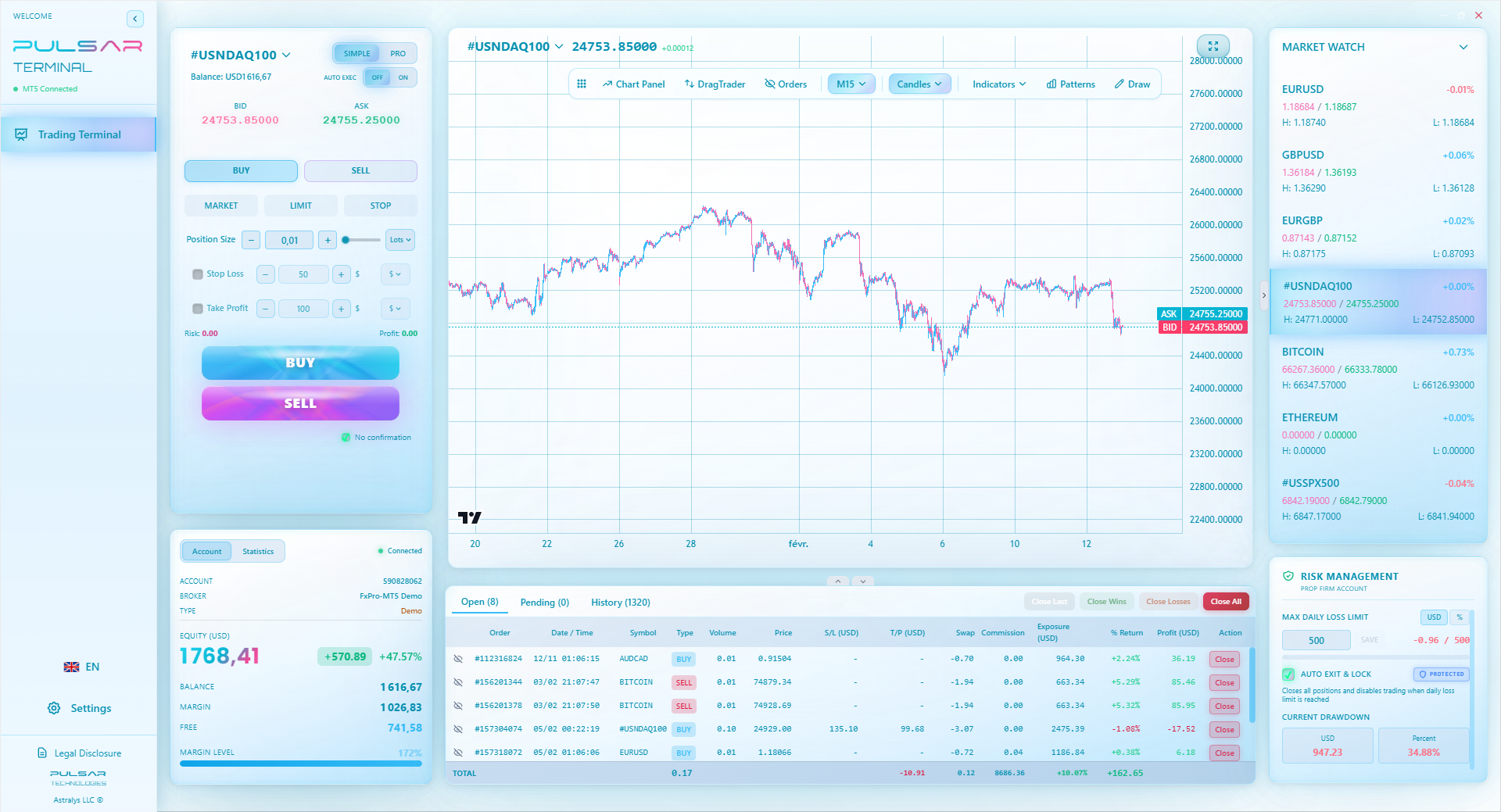
Managing multiple trades and tight stop-losses in volatile Naira markets is stressful; Pulsar Terminal's drag-and-drop order management and automated breakeven functions handle this directly on your MT5 chart.
Pulsar Terminal
The all-in-one MT5 companion: drag-and-drop orders, multi-TP/SL, trailing stop, grid trading, Volume Profile, and prop firm protection. Used by 1,000+ traders daily.
“Success will still come from discipline, continuous learning, and respecting risk.”
The landscape is changing. Digital platforms are democratising access, but regulation is playing catch-up. The CBN's stance on crypto and fintech will directly impact how we move money and access international markets.
I think we'll see more Nigerian-focused trading education and communities. The demand is there. We'll also likely see more brokers tailoring services to our market, with better Naira-based account options and local support.
The core won't change, though. Success will still come from discipline, continuous learning, and respecting risk. The forex exchange rate will always be a reflection of global and local confidence. Your job is to learn to read that reflection better than the next person. It's a skill built over years, not weeks. Start with the majors, master your emotions, and always, always protect your capital. That's how you build something that lasts, regardless of where the Naira goes next.
FAQ
Q1What is the best forex pair to trade as a Nigerian beginner?
Start with EUR/USD. It has the highest liquidity, the tightest spreads, and endless analysis available. It moves in trends you can analyse without the extreme volatility of Naira proxies. Master one pair before adding others.
Q2How can I predict the Naira to Dollar exchange rate?
You can't predict it with certainty. You can assess probabilities. Focus on the key drivers: CBN policy decisions (MPR), monthly inflation data, crude oil prices, and changes in Nigeria's external reserves. Analyse the trend these create, don't try to pick an exact number.
Q3Why is the rate on my trading platform different from the black market rate?
Your broker's rate is derived from the international interbank market and liquidity from large financial institutions. The black market rate is a local, physical cash market with different supply/demand dynamics, higher risk, and no regulation. They are related but separate markets.
Q4Is it legal to trade forex in Nigeria?
Yes, trading forex through licensed international brokers as an individual is legal. However, the CBN restricts banks from facilitating payments for margin trading, which is why you often use alternative payment channels. Always ensure your broker is regulated by a reputable foreign authority like ASIC or FCA.
Q5How much money do I need to start trading forex in Nigeria?
You can start with as little as $50 (approx ₦75,000) with some brokers. However, I strongly advise starting with at least $200-500. This allows for proper position sizing and risk management without being wiped out by a single small loss. It's a skill, and you need capital to learn effectively.
Q6What's the biggest risk for a Nigerian forex trader?
Beyond market risk, the two biggest are overleveraging and unreliable internet/power. use amplifies both gains and losses. A stable internet connection and a backup power source (like an inverter) are critical infrastructure, not luxuries. A power cut during a volatile move can be catastrophic.
Prof. Winston's Lesson
Key Takeaways:
- ✓Trade majors (EUR/USD) as proxies for Naira sentiment.
- ✓Never risk more than 2% of your capital on a single trade.
- ✓Mark CBN MPC meetings on your calendar in red.
- ✓A 500-pip spread means you're losing from the start.
- ✓Your internet connection is part of your trading system.
How useful was this article?
Click a star to rate
Weekly Trading Insights
Free weekly analysis & strategies. No spam.
About the Author
Olumide Adeyemi
West African Trading Pioneer
One of Nigeria's most active forex trading educators. 8 years of experience trading from Lagos. Specializes in low-capital strategies and prop firm challenges for African traders.
Comments
Risk Disclaimer
Trading financial instruments carries significant risk and may not be suitable for all investors. Past performance does not guarantee future results. This content is for educational purposes only and should not be considered investment advice. Always conduct your own research before trading.
You Might Also Like

Cara Trading Forex Sukses: 7 Prinsip dari Trader Profesional
Cara trading forex sukses dengan 7 prinsip trader pro: manajemen modal, disiplin, journal trading, backtest. Data nyata, bukan janji profit palsu.
Jam Trading Forex Terbaik untuk Trader Indonesia: Panduan Lengkap dengan Tabel Waktu
Panduan jam trading forex untuk trader Indonesia. Tabel 4 sesi dunia, jam emas 20:00-00:00, sesi mana yang harus dihindari. Data akurat + tips dari trader berpengalaman.
Top 5 Sàn Forex Uy Tín Nhất 2026: Review Jujur dari Trader Indonesia
Top 5 sàn forex uy tín 2026 untuk trader Indonesia. Review jujur: spread, deposit, withdraw, dukungan lokal. Exness, XM, IC Markets & lebih.
Get Pulsar Terminal
All these calculators are built into Pulsar Terminal with real-time data from your MT5 account. One-click position sizing, automatic risk management, and instant calculations.
Get Pulsar Terminal