


Most traders staring at live forex rates are doing it wrong.

David van der Merwe
Emerging Markets Trader ·  South Africa
☕ 11 min read
What you'll learn:
- 1What You're Actually Looking At: Decoding the Live Feed
- 2Where to Get Reliable Live Rates in South Africa
- 3Trading ZAR Pairs: A Local's Advantage (and Pitfalls)
- 4From Watching to Trading: Integrating Live Rates into Your Strategy
- 5Costly Mistakes South African Traders Make with Live Rates
- 6Building Your Professional Setup on a Budget
- 7The Long Game: Patience and Continuous Learning
Most traders staring at live forex rates are doing it wrong. They see a number moving and think it's a signal, when really, they're just watching price without any context. I've lost more money than I care to admit by reacting to a flickering rate without understanding what was driving it. In South Africa, with our unique market and the volatile Rand, this mistake is even more expensive. This guide isn't about watching numbers change. It's about learning to read them, to understand the story they're telling about global capital flows, local politics, and plain old market psychology. I'll show you how to move from being a passive observer to an active interpreter of live forex exchange rates.
When you pull up a live rate for USD/ZAR, you're not looking at a single price. You're looking at a constantly negotiated agreement between the world's biggest banks, hedge funds, and market makers. That number on your screen is just the most recent transaction price, the last agreed-upon value. The real action is in the bid and ask prices sitting just behind it.
Think of it like a used car dealership. The sticker price (the 'ask') is what the seller wants. Your offer (the 'bid') is what you're willing to pay. The 'live rate' is the price the last car sold for. In forex, the difference between the bid and ask is the spread, and it's your first real cost of doing business. A common trap for new traders is to see the USD/ZAR jump 20 cents and immediately hit the buy button, only to find they bought at the peak of a temporary spike caused by a single large order. I did this in 2019, buying USD/ZAR at R14.85 after a sharp rise, convinced the Rand was collapsing. It reversed instantly, and I was stopped out at R14.70. That was an expensive lesson in liquidity.

Warning: The rate you see on free financial news sites is often delayed by 15-20 minutes. For actual trading, this is useless. You must use your broker's trading platform or a professional data feed for genuine real-time prices. Trading on delayed data is like driving while looking in the rear-view mirror.
The South African Context: ZAR Pairs
Our market has a specific rhythm. Major pairs like EUR/USD are traded 24/5 with massive liquidity. But when you trade USD/ZAR, EUR/ZAR, or GBP/ZAR, you're dealing with an emerging market currency. Liquidity can dry up outside of South African and major European/London trading hours (roughly 8am to 5pm SAST). This means spreads can widen dramatically at night. A spread that's 5 pips during the day can balloon to 20-30 pips or more after hours, making short-term trades like scalping much more costly and risky.

💡 Winston's Tip
A live rate tells you 'what.' Your job is to figure out 'why.' The 'why' is what leads to the next trade.
“Most traders staring at live forex rates are doing it wrong. They see a number moving and think it's a signal.”
Not all feeds are created equal. Your choice here can directly impact your profitability.
Trading Platforms (MT4/MT5): This is your primary source. The rates streamed into your MetaTrader platform by your broker are the ones you can actually trade on. Brokers like IC Markets and Pepperstone are known for fast, reliable execution with tight spreads. The key is to understand that your broker's feed might be a slight aggregate of their liquidity providers. It's good enough for 99% of retail trading.
Economic Calendars & Financial Portals: Sites like Investing.com or ForexFactory offer real-time rates, but treat them as a reference, not a trading feed. They're fantastic for the big picture. I always have ForexFactory's calendar open to correlate rate movements with news events. Seeing the ZAR suddenly weaken at 3pm? Check the calendar. It's probably a SARB announcement or local GDP data.
Broker Comparison Tools: Use these before you fund an account. Don't just look at the advertised 'from 0.0 pips' claim. Look for average spreads during the times you'll be trading. A broker might have great EUR/USD spreads but terrible GBP/ZAR spreads. For South African traders, the ZAR pair spreads are often more important. For example, a good USD/ZAR spread during London hours might be around 5-8 pips on a standard account.
| Broker Type | Best For | Watch Out For |
|---|---|---|
| ECN/STP Brokers (e.g., FP Markets) | Raw spreads, fast execution. | Commissions per trade. Spreads can widen on news. |
| Market Maker Brokers | Fixed spreads, simpler cost structure. | The fixed spread is usually wider than the variable average. Potential conflict of interest. |
| Local FSCA Brokers (e.g., Khwezi) | ZAR accounts, local support. | May have fewer instruments or higher costs on major pairs. |

Pro Tip: Open a demo account with 2-3 different brokers and watch the same currency pair (like USD/ZAR) on all of them for a week. Note the spreads at different times of day. You'll see surprising differences. This research is more valuable than any advertisement.
“Trading the Rand is our home-game advantage, but you have to respect its volatility.”
Trading the Rand is our home-game advantage, but you have to respect its volatility. The USD/ZAR isn't just a currency pair. It's a sentiment gauge for South African risk.
What Moves the ZAR?
- Commodity Prices: We're a resource economy. Strong gold and platinum prices often strengthen the ZAR. I've often used the XAU/USD (gold) chart as a leading indicator for ZAR strength.
- USD Strength: This is the big one. A strong US dollar (DXY index up) will almost always pressure the ZAR. Don't fight the Fed.
- Local Politics & Policy: SARB interest rate decisions, budget speeches, credit rating announcements. These events cause massive, immediate volatility. I learned this the hard way by holding a EUR/ZAR position through a SARB meeting in 2022. The rate moved 150 pips against me in under 3 minutes. I hadn't used a wide enough stop-loss.
- Global Risk Sentiment: When investors are scared, they pull money out of emerging markets like South Africa. This weakens the ZAR.
A Real Trade Example: In late 2023, the USD was broadly strong, and local load-shedding fears were peaking. The USD/ZAR had been grinding higher. I saw it break above a key resistance level at R18.50 with increasing volume. I entered a long (buy) position at R18.52. My target was the next psychological level at R19.00, and my stop-loss was placed at R18.35, just below the previous day's low. I used a simple 2:1 risk-reward ratio. The trade worked, hitting R19.00 a week later. The key wasn't just the live rate breaking R18.50. It was understanding why it was breaking - a combination of global USD demand and local negative sentiment.
Warning: Never, ever transfer money overseas to an unregulated broker promising 'better rates' or 'offshore advantages'. It's illegal under SARB exchange controls and a surefire way to lose all your capital. Always use an FSCA-regulated broker. Your single discretionary allowance is for legitimate travel and investment, not for circumventing forex regulations.
💡 Winston's Tip
The Rand doesn't care about your opinion. It cares about interest rates, commodities, and capital flows. Trade what is, not what you think should be.
“Trading the Rand is our home-game advantage, but you have to respect its volatility.”
Live rates are the oxygen, but your trading plan is the engine. Here’s how to connect them.
For Swing Traders: If you're a swing trader holding positions for days or weeks, you shouldn't be glued to the tick-by-tick movement. It will drive you mad. Use live rates to identify your entry and exit zones with precision, then step away. Set your orders and alerts. For example, if your analysis says to buy USD/ZAR on a dip to R18.20, set a limit order at that price. The live rate will trigger it when it gets there. No emotion, no screen-staring required.
For Day Traders & Scalpers: This is where live rates are your lifeblood. You're looking for intraday momentum, breakouts, and rejections. Combine the price action with a momentum indicator like the RSI indicator or MACD indicator to filter your entries. A classic setup: USD/ZAR is in an uptrend on the 15-minute chart. It pulls back to a moving average. The live rate shows it stalling and starting to climb again, while the RSI bounces from 40. That's a higher-probability entry than just buying a green candle blindly.
Risk Management is Non-Negotiable: The single most important use of a live rate is to determine where your stop-loss goes. Before you enter any trade, you must know the exact price at which you are wrong. That price is your stop-loss. Use a position size calculator to ensure that if the live rate hits your stop, you're only losing a small, pre-defined percentage of your account (I risk no more than 1-2% per trade). Ignoring this is the fastest route to a margin call.
“The single most important use of a live rate is to determine where your stop-loss goes.”
I've made these. My friends have made these. Let's save you the money.
Chasing the Rate: This is the big one. You see USD/ZAR flying up, you panic about missing out, and you buy at the very top. The rate immediately reverses. The psychological fear of missing out (FOMO) is powerful. The cure is to have a plan and wait for your setup, even if it means watching a big move go by.
Over-trading Low-Impact News: Not every data release moves the market significantly. A minor uptick in SA mining production might cause a 10-pip wiggle. Don't trade every blip. Save your energy and capital for the high-impact events: SARB, CPI, Budget Speech, US Non-Farm Payrolls.
Ignoring the Spread on Entry/Exit: You buy USD/ZAR at an ask price of R18.500. To break even instantly, the bid price needs to be at least R18.500. But with a 5-pip spread, the bid might be R18.495. So the market needs to move 5 pips in your favor just for you to be at zero. Always factor in the spread as an immediate cost. This is why trading very short-term on wide-spread ZAR pairs is so tough.
Using Unrealistic Timeframes: Trying to scalp the 1-minute chart on GBP/ZAR during thin Asian session liquidity is a recipe for losing money to spread costs and random noise. Match your trading style to the pair's liquidity profile.

Example: Let's say you have a R20,000 account and you risk 1% per trade (R200). You want to buy USD/ZAR at R18.50 with a stop-loss at R18.40. That's a 100 pip risk. How much can you trade? Risk in Rands (R200) / (Risk in Pips (100) x Pip Value) First, find the pip value. For USD/ZAR, a pip is typically 0.0010 (e.g., a move from R18.50 to R18.51). The standard pip value formula gets complex with ZAR as the quote currency. Use a good online calculator. For a mini lot (10,000 units), the pip value might be around R1. So, to risk R200 over 100 pips, you'd trade 2 mini lots (R2 per pip * 100 pips = R200 risk). Never guess this. Always calculate your position size.
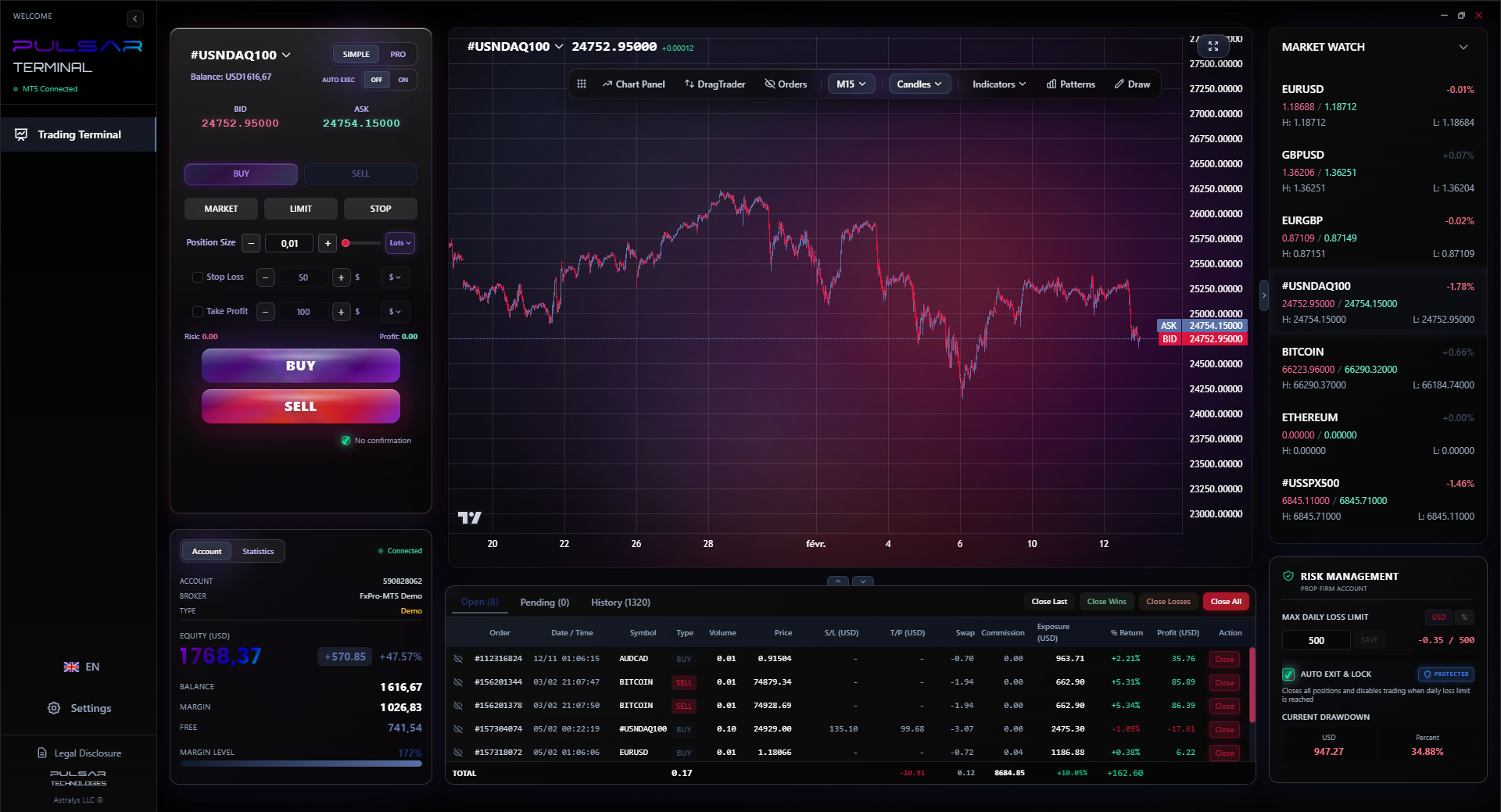
Manually calculating position size and managing complex orders while watching volatile live rates is stressful; a tool that automates this within MT5 lets you focus on the price action.
Pulsar Terminal
The all-in-one MT5 companion: drag-and-drop orders, multi-TP/SL, trailing stop, grid trading, Volume Profile, and prop firm protection. Used by 1,000+ traders daily.
“The single most important use of a live rate is to determine where your stop-loss goes.”
You don't need a Bloomberg terminal. You need a reliable, focused setup.
The Essentials:
- A Reliable Internet Connection: This is non-negotiable. A lag or dropout during a trade can be catastrophic. Consider a fibre line as a business expense.
- At Least One Large Monitor: Squinting at a laptop screen will cause you to miss details. A 24-inch monitor lets you see multiple charts and your trading platform comfortably.
- Your Core Software Stack:
- Trading Platform: MT4 or MT5 from your chosen broker.
- Economic Calendar: ForexFactory.com (free and excellent).
- Journal: A simple spreadsheet or dedicated trading journal software. Log every trade, the live rate at entry, your reasoning, and the outcome. This is how you improve.
Taking it to the Next Level: As you grow, you might look at tools that help you manage trades more efficiently. Manually moving stop-losses to breakeven or setting multiple take-profit levels can be fiddly and slow. Some advanced tools integrate directly with MT5 to automate these processes with a single click, letting you focus on analysis instead of order management. For instance, managing a complex trade on EUR/USD with partial closures becomes much simpler.
Your Daily Routine: Start your day not by opening charts, but by checking the calendar. What high-impact events are due? Then, look at the live rates for the major pairs and USD/ZAR to get a feel for the market's mood. Then, and only then, consult your charts for trading opportunities. This routine stops you from falling in love with a pre-conceived idea that the live market data immediately disproves.
💡 Winston's Tip
Your best tool for understanding live rates is a trade journal. The pattern of your mistakes will be glaringly obvious in hindsight.
“Mastering live forex rates is a marathon, not a sprint. Your first year will likely be about learning how not to lose money.”
Mastering live forex rates is a marathon, not a sprint. Your first year will likely be about learning how not to lose money. That's okay. It's a rite of passage.
Focus on consistency, not home runs. A 5% return per month, compounded, is phenomenal. Chasing 50% returns will blow up your account. I spent my first 18 months blowing up two small accounts by doing exactly that - reacting to every live rate swing with oversized positions.
Finally, never stop learning. The market changes. Re-read your journal monthly. Backtest your ideas. The live rate feed is a constant teacher, but only if you're humble enough to listen and learn from both your wins and, more importantly, your losses. The goal isn't to be right on every trade. The goal is to have a strong process that, over hundreds of trades, puts the probabilities in your favour. Now you know what those flashing numbers really mean, you can start building that process.
FAQ
Q1What is the best website for live forex rates in South Africa?
For trading, the best 'website' is your broker's own trading platform (like MT4/MT5), as it shows the actual rates you can trade at. For monitoring and analysis, Investing.com offers good real-time rates for reference. Never trade based on a free financial news site's rates, as they are often delayed.
Q2Is it legal to trade forex in South Africa?
Yes, it is completely legal. You must use a broker regulated by the Financial Sector Conduct Authority (FSCA). It is illegal to use unregulated offshore brokers or to attempt to move funds outside of SARB exchange control allowances for the purpose of trading.
Q3Why is the USD/ZAR so volatile?
The ZAR is an emerging market currency. Its value is highly sensitive to global US dollar strength, commodity prices (like gold), South African political and economic news, and overall global risk sentiment. This combination of factors leads to larger and more frequent price swings compared to major pairs like EUR/USD.
Q4What is a good spread for USD/ZAR?
During active London/South African trading hours, a competitive spread for USD/ZAR on a standard account is between 5 and 10 pips. On an ECN/raw account (where you pay a commission), you might see spreads as low as 1-3 pips. Be wary of spreads that are much wider than this during market hours.
Q5How much money do I need to start trading forex in South Africa?
While some brokers allow you to start with $5 or R100, that's not realistic for proper risk management. A more sensible minimum is R1,500 to R5,000. This allows you to trade small positions (like micro lots) and practice proper risk management without your account being wiped out by a single, small loss. For serious trading, many professionals suggest R20,000+ to comfortably handle the volatility.
Q6What is the most important thing to watch on a live rate feed?
The most important thing isn't the last price - it's the speed and depth of the order book (if available) and the relationship between the bid and ask (the spread). A rapidly widening spread often signals decreasing liquidity or upcoming volatility, which is a warning to be cautious. A consistently tight spread indicates good, liquid market conditions.
Q7Can I make a living trading forex in South Africa?
It's possible, but extremely difficult and should not be your expectation when starting. The vast majority of retail traders lose money. Treat it as a serious skill to be developed over years. Focus on consistent, small gains and protecting your capital first. Building a large enough account to generate a liveable income takes significant time, discipline, and starting capital.
Prof. Winston's Lesson
Key Takeaways:
- ✓Live rates are a report, not a recommendation.
- ✓Always know your pip value and spread cost before entering.
- ✓Risk no more than 2% of your capital on any single trade.
- ✓The SARB and commodity prices are the ZAR's primary drivers.
How useful was this article?
Click a star to rate
Weekly Trading Insights
Free weekly analysis & strategies. No spam.
About the Author
David van der Merwe
Emerging Markets Trader
Johannesburg-based trader with 11 years in emerging market currencies. Specializes in ZAR pairs, FSCA-regulated trading, and South African market analysis.
Comments
Risk Disclaimer
Trading financial instruments carries significant risk and may not be suitable for all investors. Past performance does not guarantee future results. This content is for educational purposes only and should not be considered investment advice. Always conduct your own research before trading.
You Might Also Like

Cara Trading Forex Sukses: 7 Prinsip dari Trader Profesional
Cara trading forex sukses dengan 7 prinsip trader pro: manajemen modal, disiplin, journal trading, backtest. Data nyata, bukan janji profit palsu.
Jam Trading Forex Terbaik untuk Trader Indonesia: Panduan Lengkap dengan Tabel Waktu
Panduan jam trading forex untuk trader Indonesia. Tabel 4 sesi dunia, jam emas 20:00-00:00, sesi mana yang harus dihindari. Data akurat + tips dari trader berpengalaman.
Top 5 Sàn Forex Uy Tín Nhất 2026: Review Jujur dari Trader Indonesia
Top 5 sàn forex uy tín 2026 untuk trader Indonesia. Review jujur: spread, deposit, withdraw, dukungan lokal. Exness, XM, IC Markets & lebih.
Get Pulsar Terminal
All these calculators are built into Pulsar Terminal with real-time data from your MT5 account. One-click position sizing, automatic risk management, and instant calculations.
Get Pulsar Terminal