


Most forex explanations you get are garbage.

David van der Merwe
Emerging Markets Trader ·  South Africa
☕ 10 min read
What you'll learn:
- 1What Forex Actually Is (And Isn't)
- 2The South African Rulebook: FSCA, SARB, and You
- 3The Real Cost of Trading: Spreads, Commissions, and the Rand
- 4Trading the ZAR: Our Home Turf Advantage
- 5Choosing a Broker: FSCA License is Non-Negotiable
- 6A Strategy That Works Here: Process Over Prediction
- 7Pitfalls to Avoid: The South African Trader's Kill List
- 8Your First Steps: From Reading to Trading
Most forex explanations you get are garbage. They're written by marketers who've never placed a real trade, filled with dreams of Lamborghinis and zero understanding of the FSCA's 30:1 use cap or how the USD/ZAR actually moves. I've traded through Zuma's presidency, load-shedding market spikes, and rand crashes. This isn't theory. This is what works when your capital is in rands and your broker is regulated right here. I'll prove that real trading is about managing risk, not chasing pip fantasies.
Forget the 'be your own boss' nonsense. Forex, at its core, is the simultaneous buying of one currency and selling of another. You're speculating on the exchange rate between them. In South Africa, you're doing this through a derivative called a Contract for Difference (CFD), regulated by the FSCA. That's the first crucial piece of the forex explanation most gurus skip.
You don't own the actual dollars or euros. You have a contract with your broker that mirrors the price movement. This is why concepts like spreads, swaps, and margin are non-negotiable to understand. When you trade EUR/USD, you're betting on whether the euro will strengthen or weaken against the US dollar. But when you trade USD/ZAR, you're dealing with a whole different beast - an exotic pair influenced by local politics, commodity prices, and global risk sentiment.
Here's what it isn't: a get-rich-quick scheme. The global daily volume of nearly $7.5 trillion doesn't mean there's easy money lying around. It means you're up against banks, hedge funds, and algorithms. Your edge isn't a secret indicator; it's discipline, a solid position size calculator, and understanding the South African context.
Trading here isn't the wild west. We have rules, and pretending they don't exist is a fast track to a margin call. The Financial Sector Conduct Authority (FSCA) is your main watchdog. Any broker offering services to South Africans should be licensed by them. You can and must check their FSP number on the FSCA's website. I learned this the hard way early on, depositing with an 'international' broker that vanished overnight. That R5,000 tuition fee taught me more about regulation than any course.
The use Cap
Since 2021, the FSCA has capped use for retail traders at 30:1 on major forex pairs. For exotic pairs like USD/ZAR, it's often lower, around 20:1. This is a good thing. It prevents you from blowing your account in two bad trades. Before the cap, I saw guys using 500:1, turning R2,000 into R100,000 positions. They were all gone within a week. The cap forces you to use proper capital.
SARB and Your Money
The South African Reserve Bank (SARB) controls the flow of money across borders. You need to use an authorized dealer (your broker or bank) to move funds for trading. Profits you bring back are taxable income. Declare them to SARS. It's not complicated, but ignoring it is.

Warning: Using an unregulated offshore broker to avoid use caps also means you have zero protection if they refuse a withdrawal. Your funds are not in South Africa and the FSCA can't help you. Stick with FSCA-licensed brokers like XM, IC Markets, or Exness.

💡 Winston's Tip
The market doesn't care about your opinion, your analysis, or your rent being due. Trade the price you see, not the story in your head.
“Conviction is a liability. Discipline is an asset.”
This is where the rubber meets the road. Your profit starts after covering costs. For a ZAR-based trader, these costs have two layers.
First, the direct trading costs. The spread is the difference between the buy and sell price. On a major pair like EUR/USD, expect an average of 0.6 pips on a standard account. On USD/ZAR, it can be 50-80 pips because it's an exotic pair. That's R80-R128 per standard lot before you even start. Commissions are another factor. On a raw spread account, you might pay $3.50 per lot per side. So a round turn on EUR/USD could cost you $7 plus a tiny spread.
Second, the currency conversion cost. If your account is in USD but you deposit in rands, your bank will give you a lousy rate. This is why many savvy traders now use brokers offering ZAR-denominated accounts. It eliminates that hidden fee.
Let's talk numbers. In early 2023, I took a scalping strategy trade on GBP/USD. Entry at 1.2050, stop loss at 1.2040, target at 1.2065. The spread was 0.8 pips. My risk was 10 pips, but my trade needed to move 10.8 pips just to break even. It hit 1.2064 and reversed. I scratched the trade at breakeven, but the spread cost me. That's the game.
| Cost Type | Typical Example (EUR/USD) | Typical Example (USD/ZAR) | Impact on a R10,000 Account |
|---|---|---|---|
| Spread | 0.6 pips (R9.60) | 60 pips (R960) | Massive on exotics. Can kill short-term trades. |
| Commission (Raw Account) | $7 per 100k lot | $7 per 100k lot | Adds up, but often better than wide spreads. |
| Currency Conversion | 1-3% bank fee | N/A (if using ZAR account) | A silent account killer over time. |

Example: Trading 1 mini lot (10,000 units) of USD/ZAR with an 80 pip spread. Each pip is worth R1. You're down R80 the moment you enter. Your trade needs to move 80 pips in your favor just to reach breakeven. This is why trading exotics requires a wider stop and a swing trading mindset.
USD/ZAR, EUR/ZAR, GBP/ZAR. These are our markets. We have an inherent advantage if we use it: we live the news. We feel when load-shedding hits stage 6, we hear the budget speech, we understand the mining strikes. The trick is translating that feeling into a trade setup.
The ZAR is a risk-sensitive, commodity-linked currency. When global markets are happy, money flows into emerging markets like ours, strengthening the rand (lower USD/ZAR). When panic hits, money flees to the US dollar, weakening the rand (higher USD/ZAR). It's not always that clean, but it's the dominant theme.
I remember shorting USD/ZAR (betting on rand strength) at 18.50 in November 2022, just after a particularly dovish Fed hint. My stop was at 18.85. It tested 18.80, I was sweating, but the global risk-on move held. I took half off at 17.90 and let the rest run with a trailing stop. That trade understood the macro theme, not just a chart pattern.
But be warned: liquidity can dry up around major South African news events (CPI, SARB rate decisions), causing spreads to widen violently. Don't be in a trade you can't afford to hold through the announcement. Using tools like the RSI indicator or MACD indicator on these pairs works, but you must use longer timeframes. The 1-hour and 4-hour charts are your friends here, not the 1-minute.
“The FSCA's 30:1 use cap isn't a limitation; it's a life jacket.”
Your broker is your lifeline. Here’s my blunt take on the local scene. You want two things: FSCA regulation and a platform that doesn't freeze during load-shedding (reliable servers).
Many top international brokers are now FSCA licensed. IC Markets and Pepperstone offer raw spreads and excellent execution, perfect for strategy testing. XM and Exness are great for beginners due to their low minimum deposits (as low as $5 or R700) and extensive educational materials.
Then you have local brokers like Khwezi Trade. Their advantage is being on the ground. They get it. They offer ZAR accounts, local support, and sometimes unique local market insights. Their minimum deposit might be R500.
Check their offering:
- Deposit/Withdrawal: Do they offer instant EFT, Ozow, or PayFast? How long do withdrawals take?
- Platform: MT4/MT5 is standard. Does it work on your phone when the power's out?
- Customer Support: Can you call a Johannesburg number and get help?
I split my capital. I use an international FSCA broker for most major pair trading and a local one for my ZAR-focused trades and to hold some capital in rands. Diversify your broker risk like you diversify your trades.
💡 Winston's Tip
Your first loss is often your smallest loss. Hitting a stop loss is a successful trade - it means your plan worked. Letting a loss run because you 'know' you're right is how accounts die.
You need a method. But more than that, you need the mindset to execute it. South Africa's volatility, both in markets and infrastructure, requires robustness.
Start with one pair. I don't care if it's EUR/USD or USD/ZAR. Learn everything about it. What time does it move? What news moves it? Plot its average daily range. For USD/ZAR, that can be 300-500 pips on a busy day. Your stop loss must respect that, not some arbitrary 20-pip rule from a YouTube video.
Your strategy must include:
- A clear trigger (e.g., price breaking a key 4-hour level with momentum).
- A defined stop loss (based on a recent swing high/low, not a random amount of money).
- A take-profit target (at least 1.5 times your risk, preferably using a previous support/resistance zone).
- A position size that risks no more than 1-2% of your account on that single trade. Use a position size calculator every single time.
Here’s a real fail. In 2020, I was convinced gold (XAU/USD) was going to rocket. I read all the analysis. I went heavy, risking 5% of my account. I didn't wait for a proper setup, just bought at market. It dropped $50. I got a margin call. I broke every rule in my own plan because of conviction. Conviction is a liability. Discipline is an asset. For a better approach, study our XAU/USD guide.

Pro Tip: Build a trading journal. Not just 'bought EUR/USD, won.' Record your reasoning, your emotional state ('FOMO buy after missing earlier move'), the time of day, even the load-shedding stage. After 100 trades, you'll see your real patterns. Mine was overtrading on Tuesday afternoons. I banned myself from trading on Tuesdays for 3 months.
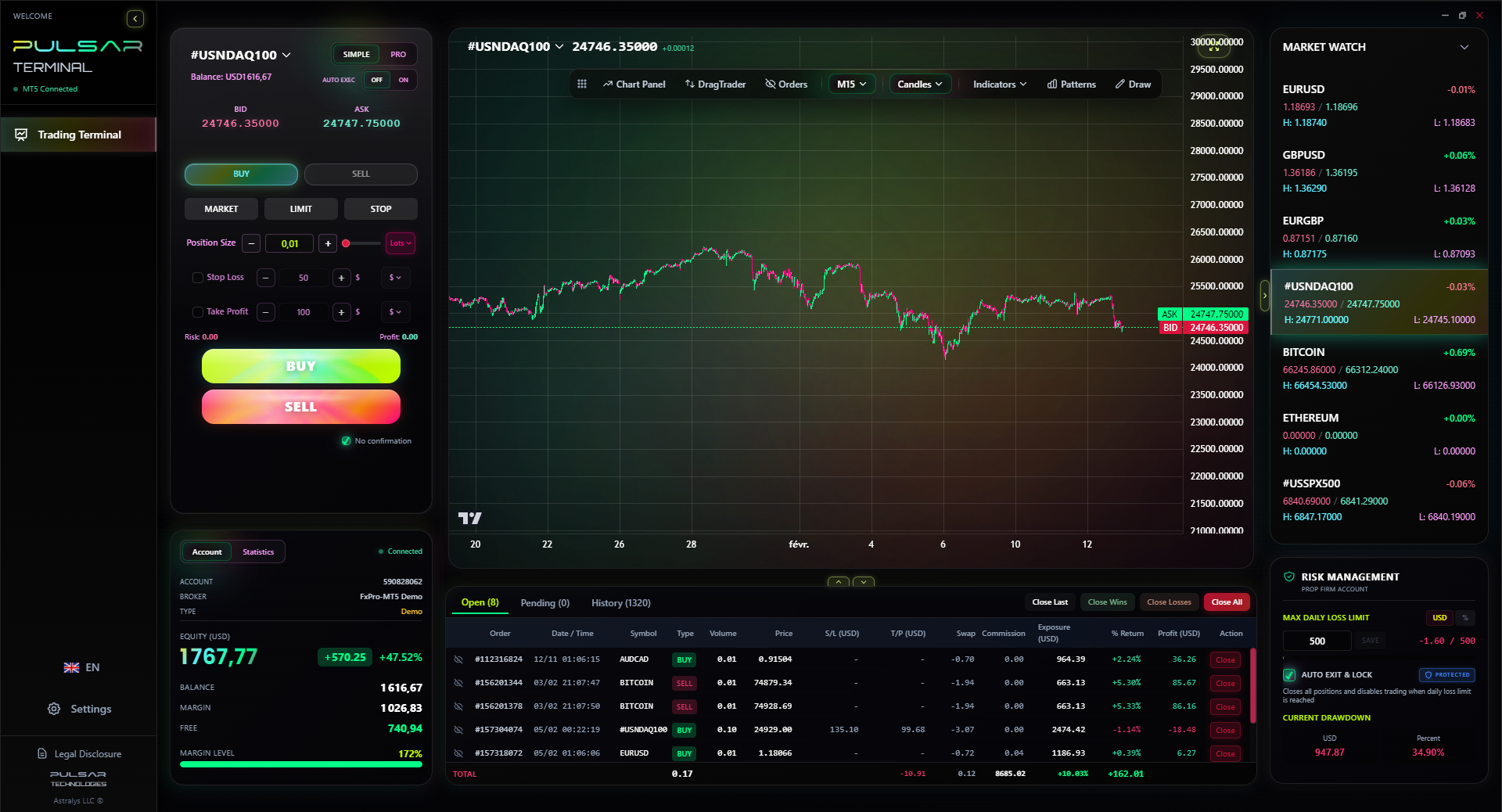
Managing multiple trades and strict stop losses is critical for surviving prop firm challenges, and Pulsar Terminal automates this directly on your MT5 platform.
Pulsar Terminal
The all-in-one MT5 companion: drag-and-drop orders, multi-TP/SL, trailing stop, grid trading, Volume Profile, and prop firm protection. Used by 1,000+ traders daily.
“Your edge isn't a secret indicator; it's understanding the South African context.”
I've made these mistakes so you don't have to.
1. Overleveraging on USD/ZAR: Even at 20:1, a 500-pip move (common) can wipe you out if your position is too big. Respect the volatility. 2. Chasing 'Prop Firm' dreams with poor skills: Prop firm challenges are trendy. They require strict daily loss limits. If you can't manage that with your own R5000, you won't pass with $100,000. Get consistently profitable first. 3. Ignoring the Swap (Overnight Financing): Holding a ZAR pair carry trade can have huge swap fees or credits. Check them. Holding USD/ZAR short (betting on ZAR strength) often pays you a small daily credit. Holding it long often costs you. This can make or break a long-term swing trading position. 4. Trading During Load-Shedding Without a UPS: Your internet goes down, your platform freezes, but your stop loss doesn't. A basic UPS for your router and laptop is a business expense. 5. Not Understanding a Pip on Exotics: On USD/ZAR, a pip is 0.0010. On USD/JPY, it's 0.01. The monetary value is different. Don't assume your risk is the same because you're risking '50 pips' on different pairs.
💡 Winston's Tip
If you can't explain your trade in one sentence ('I'm buying because price broke above the weekly high'), you shouldn't be in it. Complexity is the enemy of execution.
Okay, you've read the forex explanation. Now what?
- Open a Demo Account: Do it today. With an FSCA broker. Don't trade with fake money and fake psychology. Try to double it. Then try to double it again without blowing it up first. This takes months, not days.
- Fund a Small Live Account: Start with an amount you can afford to lose completely. R2000 is fine. The goal is not to get rich. The goal is to make 10 trades following your plan perfectly. The P&L is irrelevant.
- Analyze, Don't Just Watch: Spend 30 minutes a day analyzing the charts. Mark up support/resistance. Look for your setup. If it's not there, walk away. That's a successful trading day.
- Join a Community (Carefully): Find other South African traders. Not signal groups. People discussing market structure, broker experiences, and psychology. Learn from their mistakes.
The forex market will be here tomorrow. Your job is to make sure your capital is too. It's a marathon of consistent, small, smart decisions. That's the only forex explanation that matters in the end.
FAQ
Q1Is forex trading legal and safe in South Africa?
Yes, it's legal and regulated by the FSCA. It's 'safe' only if you use an FSCA-licensed broker, which provides a degree of protection, and if you educate yourself. It's inherently risky, like any speculative venture.
Q2What is the minimum amount I need to start forex trading in South Africa?
You can start with as little as R500 with some local brokers or $5 (approx. R90) with international FSCA brokers like XM. However, I strongly recommend starting with at least R5,000-R10,000. A tiny account forces you to over-use to see meaningful gains, which is a recipe for quick failure.
Q3Why are the spreads on USD/ZAR so much higher than on EUR/USD?
USD/ZAR is an exotic currency pair. It has lower liquidity and higher volatility than major pairs like EUR/USD. Brokers widen the spread to compensate for the increased risk of holding the position and the higher cost of executing the trade in the underlying market.
Q4How are my forex trading profits taxed in South Africa?
Profits are considered taxable income by SARS. You must declare them in your annual tax return. Keep detailed records of all your trades, deposits, and withdrawals. It's advisable to consult with a tax professional familiar with trading income.
Q5Can I use international brokers not regulated by the FSCA?
Technically, you can. But you shouldn't. You will have no recourse under South African law if there's a dispute or if the broker goes under. The FSCA use caps are also for your protection. Sticking with FSCA-licensed brokers like IC Markets, Pepperstone, or AvaTrade is the safest choice.
Q6What's the most important skill for a beginner forex trader?
Risk management. Before you learn how to make money, learn how not to lose it. This means mastering position sizing, always using a stop loss, and never risking more than 1-2% of your account on a single trade. Everything else is secondary.
Q7Is MetaTrader 4 or 5 better for South African traders?
MT5 is the more modern platform with more features, like more timeframes and built-in economic calendars. However, MT4 is simpler and still perfectly adequate. Most brokers offer both. Choose MT5 if you plan to trade anything besides forex (like stocks or commodities), otherwise, you can't go wrong with either. The key is to learn your chosen platform inside out.
Prof. Winston's Lesson
Key Takeaways:
- ✓FSCA regulation is your non-negotiable first filter.
- ✓Risk a maximum of 2% per trade, no exceptions.
- ✓USD/ZAR spreads are wide; trade longer timeframes.
- ✓A trading journal is more valuable than any indicator.
- ✓Profit starts after covering all costs (spread, commission).
How useful was this article?
Click a star to rate
Weekly Trading Insights
Free weekly analysis & strategies. No spam.
About the Author
David van der Merwe
Emerging Markets Trader
Johannesburg-based trader with 11 years in emerging market currencies. Specializes in ZAR pairs, FSCA-regulated trading, and South African market analysis.
Comments
Risk Disclaimer
Trading financial instruments carries significant risk and may not be suitable for all investors. Past performance does not guarantee future results. This content is for educational purposes only and should not be considered investment advice. Always conduct your own research before trading.
You Might Also Like

Cara Trading Forex Sukses: 7 Prinsip dari Trader Profesional
Cara trading forex sukses dengan 7 prinsip trader pro: manajemen modal, disiplin, journal trading, backtest. Data nyata, bukan janji profit palsu.
Jam Trading Forex Terbaik untuk Trader Indonesia: Panduan Lengkap dengan Tabel Waktu
Panduan jam trading forex untuk trader Indonesia. Tabel 4 sesi dunia, jam emas 20:00-00:00, sesi mana yang harus dihindari. Data akurat + tips dari trader berpengalaman.
Top 5 Sàn Forex Uy Tín Nhất 2026: Review Jujur dari Trader Indonesia
Top 5 sàn forex uy tín 2026 untuk trader Indonesia. Review jujur: spread, deposit, withdraw, dukungan lokal. Exness, XM, IC Markets & lebih.
Get Pulsar Terminal
All these calculators are built into Pulsar Terminal with real-time data from your MT5 account. One-click position sizing, automatic risk management, and instant calculations.
Get Pulsar Terminal