


I remember staring at my screen on September 13th, 2022, EUR/USD at 0.9980.

Olumide Adeyemi
West African Trading Pioneer ·  Nigeria
☕ 10 min read
What you'll learn:
- 1What Exactly Is the Forex Factory Calendar?
- 2Why This Calendar is Non-Negotiable for Nigerian Traders
- 3Decoding the Impact and Forecast: Your Pre-News Checklist
- 4Practical Trading Strategies Around News
- 5Matching the Calendar to Your Nigerian Trading Schedule
- 6Mistakes I Made (So You Don't Have To)
- 7Brokers, Platforms, and Putting It All Together
I remember staring at my screen on September 13th, 2022, EUR/USD at 0.9980. The U.S. CPI inflation data was due in minutes. My heart was pounding. I had a small short position, betting the number would be lower than expected. The red headline flashed: 'CPI (YoY): 8.3%'. Forecast was 8.1%. The pair spiked 90 pips against me in seconds. That loss, about ₦23,000 at the time, taught me more about the Forex Factory news calendar than any win ever could. It's not just a list of times; it's a map of market minefields and opportunities. Let me show you how to read it.
Think of the Forex Factory news calendar as the global trader's bulletin board. It's a free website that lists the exact times, dates, and details of upcoming economic news releases from every major country. For a Nigerian trader sitting in Lagos or Port Harcourt, this is your window into what's moving the markets in London, New York, and Tokyo.
The calendar shows events like U.S. Non-Farm Payrolls, European Central Bank (ECB) interest rate decisions, UK inflation data, and even local events that might affect the Naira. Each event is tagged with a color-coded impact rating: red for high, orange for medium, and yellow for low. A red event, like the U.S. Federal Funds Rate announcement, can cause volatility that wipes out an account or makes a month's profit in minutes. I learned that the hard way with that CPI trade.

Warning: Never, ever have an open position during a red news event unless you are a seasoned pro with a specific strategy. The spreads can widen massively, your stop-loss might not get filled at your price (slippage), and the whipsaw can trigger a margin call before you can blink.
It's not just about the headline number. The calendar provides the previous release's figure, the market's consensus forecast, and the actual result when it drops. The real magic happens in the 'deviation' - the difference between the actual and forecast. A bigger deviation usually means a bigger market move.

💡 Winston's Tip
The calendar tells you 'when.' Your chart tells you 'where.' Never place a trade based on news alone. Always have a technical level - support, resistance, a trend line - that confirms the fundamental story.
Our market context makes this tool essential. First, we're often trading with high use - I've used up to 1:500 with brokers like Exness or HFM. High use magnifies both profits and losses, so a 50-pip spike from news can have a huge percentage impact on your account balance.
Second, our primary trading sessions often align with major news. The London/New York overlap, which is the most liquid and volatile time, runs from about 1:00 p.m. to 5:00 p.m. West African Time (WAT). Guess when most top-tier U.S. data is released? Right in that window. If you're trading after work or during your break, you're likely in the heat of it.
Third, understanding global news helps you understand the Naira. While USD/NGN itself is an exotic pair with wide spreads (sometimes 80-100 pips), its long-term direction is driven by things like U.S. interest rates (which affect dollar strength) and Nigeria's own foreign reserves (which hit a 13-year high of $50.4 billion in early 2026). The calendar won't show local CBN bulletins, but it shows the global forces that pressure our local currency.
Finally, the regulatory shift in 2025 with the new Investments and Securities Act means the SEC is now watching. Trading blindly into news is a great way to blow up your account. Using the calendar for risk management isn't just smart, it's necessary for longevity.
“The Forex Factory calendar is a tool for managing risk first, and finding opportunity second.”
Don't just glance at the calendar. Interrogate it. Here’s my 5-point checklist before any significant event.
The Impact Filter
I only adjust my trading for red and sometimes orange events. Yellow events? I mostly ignore them. They might cause a 10-15 pip wiggle, but they're not worth restructuring your day for. Filter the calendar view to show only medium and high-impact events to avoid noise.
Understanding the Forecast
Where does the 'forecast' number come from? It's a median of predictions from major banks and financial institutions. The market has already 'priced in' this expectation. The trade isn't about the actual number being good or bad; it's about whether it's better or worse than expected.

Example: Let's say U.S. Retail Sales forecast is 0.5%. If the actual comes out at 0.6%, the dollar might strengthen slightly. If it comes out at 0.8%, you'll see a much stronger rally. If it comes out at 0.2% (worse than expected), the dollar could sell off. The direction isn't always intuitive - sometimes 'bad' data can cause a currency to rise if it means the central bank will be less aggressive. You have to think a step ahead.
The Previous Figure Matters
Always check the 'previous' column. Sometimes a data series is revised. A beat on the current release might be ignored if the previous month's stellar number is revised sharply lower. The market reacts to the whole story.
For a practical application of this analysis, a swing trading approach can help you position around these medium-term expectations rather than trying to scalp the volatile news spike itself.
You have three basic choices: avoid, fade, or trade the breakout. I've tried them all.
1. The Avoidance Strategy (Recommended for Beginners): This is simple. If a high-impact news event is due in 15 minutes, close all relevant positions and don't open new ones until 5-10 minutes after the release, once the initial spike and chaos have settled. This saved me countless times after my early CPI disaster. Use this time to analyze the new price level and the market's digested reaction.
2. The Fade Strategy (Advanced): This involves trading against the initial spike. The idea is that the first move is often an overreaction by algorithms, and the price will snap back. For example, if GBP/USD rockets 40 pips on news, you wait for momentum to stall and then short it, aiming for a 20-pip retracement. This is risky. You need a very tight stop-loss and the stomach for being wrong. I attempted this with an ECB press conference once. The initial spike faded, I entered, and then a second wave of comments sent it spiking again. I lost 1.5% of my account in two minutes. Not my finest hour.
3. The Breakout/Straddle Strategy (Requires Precision): This involves placing buy-stop and sell-stop orders just above and below the pre-news range. Whichever way the news breaks, one order triggers. The key is setting the orders far enough away to avoid false breakouts from pre-news jitters, but close enough to catch the move. You must immediately cancel the opposite order once one is triggered. This works best on pairs like EUR/USD or XAU/USD with high liquidity.

Pro Tip: Whatever your strategy, always reduce your position size for news trades. If your normal trade risks 1% of your account, risk 0.5% or 0.25% on a news play. The volatility is higher, so your stop-loss needs to be wider, which means a smaller position size to keep the monetary risk the same. Use a position size calculator religiously.
💡 Winston's Tip
If you're unsure, trade the aftermath, not the announcement. Let the algos fight it out for the first two minutes. The price action after that is driven by humans digesting the facts, which is often more tradable.
“If you miss the initial news spike, you missed it. Wait for the next setup. There's always another trade tomorrow.”
Let's get practical with WAT (West Africa Time, same as GMT+1).
| Trading Session | WAT Time | Key News From | What to Watch on Calendar |
|---|---|---|---|
| Asian Session | 1:00 AM - 10:00 AM | Japan, China, Australia | Low/Medium impact. China GDP, PBOC rates. Often sets the tone. |
| London Open/Session | 8:00 AM - 5:00 PM | UK, Eurozone | High Impact. UK CPI, Eurozone GDP, ECB Speeches. Volatility picks up. |
| London/NY Overlap | 1:00 PM - 5:00 PM | UK, Eurozone, US | MAX VOLATILITY. Most major U.S. data (CPI, NFP, Fed Rates) drops here. |
| New York Session | 2:00 PM - 11:00 PM | USA, Canada | High Impact continues with U.S. data and Fed speeches. |
My most profitable trades have come during the 1:00 p.m. to 5:00 p.m. WAT overlap. The liquidity is huge, and trends can develop quickly. But so can losses. If you have a day job, this might be your lunch break or late afternoon. Plan your calendar review around this window.
For instance, if you see a red 'US Durable Goods Orders' event set for 1:30 p.m. WAT on a Wednesday, you know not to enter a new USD trade at 1:25 p.m. Plan your trade after you see the outcome. This discipline is what separates consistent traders from gamblers.
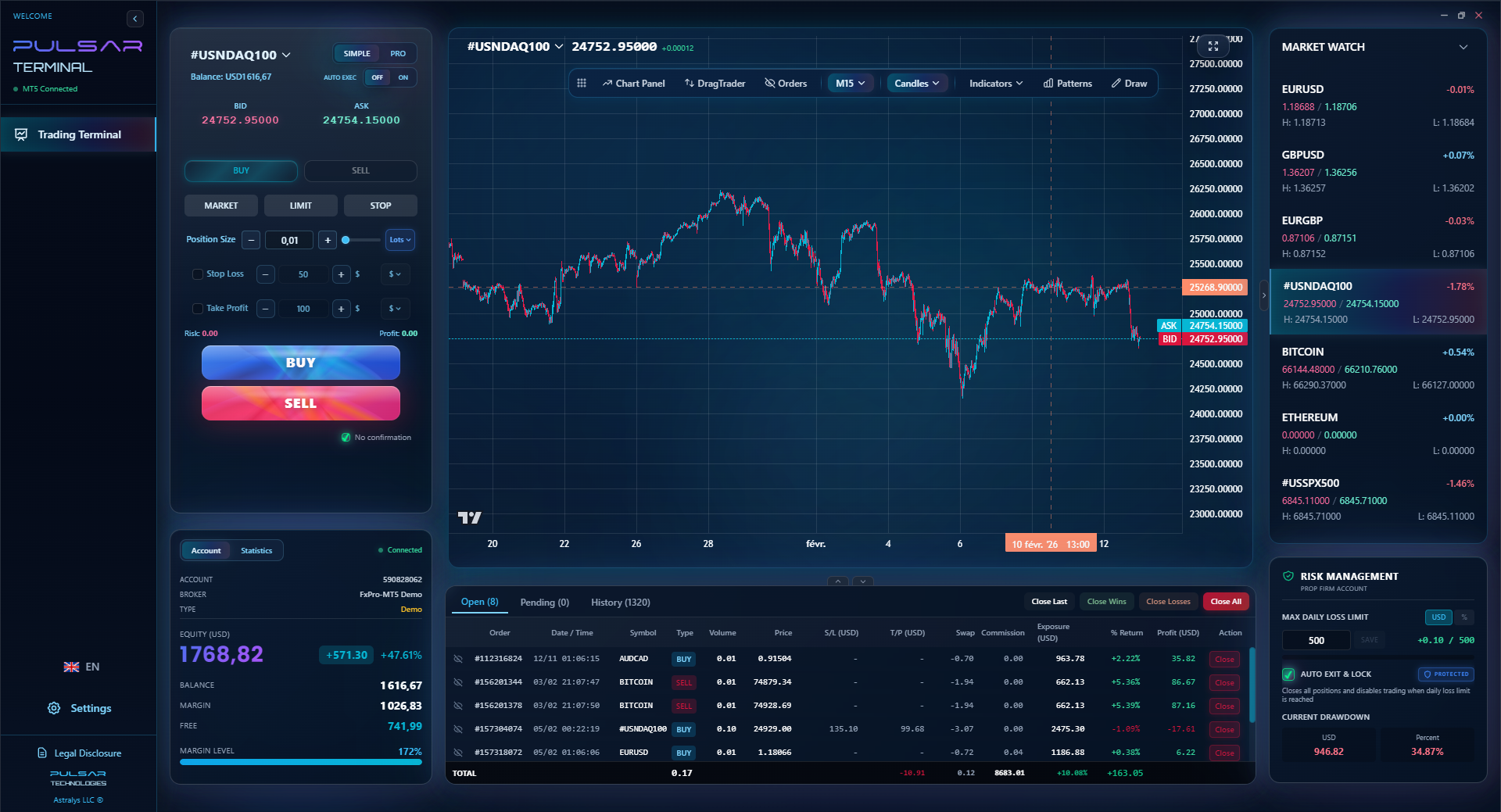
Managing multiple trades and orders around volatile news events is stressful, but Pulsar Terminal's drag-and-drop order system and multi-TP/SL features let you set complex trade plans on MT5 before the news drops, so you can focus on the data, not your mouse.
Pulsar Terminal
The all-in-one MT5 companion: drag-and-drop orders, multi-TP/SL, trailing stop, grid trading, Volume Profile, and prop firm protection. Used by 1,000+ traders daily.
Let me be brutally honest about where I've gone wrong with the Forex Factory news calendar.
Mistake 1: Trading the Rumor, Ignoring the Fact. I once bought GBP/USD because whispers before a Bank of England meeting were 'hawkish.' The actual statement was cautious. The pair dropped 60 pips. I lost money because I traded gossip, not the official data on the calendar. Now, I mute the noise and wait for the black-and-white print.
Mistake 2: Not Accounting for 'Whisper Numbers.' Sometimes, the official forecast is 0.5%, but the market 'whisper' among big desks is 0.7%. The actual comes out at 0.6% - beats the official forecast but misses the whisper. The price can sell off. The calendar shows the official forecast, not the whisper. This is where experience and watching price action in the minutes before the release come in. If EUR/USD is creeping up before a positive data release, the whisper might be high.
Mistake 3: Forgetting About Consecutive Events. A classic trap: A medium-impact US event at 1:30 p.m., followed by a Fed Chair speech at 3:00 p.m. You trade the 1:30 p.m. data successfully, get greedy, and hold through the speech. Powell says something unexpected, and your profit turns into a loss. Always check what's next on the docket. The market's focus shifts instantly.
Mistake 4: Chasing the Spike. You see EUR/USD jump 30 pips on news. FOMO kicks in, and you buy at the very top. The move is over, and it retraces 25 pips, stopping you out. This is the most common rookie error. If you miss the initial move, you missed it. Wait for the next setup. There's always another trade tomorrow. Tools like the RSI indicator can help identify overbought conditions after such a spike, warning you not to chase.
💡 Winston's Tip
Your profit target for a news trade should be at least 1.5 times your stop-loss. The volatility justifies a wider stop, so you need a proportionally larger reward to make the risk worthwhile.
“A bigger deviation between actual and forecast data usually means a bigger market move.”
Most brokers integrate economic calendars directly into their platforms. IC Markets, Pepperstone, and XM all have decent built-in calendars. But I still cross-reference with Forex Factory. It's the gold standard, and seeing the full, unfiltered list is valuable.
When choosing a broker as a Nigerian, consider not just use and spreads, but how their platform handles news volatility. Do they guarantee stop-losses? (Most don't during news). Do they have a history of requotes or freezing during high impact events? Read reviews specifically about this.
Your trading platform is your cockpit. On MT4 or MT5, you can set alerts for calendar events. I set a pop-up and sound alert 15 minutes before any red event I'm monitoring. This reminds me to check my positions and decide on my action: close, hedge, or do nothing.
The final piece is journaling. After a major news event, note down: the time, the pair, the expected vs. actual result, the immediate price reaction, and the reaction 15 minutes later. Over time, you'll see patterns. You'll learn that, for example, a beat on US Core PCE data almost always gives the dollar a sustained boost, while a beat on NFP can sometimes lead to a 'buy the rumor, sell the fact' drop. This personalized data is more valuable than any generic guide.
Remember, the Forex Factory news calendar is a tool for managing risk first, and finding opportunity second. Master it, and you take a huge step towards disciplined, professional trading. Ignore it, and you're just hoping for the best.
FAQ
Q1Is the Forex Factory calendar free for Nigerian traders?
Yes, completely free. You don't need an account to view it, though creating one lets you customize your view and set email alerts. It's one of the best free resources in the trading world.
Q2What time zone is the Forex Factory calendar set to?
By default, it shows times in Eastern Time (ET). You absolutely must change this. Click 'Settings' at the top of the calendar and select 'WAT (West Africa Time)' or 'GMT+1'. If you don't, you'll be off by 5 or 6 hours, which is a surefire way to miss an event or trade at the wrong time.
Q3How reliable are the 'impact' forecasts on the calendar?
They're a good general guide, but not gospel. A 'medium' impact event can sometimes spark a big move if the deviation from forecast is huge, or if the market is particularly tense. Always treat red events with maximum caution, but don't be surprised if an orange one packs a punch.
Q4Should I trade Naira (NGN) pairs using this calendar?
The calendar won't list local Nigerian economic data releases with the same detail. USD/NGN is driven more by local CBN policy, oil prices, and forex liquidity. While global news (like a strong USD) affects it, the pair is illiquid with very wide spreads. I'd advise using the calendar primarily for major forex pairs like EUR/USD or GBP/USD, where its data is most relevant and liquidity is high.
Q5Can I automate trades based on the Forex Factory calendar?
Not directly. The calendar is an informational website. However, some advanced trading platforms and Expert Advisors (EAs) can be programmed to reduce position sizes, close trades, or enter hibernation modes based on the time of known high-impact events. This requires programming skill. For most traders, manual discipline is the key.
Q6What's the single most important news event on the calendar?
For moving the entire market, it's the U.S. Non-Farm Payrolls (NFP) report, released the first Friday of every month at 1:30 p.m. WAT. It causes massive volatility in USD pairs, indices, and gold. The U.S. Federal Reserve interest rate decision and press conference (8 times a year) is a very close second. Mark these in your personal diary.
Q7Do I need to pay attention to news if I'm a scalper?
Even more so! If you're using a scalping strategy aiming for 5-10 pips, a news spike can blow through 10 levels of support/resistance in a second, hitting your tight stop-loss and reversing direction. Always know when high-impact news is scheduled and stop scalping at least 10 minutes before. The increased spread alone can turn your profitable strategy negative.
Prof. Winston's Lesson
Key Takeaways:
- ✓Always set your calendar to WAT (GMT+1).
- ✓Reduce position size by 50% for news trades.
- ✓Close trades 15 minutes before red events.
- ✓The 'deviation' moves markets, not the headline.
- ✓Journal every major news reaction to find patterns.
How useful was this article?
Click a star to rate
Weekly Trading Insights
Free weekly analysis & strategies. No spam.
About the Author
Olumide Adeyemi
West African Trading Pioneer
One of Nigeria's most active forex trading educators. 8 years of experience trading from Lagos. Specializes in low-capital strategies and prop firm challenges for African traders.
Comments
Risk Disclaimer
Trading financial instruments carries significant risk and may not be suitable for all investors. Past performance does not guarantee future results. This content is for educational purposes only and should not be considered investment advice. Always conduct your own research before trading.
You Might Also Like

Cara Trading Forex Sukses: 7 Prinsip dari Trader Profesional
Cara trading forex sukses dengan 7 prinsip trader pro: manajemen modal, disiplin, journal trading, backtest. Data nyata, bukan janji profit palsu.
Jam Trading Forex Terbaik untuk Trader Indonesia: Panduan Lengkap dengan Tabel Waktu
Panduan jam trading forex untuk trader Indonesia. Tabel 4 sesi dunia, jam emas 20:00-00:00, sesi mana yang harus dihindari. Data akurat + tips dari trader berpengalaman.
Top 5 Sàn Forex Uy Tín Nhất 2026: Review Jujur dari Trader Indonesia
Top 5 sàn forex uy tín 2026 untuk trader Indonesia. Review jujur: spread, deposit, withdraw, dukungan lokal. Exness, XM, IC Markets & lebih.
Get Pulsar Terminal
All these calculators are built into Pulsar Terminal with real-time data from your MT5 account. One-click position sizing, automatic risk management, and instant calculations.
Get Pulsar Terminal