


The screen was a sea of red.

Olumide Adeyemi
West African Trading Pioneer ·  Nigeria
☕ 10 min read
What you'll learn:

The screen was a sea of red. It was March 2020, and the USD/NGN pair on my broker's platform was doing things I'd never seen. The spread, normally a tight 5 pips on Exness, had blown out to over 50. My 'safe' buy order, placed after a small dip, was instantly hundreds of dollars in the hole. I felt that cold sweat, the one you only get when real money - money for school fees - is vanishing. That moment wasn't about complex strategies; it was about not understanding the absolute basics of how this market moves. This guide is what I wish I'd had before I placed that trade.
Forex isn't a get-rich-quick scheme. It's the Foreign Exchange market, where you're betting on the value of one currency against another. Think of it like this: you're trading the economic story of one country against another. When you buy EUR/USD, you're saying you think the Eurozone's story is stronger than America's in the near future.
In Nigeria, we feel this every day. The official CBN rate, the black-market (parallel market) rate for the Naira - these are all forex prices. Trading EUR/USD or GBP/JPY is just participating in that same global market, but with use, which is both the opportunity and the trap.
The biggest lie in 'forex for dummies' is that it's easy. It's not. It's a skill. You're competing against banks, hedge funds, and other retail traders who have probably already made the mistakes you're about to make. My first profitable year came only after three years of consistent loss. I had to unlearn everything the 'gurus' on Nairaland forums had taught me.
“Forex isn't a get-rich-quick scheme. It's a skill.”
Pips, Lots, and use
A pip is the smallest price move a currency pair can make. For most pairs, it's 0.0001. If EUR/USD moves from 1.1050 to 1.1051, that's one pip. This is your measuring stick for profit and loss. You need to know how to calculate a pip's value using a position size calculator before you trade a single Naira.
A lot is your trade size. A standard lot is 100,000 units of currency. Thankfully, you can trade micro lots (1,000 units) and mini lots (10,000 units). Starting with micro lots is non-negotiable. My early mistake? Trading a standard lot on USD/JPY because I had a 'sure feeling.' I lost over $800 in minutes - that was two months' savings gone.
use is borrowed capital. A 1:100 use means you control $10,000 with only $100 of your own money. Nigerian brokers like Exness or XM offer high use, sometimes up to 1:2000. This is a double-edged sword. It magnifies tiny gains and catastrophic losses. I treat high use like a live wire: useful if you know exactly what you're doing, deadly if you don't.

Warning: Never, ever use maximum use on a trade. It's the fastest route to a margin call. I use no more than 1:10 for my standard positions, no matter what my account allows.
The Major Pairs and the Naira
You'll mostly trade 'majors': EUR/USD, GBP/USD, USD/JPY, USD/CHF, AUD/USD, USD/CAD, NZD/USD. These have the tightest spreads and highest liquidity. Notice a pattern? They all involve the US Dollar (USD).
You might see USD/NGN on some international platforms. Be very careful. Liquidity can be thin, and spreads can be wild, especially during local economic announcements. I stick to the global majors; there's enough action there without the local volatility headaches.

💡 Winston's Tip
Your first 50 trades should be on a demo account. Your next 100 should be on a live account with micro lots, risking no more than 0.5% per trade. You're paying tuition; make it cheap.
“Starting with micro lots is non-negotiable.”
Prices move due to supply and demand, driven by news, economic data, and trader sentiment. The key for a beginner is to stop looking for a 'reason' for every tiny wiggle. Focus on the big picture.
Economic Calendars are Your Bible. Events like US Non-Farm Payrolls, interest rate decisions from the Fed or ECB, and inflation data (CPI) cause massive volatility. I learned this the hard way in 2015. I was in a long GBP/USD trade when the Bank of England surprised markets. The pair dropped 200 pips in seconds, wiping out my stop loss and continuing down. I was glued to the screen, unable to react.

Pro Tip: On major news days, either don't trade, or use extremely wide stop losses. Better yet, close your positions before the news hits. The spread alone can kill you.
Technical Analysis vs. Fundamentals This is the eternal debate. Fundamentals are the 'why' (economic health). Technical analysis is the 'when' and 'where' (chart patterns, support/resistance).
As a beginner, start with technicals. Learn to read a bare chart. Identify clear support (where price tends to stop falling) and resistance (where it tends to stop rising). Simple tools like RSI indicator and MACD indicator can help you spot overbought or oversold conditions and momentum shifts. Don't overload your chart with 10 indicators. I did that. It was confusing and contradictory. Start with price action and one or two indicators you truly understand.
For a deep dive on a specific pair, check out our EUR/USD guide.
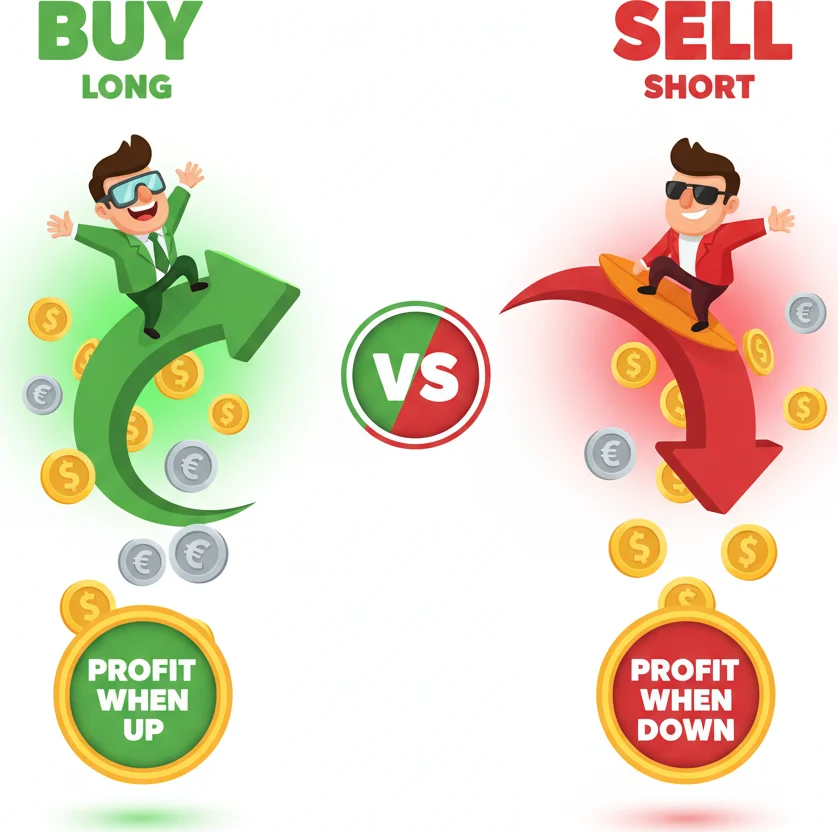
“Starting with micro lots is non-negotiable.”
Let's simulate a real trade. It's a Tuesday morning, no major news due. You're looking at EUR/USD.
- Analysis: The price has bounced off a support level at 1.0750 three times in the last week. It's currently at 1.0765. The 4-hour chart RSI indicator is reading 35, suggesting it's not oversold but getting there. You think it might bounce up again.
- Plan: You decide to BUY if price touches 1.0755, anticipating another bounce.
- Risk Management: This is the most important step. Your account has $500. You will never risk more than 1% on a single trade. That's $5.
- You place your stop loss at 1.0735, 20 pips below your entry.
- To calculate your position size: $5 risk / 20 pips = $0.25 per pip.
- On a micro lot (1,000 units), 1 pip = $0.10. You need 2.5 micro lots to risk $0.25 per pip. So, you trade 2 micro lots (risking $4) or 3 micro lots (risking $6). You choose 2 micro lots.
- You set your take profit at 1.0805, 50 pips away, aiming for a 2.5:1 reward-to-risk ratio.
- Execution: Price hits 1.0755. Your buy order executes. Stop loss at 1.0735. Take profit at 1.0805. You walk away.
- Result: The price rises to 1.0790, then falls and hits your stop loss at 1.0735. You lose $4. That's it. No panic. You followed your plan. A 1% loss is manageable. This is the discipline that separates winners from losers.

Example: That $4 loss on a $500 account is 0.8%. It doesn't feel good, but it doesn't cripple you. The trader who risks 10% ($50) on that same trade is now down to $450 and is emotionally wrecked, likely to make worse decisions next.
💡 Winston's Tip
If you can't explain your trade setup in one simple sentence ('price bounced from weekly support with RSI divergence'), it's not a trade. It's a gamble.

“A 1% loss is manageable. A 10% loss is a catastrophe.”
This is critical. A bad broker will make you lose money even when you're right. Look for:
- Regulation: This is non-negotiable. Look for brokers regulated by bodies like CySEC (Cyprus), FCA (UK), or ASIC (Australia). They have client fund protection rules. Many 'offshore' brokers target Nigerians with crazy bonuses; avoid them.
- Deposit/Withdrawal: How do you fund your account? Local bank transfer (in Naira), card payments, or cryptocurrencies? How long do withdrawals take? I use brokers with reliable local bank transfer options. IC Markets and Pepperstone have good track records here.
- Spreads & Commissions: The spread definition is the cost of trading. Compare the EUR/USD spread during the London session. A difference of 0.2 pips adds up massively over hundreds of trades.
My experience? I started with an unregulated broker offering 1:1000 use and '100% deposit bonuses.' The bonus was a trap - you couldn't withdraw profits until you traded an impossible volume. When I finally made a decent profit, my withdrawal was 'pending' for months before the website disappeared. Stick to the reputable names, even if their sign-up bonus is smaller.
Here’s a quick comparison based on my experience:
| Feature | What to Look For | Nigerian Reality Check |
|---|---|---|
| Regulation | FCA, ASIC, CySEC license. | Avoid brokers with only offshore licenses. |
| Funding | Local bank transfer, cards, stablecoins. | Bank transfers can take 1-3 business days. |
| Spreads | Low, stable spreads on majors (e.g., <1.0 pip on EUR/USD). | Check during your main trading hours (often London session). |
| Platform | MT4/MT5. The industry standard. | Ensure it runs smoothly on your PC and phone. |
| Customer Support | 24/5 live chat, local phone number a plus. | Test their response time with a pre-sign-up question. |
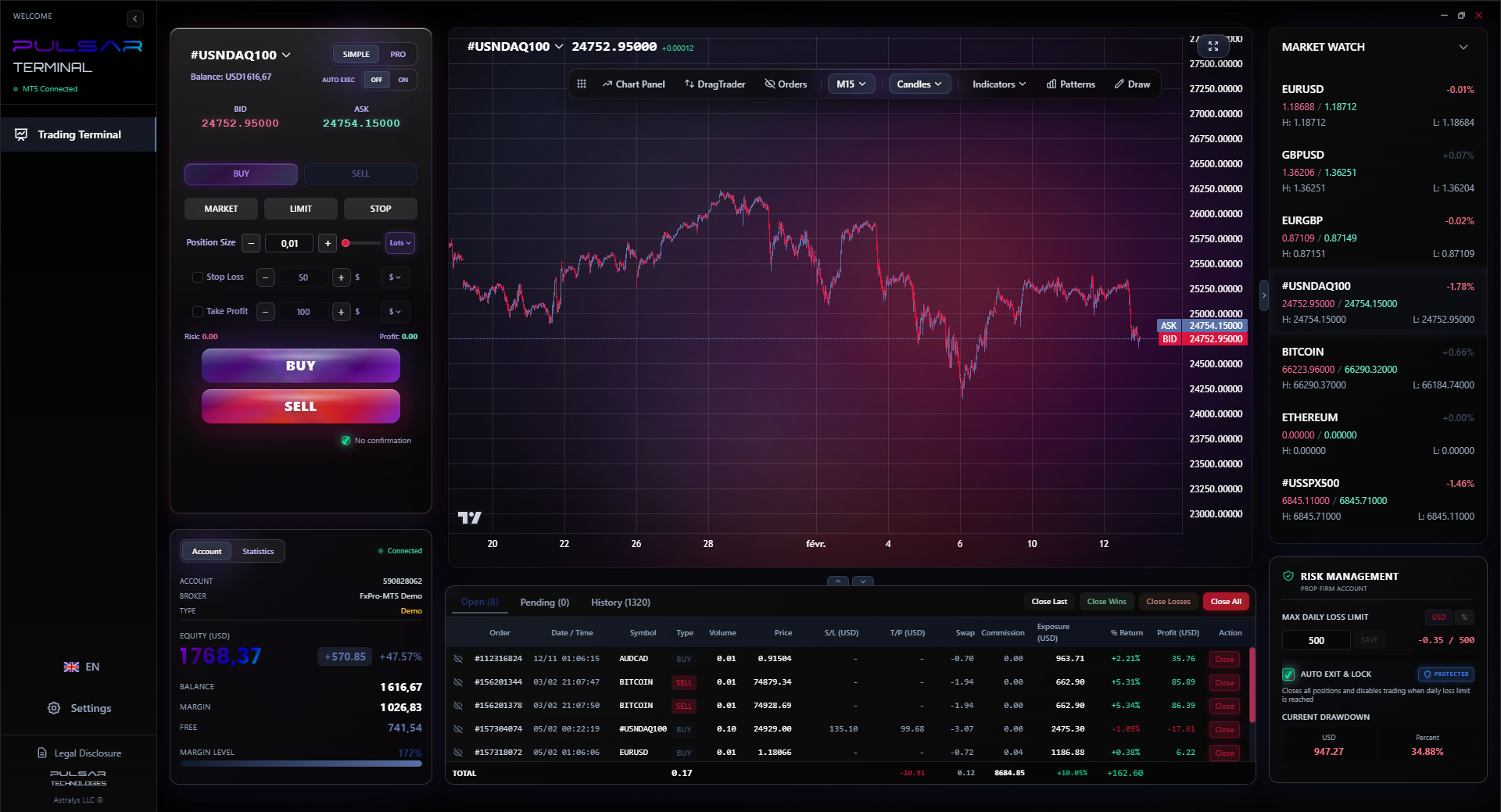
Sticking to a disciplined plan with precise stop losses and take profits is the core of survival, and tools like Pulsar Terminal make managing these orders on MT5 far more visual and intuitive.
Pulsar Terminal
The all-in-one MT5 companion: drag-and-drop orders, multi-TP/SL, trailing stop, grid trading, Volume Profile, and prop firm protection. Used by 1,000+ traders daily.
“A 1% loss is manageable. A 10% loss is a catastrophe.”
- Trading Without a Stop Loss: This is suicide. In 2014, I went long on gold (XAU/USD). It went against me. 'It'll come back,' I thought. It didn't. I watched a $200 loss turn into a $1,200 loss before I manually closed, devastated. Always use a stop loss. Every. Single. Time. For more on gold, see our XAU/USD guide.
- Over-trading: Boredom is not a trading signal. I used to trade 10-15 times a day, a classic scalping strategy gone wrong. Most were noise trades. The commissions and spreads ate my account. Now, as a swing trading disciple, I might take 2-3 trades a week.
- Revenge Trading: After a loss, the urge to 'get it back immediately' is overwhelming. I'd double my lot size on the next trade, usually while angry. This never, ever worked. After a loss, I close the platform for the day.
- Following the Crowd: When everyone on Twitter is screaming 'BUY USD/JPY!' it's often too late. The smart money is already taking profits. Learn to think independently.
- Ignoring the Trend: 'The trend is your friend' is a cliché because it's true. My first profitable year came when I stopped trying to pick tops and bottoms and simply rode established trends. If the daily chart is pointing up, look for buys on pullbacks. Don't try to be a hero.
💡 Winston's Tip
The market doesn't know you exist. It doesn't care about your rent, your goals, or your previous losses. Trade the chart in front of you, not the story in your head.
“Your brain is your biggest enemy.”
Forex is 80% psychology, 15% risk management, 5% strategy. Your brain is your biggest enemy.
Treat It Like a Business. You are the CEO of a small hedge fund (your account). You wouldn't blow your company's capital on a whim. Have a trading plan: What pairs do you trade? What's your daily loss limit? What's your weekly profit target? Write it down.
Embrace Losses. You will lose. A lot. A 40% win rate with good risk management can be wildly profitable. The goal isn't to be right every time; it's to be profitable over 100 trades. When I finally accepted that a string of 5 losses was statistically normal and not a personal failure, my trading changed.
Keep a Journal. This was my single best habit. Every trade: screenshot, entry/exit reasoning, emotional state. Review it weekly. You'll see your patterns - your real, costly patterns. I noticed I lost 70% of my trades entered after 10 PM Lagos time. I was tired and impulsive. I now have a hard 'no trade' rule after 9 PM.
This journey is a marathon. There's no finish line, just constant learning. Start small, protect your capital, and focus on the process, not the weekly payout. The money will follow the discipline.


FAQ
Q1How much money do I need to start forex trading in Nigeria?
You can start with as little as $50 or ₦20,000 with a broker offering micro lots. However, I strongly recommend starting with at least $200-$500. This gives you enough buffer to absorb initial losses while learning proper position sizing without blowing your account on a few bad trades.
Q2Is forex trading legal in Nigeria?
Yes, forex trading is legal in Nigeria. You are trading on international markets through licensed foreign brokers. The key is to use a reputable, internationally regulated broker, not an unlicensed platform operating within Nigeria.
Q3What is the best time to trade forex in Nigeria?
The most liquid and volatile sessions are the London session (1 PM - 10 PM Nigerian Time) and the overlap with the New York session (3 PM - 10 PM Nigerian Time). This is when spreads are tightest and you get the cleanest price action. Avoid the Asian session (late night/early morning) as a beginner.
Q4Can I make a living from forex trading in Nigeria?
It's possible, but extremely difficult and should not be your initial goal. Less than 5% of retail traders are consistently profitable. Treat it as a skill to develop over years. Have a primary income first. Aim to grow your account by a realistic 5-20% per month, not to replace your salary immediately.
Q5What's the difference between a demo account and a live account?
A demo account uses virtual money. It's perfect for learning the platform and testing strategies. A live account uses real money, which triggers real emotions - fear and greed. The psychology is completely different. Use a demo to get fluent, then switch to a live account with very small amounts to learn the emotional side.
Q6How do I handle the volatility of the Naira when trading?
If you're trading major pairs (EUR/USD, etc.), your profit/loss is in USD or another foreign currency. Your broker converts it to Naira for withdrawal. The volatility affects your final Naira amount. To mitigate this, you could consider holding some profits in a stable foreign currency within a multi-currency account if your broker offers it, converting to Naira when the rate is favourable.
Prof. Winston's Lesson
Key Takeaways:
- ✓Risk only 1% of your capital per trade.
- ✓Use a stop loss on every single position.
- ✓Start with micro lots for your first 100 live trades.
- ✓The London/New York session overlap is your best friend.
- ✓A 40% win rate with good risk management can be profitable.
How useful was this article?
Click a star to rate
Weekly Trading Insights
Free weekly analysis & strategies. No spam.
About the Author
Olumide Adeyemi
West African Trading Pioneer
One of Nigeria's most active forex trading educators. 8 years of experience trading from Lagos. Specializes in low-capital strategies and prop firm challenges for African traders.
Comments
Risk Disclaimer
Trading financial instruments carries significant risk and may not be suitable for all investors. Past performance does not guarantee future results. This content is for educational purposes only and should not be considered investment advice. Always conduct your own research before trading.
You Might Also Like

Cara Trading Forex Sukses: 7 Prinsip dari Trader Profesional
Cara trading forex sukses dengan 7 prinsip trader pro: manajemen modal, disiplin, journal trading, backtest. Data nyata, bukan janji profit palsu.
Jam Trading Forex Terbaik untuk Trader Indonesia: Panduan Lengkap dengan Tabel Waktu
Panduan jam trading forex untuk trader Indonesia. Tabel 4 sesi dunia, jam emas 20:00-00:00, sesi mana yang harus dihindari. Data akurat + tips dari trader berpengalaman.
Top 5 Sàn Forex Uy Tín Nhất 2026: Review Jujur dari Trader Indonesia
Top 5 sàn forex uy tín 2026 untuk trader Indonesia. Review jujur: spread, deposit, withdraw, dukungan lokal. Exness, XM, IC Markets & lebih.
Get Pulsar Terminal
All these calculators are built into Pulsar Terminal with real-time data from your MT5 account. One-click position sizing, automatic risk management, and instant calculations.
Get Pulsar Terminal