


It was October 2022, and the USD/ZAR was screaming past R18.40.

David van der Merwe
Emerging Markets Trader ·  South Africa
☕ 10 min read
What you'll learn:
It was October 2022, and the USD/ZAR was screaming past R18.40. My phone was buzzing with messages from a guy in my trading group who’d just gone all-in on a short, convinced the Reserve Bank would save the day. He didn’t have a stop loss. ‘It has to reverse,’ he kept saying. I watched his margin call happen in real-time over WhatsApp, a R50,000 account evaporating in an afternoon because he traded on hope, not a plan. That moment, right there, is why we need to talk plainly about forex forex trading in South Africa. It’s not about getting rich quick from your couch in Sandton. It’s about understanding a global casino where the Rand is often the chip.
Let's clear this up first. 'Forex forex trading' is a bit of a redundant phrase people search for, but it points to the core of the market: trading currencies. You're betting on the value of one currency against another. For us, that usually means the South African Rand (ZAR) paired with something like the US Dollar (USD) or Euro (EUR).
When you buy USD/ZAR, you're not buying dollars to hold in your hand. You're entering a contract for difference (CFD) with a broker. You profit if the pair's price goes up (the dollar strengthens against the rand), and you lose if it goes down. It's all done on margin, meaning you put down a small deposit (your margin) to control a much larger position. This is where the magic and the misery happen.

Warning: Trading CFDs is not investing. You don't own the underlying currency. You're speculating on price movements, and most retail traders lose money. The FSCA says this for a reason.
I made my first real profit trading GBP/ZAR during the Brexit volatility. I went long at R21.50 with a tight stop at R21.30, risking R2,000. It ran to R22.10 and I got out. A R6,000 gain felt incredible. Then, I gave half of it back the next week on a stupid EUR/ZAR trade I entered because I was bored. That's the cycle. Forex forex trading is a psychological grind as much as a technical one.

💡 Winston's Tip
If you can't articulate the exact reason for your trade in one sentence - 'Price is bouncing from the 4H support with RSI divergence' - you have no business being in the market. Hope is not a strategy.
Brokers hook you with 'zero commission' but make their money on the spread - the difference between the buy and sell price. For a major pair like EUR/USD, a good raw spread is under 0.1 pips with a commission. For USD/ZAR, expect spreads of 80-150 pips during active hours. That's your immediate cost.
Let's break down a real trade with numbers that matter:
Example: Selling USD/ZAR
- Account Balance: R20,000
- Trade Size: 1 standard lot (100,000 units)
- Entry Price: R18.5000
- Spread: 100 pips (R0.0100)
- Your actual entry: R18.4900 (you start 100 pips in the hole)
- Stop Loss: R18.6000 (100 pips risk)
- Take Profit: R18.3500 (150 pips target)
The Math:
- Pip Value for USD/ZAR: Roughly R5.41 per pip per lot (100,000 / 18.50)
- Spread Cost: 100 pips * R5.41 = R541 lost before you even start.
- Risk: 100 pips * R5.41 = R541 potential loss.
- Reward: 150 pips * R5.41 = R811 potential profit.
Your risk/reward is about 1:1.5, but you need the market to move 250 pips in your favor just to be net up R270. This is why you need a proper position size calculator. Don't guess.
Overnight Financing (Swap Rates)
This is the killer newbies forget. If you hold a trade past 10 PM SAST, you pay or receive interest. For ZAR pairs, you're often paying a hefty fee to hold a long position overnight because of South Africa's higher interest rates. I once held a long USD/ZAR trade over a weekend and got slapped with a R350 financing charge. It turned a winning trade into a loser. Check your broker's swap sheet. Every. Time.
“Forex forex trading is a psychological grind as much as a technical one.”
Your first filter is regulation. The Financial Sector Conduct Authority (FSCA) is our local watchdog. A broker registered with them (even as a foreign financial services provider) offers some recourse. It's not a guarantee, but it's the bare minimum. Never, ever deposit money with an unregulated 'bucket shop' promising insane bonuses.
You'll see ads for big international names. Some are good, but you must check their specific offering for South African clients.
| Broker | Key Consideration for SA Traders | My Experience |
|---|---|---|
| Local SA Brokers | Easy ZAR deposits, local support. Often higher spreads and limited platforms. | Used one early on. Funding was instant via EFT, but the trading conditions were poor. Felt expensive. |
| Exness | Popular for its variety of accounts. Accepts ZAR deposits. | Their Raw Spread account can be decent for majors, but always verify current ZAR payment methods. |
| IC Markets | Known for low raw spreads on True ECN accounts. | This is where I trade now. Depositing ZAR involves a currency conversion to USD, but the tight spreads on EUR/USD make it worth it for my strategy. |
| XM | Heavy on education and offers ZAR-denominated accounts. | Good for beginners. The ZAR account means you see all profits and losses in Rands, which simplifies psychology. Spreads are higher than IC Markets. |
| Pepperstone | Another strong ECN broker with good execution. | Similar to IC Markets. Excellent for scalping strategies due to fast execution. |

Pro Tip: Open a demo account with at least two brokers. Compare the real, live spreads on the USD/ZAR pair at 10 AM and 3 PM SAST. That's where you'll see the true cost.
You can't trade the London open at 10 AM SAST and the US open at 3:30 PM SAST? Then don't try to be a scalping hero on EUR/USD. Play to your time zone. The most liquid period for ZAR pairs is during our business day, overlapping with Europe.
Here’s a basic, price-action swing strategy I've used:
- Timeframe: Use the 4-hour chart for direction and the 1-hour chart for entry. This suits swing trading over days, not minutes.
- Find the Zone: Identify clear areas of support or resistance where the price has reversed before. Draw a horizontal line.
- Wait for the Reaction: Don't buy at the support line. Wait for the price to touch it, then start to move away (a bullish candle closing above the line for a buy).
- Enter on Retest: Place your buy order just above the high of that bullish candle, anticipating a retest of the broken level as new support.
- Manage the Trade: Stop loss goes just below the support zone. Aim for a take profit at the next resistance area, for a risk/reward of at least 1:2.
I used this on GBP/ZAR. Support was at R22.80. It touched, formed a pin bar, and I entered a long at R22.85. Stop at R22.65 (200 pip risk). Took profit at R23.45 (600 pip gain). R1,200 profit on a R400 risk. It works because it's patient. It doesn't require you to stare at screens all day.
Combine this with an oscillator like the RSI indicator for confluence. If price is at support and the RSI is below 30 and starting to curl up, that's a stronger signal than just price alone.
💡 Winston's Tip
Your first R10,000 profit will teach you less than your first R2,000 loss. Journal the loss obsessively. That's where the real curriculum is.
“Your risk/reward is about 1:1.5, but you need the market to move 250 pips in your favor just to be net up R270.”
This is the most important section. Your strategy is only 30% of the battle. Your psychology is 70%.
Pitfall 1: Trading the News Blindly. SARB interest rate announcements, budget speeches, US Non-Farm Payrolls. These events cause massive volatility. I learned this the hard way trying to trade the SARB announcement in January 2023. I had a prediction, entered before the news, and got whipped in 90 seconds as the price spiked 300 pips in both directions. My stop was vaporized. Now, I either close all positions before major news or I don't trade at all. The spreads widen to insane levels, and your stop loss isn't guaranteed.
Pitfall 2: Revenge Trading. You take a R1,000 loss. Your ego is bruised. You immediately jump into another trade twice the size to 'make it back.' This is how a bad day becomes a catastrophic month. I've done it. After a loss, walk away. Shut the platform. Go for a braai. The market will still be there tomorrow.
Pitfall 3: The 'Load Shedding' Risk. Our glorious national pastime. You do not want your internet to drop during a live trade. Use a broker with a reliable mobile app, and consider a UPS for your router. Having a hard stop loss in place is your final safety net if you get disconnected.
Pitfall 4: Converting to Rand in Your Head. You make $300 on a EUR/USD trade. You instantly think 'That's over R5,000!' This leads to overtrading. Trade the charts, not the Rand conversion. Keep your focus on the pips and the percentage of your account at risk.
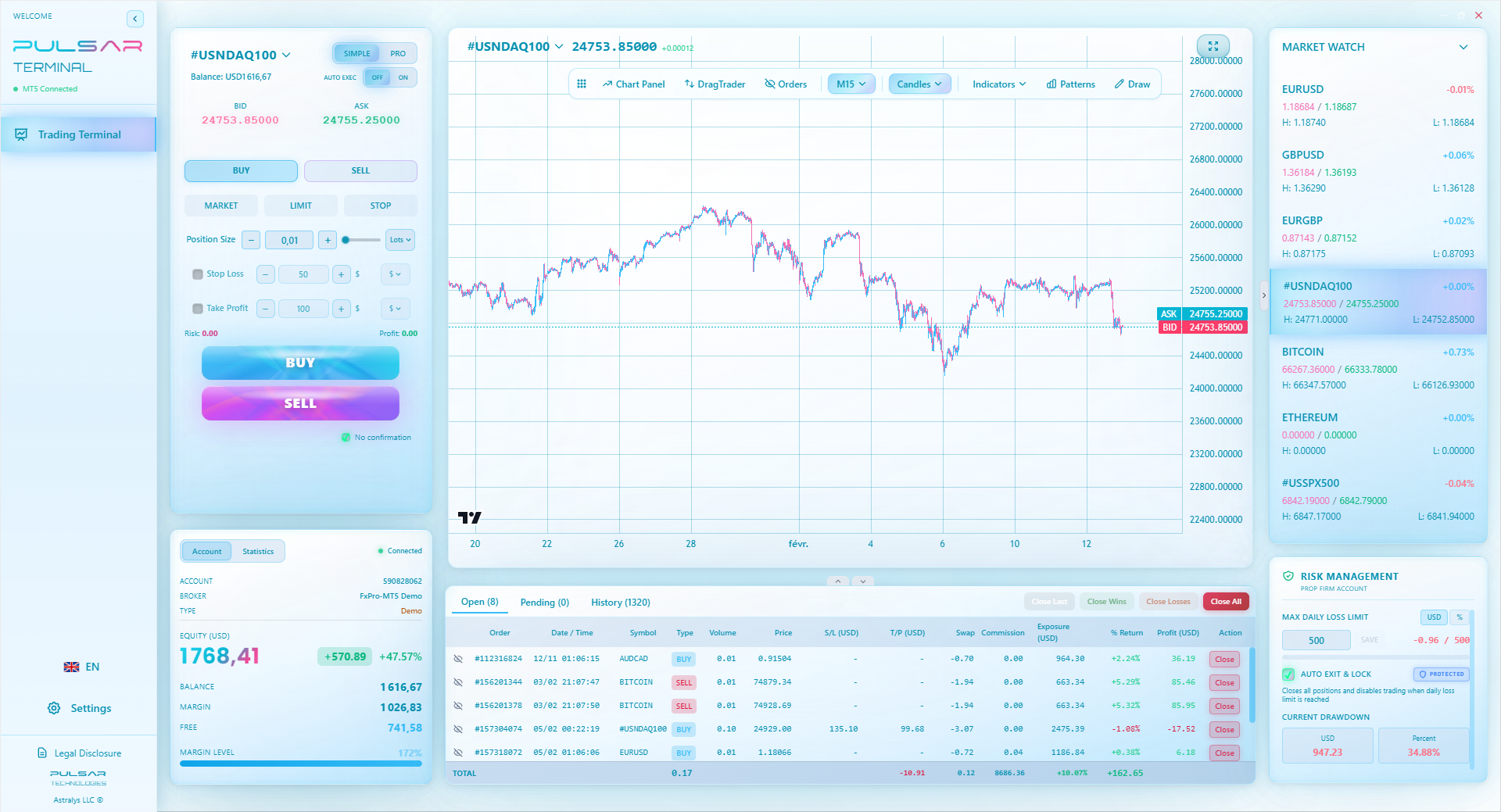
Managing the psychological stress of multiple trades is easier when your platform automates risk controls, like setting a firm daily loss limit to prevent revenge trading.
Pulsar Terminal
The all-in-one MT5 companion: drag-and-drop orders, multi-TP/SL, trailing stop, grid trading, Volume Profile, and prop firm protection. Used by 1,000+ traders daily.
I am not a tax advisor. You need to consult one. But here's the basic lay of the land from my experience and discussions with other traders.
Trading profits are generally considered revenue in nature (from carrying on a trade) and are taxable as ordinary income. This means it gets added to your other income and taxed at your marginal rate. You can deduct certain expenses directly related to generating that income: data fees, trading platform subscriptions, a portion of home office costs, and even educational material if it's directly for your trading business.
Keep careful records. Every trade statement from your broker. Every invoice for trading-related expenses. SARS may ask for proof. The onus is on you.
If your trading is more sporadic and not run like a business, there's an argument it could be seen as capital in nature, falling under Capital Gains Tax (CGT). CGT rates are lower (max 18% for individuals). However, the frequency of your trades, your intention, and how you manage it will determine this. This is a grey area. Do not guess. Get professional advice. The last thing you want is a nasty surprise from SARS after a good trading year.
💡 Winston's Tip
The SARB doesn't care about your long USD/ZAR position. Never trade a central bank announcement unless you enjoy donating to the market.
“The market doesn't care about your bills, your dreams, or how smart you think you are.”
- Education First, Money Last. Use Babypips.com's 'School of Pipsology.' It's free and explains everything from what a pip definition is to complex strategies.
- Open a Demo Account. Pick a broker from the list above and trade with virtual money for at least three months. Your goal is not to make fake profit, but to not lose the fake money. Practice one strategy until it's boring.
- Start a Trading Journal. Not just 'bought here, sold there.' Write down your reasoning, your emotional state, what you saw on the chart. Review it weekly. This is your single best tool for improvement.
- Fund a Live Account with Money You Can Lose. Start small. R5,000 is enough. Your goal in the first year is to survive, not to buy a Ferrari. Risk no more than 1% of your account per trade. For a R5,000 account, that's R50. That means very small position sizes.
- Find a Community, Not a Guru. Avoid 'signal sellers' on Telegram promising 100% returns. Find a group of serious traders who discuss analysis and psychology, not just brag about wins. Learn from each other's mistakes.
Forex forex trading is a skill. It takes years to get good. There are no shortcuts. The market doesn't care about your bills, your dreams, or how smart you think you are. It only responds to one thing: collective buying and selling pressure. Your job is to learn how to read that pressure, manage your own fear and greed, and protect your capital above all else. Good luck. You'll need it, and a whole lot of discipline.
FAQ
Q1Is forex trading legal in South Africa?
Yes, it is completely legal. However, you must use a broker that is authorised by the Financial Sector Conduct Authority (FSCA) to offer services to South African residents. This is for your protection.
Q2What is the minimum amount I need to start forex trading in South Africa?
Technically, some brokers allow you to start with as little as $10 (roughly R180). Practically, I would never recommend less than R5,000. This allows for proper position size and risk management without being wiped out by a single, small loss. Starting too small can force you to take excessive risk.
Q3How do I deposit and withdraw ZAR with an international broker?
Most international brokers accept bank wire transfers in ZAR, which they convert to USD or EUR. Some offer partnerships with local payment processors for faster EFTs. Always check the broker's website for 'Deposit Methods' for South Africa, and be aware of the conversion fees and processing times.
Q4What is the most traded currency pair involving the Rand?
USD/ZAR (US Dollar/South African Rand) is by far the most liquid and commonly traded pair. After that, EUR/ZAR and GBP/ZAR see significant volume. These are the pairs you should focus on as a beginner due to their relative stability and lower spreads compared to exotic pairs.
Q5Can I make a living from forex trading in South Africa?
A very small percentage of traders do. It requires significant capital (well into six figures), years of experience, and extreme discipline. For 95% of people, it should be treated as a high-risk side activity, not a primary income. The statistics are brutal, and the psychological pressure of relying on it to pay bills often leads to disastrous decisions.
Q6Do I need to pay tax on my forex trading profits?
Almost certainly, yes. Profits are likely considered income and taxable. You must declare this to SARS. Keep all your trading statements and consult with a tax professional who understands trading income. Ignorance is not a defence.
Q7What's the biggest mistake new South African traders make?
Two things: underestimating the cost of the spread on ZAR pairs, and not using a stop loss. They see a 100-pip move, think of the Rands, and jump in without realizing they're starting 80 pips in the hole. Then, when the trade goes against them, they 'hope' it will come back instead of using a hard stop, leading to a margin call.
Prof. Winston's Lesson
Key Takeaways:
- ✓Trade ZAR pairs during SA/EU overlap for best liquidity.
- ✓A 100-pip spread on USD/ZAR costs you R540 on a standard lot.
- ✓Always use a stop loss. No exceptions.
- ✓SARS taxes trading profits as income. Keep records.
How useful was this article?
Click a star to rate
Weekly Trading Insights
Free weekly analysis & strategies. No spam.
About the Author
David van der Merwe
Emerging Markets Trader
Johannesburg-based trader with 11 years in emerging market currencies. Specializes in ZAR pairs, FSCA-regulated trading, and South African market analysis.
Comments
Risk Disclaimer
Trading financial instruments carries significant risk and may not be suitable for all investors. Past performance does not guarantee future results. This content is for educational purposes only and should not be considered investment advice. Always conduct your own research before trading.
You Might Also Like

Cara Trading Forex Sukses: 7 Prinsip dari Trader Profesional
Cara trading forex sukses dengan 7 prinsip trader pro: manajemen modal, disiplin, journal trading, backtest. Data nyata, bukan janji profit palsu.
Jam Trading Forex Terbaik untuk Trader Indonesia: Panduan Lengkap dengan Tabel Waktu
Panduan jam trading forex untuk trader Indonesia. Tabel 4 sesi dunia, jam emas 20:00-00:00, sesi mana yang harus dihindari. Data akurat + tips dari trader berpengalaman.
Top 5 Sàn Forex Uy Tín Nhất 2026: Review Jujur dari Trader Indonesia
Top 5 sàn forex uy tín 2026 untuk trader Indonesia. Review jujur: spread, deposit, withdraw, dukungan lokal. Exness, XM, IC Markets & lebih.
Get Pulsar Terminal
All these calculators are built into Pulsar Terminal with real-time data from your MT5 account. One-click position sizing, automatic risk management, and instant calculations.
Get Pulsar Terminal