


Ever watched the USD/ZAR swing wildly and wished you could lock in a rate for the future? Maybe you're an importer worried about next month's bill, or a trader with a strong view on where the rand is headed.

David van der Merwe
Emerging Markets Trader ·  South Africa
☕ 10 min read
What you'll learn:
- 1What Exactly Is a Forex Forward Rate?
- 2Why Should a South African Trader Care?
- 3The Math: Forward Points and Your Bottom Line
- 4How to Actually Trade Forwards with a South African Broker
- 5The Real Risks and Common Pitfalls
- 6Practical Trading Strategies Using Forward Rates
- 7Forwards vs. Futures vs. Swaps: Clearing the Confusion
Ever watched the USD/ZAR swing wildly and wished you could lock in a rate for the future? Maybe you're an importer worried about next month's bill, or a trader with a strong view on where the rand is headed. That's where forex forward rates come in. They're not just for big corporations. As a retail trader in South Africa, understanding forwards can be a powerful tool, both for protecting your capital and for taking calculated speculative positions. I've used them to hedge my own exposure and, I'll be honest, I've also gotten burned by them. Let's break down how they really work on our local turf.
Think of a forex forward contract as a firm handshake deal for a future transaction. It's a private agreement between you and your broker (or a bank) to exchange a specific amount of one currency for another at a predetermined rate on a set future date. Unlike the spot market, where you buy and sell for immediate delivery (T+2), a forward locks in the price today for a trade that will happen later.
The key thing to grasp is the forward rate itself. It's not a guess. It's calculated mathematically based on the spot rate and the interest rate differential between the two currencies. This is called the cost of carry. If South Africa's interest rates are higher than the US's (which they usually are), then forward-selling USD/ZAR will typically be at a discount to the spot rate. This discount, or premium, is built into the price.

Example: Let's say the spot USD/ZAR is 18.50. The South African repo rate is 8.25%, and the US Fed Funds rate is 5.5%. For a 3-month forward, the forward points would be calculated to reflect this ~2.75% interest differential. You might see a 3-month forward rate quoted at 18.42, a discount. That's the market's built-in compensation for the interest rate gap.
For us traders, this means the forward market gives you a direct window into interest rate expectations. It's a tool for both action (hedging or speculating) and information.
You might think forwards are only for CEOs moving millions. Not true. I've found two main uses that are incredibly relevant for us, especially with the ZAR's famous volatility.
Hedging Real-World Exposure
This is the classic, prudent use. Say you run a small online business buying supplies from the US. You know you'll need to pay $10,000 in three months. Instead of sweating every news headline that moves the rand, you can enter a forward contract to buy USD/ZAR at a fixed rate. You sleep better. I used this in 2020 when I had a tax bill in euros due. I locked in a EUR/ZAR forward and saved myself about R4,500 compared to the spot rate on the payment day when the rand tanked briefly. It's insurance.
Pure Speculation (The Risky Play)
This is where it gets interesting for active traders. You can use forwards to express a view on future currency movements and the interest rate differential. If you believe the ZAR will weaken more than the forward discount implies, you could buy USD/ZAR forward. You're not just betting on direction, but on the pace. I tried this in 2021, selling AUD/ZAR forward, thinking the high SA rates would work in my favour. I was right on the direction but wrong on the timing and the cost of rolling the contract ate into my profits. It taught me that speculative forwards require a very strong conviction and a solid understanding of the carry trade dynamics.

Warning: Using forwards for speculation is a commitment. Unlike a spot position you can close in seconds, a forward binds you to a future settlement date. You can't just click 'close trade' early without potentially significant costs.

💡 Winston's Tip
A forward contract is a promise. Never make a promise to the market you don't have the capital or conviction to keep. The exit door is narrower than you think.
“Using forwards for speculation is a commitment. Unlike a spot position you can close in seconds, a forward binds you to a future settlement date.”
Let's get practical. You won't see a single 'forward price' on your broker's platform like you see a spot price. Instead, you'll see the spot rate and then 'forward points' for different tenors (1M, 3M, 6M, etc.). These points are the adjustment.
The formula is simple: Forward Rate = Spot Rate + Forward Points.
But remember, points can be positive or negative (a premium or discount). For USD/ZAR, with higher ZA rates, points are usually negative. So if spot is 18.5000 and 3M points are -80, the 3M forward rate is 18.4920.
Where this hits your pocket is the spread. Forward spreads are almost always wider than spot spreads. Where you might pay a 3-pip spread on spot EUR/USD, a forward spread could be 10-15 points or more. This is a hidden cost many new traders miss. Always check the quoted points against the mid-market rate to see the broker's markup.
You also need to consider the margin requirement. While you're not paying the notional amount upfront, your broker will require collateral (margin) to hold the position. This margin is usually a percentage of the contract value and can change. It's crucial to factor this locked-up capital into your position size calculator when planning a forward trade. A margin call on a forward you can't easily exit is a special kind of stress.

Not all retail brokers offer true forward contracts. Many offer 'rolling spot' (CFDs) which mimic some aspects but have different costs. For genuine forwards, you're often looking at more established, regulated brokers.
Brokers like IC Markets and Pepperstone offer forward contracts on major pairs, though availability on ZAR crosses can be limited. You typically access them through the MT4/MT5 platform by selecting a 'forward' or 'future' expiry symbol instead of the spot symbol.
The process:
- Choose Your Tenor: Select the expiry date (e.g., 3 months out).
- Check the Quote: The platform will display the forward rate (spot + points). Pay close attention to the bid/ask spread.
- Place the Order: It feels just like placing a spot order. But remember, this contract will expire and settle on that specific date.
- Manage or Roll: As expiry approaches, you must decide: take delivery (rare for speculators), close the contract for a profit/loss, or 'roll it over' into a new forward date. Rolling involves closing the expiring contract and opening a new one further out, which incurs a cost based on the new forward points.
My advice? Start small. Open a demo account and book a dummy 1-month forward on EUR/USD first. Watch how the P&L behaves differently from a spot trade as it approaches expiry. Get comfortable with the rollover process before risking real capital, especially on volatile pairs like XAU/USD or exotic crosses.
💡 Winston's Tip
Watch the forward curve like a hawk. If the 3-month rate is suddenly much cheaper than the 1-month, smart money is pricing in a shift. That's free information for your next spot trade.
“The forward market gives you a direct window into interest rate expectations. It's a tool for both action and information.”
Forwards are powerful, but they have teeth. Here are the mistakes I've made so you don't have to.
Liquidity Risk: Forward markets, especially for longer-dated contracts or exotic pairs, can be less liquid than spot. This means wider spreads and potential difficulty exiting a large position quickly. Don't assume you can get out as easily as you got in.
Settlement Risk: You are obligated to settle the contract on the expiry date. If you're speculating and don't have the cash to deliver/receive the physical currency, you must close the position before expiry or arrange a rollover. Forgetting an expiry date is a rookie error with potentially costly consequences.
Opportunity Cost: By locking in a rate, you forgo any potential benefit if the market moves in your favour beyond the locked rate. If you hedge by selling USD/ZAR forward at 18.40 and the spot drops to 17.80 at expiry, you've 'lost' that potential gain. That's the price of certainty.
Counterparty Risk: You're relying on your broker to honour the contract. This is why using a well-regulated broker like Exness or XM for these products is non-negotiable. Check their specific terms on forward settlement.
The biggest pitfall is using forwards without a clear purpose. Are you hedging a known future flow, or are you just gambling on a long-term view? If it's the latter, ask yourself if a spot position with a careful trailing stop might give you more flexibility. Tools that help manage risk, like automated trailing stops, become even more critical when your exit options are constrained by an expiry date.
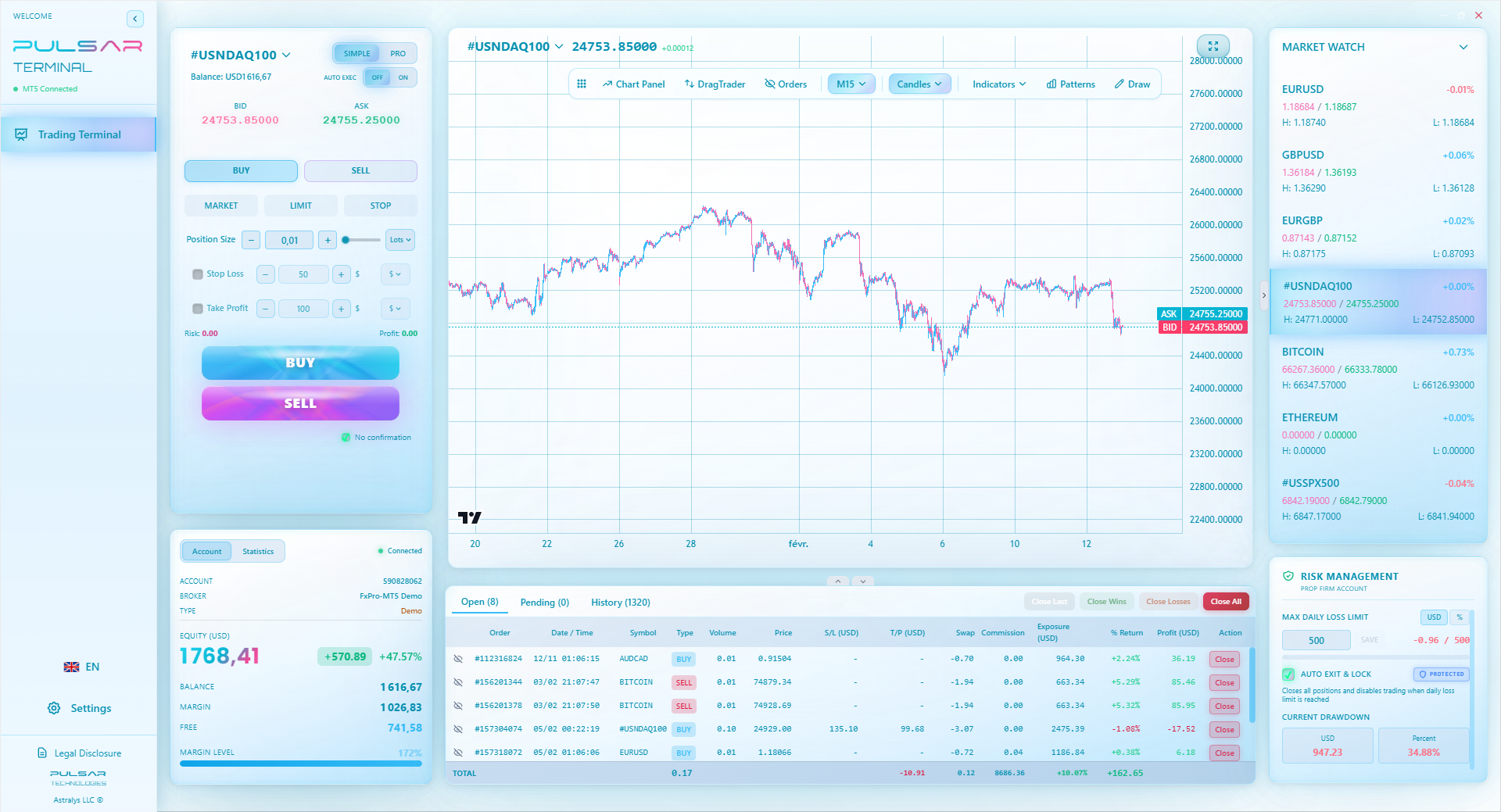
Managing the risk of a forward trade requires precision, and Pulsar Terminal's advanced order types let you set multi-level take-profits and stop-losses directly on your MT5 chart, helping you plan your exit around that fixed expiry date.
Pulsar Terminal
The all-in-one MT5 companion: drag-and-drop orders, multi-TP/SL, trailing stop, grid trading, Volume Profile, and prop firm protection. Used by 1,000+ traders daily.
How can you weave forwards into a real trading plan? Here are two concrete approaches.
The Hedged Carry Trade: This is more sophisticated. Let's say you want to earn the interest differential (carry) between the ZAR and a low-yielding currency like the JPY, but you're scared of the ZAR appreciating. You could:
- Go long USD/ZAR in the spot market to earn the carry.
- Simultaneously sell an equivalent amount of USD/ZAR forward for, say, 3 months. This partially hedges your spot exposure. Your profit becomes the forward points (the carry) minus the transaction costs. It's a play on the stability of the interest rate differential, not pure currency direction.
Using Forwards for Better Entry: Suppose your analysis says EUR/ZAR will rise in 6 months, but you think it might dip first. Instead of buying spot now and using a wide stop, you could buy a 6-month forward. This locks in your entry price today. If the spot dips tomorrow, your forward contract is already in profit (because you locked in a lower rate). It's like getting a free time buffer. I used this strategy ahead of a known ECB meeting, buying a 1M forward. The spot rate whipsawed for two weeks, but my forward P&L stayed positive because my entry was locked, and I eventually took profit at settlement.
Information Arbitrage: Even if you don't trade forwards, watch them. The forward curve (prices across different dates) is a treasure trove of information. If 6-month forwards are suddenly much cheaper than 3-month forwards, it tells you the market expects interest rate dynamics to shift. This can be a leading indicator for your spot EUR/USD or other FX trades.
💡 Winston's Tip
The spread is the silent killer in forward trading. A 15-point spread on a 3-month forward means the market needs to move 15 points just for you to break even. Factor that into your first profit target.

“The biggest pitfall is using forwards without a clear purpose. Are you hedging a known future flow, or are you just gambling?”
These terms get thrown around interchangeably, but they're different beasts. Knowing the distinction matters for your choice of instrument.
| Feature | Forward Contract | Futures Contract | FX Swap |
|---|---|---|---|
| Trading Venue | Over-the-Counter (OTC) with your broker. | Centralised exchange (e.g., JSE). | OTC with your broker. |
| Standardisation | Customisable (amount, date). | Standardised (fixed contract size, quarterly dates). | Two legs: a spot + a forward. |
| Settlement | Usually physical delivery or cash settled at expiry. | Usually cash-settled. | The two legs net out; often used for rolling funding. |
| Liquidity | Depends on broker. Can be lower. | High on major exchanges. | Very high for short-term dates. |
| Retail Access | Yes, through some CFDs or broker desks. | Yes, via futures brokers/CFDs. | Mostly implicit (it's what happens on a spot rollover). |
For most South African retail traders, 'forwards' offered by brokers are OTC contracts. A 'swap' in everyday trading often refers to the overnight rollover credit/debit on a spot position, which is a mini one-day forward transaction. Futures are a different ball game with exchange rules and margins. Start with OTC forwards to understand the concepts before venturing into the futures world.
FAQ
Q1Can I trade forex forward rates with a small account?
Technically yes, but it's not ideal. The wider spreads and margin requirements mean the costs eat into a small account faster. Most brokers have minimum contract sizes. I'd suggest having at least $5,000 - $10,000 dedicated capital before considering forwards for anything other than a tiny, educational trade.
Q2How are forex forward rates determined?
They're set by the spot rate and the interest rate differential (cost of carry) between the two currencies. The formula is: Forward Rate = Spot Rate x (1 + Interest Rate of Quote Currency x Time) / (1 + Interest Rate of Base Currency x Time). In practice, your broker calculates this and adds their spread to quote you the forward points.
Q3What happens when my forward contract expires?
You must settle. For physical settlement (rare for retail speculators), you'd need to deliver/receive the actual currencies. Almost always, you'll either close the contract for cash profit/loss before expiry, or your broker will automatically roll it into the next period (for a fee). Never let a speculative forward expire without a plan.
Q4Is trading forwards better than trading spot forex?
Not better, just different. Spot is for short-term directional trades. Forwards are for hedging a future need or expressing a longer-term view incorporating interest rates. Forwards have less flexibility and higher spreads. For most daily trading, spot is more suitable. Use forwards with a specific purpose.
Q5Do I pay swap/rollover interest on a forward contract?
No, that's the key difference. The interest rate differential is already baked into the forward price via the forward points. You won't see daily credits or debits. Your profit or loss is solely the difference between your contracted forward rate and the prevailing spot rate at expiry (or when you close).
Q6Which South African brokers offer true forward contracts?
True OTC forwards are less common. Check with international brokers serving the SA market like IG, Saxo Bank, or advanced CFD providers. Many local brokers offer CFDs on futures, which is the closest equivalent. Always read the product specification to confirm if it's a forward, futures CFD, or just a rolling spot contract.
Q7Can I use technical analysis on forward rates?
You can, but the charts are less common and liquidity can distort patterns. It's often more effective to do your technical analysis on the liquid spot market and use that insight to inform your forward trade timing and direction. The core trend is usually the same, but short-term noise differs.
Prof. Winston's Lesson
Key Takeaways:
- ✓Forward Rate = Spot Rate + Forward Points. Points reflect interest rate gaps.
- ✓Hedge real currency exposure; speculate only with high conviction.
- ✓Forward spreads are wider. They're a major hidden cost.
- ✓You are obligated to settle on expiry. Have an exit plan.
- ✓Use the forward curve as a leading indicator for spot markets.
How useful was this article?
Click a star to rate
Weekly Trading Insights
Free weekly analysis & strategies. No spam.
About the Author
David van der Merwe
Emerging Markets Trader
Johannesburg-based trader with 11 years in emerging market currencies. Specializes in ZAR pairs, FSCA-regulated trading, and South African market analysis.
Comments
Risk Disclaimer
Trading financial instruments carries significant risk and may not be suitable for all investors. Past performance does not guarantee future results. This content is for educational purposes only and should not be considered investment advice. Always conduct your own research before trading.
You Might Also Like

Cara Trading Forex Sukses: 7 Prinsip dari Trader Profesional
Cara trading forex sukses dengan 7 prinsip trader pro: manajemen modal, disiplin, journal trading, backtest. Data nyata, bukan janji profit palsu.
Jam Trading Forex Terbaik untuk Trader Indonesia: Panduan Lengkap dengan Tabel Waktu
Panduan jam trading forex untuk trader Indonesia. Tabel 4 sesi dunia, jam emas 20:00-00:00, sesi mana yang harus dihindari. Data akurat + tips dari trader berpengalaman.
Top 5 Sàn Forex Uy Tín Nhất 2026: Review Jujur dari Trader Indonesia
Top 5 sàn forex uy tín 2026 untuk trader Indonesia. Review jujur: spread, deposit, withdraw, dukungan lokal. Exness, XM, IC Markets & lebih.
Get Pulsar Terminal
All these calculators are built into Pulsar Terminal with real-time data from your MT5 account. One-click position sizing, automatic risk management, and instant calculations.
Get Pulsar Terminal