


Most new traders I meet think the forex fundamental calendar is just a list of boring announcements.

David van der Merwe
Emerging Markets Trader ·  South Africa
☕ 9 min read
What you'll learn:
- 1What Is a Forex Fundamental Calendar, Really?
- 2The Events That Actually Move the Rand (ZAR)
- 3How to Read the Numbers: Forecast, Actual, and Revision
- 4Trading Strategies: Before, During, and After the News
- 5Practical Tips for the South African Trader
- 6Common Mistakes I've Made (So You Don't Have To)
- 7Tools and Calendars to Use
Most new traders I meet think the forex fundamental calendar is just a list of boring announcements. They focus on charts and ignore the news, only to get wiped out when the Rand suddenly spikes 200 pips. I made that exact mistake early on. The truth is, for a South African trader, the calendar isn't background noise, it's the schedule for when the market's rules change. This guide will show you how to read it, trade it, and not get caught on the wrong side of a SARB decision.
At its core, a forex fundamental calendar is a diary of economic and political events that have the power to move currency prices. It tells you when new information - the kind that changes a country's economic story - is going to be released. For us trading from South Africa, it's our heads-up for when volatility is about to be served.
Think of it this way: price charts show you where the market has been. The calendar tells you what might make it go somewhere new. It lists things like interest rate decisions, inflation reports (CPI), employment data, and speeches by central bankers like the Governor of the South African Reserve Bank (SARB).
Every event on the calendar is tagged with an expected impact level: low, medium, or high. Don't ignore those. A high-impact event on the USD/ZAR can easily mean a 100 to 300 pip move in minutes. I learned this the hard way during a US Non-Farm Payrolls release. I was in a nice short trade on EUR/USD, got complacent, and the news whipsawed the market, hitting my stop loss and reversing to hit my take-profit level in the span of 90 seconds. The calendar had warned me; I just didn't listen.

Warning: A 'Low' impact event for the Euro might be a 'High' impact event for the Rand if it affects global risk sentiment. Always consider the indirect effects.
You don't need to watch every global data point. Focus on the events that directly shake the ZAR pairs you're likely trading, like USD/ZAR, EUR/ZAR, or GBP/ZAR.
South African-Specific Events
These are your non-negotiables. When these are scheduled, you need a plan.
- SARB Interest Rate Decision: This is the big one. The repo rate decision directly influences the yield on the Rand. A hike can strengthen the ZAR (temporarily), a cut weakens it. The statement and press conference afterward are often more important than the number itself.
- South African CPI (Inflation): The SARB's primary mandate is price stability. A high CPI print increases the chance of a rate hike. I remember a print coming in at 7.4% against a 7.0% forecast. USD/ZAR dropped nearly 2% in an hour as markets priced in more aggressive SARB action.
- Budget Speech & Medium-Term Budget Policy Statement (MTBPS): This is about fiscal health. Markets watch for debt projections, spending plans, and the government's commitment to reform. A credible budget can support the Rand.
- Employment Data (Quarterly Labour Force Survey): A weak jobs market limits consumer spending and economic growth, which is negative for the currency.
Global Events That Dictate Market Mood
The ZAR is a 'risk-sensitive' currency. It often weakens when global investors are scared and strengthens when they're chasing yield.
- US Federal Reserve Decisions & US CPI: The US Dollar is the world's reserve currency. What the Fed does sets the tone for all markets. A hawkish Fed strengthens the USD, which typically pressures USD/ZAR higher.
- US Non-Farm Payrolls (NFP): The world's most watched jobs report. It causes massive USD volatility that spills into every pair, including ZAR crosses.
- Major Geopolitical Events: Elections, trade wars, or conflicts. In times of panic, money flows out of markets like South Africa and into 'safe havens' like the USD and Gold. You can see this correlation by checking the XAU/USD guide during turbulent times.
“The forex fundamental calendar isn't background noise, it's the schedule for when the market's rules change.”
Looking at a calendar entry and seeing "CPI 5.3%" isn't enough. You need to understand the three key figures that create the market's reaction.
| Term | What It Means | Why It Matters |
|---|---|---|
| Previous | The data released for the last period. | Establishes the trend. |
| Forecast (Consensus) | The median expectation of all economists surveyed. | This is the market's priced-in expectation. The price before the news reflects this number. |
| Actual | The real, just-released number. | The surprise factor. Does it beat or miss the forecast? |
Here's the secret: the market moves on the difference between the Actual and the Forecast, not the Actual alone.

Example: SA CPI Forecast = 5.0%, Previous = 5.2%.
- If Actual = 5.1%, it's higher than forecast (bearish for ZAR) but lower than previous (shows disinflation). Reaction may be mixed.
- If Actual = 4.8%, it's much lower than forecast (bullish for ZAR). USD/ZAR likely falls.
- If Actual = 5.3%, it's higher than both forecast AND previous (very bearish for ZAR). USD/ZAR likely spikes.
Also, watch for revisions to the Previous number. A strong Actual print can be completely negated if the Previous month's great number is revised sharply lower. The market trades the delta in information.

💡 Winston's Tip
The market's biggest moves often happen when the 'Actual' not only misses the 'Forecast,' but also reverses the trend suggested by the 'Previous' number. That's a double surprise.
You have three basic approaches. I've used all three, and each requires a different mindset.
1. The Pre-News Positioning (High Risk, High Reward)
This involves placing a trade before the number drops, anticipating the direction of the surprise. I don't recommend this for beginners. It's a gamble. You need a strong view on why the consensus is wrong. Even then, I've been stopped out by a whipsaw only to see my original idea play out perfectly minutes later. The scalping strategy mentality can sometimes apply here, but the risks are magnified.
2. The Post-News Reaction Trade (My Preferred Method)
You wait for the news to hit, let the initial insane volatility spike settle (usually 30-90 seconds), and then trade in the direction of the break. Look for the price to consolidate after the spike and then continue moving. This requires patience and a broker with fast execution. On a high-impact event, I'll set an alert, wait for the release, watch the 1-minute chart for a clear breakout from the initial range, and then enter with a tight stop.
3. The Avoidance Strategy (Often the Smartest)
Simply close all positions 30 minutes before a major high-impact event and don't trade until 15-30 minutes after. This preserves capital. There's no rule that says you must trade the news. Some of my most profitable months have been when I sat on my hands during major announcements. This is crucial for swing trading positions, where an overnight gap can ruin a well-planned trade.

Pro Tip: Reduce your position size by at least 50% if you're trading around news. The volatility is higher, so your normal risk in Rands will be hit much faster. Always use a position size calculator.
“The market moves on the difference between the Actual and the Forecast, not the Actual alone.”
Let's get local. Our time zone (SAST), our brokers, and our currency present unique challenges.
Timing is Everything: High-impact US data (like NFP or CPI) is released at 3:30 PM SAST. EU data is often at 11:00 AM SAST. SARB announcements are usually around 3:00 PM SAST. Mark these in your actual diary. Trading at 2:45 PM? Check the calendar.
Broker Behavior: During news, spreads can widen dramatically. That 5-pip spread on USD/ZAR can blow out to 50 pips or more for a few seconds. This can trigger stop losses even if the price didn't technically hit your level. Use brokers known for stable execution during volatility, like Pepperstone or IC Markets. Also, understand their specific policies on margin call during high volatility.
Economic Context: Never trade a number in isolation. Is CPI high because the SARB has already been hiking? Then a high print might be the 'peak inflation' story and the ZAR could sell off. Read the analysis that accompanies the calendar. Understand the narrative.
Start Simple: For your first few news trades, use a demo account. Then, use a micro or cent account with real money but tiny stakes. The goal is to experience the speed and emotion without blowing up your account. Record what you did and review it.
💡 Winston's Tip
If you wouldn't walk into a lion's den without a plan, don't open your trading platform 5 minutes before a red-news event without one. Know your entry, exit, and the price level that invalidates your idea before the number hits.
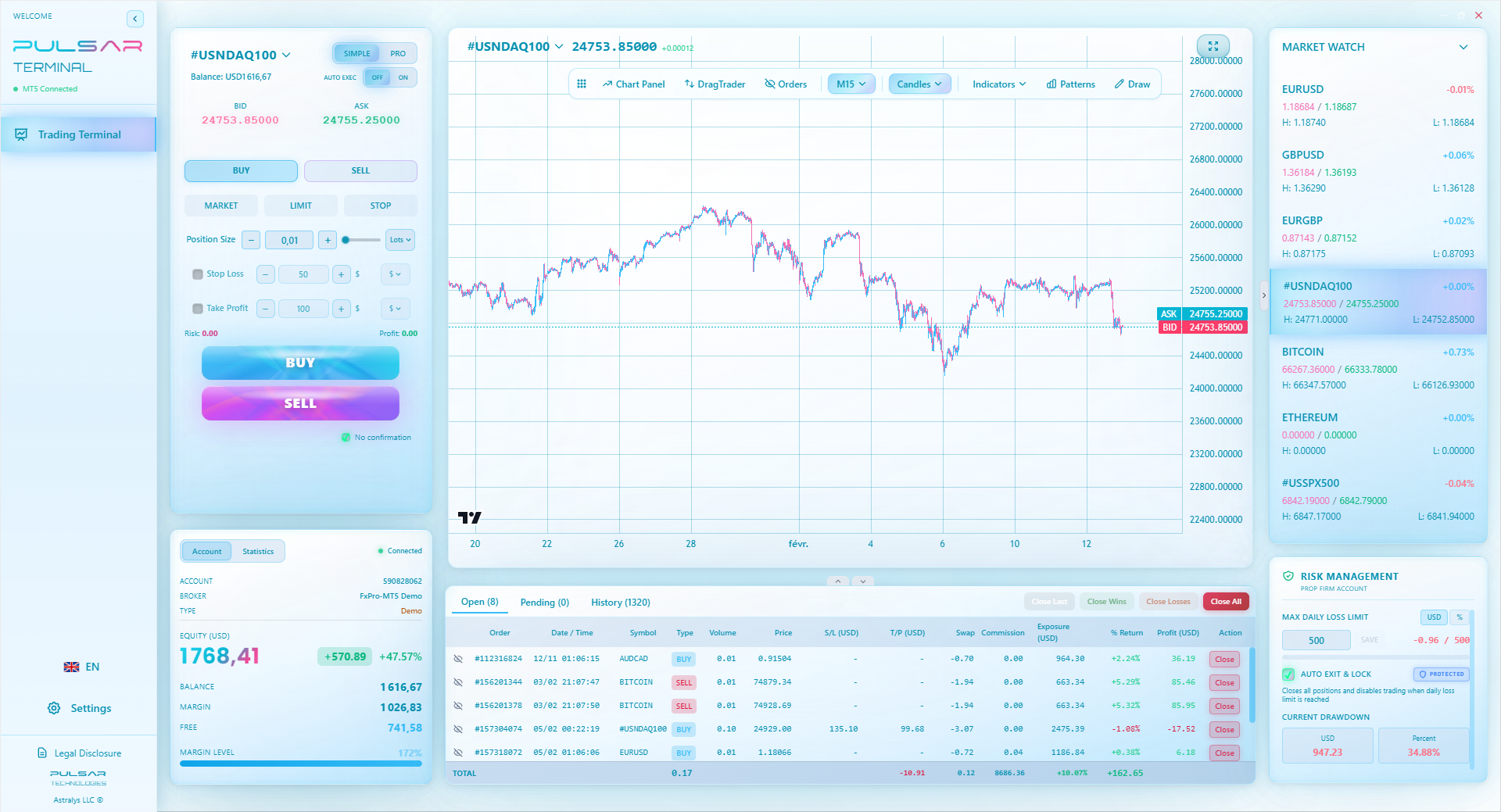
Managing multiple trades and stops around volatile news events is stressful, but tools like Pulsar Terminal let you set advanced order types like trailing stops and breakeven levels directly on your MT5 charts before the news even hits.
Pulsar Terminal
The all-in-one MT5 companion: drag-and-drop orders, multi-TP/SL, trailing stop, grid trading, Volume Profile, and prop firm protection. Used by 1,000+ traders daily.
Let me save you some money and frustration by sharing my blunders.
Mistake 1: Trading Without a Stop Loss 'Because of Volatility.' This is suicide. In 2018, I held a USD/ZAR long into a SARB decision without a stop, thinking I could 'ride out the noise.' The Rand strengthened sharply on a hawkish surprise. I watched my loss grow from -R500, to -R1,500, to -R5,000 before I manually closed in a panic. Always have a stop. Always.
Mistake 2: Chasing the Initial Spike. The first move is often a liquidity grab that reverses. You see USD/ZAR rocket 150 pips up, you FOMO buy, and then it collapses 200 pips down. Wait for the structure to form.
Mistake 3: Ignoring Consecutive Events. Sometimes a medium-impact event is followed by a Fed speaker 30 minutes later. The market might be quiet for the first event, then erupt on the second. Look at the whole day's schedule.
Mistake 4: Over-allocating to One News Trade. You think you've nailed the forecast, so you risk 5% of your account. Even if you're right 60% of the time, the 40% where you're wrong will cripple you. News trading should be a small part of a broader strategy. Stick to your 1-2% risk rule, especially here.
“Some of my most profitable months have been when I sat on my hands during major announcements.”
You don't need to pay for a fancy calendar. These free ones are excellent.
- ForexFactory.com: The classic. It's simple, reliable, and you can filter for high-impact events and specific currencies. The time zone automatically adjusts to your computer's clock.
- MyFXBook.com Economic Calendar: Very clean interface with good historical data on past events and their outcomes.
- Your Broker's Calendar: Brokers like XM and Exness have built-in calendars in their platforms. The advantage is they sometimes include their own analysis.
- TradingView's Calendar: Built right into the charting platform. You can see event icons directly on your price chart, which is incredibly useful for contextualizing past price moves.
Integrate the calendar into your daily routine. The first thing I do when I sit down is check it. Is there anything in the next 24 hours that could affect my open trades or my planned setups? This 60-second habit has saved me more times than I can count.
FAQ
Q1What's the best time for a South African to trade the forex fundamental calendar?
Focus on the 11:00 AM - 4:00 PM SAST window. This covers key European data releases and, most importantly, the US data released at 3:30 PM SAST. SARB announcements also typically fall in this afternoon period. This is when liquidity and volatility for ZAR pairs are highest.
Q2Should I use a fundamental calendar for scalping?
Absolutely, but in a specific way. Use it to know when not to scalp. Avoid the 5 minutes before and after a high-impact release, as spreads widen and price action becomes chaotic and unpredictable. The calendar helps you identify the quiet, high-probability periods for your scalping strategy.
Q3Why does the Rand (ZAR) sometimes move on foreign news?
The ZAR is a proxy for global 'risk appetite.' Bad news in China (slowing growth) or the US (recession fears) can cause investors to pull money out of emerging markets like South Africa, weakening the Rand. Good global economic news can have the opposite effect. It's not always about local data.
Q4How do I manage risk during a high-impact news event?
Drastically reduce your position size (by 50-75%), use a wider stop loss to account for initial spikes (but still calculate it based on your reduced risk in Rands), and consider using a guaranteed stop loss if your broker offers it (for a fee). Most importantly, have an exit plan before the news hits.
Q5Is the 'Actual' number or the 'Forecast' more important?
The difference between them is what matters. The market price has already 'discounted' the Forecast. The surprise (Actual vs. Forecast) is the new information that forces the market to re-price the currency. A big miss or beat is what causes the violent moves.
Q6Can I automate trades based on calendar news?
Technically yes, with expert advisors (EAs), but it's extremely complex and risky. You're coding a reaction to a volatile, often illogical, few seconds of market behavior. News algorithms used by banks are far more sophisticated. For most retail traders, manual discretion after the initial spike is safer and more effective.
Prof. Winston's Lesson
Key Takeaways:
- ✓Trade the surprise (Actual vs. Forecast), not just the headline number.
- ✓Always reduce position size by 50% for high-impact news trades.
- ✓The initial 30-second spike is often a trap; wait for consolidation.
- ✓The ZAR reacts to global risk sentiment as much as local data.
How useful was this article?
Click a star to rate
Weekly Trading Insights
Free weekly analysis & strategies. No spam.
About the Author
David van der Merwe
Emerging Markets Trader
Johannesburg-based trader with 11 years in emerging market currencies. Specializes in ZAR pairs, FSCA-regulated trading, and South African market analysis.
Comments
Risk Disclaimer
Trading financial instruments carries significant risk and may not be suitable for all investors. Past performance does not guarantee future results. This content is for educational purposes only and should not be considered investment advice. Always conduct your own research before trading.
You Might Also Like

Cara Trading Forex Sukses: 7 Prinsip dari Trader Profesional
Cara trading forex sukses dengan 7 prinsip trader pro: manajemen modal, disiplin, journal trading, backtest. Data nyata, bukan janji profit palsu.
Jam Trading Forex Terbaik untuk Trader Indonesia: Panduan Lengkap dengan Tabel Waktu
Panduan jam trading forex untuk trader Indonesia. Tabel 4 sesi dunia, jam emas 20:00-00:00, sesi mana yang harus dihindari. Data akurat + tips dari trader berpengalaman.
Top 5 Sàn Forex Uy Tín Nhất 2026: Review Jujur dari Trader Indonesia
Top 5 sàn forex uy tín 2026 untuk trader Indonesia. Review jujur: spread, deposit, withdraw, dukungan lokal. Exness, XM, IC Markets & lebih.
Get Pulsar Terminal
All these calculators are built into Pulsar Terminal with real-time data from your MT5 account. One-click position sizing, automatic risk management, and instant calculations.
Get Pulsar Terminal