


Most new traders think trading gold is just about buying low and selling high.

David van der Merwe
Emerging Markets Trader ·  South Africa
☕ 11 min read
What you'll learn:
Most new traders think trading gold is just about buying low and selling high. They load up a chart, see the shiny line moving, and jump in whenever they feel like it. That's a fantastic way to lose money. The single biggest factor that separates profitable gold traders from the rest isn't some secret indicator - it's understanding when to trade. Get the timing wrong, and you're fighting against thin liquidity and wild spreads. Get it right, and you're riding the market's natural momentum. I'm going to show you the exact forex gold trading hours that matter for South Africans, cutting through the generic advice you find everywhere else.
Let's clear something up right away. Gold (XAU/USD) trades 24 hours a day, five days a week. Saying that is about as useful as saying you can drive from Cape Town to Johannesburg at any time. Sure, you can, but doing it at 3 AM is a very different experience from doing it at 8 AM.
The price you see on your screen is a global price, but the activity behind it isn't constant. It's driven by the opening and closing of the world's major financial centers: Sydney, Tokyo, London, and New York. For us in South Africa, our time zone (SAST, UTC+2) puts us in a unique position, right between the Asian close and the European open.
Here's the mistake I made for years: I'd wake up early, see some movement on the gold chart from the Asian session, and enter a trade. More often than not, the market would just... sit there. The spread would be wide, and any move would be quickly reversed when London traders came online with their own agenda. I was trading in the dead zone. The real action, the moves that create sustainable trends and clean breakouts, happen when liquidity is high. That means overlap.

Warning: Trading gold during low-liquidity hours (like the late Asian session or early European session before London is fully online) is asking for trouble. Spreads can widen dramatically. I've seen the typical 30-pip spread on a standard account blow out to 80 pips during thin volume. That's a R800 per lot cost just to get into the trade before it even moves.
“The single biggest factor that separates profitable gold traders from the rest isn't some secret indicator - it's understanding when to trade.”
Forget New York time. Here’s what the trading day looks like from Johannesburg or Cape Town. This is the schedule you should live by.
The Warm-Up: Asian Session (2:00 AM - 8:00 AM SAST)
This is the quiet period. Price action here is often a continuation or reversal of the previous New York close. It can set intraday highs and lows, but breakouts are frequently fake. I use this time for analysis, not execution. If you're a scalper looking for tiny moves, you might find some opportunities, but the juice is rarely worth the squeeze.
The Main Event: London Session (10:00 AM - 7:00 PM SAST)
This is where you make your money. The London market is the historic center of physical gold trading. Volume spikes, spreads tighten, and real trends begin. The most critical window is the first two hours after the open (10:00 AM - 12:00 PM SAST). Economic data from Europe and the UK hits the wires, and big institutional orders get filled.
The Power Overlap: London & New York (3:00 PM - 7:00 PM SAST)
This 4-hour window is the most volatile and liquid period of the entire day. Both London and New York are fully active. This is when you get the big, decisive candles. Major US economic news (like Non-Farm Payrolls or CPI) is released during this time. If you're a swing trader looking for a daily close signal or a day trader looking for momentum, this is your playground.
The Wild West: New York Session (3:00 PM - 12:00 AM SAST)
After London closes at 7 PM SAST, the New York session carries on. Liquidity drops a notch, but the US session can produce strong directional moves based on American economic sentiment and dollar strength. The last hour (11:00 PM - 12:00 AM SAST) can be tricky as traders square positions before the daily close.

Example: My most consistent gold trades are entered between 10:15 AM and 11:30 AM SAST. I wait for the initial London volatility to settle, then trade the established direction. On January 15th last year, I entered a long position on XAU/USD at $2046.50 after a bullish rejection of the London open range. I closed half at $2059.00 during the London-New York overlap and let the rest run with a trailing stop.

💡 Winston's Tip
The market's first story of the day is often a lie. Wait for the London session to confirm the narrative before you commit your capital.
“The London-New York overlap is the most volatile and liquid period of the entire day. This is when you get the big, decisive candles.”
Trading from South Africa isn't just about charts and times. There's a legal and tax framework you must understand, or SARS will happily remind you.
First, the legality. You cannot legally speculate on the Rand (like ZAR/USD) as an individual through a foreign broker. That's SARB's domain. However, trading gold CFDs (XAU/USD) through an FSCA-licensed provider is perfectly legal and common. Always verify your broker's FSCA license number. I made the mistake early on of using an offshore broker with flashy ads. When I had a withdrawal issue, I had zero recourse. Stick with regulated entities like Exness, IC Markets, or Pepperstone who have local authorization.
Now, the tax man. Profits from trading gold CFDs are subject to Capital Gains Tax (CGT). It's not a "maybe." The inclusion rate is 40% for individuals. So, if you make a net profit of R100,000 in a tax year, R40,000 of that gets added to your taxable income. You then pay your normal income tax rate on that portion. Keep a detailed trade journal. I use a simple spreadsheet logging entry, exit, profit/loss in Rands, and broker statements. It saves headaches during tax season.
Also, know your allowances. You have a R1 million single discretionary allowance and a R10 million foreign capital allowance per year. If you're funding an international broker, you'll use these through an Authorised Dealer (your bank). Don't try to sneak money out via PayPal for trading; it violates exchange controls.
“The London-New York overlap is the most volatile and liquid period of the entire day. This is when you get the big, decisive candles.”
This is where your profit gets eaten if you're not careful. The numbers from the research briefing are real, and they matter.
Spreads are Everything with Gold: Gold doesn't have a tiny spread like the EUR/USD. It's a commodity. A "good" spread varies by account type.
| Broker & Account Type | Typical XAU/USD Spread (in pips*) | Key Note |
|---|---|---|
| IC Markets (Raw Spread) | 0.03 - 0.10 | Plus commission (~$7 per lot). Best for high volume. |
| Pepperstone (Razor) | 0.10 - 0.15 | Plus commission. Tight and reliable. |
| FP Markets (Standard) | 16.0 - 29.0 | No commission, but spread is the cost. |
| Exness (Standard) | Variable, often low | Can be very competitive, check live feed. |
*A gold pip is usually $0.01 for a micro lot (0.01). So a 30-pip spread costs $3.00 on a micro lot.
use: It's a double-edged sword. Brokers like Exness offer up to 1:1000, but for gold, that's insane. I never use more than 1:50 on XAU/USD. Why? Gold's daily range can easily be $50 (5000 pips). At 1:100 use, a $50 move against you on a standard lot is a 50% loss on your margin. Use a position size calculator religiously. I learned this the hard way in 2013, blowing a R20,000 account in two trades because I used 1:200 use and got whipped by volatility.
Overnight Fees (Swaps): If you hold a CFD position overnight, you pay or receive a swap. For gold, it's usually negative for long positions (you pay) and slightly positive for short positions (you earn a tiny amount). These fees triple on Wednesday nights to account for the weekend. If you're a long-term bull holding for weeks, these costs add up. It's one reason I prefer to trade the daily and weekly cycles rather than hold for months.
💡 Winston's Tip
Your most important tool isn't an indicator; it's a clock. If you can't name the active trading session and its typical character, you have no business being in a trade.
“Using 1:1000 use on gold is insane. I never use more than 1:50. I learned this the hard way.”
Your strategy must match the session's personality.
London Open (10:00 AM SAST): This is a breakout/breakdown zone. I watch the range formed in the late Asian session (roughly 7:00 AM - 9:50 AM SAST). A sustained move above or below this range in the first 30 minutes of London often sets the tone for the day. I'll enter on a retest of the breakout level with a stop just inside the old range.
London-New York Overlap (3:00 PM SAST): This is momentum heaven. I use a simple 5-period and 20-period EMA on the 15-minute chart. When both are angled sharply and price is riding the 5 EMA, I look for small pullbacks to join the trend. The MACD indicator on a 1-hour chart is great here for confirming momentum. Avoid getting cute with counter-trend trades during this window.
Late New York / Asian Handover (11:00 PM - 2:00 AM SAST): This is pure scalping strategy territory, if you're into that. Volatility dies down, and price often enters a tight range. I might use a stochastic oscillator on a 5-minute chart to fade the edges of the range for 10-15 pip targets. It's low-risk, low-reward, and requires intense focus. Most of the time, I'm asleep.

Pro Tip: The best trade is often no trade. If London opens with a messy, choppy 90-minute candle that goes nowhere, it's telling you the big players are confused. Sit on your hands. Wait for the New York overlap for clarity. Forcing a trade in a directionless market is how you get stopped out repeatedly.
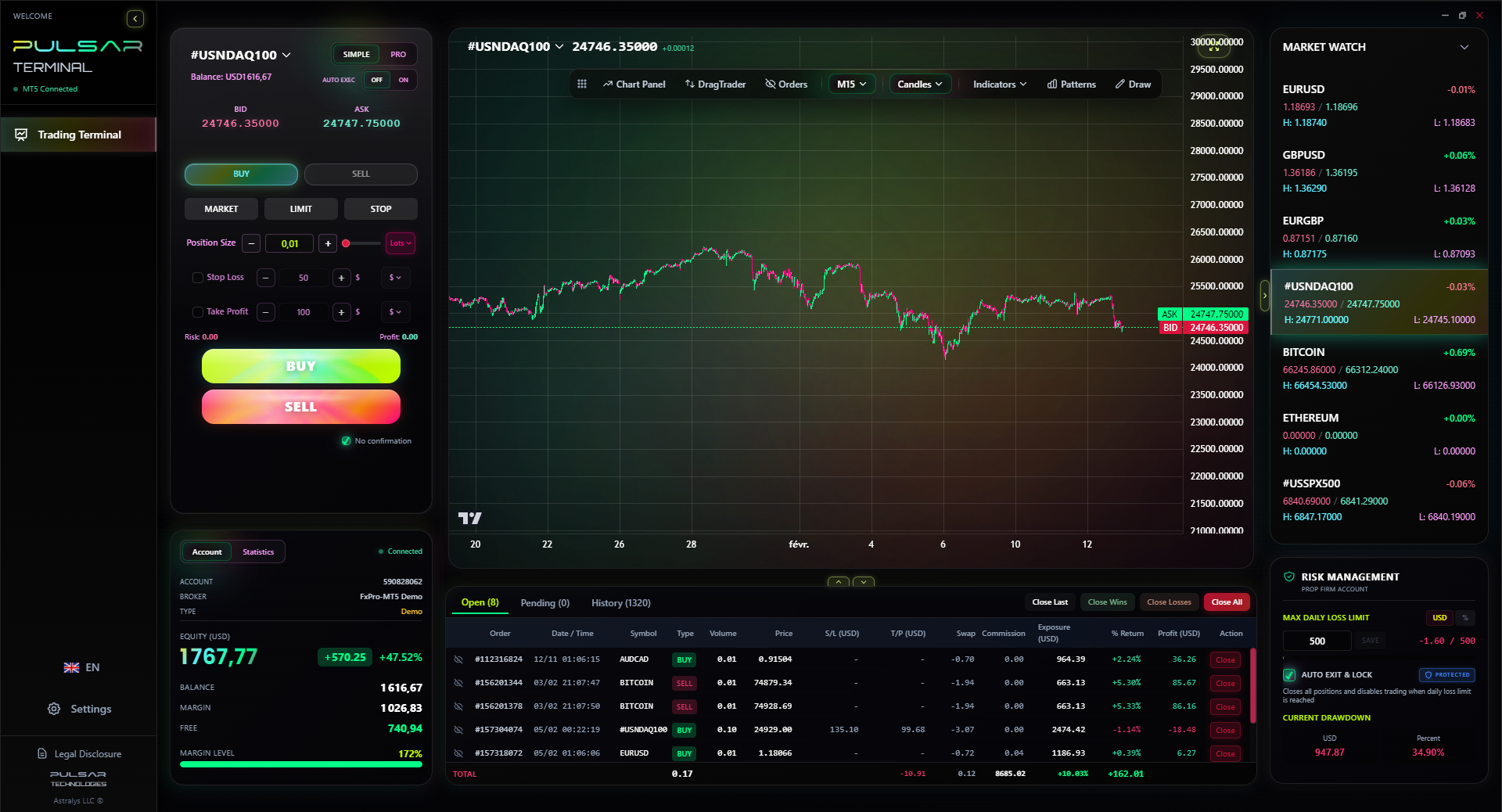
Managing multiple trades across volatile gold sessions is complex, but tools like Pulsar Terminal let you set multi-level take-profits and trailing stops on MT5 before you even enter the trade, automating your London overlap strategy.
Pulsar Terminal
The all-in-one MT5 companion: drag-and-drop orders, multi-TP/SL, trailing stop, grid trading, Volume Profile, and prop firm protection. Used by 1,000+ traders daily.
“Using 1:1000 use on gold is insane. I never use more than 1:50. I learned this the hard way.”
I've seen these destroy accounts, including my own in the early days.
- Trading Around SA Market Holidays: When JSE is closed, local liquidity in ZAR pairs dries up, but the global gold market doesn't care. However, your mindset might be in holiday mode. Stick to your routine, or don't trade at all.
- Ignoring Swap Rates on Long-Term Holds: You buy gold, it goes sideways for three weeks, and you wonder why your account is slowly bleeding. Check the swap. Holding a long CFD position can cost you 0.5% to 1% of your position value per month. That's a silent killer.
- Chasing News During Off-Hours: You see a headline about Middle East tensions at 5 AM SAST and rush to buy gold. The Asian session might give it a small pop, only for London traders to sell into that strength when they log on, crushing your position. Major news only has sustained impact during high-liquidity hours.
- Misunderstanding the Spread: They see a "0.3" spread advertised and think that's what they'll get on gold. That's for EUR/USD. Gold spreads are inherently larger. Not understanding this leads to shock when they see the real cost on their platform. Always check the live quote before entering.
- Overleveraging During Volatile Events: NFP, CPI, Fed meetings - these often happen during our late afternoon (NY session). The volatility is extreme. Using your normal 1:50 use here is like driving your normal speed in a hailstorm. I cut my use by at least half for known event risk. A wider stop with lower use is smarter than a tight stop with high use that gets taken out by a random spike.
💡 Winston's Tip
A wide spread is the market charging you admission to a empty stadium. Never pay it. Wait for the crowd (liquidity) to arrive.
“Your strategy must match the session's personality. Don't try to scalp during a trend session or swing trade during a chop session.”
Here's what a disciplined day looks like for me now. It's boring, but boring is profitable.
- 7:00 AM SAST: Wake up. Review the daily gold chart. What was yesterday's close? Where is the key support/resistance? I note the Asian session high and low.
- 9:45 AM SAST: Final prep before London. I have my key levels drawn. I know my maximum position size based on my account risk (never more than 1%). I'm waiting for the market to tell me its story.
- 10:00 AM - 12:00 PM SAST: Active trading window. I'm looking for my London open setup. If a clear signal forms, I take it. If not, I wait.
- 12:00 PM - 3:00 PM SAST: Monitor existing trades. Maybe do some research. This is often a consolidation period.
- 3:00 PM - 6:00 PM SAST: Second active window. Assess momentum from the overlap. Look for continuation or reversal patterns from the London move. This is where I manage trades - taking partial profits or moving stops to breakeven.
- After 7:00 PM SAST: I'm done for the day. I might check the chart once before bed, but I rarely enter new trades. The New York session is for managing existing positions, not starting new ones.
The core of this routine is respecting the market's rhythm. You wouldn't call a client at midnight; don't expect the gold market to give you its best moves when its main participants are asleep. Align your activity with the London and New York power hours, manage your risk according to South African rules and costs, and you'll be ahead of 90% of retail traders who treat this like a casino.
FAQ
Q1What is the absolute best time of day to trade gold in South Africa?
The most reliable time is between 10:30 AM and 12:30 PM SAST (first two hours of the London session) and again from 3:30 PM to 6:00 PM SAST (the London-New York overlap). This is when liquidity and volatility align for sustainable moves.
Q2Is it legal for me in South Africa to trade gold CFDs with an international broker?
Yes, but with a critical condition. The broker must be licensed by the South African FSCA to offer CFD products to residents. Trading with an unregulated offshore broker is not illegal for you, but it removes all local consumer protection, making it extremely risky. Always verify the FSCA license.
Q3How are my gold trading profits taxed by SARS?
Profits are subject to Capital Gains Tax (CGT). 40% of your net annual profit from trading is added to your taxable income and taxed at your marginal income tax rate. You must declare this in your annual tax return. Keep careful records of all trades.
Q4Why is the spread on gold so much higher than on forex pairs like EUR/USD?
Gold is a physical commodity with different market dynamics. The underlying spot market has a wider bid-ask spread than major currency pairs. This inherent cost is passed through to the CFD. Always check the live spread on XAU/USD before trading, as it can widen significantly during low-liquidity hours.
Q5Can I trade gold on the weekend?
No. The global spot gold market (which CFDs track) is closed from roughly Friday 11 PM SAST until Sunday 10 PM SAST. Any platform offering weekend trading is likely using a synthetic or forecast price, which is not the real market. Avoid it.
Q6What use should I use for gold trading?
Use extreme caution. Gold is volatile. I recommend no more than 1:50 use for new traders, and even experienced traders should rarely exceed 1:100. High use is the fastest path to a margin call. Always calculate your position size based on your stop-loss distance, not your account balance.
Q7Do I pay VAT on gold trading profits?
No. VAT applies to the purchase of physical gold items (with exceptions like Krugerrands). Trading gold CFDs is a financial service, and your profit is subject to CGT, not VAT.
Prof. Winston's Lesson
Key Takeaways:
- ✓Trade gold between 10:30 AM and 6:00 PM SAST for best liquidity.
- ✓Never use more than 1:50 use on XAU/USD.
- ✓40% of your net profit is taxable as income.
- ✓Always verify your broker's FSCA license number.
- ✓A 30-pip gold spread costs $3 on a micro lot (0.01).
How useful was this article?
Click a star to rate
Weekly Trading Insights
Free weekly analysis & strategies. No spam.
About the Author
David van der Merwe
Emerging Markets Trader
Johannesburg-based trader with 11 years in emerging market currencies. Specializes in ZAR pairs, FSCA-regulated trading, and South African market analysis.
Comments
Risk Disclaimer
Trading financial instruments carries significant risk and may not be suitable for all investors. Past performance does not guarantee future results. This content is for educational purposes only and should not be considered investment advice. Always conduct your own research before trading.
You Might Also Like

Cara Trading Forex Sukses: 7 Prinsip dari Trader Profesional
Cara trading forex sukses dengan 7 prinsip trader pro: manajemen modal, disiplin, journal trading, backtest. Data nyata, bukan janji profit palsu.
Jam Trading Forex Terbaik untuk Trader Indonesia: Panduan Lengkap dengan Tabel Waktu
Panduan jam trading forex untuk trader Indonesia. Tabel 4 sesi dunia, jam emas 20:00-00:00, sesi mana yang harus dihindari. Data akurat + tips dari trader berpengalaman.
Top 5 Sàn Forex Uy Tín Nhất 2026: Review Jujur dari Trader Indonesia
Top 5 sàn forex uy tín 2026 untuk trader Indonesia. Review jujur: spread, deposit, withdraw, dukungan lokal. Exness, XM, IC Markets & lebih.
Get Pulsar Terminal
All these calculators are built into Pulsar Terminal with real-time data from your MT5 account. One-click position sizing, automatic risk management, and instant calculations.
Get Pulsar Terminal