


Ever stared at a forex chart and felt completely lost? All those lines, bars, and wicks look like some secret code.

David van der Merwe
Emerging Markets Trader ·  South Africa
☕ 11 min read
What you'll learn:
Ever stared at a forex chart and felt completely lost? All those lines, bars, and wicks look like some secret code. I remember my first time opening a USD/ZAR chart back in 2012 - I had no idea what I was looking at, and it cost me. The truth is, learning to read these graphs is the single most important skill you'll develop. It's not about fancy indicators at first; it's about understanding the story the price is telling you. Let's break it down together, with a focus on what matters for us trading from South Africa.
At its core, a forex graph is just a picture of price movement over time. Think of it like a heartbeat monitor for a currency pair. The vertical axis shows the price (like R18.50 per USD), and the horizontal axis shows time (minutes, hours, days). Every single trade that happens gets recorded and plotted on this chart. For us in South Africa, this is crucial because the ZAR is what we live and breathe. Seeing how the USD/ZAR or EUR/ZAR moves on a chart helps us understand the market's mood better than any news headline.
There are a few main types, but they all serve the same purpose: to show you where price has been so you can make an educated guess about where it might go next. The most common ones you'll see on platforms like MT4 or MT5 are line charts, bar charts, and the king of them all - candlestick charts. When I started, I used line charts because they were simple, but I quickly realized I was missing half the story. I couldn't see the battles between buyers and sellers within each time period.

Example: Let's say you're looking at a daily chart for USD/ZAR. Each point on a line chart would just be the closing price for that day - R18.10, R18.15, R18.05. It shows you the general direction, but not the chaos that happened in between. That's where the other charts come in.

💡 Winston's Tip
A chart is a record of emotion - greed at the highs, fear at the lows. Your job is to be the calm reader of that emotional story, not a character in it.
Line Charts: The Big Picture
Line charts are your starting point. They connect the closing prices of each period with a simple line. It's great for identifying the overall trend without the noise. If you're new, pull up a weekly line chart on EUR/USD or GBP/ZAR to get a feel for the long-term movement. It cleans up the view. But honestly, I don't trade off them. They're a diagnostic tool, not a trading tool.
Bar Charts: A Bit More Detail
Bar charts (or OHLC charts) give you more. Each vertical bar has little horizontal ticks. The top of the bar is the high price, the bottom is the low, the left tick is the open, and the right tick is the close for that period. It's more informative, but it's still not my go-to. It's a bit cluttered for my eyes, especially on a fast-moving day.
Candlestick Charts: Where the Magic Happens
This is it. This is what 95% of serious traders use, and for good reason. A candlestick packs the same information as a bar chart (Open, High, Low, Close) into a much more visual format. The "body" of the candle shows the range between the open and close. If the close is higher than the open (a bullish candle), the body is often green or white. If the close is lower (a bearish candle), it's red or black.
The thin lines above and below the body are called "wicks" or "shadows." They show the absolute high and low for that period. The beauty is in the patterns. A long green body with small wicks tells you buyers were in strong control that hour/day/week. A small body with long wicks above and below (a "spinning top") shows indecision - a tug of war where neither buyers nor sellers won.
I made my first consistent profits only after I forced myself to learn candlesticks. I spent two weeks just looking at charts, not trading, identifying every candle. It was boring, but it built the foundation. When you see a long red candle close near its low on the USD/ZAR daily chart, you know there was serious selling pressure. That's actionable information.

Pro Tip: Start your analysis with a line chart on a higher timeframe (like weekly) to find the trend. Then, switch to candlestick charts on the 4-hour or 1-hour chart to find your exact entry and exit points. This 'top-down' approach keeps you trading in the direction of the main trend.
“Learning to read forex graphs is the single most important skill you'll develop.”
This is where most new South African traders trip up. A chart can show the same USD/ZAR pair in completely different lights depending on your timeframe.
- The 1-Minute Chart: Pure noise. Every little blip is visible. It's for scalpers with nerves of steel, not for learning the market's character.
- The 1-Hour Chart (H1): My favorite for swing trading. You get several candles a day, enough to see developing patterns without getting whiplash.
- The Daily Chart (D1): This is where the real trend lives. One candle equals one full trading day. It smooths out the intraday drama.
Here's my painful lesson: In 2015, the USD/ZAR was in a strong uptrend on the daily chart (making higher highs and higher lows). On the 15-minute chart, I saw a nice-looking drop and thought, "Aha! The trend is reversing!" I went short. The daily trend didn't care about my 15-minute analysis. It swallowed my position whole, and I hit a margin call. I lost R8,000 in an afternoon because I ignored the higher timeframe.
The trend on the higher timeframe almost always overrules the signals on the lower one. Before you place any trade, check the daily chart direction first. Always. For ZAR pairs, which can be extra jumpy, this is a survival rule.

Warning: Don't fall into the trap of looking at only one timeframe. A chart might look bullish on the 5-minute but be smack in the middle of a bearish move on the 4-hour. You'll be betting against the bigger money, which is a sure way to lose.
Graphs aren't just random squiggles. They reveal structure. The two most important concepts you'll ever learn are trends and support/resistance.
Identifying the Trend
A trend is simply the direction the market is favoring. An uptrend is a series of higher highs and higher lows. Draw a line connecting the lows - it slopes up. A downtrend is lower highs and lower lows. Connect the highs - it slopes down. When it's not doing either clearly, it's ranging or consolidating.
Look at the USD/ZAR chart from late 2025 into 2026. It made a high near R19.20, then dropped to a low around R16.48 by April 2026. That series of lower highs and lower lows was a textbook downtrend on the daily chart. Trading with that trend (looking for sell opportunities on bounces) was the high-probability play.
Support and Resistance: The Market's Memory
These are price levels where the market has historically paused or reversed. Support is a floor where buying interest tends to come in. Resistance is a ceiling where selling pressure emerges.
They work because traders remember. If USD/ZAR bounced from R18.00 three times, traders will watch that level the fourth time it approaches. They'll place buy orders near it, often creating a self-fulfilling prophecy.
I once tracked the EUR/ZAR pair and noticed it struggled to break above R20.50 for months. Every touch was a sell opportunity. When it finally broke above and held (a breakout), that old resistance became new support. That's a powerful concept. I bought the retest to R20.55 and rode it to R21.20. The chart told me exactly where to get in and where to place my stop loss (just below the new support).
Drawing these levels is more art than science. Use the obvious swing points on your chart. Don't force it. If a level isn't clear, it probably isn't valid.
💡 Winston's Tip
The most important level on any chart is not where price is going, but where it has recently turned. Those turning points hold the market's memory.
“The trend on the higher timeframe almost always overrules the signals on the lower one.”
Let's walk through a real-world example using what we've learned. It's early April 2026, and we're looking at the USD/ZAR daily candlestick chart.
- Timeframe & Chart Type: We start on the Daily (D1) candlestick chart. This is our decision-making timeframe.
- Identify the Trend: Price has fallen from a high near R17.23 in March to R16.48 in early April. The last few candles are making lower highs. The trend is down.
- Find Key Levels: We see that the price recently bounced from around R16.50. That's a potential support zone. The last significant high before the drop was near R17.00 - that's our nearest resistance.
- Read the Candles: As price approaches R17.00 (resistance), we look for signs of sellers stepping in. Do we see long upper wicks or red candles forming? That would suggest the downtrend is resuming.
- Make a Plan: Our bias is to sell, in line with the downtrend. We wait for price to reach the R17.00 resistance area and show weakness (maybe a bearish engulfing candle or a pin bar). We enter a short trade there. Our stop loss goes above the recent swing high, maybe at R17.15. Our take-profit target could be near the next support level, perhaps back towards R16.60.
This isn't a guaranteed win, but it's a structured, probability-based approach. You're not guessing; you're reading the clues the graph is giving you. This same process works for any pair, whether you're trading the popular EUR/USD guide or the volatile XAU/USD guide (Gold).
Remember, South African brokers like Exness review, IC Markets review, and Pepperstone review offer these charts on their platforms. Your job is to learn to read them.
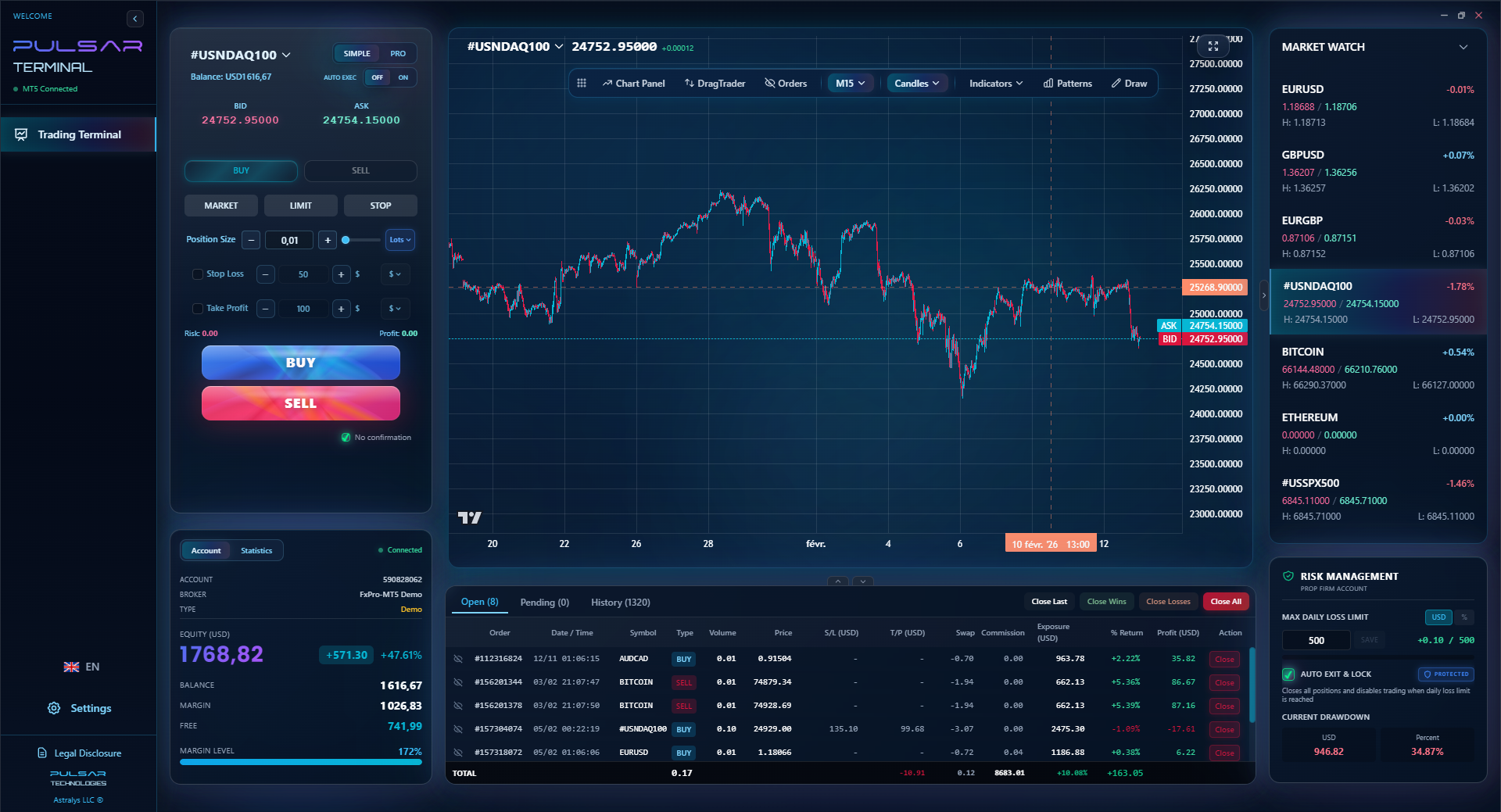
Once you can read support and resistance on a chart, tools like Pulsar Terminal let you drag and drop orders directly onto those levels on your MT5 chart, making execution precise and fast.
Pulsar Terminal
The all-in-one MT5 companion: drag-and-drop orders, multi-TP/SL, trailing stop, grid trading, Volume Profile, and prop firm protection. Used by 1,000+ traders daily.
We all make them. Here's how to shortcut the pain.
Mistake 1: Overcomplicating the Chart. You don't need 10 indicators. A clean candlestick chart with a few key support/resistance lines is often more powerful than a rainbow of moving averages and oscillators. I used to have the RSI indicator, MACD indicator, Bollinger Bands, and Stochastic all on one screen. It was paralyzing. Start with just price action.
Mistake 2: Ignoring the Spread on ZAR Pairs. This is a local cost killer. You might see a beautiful setup on USD/ZAR, but if the spread is 5 pips (common with brokers like Pepperstone), your trade starts 5 pips in the hole. A 1-pip move on EUR/USD is not the same as a 1-pip move on USD/ZAR when costs are higher. Always factor in the spread definition before you enter. Use a position size calculator that includes spread cost.
Mistake 3: Chasing Timeframes. Jumping from the 5-minute to the 4-hour chart looking for confirmation of your biased idea is a disaster. Pick two timeframes: one for trend (like daily), one for entry (like 1-hour). Stick to them for that trade.
Mistake 4: Not Understanding What a 'Pip' Is for Exotics. On USD/ZAR, a pip is typically 0.0010 (e.g., a move from 18.5000 to 18.5010). But some brokers quote it to two decimal places (like 18.50), where a pip is 0.01. Know how your broker quotes the pair. A misunderstanding here will wreck your risk management.
“A clean candlestick chart with a few key support/resistance lines is often more powerful than a rainbow of indicators.”
You don't need to risk a cent to get good at this.
- Open a Demo Account: Every broker I've mentioned - XM review, IC Markets, Pepperstone - offers a free demo account with virtual money. Do it right now.
- Pick One Pair: Start with USD/ZAR. It's your home currency, you'll feel the news behind it.
- Observe, Don't Trade: For a week, just look at the daily and 4-hour candlestick charts. Label the trends. Draw horizontal lines at obvious support and resistance. Don't even think about placing a trade.
- Start a Trading Journal: A simple notebook or spreadsheet. Write down what you see. "April 10: USD/ZAR daily chart. Price rejected at R17.00 resistance with a long wick. Downtrend still intact." This builds pattern recognition.
- Paper Trade: After a week of observation, start making hypothetical trades on your demo. Write down your entry reason, your stop loss, your target. Review them after a few days. Were you right about the trend? Did you place your stop in a sensible spot?
This process might seem slow, but it builds real skill. It's how I finally turned the corner from a gambler to a trader. The graphs will start talking to you. You'll see a cluster of candles at a certain level and just know it's important. That's when you know you're getting it.
💡 Winston's Tip
If you can't state your trade thesis in one sentence based on the chart ('selling at resistance in a downtrend'), your understanding isn't clear enough. Simplify.
FAQ
Q1What is the best type of forex chart for beginners?
Start with candlestick charts on a higher timeframe like the 4-hour or daily. They give you the full picture (open, high, low, close) in a visual way that's easier to interpret than bar charts. Line charts are too simple for trading, and lower timeframes like 1-minute are far too noisy when you're learning.
Q2How do I know if a trend is real on a forex graph?
A real trend shows persistence. In an uptrend, you should see a series of higher highs and higher lows. In a downtrend, look for lower highs and lower lows. The trend should be visible on the daily chart first. If you can't easily draw a sloping line connecting the swing highs (downtrend) or swing lows (uptrend), the market is probably ranging, and you should avoid trend-following strategies.
Q3Why are spreads so important for South Africans trading ZAR pairs?
Spreads represent your immediate transaction cost. On exotic pairs like USD/ZAR or EUR/ZAR, spreads are much wider (often 5-14 pips) than on majors like EUR/USD (often under 1 pip). This means your trade starts significantly in the red. You need a much larger price movement just to break even, which changes your risk/reward calculation entirely. Always check the live spread before entering a trade on a ZAR pair.
Q4What's the difference between a forex graph and a trading platform?
The forex graph (or chart) is the visual display of price data. The trading platform (like MetaTrader 4, MetaTrader 5, or cTrader) is the software that provides those charts, connects you to the broker, and allows you to place orders. Think of the graph as the map and the platform as the entire car with the steering wheel and pedals.
Q5How many timeframes should I look at?
For clarity, stick to two or three. Use a higher timeframe (like Daily) to determine the overall trend and key support/resistance. Use a lower timeframe (like 1-Hour or 4-Hour) to fine-tune your entry and exit points. Adding more than three often leads to "analysis paralysis" where conflicting signals stop you from making any decision.
Q6Is forex trading legal in South Africa?
Yes, retail forex and CFD trading is legal and regulated by the Financial Sector Conduct Authority (FSCA). However, you must comply with tax rules (SARS considers trading profits as income) and use an authorized dealer to send funds abroad. It's highly recommended to use an FSCA-regulated broker for client protection, especially since use for retail clients is capped at 30:1.
Q7Can I make money just by reading forex graphs?
Reading graphs (technical analysis) is a critical skill, but it's only one piece of the puzzle. You also need solid risk management (position sizing, stop losses), discipline to follow your plan, and an understanding of market context (like major economic news). The graph tells you 'what' is happening; you need the other skills to know 'how' to act on it safely and consistently.
Prof. Winston's Lesson
Key Takeaways:
- ✓Master candlesticks first; they show the market's battle.
- ✓Always define trend on the daily chart before trading.
- ✓Wider ZAR spreads demand larger price targets.
- ✓Practice on demo for a month before risking capital.
How useful was this article?
Click a star to rate
Weekly Trading Insights
Free weekly analysis & strategies. No spam.
About the Author
David van der Merwe
Emerging Markets Trader
Johannesburg-based trader with 11 years in emerging market currencies. Specializes in ZAR pairs, FSCA-regulated trading, and South African market analysis.
Comments
Risk Disclaimer
Trading financial instruments carries significant risk and may not be suitable for all investors. Past performance does not guarantee future results. This content is for educational purposes only and should not be considered investment advice. Always conduct your own research before trading.
You Might Also Like

Cara Trading Forex Sukses: 7 Prinsip dari Trader Profesional
Cara trading forex sukses dengan 7 prinsip trader pro: manajemen modal, disiplin, journal trading, backtest. Data nyata, bukan janji profit palsu.
Jam Trading Forex Terbaik untuk Trader Indonesia: Panduan Lengkap dengan Tabel Waktu
Panduan jam trading forex untuk trader Indonesia. Tabel 4 sesi dunia, jam emas 20:00-00:00, sesi mana yang harus dihindari. Data akurat + tips dari trader berpengalaman.
Top 5 Sàn Forex Uy Tín Nhất 2026: Review Jujur dari Trader Indonesia
Top 5 sàn forex uy tín 2026 untuk trader Indonesia. Review jujur: spread, deposit, withdraw, dukungan lokal. Exness, XM, IC Markets & lebih.
Get Pulsar Terminal
All these calculators are built into Pulsar Terminal with real-time data from your MT5 account. One-click position sizing, automatic risk management, and instant calculations.
Get Pulsar Terminal