


Here's the biggest lie you'll hear about hedging in South Africa: that it's a 'free lunch' or a magic shield against losses.

David van der Merwe
Emerging Markets Trader ·  South Africa
☕ 11 min read
What you'll learn:
- 1What Hedging Actually Is (And What It Isn't)
- 2The South African Rulebook: FSCA, SARB, and What You Can Actually Do
- 3Practical Hedging Techniques That Work for ZAR Traders
- 4The Real Costs: Doing the Math in Rands
- 5Classic South African Trader Mistakes (I've Made Most of These)
- 6When to Hedge, When to Walk Away
Here's the biggest lie you'll hear about hedging in South Africa: that it's a 'free lunch' or a magic shield against losses. I've watched too many traders, especially those new to the USD/ZAR volatility, pile into complex hedges thinking they're being smart, only to get absolutely shredded by spreads, margin calls, and their own confusion. The truth is, hedging is a specific tool for a specific job - it's not a strategy in itself. It's like buying insurance: you pay a premium to limit your downside, and if you don't understand the policy, you'll get a nasty surprise when you try to claim. Let's cut through the nonsense. I'll show you what a real forex hedging strategy looks like for a South African trader, the exact costs in Rand, the FSCA rules you can't ignore, and when you should just walk away from the idea entirely.
Let's get this straight from the start. Hedging is not a way to make money. It's a way to protect money you already have at risk. Think of a farmer in the Free State who's planted maize. The price could crash by harvest. He sells futures contracts to lock in a price today. He's not speculating for extra profit; he's ensuring survival.
In forex, it's the same principle. You're taking an offsetting position to reduce the risk of your primary trade. The most basic example for us is holding a long-term investment in a US stock (in USD) while being paid in ZAR. A weakening rand boosts your investment value, but you're exposed if the rand strengthens. Opening a short USD/ZAR position can offset that currency risk.
Where traders mess up is trying to hedge short-term speculative trades. If you're day trading EUR/USD from Cape Town, hedging is usually pointless. The costs will eat any potential benefit. Hedging is for managing existing, unavoidable risk, not for rescuing a bad trade you're emotionally attached to. I learned this the hard way early on. I was long GBP/ZAR during a volatile political period. Instead of taking my stop loss, I opened a tiny counter position 'to hedge.' All I did was lock in a small loss on both sides and double my transaction costs. A complete waste of time and capital.

Warning: Using a hedge to avoid closing a losing trade is the number one mistake. You're not managing risk; you're refusing to admit you're wrong. The market has a brutal way of fixing that attitude.

💡 Winston's Tip
If you're considering a hedge, write down its exact purpose in one sentence. If the sentence contains the words 'just in case' or 'maybe,' throw the plan away.
“Hedging is not a way to make money. It's a way to protect money you already have at risk.”
You can't talk strategy without knowing the local rules. Ignorance here will get your account frozen.
The main players are the Financial Sector Conduct Authority (FSCA) and the South African Reserve Bank (SARB). Any broker offering you derivatives (CFDs, options) for hedging must be a licensed Financial Service Provider (FSP) with the FSCA. Always check their FSP number. This isn't optional.
The Big Regulatory Shift
There's a massive change happening that affects bigger players and trickles down to all of us: transparency. In December 2024, the FSCA licensed Strate as South Africa's first Trade Data Repository (TDR). Why should you care? Because by March 2027, all OTC derivative providers must report detailed trade data. This means more oversight, cleaner pricing, and less room for shady brokers to operate. It's a good thing for market integrity.
For you as a retail trader, the most relevant tool is on the JSE. They offer JSE-listed Currency Options. You don't need SARB exchange control permission to use them - you pay the premium in Rands. This is a legitimate, exchange-traded way to hedge currency exposure. For example, if you're an importer worried about the USD/ZAR rate spiking in 3 months, you can buy a call option to lock in a maximum price.
The Margin Rule You Must Understand
For CFD hedging (like opening a long and short on the same pair with the same broker), understand the Joint Standard on margin. Brokers must collect collateral for non-centrally cleared trades. In practice, this means your broker's margin calculator might not fully 'net off' your hedged positions, especially during high volatility. You could still get a margin call even on a 'hedged' book if your broker's system treats the legs separately. Always ask your broker specifically about their margin policy for offsetting positions.

Pro Tip: Before you set up a complex hedge, send your broker's support a simple email: 'What is your margin requirement for a perfectly hedged position on USD/ZAR?' Their answer will tell you everything about their execution model and your real capital requirement.
“Using a hedge to avoid closing a losing trade is the number one mistake. You're not managing risk; you're refusing to admit you're wrong.”
Enough theory. Here’s how you apply this, with real numbers from our market.
1. The Direct Pair Hedge (The Simple One)
You are long 1 standard lot of USD/ZAR at R18.50. You have a 200-pip profit (R20,000), but you think there might be a short-term pullback before it goes higher. Instead of closing and re-entering, you open a short position of 0.5 lots (a partial hedge).
- What it does: It protects half your unrealized profit. If ZAR strengthens by 100 pips, your short hedge makes R5,000, offsetting half the loss on your original long.
- The cost: You pay the spread twice. If the USD/ZAR spread is 50 pips (R500 per lot), you've immediately paid R250 in transaction costs to set this up.
- My experience: I used this in early 2024 when USD/ZAR broke above R19.00. I was long from R18.70, hedged 50% at R19.05. The pair pulled back to R18.80, my hedge made money, and I removed it. It saved me about R8,000 in given-back profit, net of costs. The key was having a clear plan to remove the hedge.
2. The Correlation Hedge (The Smarter One)
The ZAR is a commodity currency. When global risk sours, USD/ZAR and EUR/ZAR often both rise (USD and EUR strengthen vs. ZAR). But sometimes, USD itself strengthens against everything. If you're long EUR/ZAR but worried about a broad USD surge, you might hedge with a short position on EUR/USD.
- Logic: A strong USD would make EUR/USD fall, but could push EUR/ZAR up or down depending on which force is stronger. The short EUR/USD profits from USD strength, partially offsetting any loss if EUR/ZAR falls because of it.
- This is advanced. You need to understand the correlation dynamics. It's not a perfect lock. I once botched this by not sizing correctly. My EUR/USD hedge was too small, and the correlation broke down for a day, leaving me with losses on both sides.
3. Using Options (The Precise One)
This is where the JSE product shines. Let's say the current USD/ZAR spot is R18.00. You believe it will rise, but want catastrophic risk protection.
- Action: Buy a USD Call / ZAR Put option with a strike price of R18.50, expiring in 3 months. The premium is quoted in Rand per contract.
- Example: Premium = R300 per futures contract. One JSE Currency Futures contract is for $1,000. So, your cost is R300 to control $1,000 at a strike of R18.50. Your maximum loss is that R300 premium. If USD/ZAR rockets to R19.50, your option is deeply in the money.
This is perfect for businesses or individuals with known future foreign currency expenses. For the average retail swing trader, the premium cost can be a high percentage of the trade, so it's often not efficient for small, speculative positions.
💡 Winston's Tip
The swap rate isn't a footnote; it's the main character in a long-term hedge. A negative carry of R10/day turns into R3,650 a year. That's not a hedge; it's a subscription fee for worry.

“The 'cheap' hedge often has hidden costs like unfavorable swap rates.”
Hedging isn't free. Let's break down where your money goes, because this is where dreams die.
| Cost Factor | What It Is | Impact on a R100,000 Notional Hedge (USD/ZAR) |
|---|---|---|
| Spread | The buy/sell difference. Paid on BOTH sides of the hedge. | At a 50-pip spread, that's R500 to open and R500 to close the hedge leg. R1,000 gone. |
| Overnight Financing (Swap) | Interest you pay or receive for holding positions overnight. On a hedge, you often pay on one side and receive on the other, but the rates are NEVER equal. | You might pay -R15 per night on your long and receive +R5 on your short. Net cost: -R10/night. Over a month: R300. |
| Opportunity Cost | The capital tied up as margin that can't be used elsewhere. | If your broker requires R5,000 margin for the hedge, that's R5,000 not earning potential elsewhere. |
| Option Premium | The upfront, non-refundable cost of buying an option. | A JSE option might cost R300-R800 per contract. This is your maximum loss. |
A Real Trade Breakdown: In 2023, I hedged a long-term GBP/ZAR position for 6 weeks.
- Notional Value: ~R200,000
- Spread Costs: R950
- Net Swap Costs: -R425 (GBP interest was lower than ZAR)
- Total Direct Costs: R1,375 The hedge saved an estimated R4,000 in potential drawdown. So, net 'benefit' of R2,625. Was it worth the hassle and capital lock-up? Barely. It taught me that unless the risk you're hedging is substantial, the costs make it a marginal exercise. Always run these numbers first. Use a position size calculator to understand your exposure before you even think about hedging it.
“The 'cheap' hedge often has hidden costs like unfavorable swap rates.”
Let me save you some pain and money.
1. Hedging with the Same Broker and Getting 'Netted Off'. Some broker platforms, especially basic ones, will see your long and short on the same pair and simply cancel them out at their internal rate. You think you're hedged, but the platform closes both positions at a loss the moment you're net flat. Always, always test with a tiny micro-lot first to see how your broker's system behaves.
2. Ignoring the ZAR Swap Rate. Our interest rates are high. If you're long a high-yielding currency (like ZAR) against a low-yielder (like JPY), you earn a positive swap. If you hedge it, you might flip that to a negative carry, where you pay interest every day. That slowly bleeds your account. I got caught on a USD/ZAR hedge where the net swap was -R22 per lot per day. Over two months, that hurt more than the small move I was protecting against.
3. Over-complicating with Multiple Pairs. You're long USD/ZAR, short EUR/ZAR, and long gold as a 'safe haven' hedge. Now you're not hedging; you're running a poorly conceived multi-asset portfolio with no clear thesis. Manage your risk on each trade individually first. Use stops. A hedge should be a simple, clear offset, not a web of confusion.
4. Hedging Emotionally, Not Logically. This is the killer. Your USD/ZAR trade is -80 pips. Your brain says, 'I'll just open a short to hedge while I figure this out.' No. You're confused. The correct action is to re-analyze your thesis. If it's broken, close the trade. A hedge born of confusion always loses money. I promise you.

Example: Emotional Hedge Cost. Trade: -R800. Emotional Hedge Cost (spread + swap for 3 days): -R150. Result: You've now guaranteed a loss of at least -R950, and you still have to make a decision later. Just take the -R800 loss and reset.
💡 Winston's Tip
Test your broker's hedge mechanics with a 0.01 lot trade first. Watch how margin, P&L, and swaps behave for 48 hours. It's the cheapest due diligence you'll ever do.
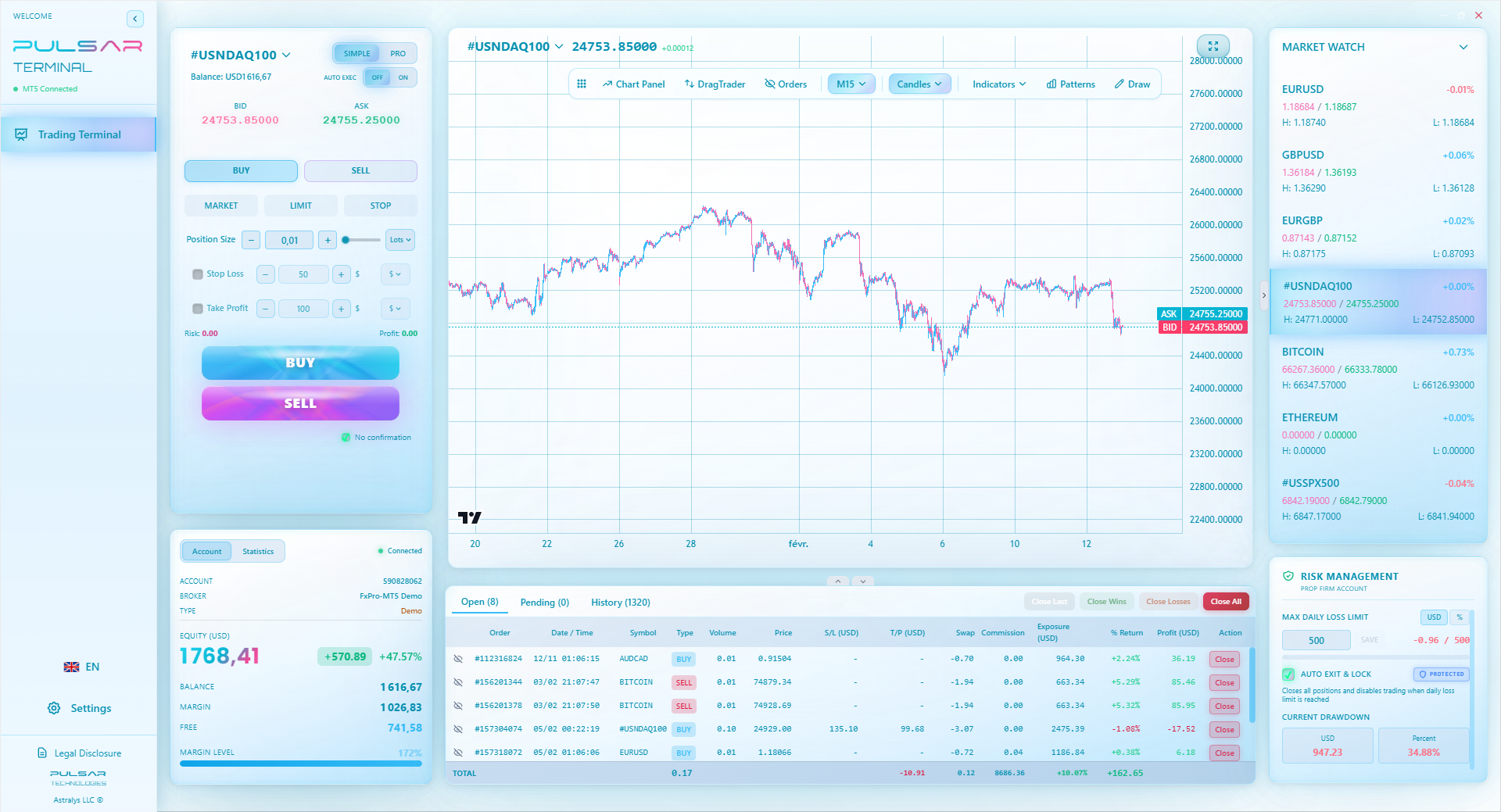
Managing the multiple legs and precise exits of a hedge is complex, which is why tools like Pulsar Terminal allow you to set multi-level take-profits and stop-losses on a single chart, keeping your risk management clean.
Pulsar Terminal
The all-in-one MT5 companion: drag-and-drop orders, multi-TP/SL, trailing stop, grid trading, Volume Profile, and prop firm protection. Used by 1,000+ traders daily.
“Focus on getting your entry and exit right first. Hedging is an advanced technique for protecting capital, not for making it.”
Hedge This:
- You have a physical, non-speculative exposure. You're a freelancer being paid $5,000 next month. Buying a USD put option makes sense.
- You have a large, profitable medium-term position and a scheduled high-impact event (like an SARB interest rate decision) is coming. A partial, temporary hedge can smooth the volatility.
- You are swing trading but want to hold through a weekend of geopolitical risk. A small offsetting position or an option can be cheaper than closing and re-entering.
Never Hedge This:
- A losing trade. Use a stop loss. Full stop.
- Short-term or scalping trades. The costs dwarf any benefit.
- When you don't fully understand the cost structure. If you can't instantly calculate the all-in cost of the hedge, you shouldn't be placing it.
- To feel clever. The market punishes complexity for its own sake.
The bottom line? A forex hedging strategy is a risk management tool for specific scenarios. For most South African retail traders, 95% of the time, a well-placed stop loss and smart position size calculator use is a far more effective and cheaper 'hedge' than any fancy dual position. Focus on getting your entry and exit right first. Hedging is an advanced technique for protecting capital, not for making it. Start treating it that way, and you'll be ahead of 90% of the people trying it.
FAQ
Q1Is forex hedging legal in South Africa?
Yes, but with strict rules. You must use an FSCA-licensed broker (FSP). Hedging via CFDs is permitted, but brokers must comply with the Financial Markets Act. For more structured hedging, JSE-listed Currency Options are a fully regulated, exchange-controlled-compliant tool.
Q2What's the cheapest way to hedge my USD exposure as a South African?
For a one-off, known future expense (like paying for imports), a forward contract from your bank or a JSE Currency Option can be cost-effective. For ongoing speculative trading exposure, it's often cheaper to simply use a tighter stop-loss order. The 'cheap' hedge often has hidden costs like unfavorable swap rates.
Q3Can I hedge the South African Rand (ZAR) against itself?
Not directly. You hedge a specific exposure. If you're long USD/ZAR, you hedge by shorting USD/ZAR. You're hedging the USD vs. ZAR movement, not the rand in isolation. To hedge general ZAR weakness, you'd look to hold assets in other currencies (USD, EUR) or commodities like gold (XAU).
Q4Do I pay double spreads when I hedge?
Almost always, yes. When you open the hedge, you pay the spread on that new trade. When you later close either the original trade or the hedge, you pay the spread again. This double transaction cost is the first and most immediate penalty for hedging.
Q5How does the high South African interest rate affect hedging?
Massively. If you are long ZAR (short USD/ZAR), you typically earn a positive swap due to high local rates. If you hedge this by going long USD/ZAR, you will likely pay a negative swap. This creates a daily cost (carry) that can erode the benefit of the hedge over time. Always check the net swap rate.
Q6What's the difference between a stop loss and a hedge?
A stop loss is a definite exit. It closes the risk for a known, limited loss. A hedge is an open, opposing position that reduces risk but keeps you in the market. It has ongoing costs (swap, margin) and doesn't cap your loss until you decide to close the positions. A stop loss is simple and final; a hedge is complex and ongoing.
Q7Can I use hedging for a prop firm challenge?
Extremely carefully. Most prop firms explicitly forbid 'hedging' or 'locking' positions within the same account, as it's seen as circumventing risk rules. It can lead to instant failure. Their systems detect offsetting positions. Your best tool for a prop challenge is strict risk management and a clear exit strategy, not hedging.
Prof. Winston's Lesson
Key Takeaways:
- ✓Hedging manages existing risk, it doesn't create profit.
- ✓Always calculate the full cost: spread x2 + swap + opportunity cost.
- ✓FSCA licensing is non-negotiable for any broker.
- ✓A stop loss is often simpler and cheaper than a hedge.
How useful was this article?
Click a star to rate
Weekly Trading Insights
Free weekly analysis & strategies. No spam.
About the Author
David van der Merwe
Emerging Markets Trader
Johannesburg-based trader with 11 years in emerging market currencies. Specializes in ZAR pairs, FSCA-regulated trading, and South African market analysis.
Comments
Risk Disclaimer
Trading financial instruments carries significant risk and may not be suitable for all investors. Past performance does not guarantee future results. This content is for educational purposes only and should not be considered investment advice. Always conduct your own research before trading.
You Might Also Like

Cara Trading Forex Sukses: 7 Prinsip dari Trader Profesional
Cara trading forex sukses dengan 7 prinsip trader pro: manajemen modal, disiplin, journal trading, backtest. Data nyata, bukan janji profit palsu.
Jam Trading Forex Terbaik untuk Trader Indonesia: Panduan Lengkap dengan Tabel Waktu
Panduan jam trading forex untuk trader Indonesia. Tabel 4 sesi dunia, jam emas 20:00-00:00, sesi mana yang harus dihindari. Data akurat + tips dari trader berpengalaman.
Top 5 Sàn Forex Uy Tín Nhất 2026: Review Jujur dari Trader Indonesia
Top 5 sàn forex uy tín 2026 untuk trader Indonesia. Review jujur: spread, deposit, withdraw, dukungan lokal. Exness, XM, IC Markets & lebih.
Get Pulsar Terminal
All these calculators are built into Pulsar Terminal with real-time data from your MT5 account. One-click position sizing, automatic risk management, and instant calculations.
Get Pulsar Terminal