


I lost R8,000 in 45 minutes.

David van der Merwe
Emerging Markets Trader ·  South Africa
☕ 10 min read
What you'll learn:
- 1The Basics: It's Just Buying and Selling, But With use
- 2The South African Rules You Can't Ignore
- 3The Real Costs: Spreads, Commissions, and the Silent Killer
- 4From Click to Fill: How Trades Actually Execute
- 5Trading ZAR Pairs: The Local Market Context
- 6The Harsh Truth: Why Most South African Traders Blow Up
- 7A Realistic Path Forward: From Demo to Live
I lost R8,000 in 45 minutes. It was 2015, and I thought I had the USD/ZAR figured out. The pair was at 14.50, and I was convinced it would drop. I put on a massive short trade using 1:100 use, risking 15% of my account. A surprise SARB announcement sent it rocketing to 14.85. My stop-loss was a distant memory, and the margin call came fast. That's the reality of forex how does it work - it's not about getting rich quick. It's about understanding a global machine where your rand is just another cog, and learning how not to get crushed by it.
At its core, forex how does it work is simple. You're betting on the value of one currency against another. These are called pairs, like EUR/USD or USD/ZAR. The first currency is the base, the second is the quote. If you buy EUR/USD, you're buying euros and selling dollars, hoping the euro goes up. The price you see is how much of the quote currency you need to buy one unit of the base.
For us in South Africa, the USD/ZAR is the local favourite. When it moves from 18.50 to 19.00, the rand has weakened. You need more rand to buy one US dollar. That 0.50 move is 500 pips, which is the smallest price move a pair can make. Understanding pips is your first step to calculating profit and loss.
Now, here's where it gets dangerous: use. Your broker lets you control a large position with a small deposit. The FSCA caps this at 1:30 for retail traders, but that's still powerful. With R10,000 and 1:30 use, you control R300,000 worth of currency. A 1% move against you wipes out 30% of your capital. That use is why my R8,000 disappeared so fast. It amplifies everything - gains and losses. Most beginners fixate on the amplification of gains and completely ignore the guaranteed destruction that comes with the losses. You need a tool like a position size calculator for every single trade to manage this risk.

Warning: use is a loan, not free money. A 1:30 use means a 3.33% move against you can wipe out 100% of your margin. Treat it with extreme caution.
Trading forex here isn't a free-for-all. We have a solid regulatory framework, and ignoring it is a sure way to lose your money to a scam or get on the wrong side of SARS.
The FSCA is Your First Checkpoint
The Financial Sector Conduct Authority (FSCA) is the main watchdog. Any broker offering services to South Africans must be licensed by them. This isn't optional. Before you deposit a cent, check the FSCA's public register. A licensed broker must segregate client funds, meaning your money is held separately from the company's operating cash. If the broker goes under, your capital should be protected. I only use FSCA-regulated brokers like Pepperstone or IC Markets for this reason.
The 1:30 use cap I mentioned is an FSCA rule for retail clients. Some offshore brokers might offer you 1:500, but if they're not FSCA-regulated, you have zero protection. It's not worth the risk.
SARS Wants Its Share
This is the part most new traders forget. Profits from forex trading are not some magical tax-free income. In the eyes of the South African Revenue Service (SARS), it's taxable income. You need to keep careful records of every trade - entry, exit, profit, loss. You declare your net profit (total profits minus total losses) on your annual tax return. I learned this the hard way after a good year and had to scramble for old statements. Get an accountant who understands trading, or at least use a proper trading journal from day one.

💡 Winston's Tip
Your first 100 trades are for data collection, not profit. Journal every single one: entry reason, exit reason, emotional state. Patterns in your failures are more valuable than patterns in your wins.
“use is a loan, not free money. A 1:30 use means a 3.33% move against you can wipe out 100% of your margin.”
Forex brokers aren't charities. They make money from you in a few ways, and if you don't understand these costs, they'll eat your account alive, even if your predictions are right.
The Spread: This is the difference between the buy (ask) and sell (bid) price. It's your immediate cost to enter a trade. For major pairs like EUR/USD, it can be razor-thin (0.1 pips on a good ECN account). For USD/ZAR, it's wider, often 40-80 pips. That means the pair needs to move 40 pips in your favour just for you to break even. Always check the typical spread for your chosen pair.
Commissions: Some brokers, especially those offering raw spreads, charge a commission per lot traded. It might be $3 per side per 100,000 units. This adds up fast if you're scalping.
The Silent Killer: Swap Rates This is the cost (or credit) for holding a position overnight. It's based on the interest rate differential between the two currencies. If you're long USD/ZAR (buying dollars, selling rand), you might pay a daily swap because South African interest rates are typically higher. I once held a USD/ZAR short trade for two weeks during a quiet market. The price barely moved, but the nightly swap fees chipped away over R1,200 from my position. You must factor this in for any swing trading strategy.

Example: Trading USD/ZAR with a 50-pip spread. You buy at 18.5050 (ask). The bid price is 18.5000. Your trade is instantly 50 pips in the red. You need a 50-pip move up just to reach breakeven, before any other fees.
You click 'buy', but what happens next? The simplicity on your screen hides a complex process.
When you place a market order, your broker sends it to their liquidity providers - big banks and financial institutions. Your tiny R10,000 order gets pooled with others. The speed and price you get (your 'fill') depend on your broker's technology and the market's liquidity. During major news events (like SARB rate announcements), liquidity dries up. Your order might get filled at a wildly different price than you expected, a phenomenon called 'slippage'. I've had slippage of over 100 pips on GBP/ZAR during Brexit votes.
There are two main broker models:
- Market Maker (Dealing Desk): The broker may take the other side of your trade. Their profit is the spread. Conflicts of interest can exist.
- ECN/STP Broker: Your order is passed straight through to the interbank market. You get tighter spreads but pay a commission. For active traders, this is usually cheaper. Most reputable FSCA brokers like Exness or XM operate on an STP/ECN model.
Your platform (like MT4 or MT5) is just the interface. The real magic (or horror) happens in the broker's servers and their connections to liquidity. Always test a broker's execution with a small trade in volatile conditions before committing serious capital.
💡 Winston's Tip
The spread isn't a fee, it's a toll bridge. If the bridge toll (spread) is 50 pips on USD/ZAR, you must make a 50-pip journey just to reach the starting line of your trade. Choose your crossings wisely.
“The market doesn't care about your braai money, your car payment, or your dreams. It's a probabilistic game.”
Trading USD/ZAR or EUR/ZAR isn't like trading EUR/USD. You're dealing with an emerging market currency, and it has its own personality - volatile, emotional, and tied to our local realities.
The Rand is a 'commodity currency.' Its value is heavily influenced by the prices of what we dig out of the ground: platinum, gold, iron ore. When gold (XAU/USD) rallies, the ZAR often strengthens with it. You also have to watch local politics, Eskom's latest woes, and credit rating announcements. The liquidity in ZAR pairs is lower than in majors. This means wider spreads and the potential for sharper, more sudden moves.
A unique factor is the South African Reserve Bank (SARB). Their interest rate decisions are huge market movers. The Monetary Policy Committee (MPC) meetings are circled in red on every local trader's calendar. A surprise 50-basis-point hike can send USD/ZAR crashing 200 pips in minutes. You need to know the schedule and avoid holding unhedged positions into these events unless you're specifically trading the news.
Trading these pairs requires a different mindset. The swings are bigger, the costs are higher, and the emotional toll is greater because you're trading your own currency. It feels personal. Don't let it be. Treat it with the same cold, analytical discipline you would any other instrument.
The failure rate here is over 80%. It's not because South Africans aren't smart. It's because of systemic, behavioural errors that the market punishes ruthlessly.
1. Underestimating Costs. Trading R5,000 account with a 50-pip spread on USD/ZAR means 1% of your capital is gone before you start. Make 10 trades, and you've paid 10% in spreads alone. It's a marathon of a thousand tiny cuts.
2. Over-leveraging. The 1:30 cap helps, but it's still enough to blow an account. People see R10,000 and think they can trade 3 standard lots. That's a margin call waiting for a 30-pip move.
3. Chasing 'Gurus' and Signals. The local WhatsApp groups are full of 'prophets' selling signals. I bought into one early in my career. The guy posted screenshots of wins but never the losses. I followed a 'guaranteed' EUR/USD call and lost 8% of my account in one go. Your strategy must be your own.
4. No Risk Management. This is the king. No stop-loss. No profit target. Just a 'feeling.' I've been there. You turn a R1,000 loss into a R5,000 loss hoping it'll come back. It usually doesn't. You must define your risk per trade (I never risk more than 1%) and stick to it. Use the RSI indicator or MACD indicator for confluence, but never let an indicator override your pre-set stop.
The market doesn't care about your braai money, your car payment, or your dreams. It's a probabilistic game. Your job is to manage risk so you can survive long enough to let probability work in your favour.
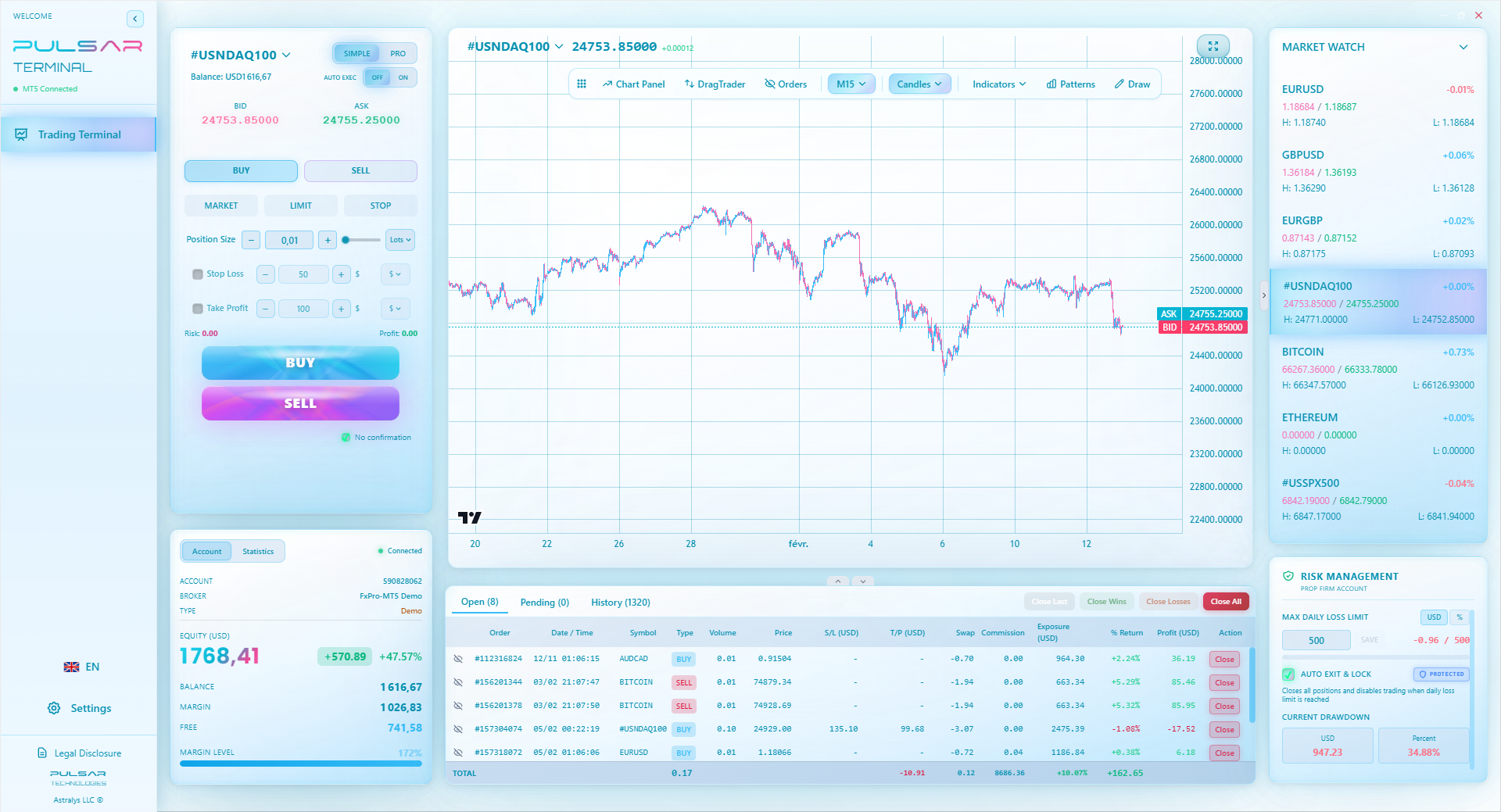
Sticking to a 1% risk rule is impossible without precise order management, which is where a tool like Pulsar Terminal's drag-and-drop orders and one-click risk calculation on MT5 becomes essential.
Pulsar Terminal
The all-in-one MT5 companion: drag-and-drop orders, multi-TP/SL, trailing stop, grid trading, Volume Profile, and prop firm protection. Used by 1,000+ traders daily.
“Your first R10,000 in the market is tuition fees, not investment capital. Expect to pay it to learn.”
So, forex how does it work for someone who wants to do it properly? Here's a blunt, step-by-step approach.
1. Learn, Don't Trade. Spend 3 months understanding economics, chart patterns, and risk management. Paper trade your ideas. If you can't be profitable on demo for 2 consecutive months, you have no business going live.
2. Start Absurdly Small. When you go live, start with the smallest possible amount. Many brokers allow $5 or $10. Your goal with your first R500 is not to make money. Your goal is to not lose it while executing your plan under real emotional pressure. The psychological jump from demo to live is massive.
3. Choose Your Broker Wisely. Regulated, low spreads on your chosen pairs, reliable platform. Compare broker reviews carefully. Don't just go for the one with the flashiest ads.
4. Build a Simple System. Pick one pair (maybe EUR/USD to start, it's cleaner). Define your entry rules (e.g., price bouncing off a key support level with RSI indicator oversold). Define your exit: a stop-loss 50 pips away, a take-profit 100 pips away. That's a 1:2 risk-reward ratio. Now trade only that setup.
5. Scale Painfully Slowly. Only add to your position size or trading frequency after 3 months of consistent, small profits. This is a career, not a lottery ticket. The market will be here tomorrow. Your job is to make sure your account is too.

Pro Tip: Your first R10,000 in the market is tuition fees, not investment capital. Expect to pay it to learn. If you manage to keep it, you're already ahead of 90% of beginners.
FAQ
Q1Is forex trading legal in South Africa?
Yes, it's completely legal. However, you must trade with a broker that is licensed by the Financial Sector Conduct Authority (FSCA) to ensure your funds are protected and you're operating within the local regulatory framework, including the 1:30 use cap for retail traders.
Q2How much money do I need to start forex trading in South Africa?
Technically, you can start with as little as $5 (about R90) with some brokers. Realistically, to properly manage risk and cover costs like the wide spreads on ZAR pairs, a minimum of R1,500 to R5,000 is a more sensible starting point. Remember, this capital should be money you can afford to lose entirely.
Q3How are forex profits taxed in South Africa?
SARS views forex trading profits as taxable income. You must declare your net profit (total gains minus total losses and allowable expenses) on your annual income tax return (ITR12). It's crucial to keep detailed records of all your trades for tax purposes.
Q4What is the best currency pair for beginners in South Africa?
Start with a major pair like EUR/USD. It has high liquidity, very tight spreads (lower costs), and is less volatile than ZAR pairs. It allows you to focus on learning strategy and execution without the added complexity of local commodity and political news driving wild swings.
Q5What does a 1:30 use limit mean?
It means for every R1 of your own money (margin), you can control a position worth R30. So, with R1,000, you can open a trade valued at R30,000. While it amplifies potential gains, it also amplifies losses. A 3.33% move against your position will wipe out your entire R1,000 margin.
Q6Can I trade forex with a South African bank?
Major banks like Standard Bank or Absa offer forex trading, but typically for larger, institutional clients or for physical currency exchange and hedging. For speculative retail trading, dedicated online brokers regulated by the FSCA offer far better platforms, tools, lower costs, and are built for active trading.
Prof. Winston's Lesson
Key Takeaways:
- ✓Forex is a cost business: mind the spread, swap, and commission.
- ✓FSCA regulation and SARS compliance are non-negotiable.
- ✓1:30 use can still destroy an account in minutes.
- ✓Trade EUR/USD before tackling volatile ZAR pairs.
- ✓Risk 1% per trade, no exceptions.
How useful was this article?
Click a star to rate
Weekly Trading Insights
Free weekly analysis & strategies. No spam.
About the Author
David van der Merwe
Emerging Markets Trader
Johannesburg-based trader with 11 years in emerging market currencies. Specializes in ZAR pairs, FSCA-regulated trading, and South African market analysis.
Comments
Risk Disclaimer
Trading financial instruments carries significant risk and may not be suitable for all investors. Past performance does not guarantee future results. This content is for educational purposes only and should not be considered investment advice. Always conduct your own research before trading.
You Might Also Like

Cara Trading Forex Sukses: 7 Prinsip dari Trader Profesional
Cara trading forex sukses dengan 7 prinsip trader pro: manajemen modal, disiplin, journal trading, backtest. Data nyata, bukan janji profit palsu.
Jam Trading Forex Terbaik untuk Trader Indonesia: Panduan Lengkap dengan Tabel Waktu
Panduan jam trading forex untuk trader Indonesia. Tabel 4 sesi dunia, jam emas 20:00-00:00, sesi mana yang harus dihindari. Data akurat + tips dari trader berpengalaman.
Top 5 Sàn Forex Uy Tín Nhất 2026: Review Jujur dari Trader Indonesia
Top 5 sàn forex uy tín 2026 untuk trader Indonesia. Review jujur: spread, deposit, withdraw, dukungan lokal. Exness, XM, IC Markets & lebih.
Get Pulsar Terminal
All these calculators are built into Pulsar Terminal with real-time data from your MT5 account. One-click position sizing, automatic risk management, and instant calculations.
Get Pulsar Terminal