


I lost ₦450,000 in a single week back in 2023.

Olumide Adeyemi
West African Trading Pioneer ·  Nigeria
☕ 12 min read
What you'll learn:
- 1Is Forex Trading Legal in Nigeria? The 2026 Reality
- 2The New Rules Every Trader Must Know (2024-2026)
- 3The Real Costs: Taxes, Fees, and What You Actually Keep
- 4Funding Your Account: A Practical Guide for Nigerians
- 5Choosing a Broker in 2026: Regulation is Everything
- 6Building a Nigerian-Proof Trading Plan
- 7Common Pitfalls and How to Avoid Them
- 8The Future of Forex Investment in Nigeria
I lost ₦450,000 in a single week back in 2023. Not to a bad trade, but to pure confusion. I’d made a decent profit on EUR/USD, withdrew to my local bank, and then got a letter from my accountant about unpaid capital gains tax, plus penalties. I had no idea the rules applied to offshore broker profits. That painful lesson cost me more than any stop-loss ever did. In Nigeria, understanding the legal and financial landscape isn't just helpful for your forex investment, it's absolutely critical to keeping your profits. Let me walk you through what I've learned the hard way.
This is the first question everyone asks, and the answer is a firm yes, but with major new caveats as of 2025. For years, trading for individuals was legal but existed in a sort of gray area. The Central Bank of Nigeria (CBN) regulated the overall FX market, but the Securities and Exchange Commission (SEC) wasn't really focused on online retail platforms. That all changed with the Investments and Securities Act (ISA) 2025. This law, signed in March 2025, is a game-changer (sorry, had to use it). It gives the SEC the explicit power to regulate online forex trading platforms. Operating without SEC registration is now illegal. The SEC has issued warnings, and they're not messing around. This is actually good news for us. It means the wild west days are (theoretically) ending. The goal is investor protection - stopping scam brokers and bringing clarity. So, your first step in any forex investment now is to check if your broker is on the path to SEC registration or, at the very least, holds a top-tier international license like the UK's FCA. Don't just trust a fancy website.

Warning: The CBN has a separate, long-standing rule: Nigerian banks are prohibited from providing foreign currency from the official window for speculative trading. This is why funding your trading account can be a headache, but it doesn't make your trading illegal. It just means you need to use the workarounds we'll discuss later.
The regulatory ground has shifted under our feet. If you're trading based on info from 2023, you're already behind. Here’s the breakdown of what’s changed and how it impacts your daily trading.
The SEC's New Power
The ISA 2025 is the big one. Think of it as the SEC finally getting the legal toolkit to police our corner of the market. They can now set standards for platforms, demand transparency, and shut down illegal operations. For you, this means due diligence is non-negotiable. A broker's "regulation" page needs more than a flashy logo from some island nation you can't find on a map.
The CBN's Market Consolidation
In late 2024, the CBN issued revised guidelines that merged all the various foreign exchange windows into one unified official market. They also released a new Foreign Exchange Code in early 2025. The goal? More transparency and a deeper, more liquid market at the institutional level. This trickles down to us by (hopefully) reducing wild volatility caused by arbitrage between different official rates.
What About BDCs?
Bureau De Change operators have seen their limits tightened. A February 2025 circular set a weekly cap of $25,000 for BDCs sourcing from the official market, and they can only add a 1% margin when selling to the public. This makes them less relevant for larger traders but is part of the broader squeeze on arbitrage and currency speculation outside the official channels.
My advice? Bookmark the SEC and CBN websites. A quick monthly check for new circulars or guidelines can save you a world of trouble. I set a calendar reminder after my tax fiasco.
“In Nigeria, understanding the legal and financial landscape isn't just helpful for your forex investment, it's absolutely critical to keeping your profits.”
Let's talk about the most important number: the profit that hits your bank account. This is where most new traders get blindsided.
Capital Gains Tax: The 10% Rule This is non-negotiable. You are subject to a 10% capital gains tax on all gross trading profits. It doesn't matter if your broker is in Cyprus, your money is in a USD account, or you trade from your phone in Lagos. If you're a Nigerian tax resident and you make a profit, the taxman wants his share. I learned this the expensive way. Let's say you turn a ₦1,000,000 account into ₦1,500,000 in a year. Your gross profit is ₦500,000. You owe ₦50,000 in tax. Full stop. You need to declare this yourself; your broker won't do it for you.
Broker Costs: Spreads, Commissions, Swaps These are your operational costs. For major pairs like EUR/USD, look for average spreads under 1.0 pip on a raw account. Many international brokers offer this. Commissions vary, but a common structure is $3.50 per 100k lot round turn. Overnight financing (swap) costs can eat into a long-term swing trading position, so always check the swap rates on your platform before holding over Wednesday night (when triple charges often apply).

Example: A 1-lot trade on GBP/USD with a 0.9 pip spread. The spread cost is 0.00009 * 100,000 = $9. If you pay a $3.50 commission, your total entry/exit cost is $12.50. You need the price to move over 1.25 pips just to break even. This is why a position size calculator is essential - it factors in these costs from the start.
Payment Method Fees Funding and withdrawing isn't free. Local bank transfers via broker payment processors might have a 1-2% fee. Crypto or P2P transfers have network fees and sometimes a rate premium. Factor this into your profitability math. A strategy that yields a 5% return before costs might only net you 3% after all fees and taxes.

💡 Winston's Tip
Your first ₦100,000 profit is the most expensive. After tax and fees, it might only be ₦85,000. Plan for the net, not the gross.
This is the first practical hurdle. Because of the CBN's restrictions on banks funding speculation, you can't just do a normal international wire transfer for forex trading. Here’s how we get it done.
1. Broker-Localized Payment Methods This is the easiest route. Many international brokers serving the Nigerian market have integrated local payment partners. You see an option for a "NGN Deposit," you enter an amount in Naira, and you're given local bank details to transfer to. The broker's payment partner converts it and credits your trading account, usually within a few hours. Brokers like Exness and XM have been strong on this front. Fees are usually transparent.
2. Cryptocurrency Transfers A huge number of traders I know use this. You buy USDT (Tether) on a local crypto exchange like Binance P2P with Naira, then send the USDT to your broker's crypto wallet address. It's fast (often under 30 minutes) and bypasses the banking system entirely. The downsides are crypto volatility during the transfer window and network gas fees.
3. Peer-to-Peer (P2P) Services Similar to crypto, but sometimes facilitated directly by the broker. You're matched with someone who wants to sell USD for Naira.
A Word on Withdrawals The process is generally the reverse. Plan for it to take 1-3 business days. Always withdraw to the same method you used to deposit if possible, to avoid anti-money laundering flags. And remember, when that profit lands in your Naira account, the 10% tax liability is officially triggered.
“Your risk per trade shouldn't just be a percentage of your account. It must be a percentage you can afford to lose after accounting for all the friction.”
Your broker is your gateway to the market. With the new SEC rules, your choice needs more scrutiny than ever. Here’s my checklist.
Priority 1: Regulation Until the SEC's new framework is fully populated with licensed brokers, your safest bet is a broker regulated by a top-tier international authority. This provides a layer of protection for your funds. Look for:
- FCA (UK): The gold standard. Strong client money protection.
- CySEC (Cyprus): Common and solid EU regulation.
- ASIC (Australia): Historically strong, though some restrictions have applied.
Many brokers have a global entity (regulated by FCA/CySEC) and a separate international entity. Nigerians are often directed to the international entity. That's okay, but you must check who regulates that specific entity. The FCA register and CySEC website are public - verify the license number.
Priority 2: Trading Conditions
- Spreads & Commissions: Compare. For scalping, you need ultra-low latency and tight spreads. For swing trading, swaps matter more.
- Minimum Deposit: Should be low. You shouldn't need more than ₦50,000 to start a live account. If a broker asks for $5,000 minimum, walk away.
- Platform & Tools: MT4/MT5 is standard. Does the broker offer additional tools like advanced charting or economic calendars?
Priority 3: Nigerian-Specific Services
- NGN Accounts/Local Deposits: As discussed above.
- Customer Support: Do they have a local phone number or WhatsApp support that understands Nigerian payment issues?
Based on my experience and that of my network, brokers like IC Markets (for raw spreads), Pepperstone (for great research), and Exness (for ease of local deposits) are consistently mentioned. But you must do your own verification every single time.
A trading plan that works in London or New York might fail here if it doesn't account for our unique challenges: internet stability, power outages, and market sessions that overlap with our daily lives.
1. Session Selection The London session (8 AM - 5 PM GMT) is 9 AM - 6 PM Nigerian time. This is the most liquid session and a great focus. The London/New York overlap (1 PM - 5 PM GMT, 2 PM - 6 PM Nigerian time) is the most volatile. If you have a 9-5 job, maybe you focus on the New York session evening (after work). Don't try to trade the Asian session from Nigeria unless you're a night owl; the liquidity is lower and moves can be erratic.
2. Strategy Alignment
- Scalping: Requires perfect internet and focus. A single disconnection can cause a margin call. Have a UPS/inverter. Use a mobile data hotspot as a backup.
- Swing Trading: More forgiving of connectivity blips. You set your trade and leave it with a stop-loss and take-profit. This suits many Nigerian traders better. You can analyze in the evening, set orders, and check them the next day.
3. Risk Management with Local Costs in Mind Your risk per trade shouldn't just be a percentage of your account. It must be a percentage you can afford to lose after accounting for all the friction. If your total cost of trading (spreads + commissions + payment fees + tax) is 3% per round trip, risking 5% of your account on a trade is insane. I risk no more than 1% of my account equity on any single trade. This conservative approach has kept me in the game for 12 years.
4. The Tech Setup Invest in a good UPS. Use a broker with a reliable mobile app. I've closed trades from my phone during a power outage more times than I can count. Charting tools like the RSI indicator or MACD indicator are standard, but consider tools that help you manage trades efficiently, especially if you're juggling trading with other work.
💡 Winston's Tip
If your trading strategy doesn't survive a 30-minute power outage in Lagos, it's not a strategy. Always have a mobile backup plan.
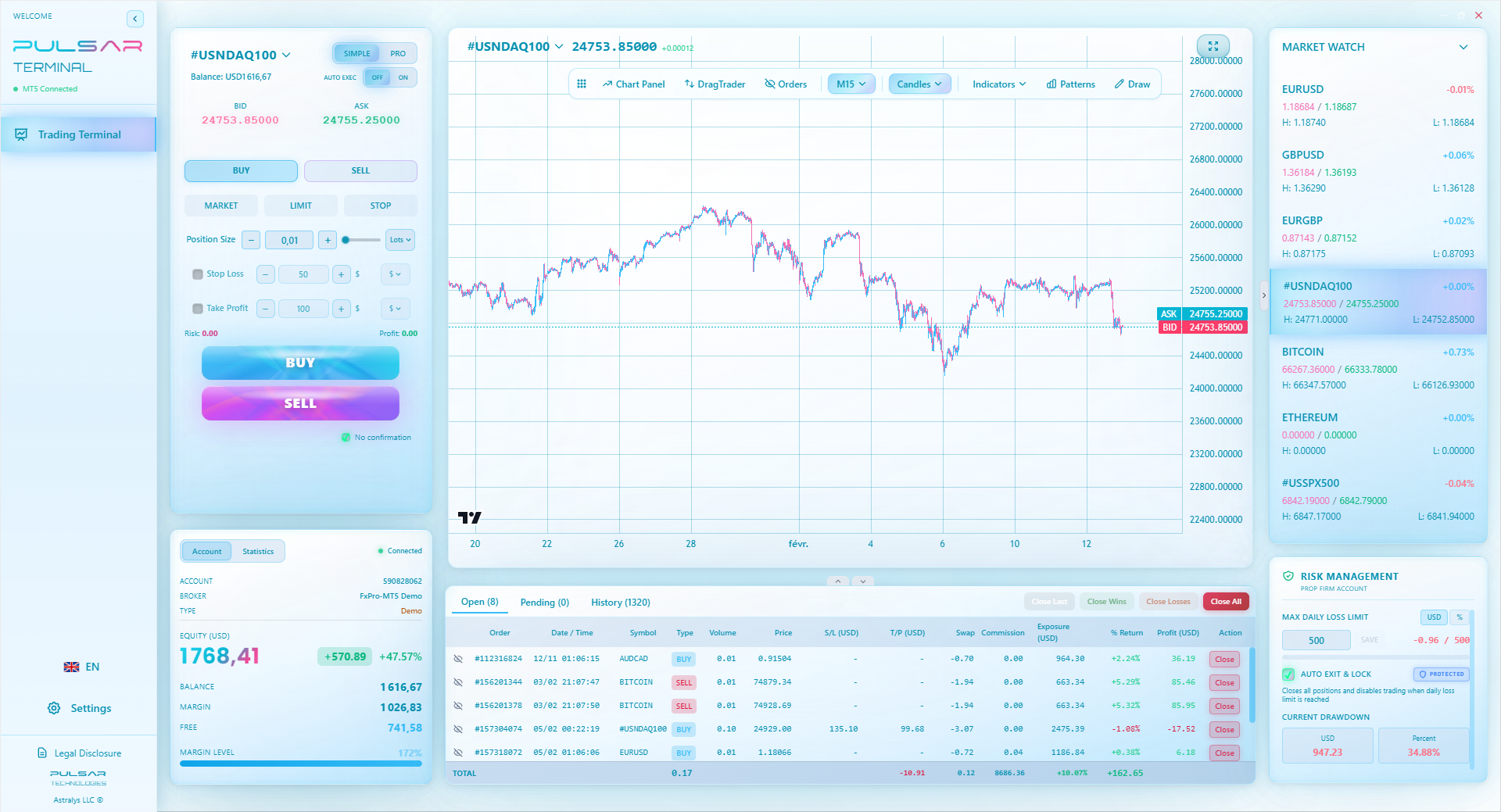
Managing multiple trades and protecting profits during volatile sessions is key, and tools like Pulsar Terminal automate advanced order types like trailing stops and multi-level take-profits directly on your MT5 platform.
Pulsar Terminal
The all-in-one MT5 companion: drag-and-drop orders, multi-TP/SL, trailing stop, grid trading, Volume Profile, and prop firm protection. Used by 1,000+ traders daily.
“The traders who treat this as a serious business, with a plan, proper risk management, and compliance, will be the ones who thrive.”
I've made these mistakes so you don't have to.
Pitfall 1: Chasing the 'Naira Trade' A lot of new traders want to trade USD/NGN. They think they have a feel for the Naira. This is a trap. The official rate is controlled, the black-market rate is volatile and illiquid for our size, and most brokers don't even offer a liquid USD/NGN pair for retail traders. Stick to the major pairs like EUR/USD or XAU/USD. The liquidity is immense, the spreads are tight, and the rules are clear.
Pitfall 2: Ignoring Tax Liability We covered this, but it bears repeating. Set aside 10% of every single withdrawal immediately. Open a separate savings account for it. When the tax bill comes, you're ready.
Pitfall 3: Overleveraging use of 1:500 or 1:1000 is readily available. It's a tool, not a mandate. Using high use on a standard account is like driving a Ferrari in first gear everywhere - you'll blow the engine. Start with low use (1:10 or 1:20) to get a real feel for pip movement and spread impact. My worst loss ever was in 2015, using 1:400 on a GBP news event. I lost 60% of my account in 90 seconds. The trade was directionally correct, but the volatility whipped me out before it went my way.
Pitfall 4: Signal Services and 'Guaranteed' Profit Gurus If someone has a guaranteed system, why are they selling it for ₦20,000 instead of using it to trade? The Nigerian social media space is full of these characters. Your greatest asset is your own educated judgment. Invest in learning, not in signals.
💡 Winston's Tip
The 'Naira rate' feeling is emotional, not analytical. Trade the charts of major pairs, not your frustration with the exchange bureau queue.
The direction is clear: more regulation, more transparency, and hopefully, more protection. The SEC's new role under ISA 2025 is the most significant development for retail traders in a decade. It will likely mean:
- A Clean-up of Broker Offerings: Shady, unregulated bucket shops will find it harder to operate.
- Formalized Education: The SEC may mandate or endorse educational resources for investors.
- Clearer Dispute Resolution: A formal path if you have a issue with a registered platform.
For you, this means the barrier to safe entry is getting higher, but in a good way. The cost of doing business (compliance, taxes) is clear and upfront. This professionalizes the space. The traders who treat this as a serious business, with a plan, proper risk management, and compliance, will be the ones who thrive. The ones looking for a quick, unregulated gamble will be squeezed out. My final thought? Embrace the structure. It's the sign of a maturing market. Your forex investment journey in Nigeria is now more challenging but also more legitimate and potentially more rewarding than ever before.
FAQ
Q1Do I need a license from the CBN to trade forex as an individual in Nigeria?
No, individual retail traders do not need a personal license from the CBN to trade forex. The licensing requirement is for the brokers and financial institutions themselves. Your responsibility is to ensure you use a broker that is properly registered, either with the SEC under the new 2025 rules or with a reputable international regulator.
Q2How do I pay the 10% capital gains tax on my forex profits?
You are responsible for declaring and paying this tax yourself. When you withdraw profits to your Nigerian bank account, you should calculate 10% of the gross profit from that withdrawal (or your annual total) and remit it to the Federal Inland Revenue Service (FIRS) using the appropriate tax forms. It is highly recommended to consult with a Nigerian accountant who understands trading income to ensure proper filing.
Q3Can I trade with a Nigerian broker now that the SEC is regulating?
As of early 2026, the SEC's framework under the ISA 2025 is still new. You should check the SEC's official website for a list of licensed online FX platforms. Until that list is populated with trusted local brokers, most experienced traders continue to use internationally regulated brokers that accept Nigerian clients and offer local payment methods for safety and reliability.
Q4What is the best way to fund my forex trading account from Nigeria?
The most reliable methods are: 1) Using a broker's integrated local Naira deposit option (you get local bank details to transfer to), or 2) Using cryptocurrency (e.g., buying USDT on a local P2P platform and sending it to your broker's wallet). These methods bypass the CBN's restrictions on banks funding speculative forex trades.
Q5Is USD/NGN a good pair for beginner traders in Nigeria?
No, it is generally a poor choice for beginners. The retail market for USD/NGN is often illiquid, with very wide spreads and unpredictable volatility due to local market controls. It is far better to start with major global pairs like EUR/USD or GBP/USD, which have immense liquidity, tight spreads, and more predictable behavior based on global economic news.
Q6What is a realistic starting capital for forex trading in Nigeria?
You can start with as little as ₦50,000 to ₦100,000 with many international brokers. The key is not the amount, but how you manage it. With that capital, you must use micro or nano lots to keep your risk per trade very small (e.g., 0.01 lots). The goal is to learn and preserve capital, not to make life-changing money immediately. A common mistake is starting with too little and being forced to over-use to see meaningful gains.
Q7How does the new SEC regulation protect me?
The ISA 2025 gives the SEC authority to set operational standards for platforms, ensure client funds are segregated and protected, mandate fair pricing and execution, and provide a formal channel for dispute resolution. It aims to eliminate unregulated, fraudulent platforms from targeting Nigerian traders, thereby increasing overall market integrity and investor confidence.
Prof. Winston's Lesson
Key Takeaways:
- ✓The 10% capital gains tax applies to all gross forex profits, onshore or offshore.
- ✓ISA 2025 gives the SEC new power to regulate platforms: verify your broker's status.
- ✓Use broker-localized Naira deposits or crypto to fund your account, not bank FX.
- ✓Risk a maximum of 1% of your account per trade to survive local market friction.
How useful was this article?
Click a star to rate
Weekly Trading Insights
Free weekly analysis & strategies. No spam.
About the Author
Olumide Adeyemi
West African Trading Pioneer
One of Nigeria's most active forex trading educators. 8 years of experience trading from Lagos. Specializes in low-capital strategies and prop firm challenges for African traders.
Comments
Risk Disclaimer
Trading financial instruments carries significant risk and may not be suitable for all investors. Past performance does not guarantee future results. This content is for educational purposes only and should not be considered investment advice. Always conduct your own research before trading.
You Might Also Like

Cara Trading Forex Sukses: 7 Prinsip dari Trader Profesional
Cara trading forex sukses dengan 7 prinsip trader pro: manajemen modal, disiplin, journal trading, backtest. Data nyata, bukan janji profit palsu.
Jam Trading Forex Terbaik untuk Trader Indonesia: Panduan Lengkap dengan Tabel Waktu
Panduan jam trading forex untuk trader Indonesia. Tabel 4 sesi dunia, jam emas 20:00-00:00, sesi mana yang harus dihindari. Data akurat + tips dari trader berpengalaman.
Top 5 Sàn Forex Uy Tín Nhất 2026: Review Jujur dari Trader Indonesia
Top 5 sàn forex uy tín 2026 untuk trader Indonesia. Review jujur: spread, deposit, withdraw, dukungan lokal. Exness, XM, IC Markets & lebih.
Get Pulsar Terminal
All these calculators are built into Pulsar Terminal with real-time data from your MT5 account. One-click position sizing, automatic risk management, and instant calculations.
Get Pulsar Terminal