


I remember the exact date: March 15, 2023.

Olumide Adeyemi
West African Trading Pioneer ·  Nigeria
☕ 13 min read
What you'll learn:
I remember the exact date: March 15, 2023. A 'forex investment company' in Lagos promised me 15% monthly returns. I handed over ₦500,000. For two months, I got beautiful PDF statements showing my 'growth' to ₦575,000. The third month, the phone number was disconnected, the office was empty, and my money was gone. That ₦500,000 lesson cost me more than just cash; it cost me trust. This guide is what I wish I'd had back then. We'll cut through the noise, look at how real forex investment companies operate in Nigeria's 2026 market, and I'll show you how to protect your capital - whether you're handing it to someone else or learning to trade it yourself.
Let's get this straight from the start. In Nigeria, the term 'forex investment company' is a broad, often misused label. It can mean three very different things, and confusing them is where people lose money.
The Three Types You'll Encounter:
- The Fund Manager (The Legitimate Professional): This is a registered entity, often with the SEC, that pools client funds to trade the forex market. They operate like a hedge fund for forex. You're buying into their strategy and expertise. They charge a management fee (usually 1-2% per year) and a performance fee (often 20% of profits). Their returns are variable, not guaranteed, and they should provide regular, audited statements. Finding a truly legitimate one in Nigeria is rare.
- The Prop Trading Firm Facilitator (The Modern Gateway): This isn't a company that manages your money directly. Instead, they help you access proprietary trading firms. You pay a fee to take a trading challenge (e.g., a $100,000 account challenge for a $500 fee). If you pass, you get to trade the firm's capital and keep a large share of the profits (often 80-90%). Companies like FTMO or The5%ers are accessed this way. This model has exploded in popularity because it shifts the risk of loss from the client's pocket to their trading skill.
- The Ponzi Scheme (The Scam): This is, unfortunately, the most common version on the ground. They promise fixed, high returns (e.g., 5-10% monthly). They use new investors' money to pay 'returns' to old investors, creating an illusion of profit. They often have flashy offices, charismatic leaders, and complex jargon. They collapse when they can't recruit new investors fast enough. My ₦500,000 mistake was with one of these.

Warning: If a company guarantees you a specific monthly percentage return in forex, run. The market is far too volatile for guarantees. That's the number one red flag.
The Nigerian market has seen a shift. Post-2024 CBN reforms aimed at transparency have pushed some of the worst scams underground, but they've rebranded online. The allure is stronger than ever, especially with the Naira's volatility. People see the dollar moving from ₦800 to ₦1700 and back, and they think, 'Someone must know how to profit from this consistently.' That desperation is what these companies feed on.
I learned the hard way that due diligence is non-negotiable. Before you even think about returns, you need to understand which of these three models you're looking at. The next section will show you how to tell them apart with cold, hard facts.

💡 Winston's Tip
A guarantee in forex is a guarantee of a scam. Volatility doesn't do promises.
Based on my experience and watching this space for over a decade, here are the specific red flags that scream 'scam' in the Nigerian context.
The Guarantee: As mentioned, any guaranteed return is a fantasy. Forex is a zero-sum game; for you to win, someone else loses. No one can control that outcome every month.
The Pressure Tactics: 'This offer closes today!' or 'We only have three slots left for our VIP pool!' This is designed to bypass your logical thinking. A legitimate investment firm doesn't need to pressure you.
The Opaque Strategy: Ask, 'What is your trading strategy?' If they can't explain it simply - like 'We use swing trading on major currency pairs, focusing on support and resistance levels with a 2:1 risk-reward ratio' - but instead say 'It's a secret algorithm' or 'Our expert traders in London handle it,' be very suspicious. My scam company talked about 'AI arbitrage' but couldn't define a pip definition.
The Lack of Regulation (The Big One): In Nigeria, check for SEC registration. Ask for their registration number and verify it on the SEC website. If they say they're 'regulated internationally,' ask for the license number and which authority (FCA UK, CySEC, ASIC). Then, go to that regulator's website and check. Most scams will have a fake certificate or claim regulation from a obscure island you've never heard of.
The Payment Structure: If returns are paid like clockwork on the 5th of every month, regardless of market conditions (a huge losing week, a bank holiday), it's likely a Ponzi. Real trading profits are irregular.
The Social Proof Illusion: They'll show you WhatsApp screenshots of 'testimonials' and 'alert' messages. These are easily faked. Ask to speak to a long-term client in person. They'll never let that happen.

Pro Tip: Do a simple test. Tell them you want to start with a very small amount, say ₦50,000. A legitimate manager might have a higher minimum, but they'll understand. A scam will often belittle you or try to upsell you aggressively, saying 'Serious investors start with at least ₦2 million.' They need large chunks of capital to keep the scheme running.
Let me give you a real example from 2024. A company was offering 7% monthly. They had a fancy website, an Ikeja office. I asked for their Q3 2023 audited P&L statement. They sent a poorly formatted Excel sheet. I asked which brokerage they executed trades through. They said 'Our in-house platform.' That was the final nail. No legitimate firm uses an 'in-house' platform; they use established names like the platforms offered by Exness review or IC Markets review. Always trace the execution to a known, regulated broker.
“In forex, if it sounds too good to be true, it's not just too good - it's a lie designed to take everything.”
If most 'forex investment companies' are risky or outright scams, what are your real options? You have two solid paths that put you in control.
The Prop Firm Route
This has become the most credible alternative. You're not giving your money to someone else; you're paying to prove you can trade.
How it works:
- You choose a prop firm (do your research, stick with well-known ones).
- You pay a one-time challenge fee for a simulated account (e.g., $500 for a $100K challenge).
- You have to hit a profit target (e.g., 10%) without breaching daily loss limits (e.g., 5%). This is where discipline is key.
- If you pass, you get a funded account. You trade their capital, and profits are split (commonly 80/90% to you).
The Reality Check: It's not easy. The rules are strict. But it's honest. You're being evaluated on skill, not your ability to recruit others. The fee is for the evaluation, not an 'investment.' I passed a $50K challenge in 2024. My fee was $350. I made a 9% profit in the funded account in my first month and took home $3,600 (90% of $4,000). The key was using a strict scalping strategy with a rock-solid position size calculator to never risk more than 0.5% per trade.

Example: For a $100,000 funded account with a 5% max daily loss limit, your daily risk is $5,000. If you risk 0.5% per trade ($500), you can only take 10 losing trades in a day before a margin call on the challenge. This forces insane discipline.
The Self-Education Route
This is the long game, but it's the only way to build lasting skill. You learn to trade yourself.
Start with a reputable international broker that accepts Nigerian clients and offers local deposits. Brokers like XM review or Pepperstone review are common choices. Start with a demo account for at least 3-6 months. Then, move to a live account with the absolute minimum deposit - maybe $100.
Your goal isn't to get rich. Your goal is to lose small while you learn. I blew up my first $200 account in two weeks in 2012. That $200 lesson was cheaper than the ₦500,000 scam later.
Focus on one thing at a time. Master one currency pair, like the EUR/USD guide. Learn one indicator inside out, like the RSI indicator. Paper trade a single strategy, such as swing trading pullbacks to a moving average. This focused approach beats jumping between a hundred signals from a 'company.'
The truth is, after my scam experience, I chose the self-education route. It took years of losses, study, and frustration. But now, I don't need to trust a 'forex investment company' with my financial future. I manage it myself, and that's the most secure feeling of all.
💡 Winston's Tip
Your first investment in forex should be in books and a demo account, not a 'company.' Knowledge is the only asset no one can steal from your trade.
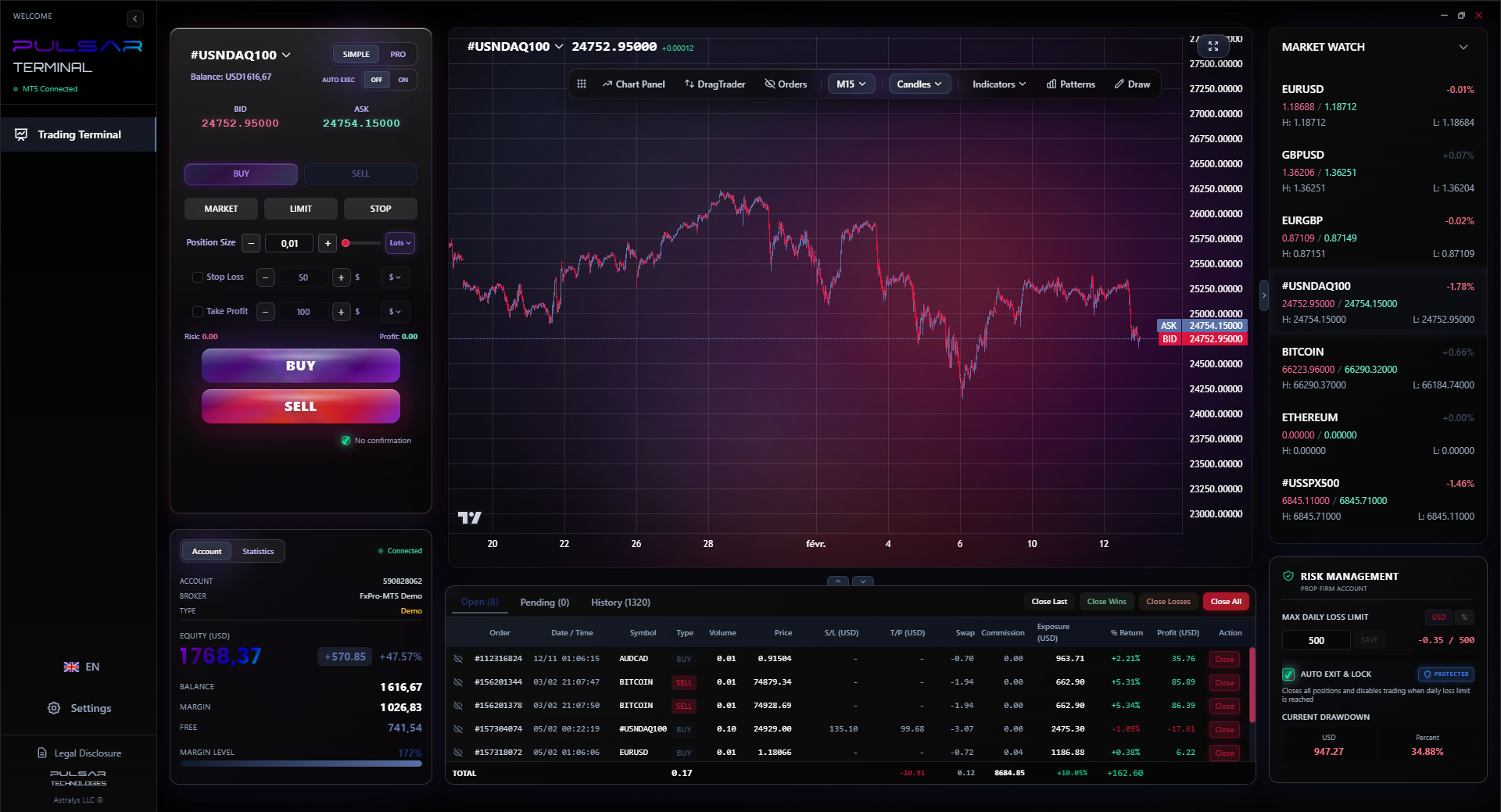
When trading a prop firm challenge, the strict daily loss limits are everything; Pulsar Terminal's real-time equity protection can automatically close all trades if you hit your daily max, saving your account instantly.
Pulsar Terminal
The all-in-one MT5 companion: drag-and-drop orders, multi-TP/SL, trailing stop, grid trading, Volume Profile, and prop firm protection. Used by 1,000+ traders daily.
You can't talk about forex in Nigeria without understanding the wild ride of the Naira. The context has shifted dramatically since the 2023 unification and the reforms through 2024-2025. This changes the game for everyone, including any company claiming to trade forex.
The Volatility is Real, But So is the Reform. Remember when the Naira went from around ₦400/$1 to nearly ₦1,700/$1? That kind of move destroys businesses and creates scams. It also creates real trading opportunities (and huge risks). The CBN's reforms - hiking interest rates to 27.5%, clearing the FX backlog, pushing for a transparent 'willing buyer, willing seller' system - are attempts to stabilize this.
What this means for 'investment companies':
- Increased Scrutiny: The environment is slightly less permissive for the blatant Ponzi schemes that operated in plain sight. They've moved more online.
- Liquidity Changes: The CBN reports market turnover jumped to $8.6 billion in 2025. More liquidity can mean tighter spreads for real traders, but it also means bigger, faster moves.
- The Dollar Mindset: Many Nigerians don't just want Naira returns; they want dollar-denominated returns as a hedge against devaluation. This desperation makes them easy targets for companies promising dollar profits.
A Key Consideration: If a Nigerian forex investment company is truly trading the international market (EUR/USD, GBP/JPY), the Naira's volatility is a secondary factor. But if they are specifically trading Naira pairs (like USD/NGN on the international market), they are taking on an enormous amount of sovereign risk. Very, very few legitimate firms will touch this with client money because the CBN's interventions can be unpredictable.
My advice? In 2026, be extra wary of any company that claims to have a 'special method' for trading the Naira's recovery or predicting CBN policy. No one has a crystal ball. The reforms are positive, but the market is still finding its feet. Your best protection is to focus on the global forex market (majors like EUR/USD, XAU/USD guide) through reputable international channels, not on local Naira speculation packaged as an 'investment plan.'
“A legitimate manager worries about their track record. A scammer worries about their marketing brochure.”
Don't rely on gut feeling. Use this checklist. If you can't tick every box, walk away.
Registration & Regulation:
- SEC Nigeria: Are they registered with the Securities and Exchange Commission? Get the number and VERIFY online.
- International Regulation: If they claim other regulation, which body? (FCA, CySEC, ASIC). Get the license number and VERIFY on the regulator's official site.
- Business Address: Is it a real, physical office you can visit? A P.O. Box in Apapa is not enough.
Transparency & Operations:
- Clear Strategy: Can they explain their trading strategy in simple terms? (e.g., 'We trade breakouts on the 4-hour chart using the MACD indicator for confirmation').
- Broker Partnership: Which brokerage do they use to execute client trades? It should be a major, internationally regulated broker you can independently research.
- Audited Track Record: Can they provide at least 2 years of audited performance statements from a recognized audit firm? Not Excel sheets, not screenshots.
- Risk Disclosure: Do they have a clear, written document explaining the risks of forex trading and that past performance doesn't guarantee future results?
Fees & Structure:
- Fee Clarity: Are all fees (management, performance, withdrawal) clearly stated in writing? A typical legitimate model is '2 and 20' (2% management fee, 20% performance fee).
- No Guarantees: Does their documentation explicitly state that returns are NOT guaranteed?
- Your Money's Location: Is client money held in segregated accounts with a third-party bank? This is non-negotiable. Your funds should not be in the company's main operating account.
The Practical Test:
- Small Start: Will they allow you to start with a small amount that you're comfortable losing completely?
- Direct Contact: Can you speak directly to the lead trader or portfolio manager, not just a marketing representative?
- Online Search: Have you searched the company name + 'scam', 'complaint', or 'review' on forums like Nairaland? Look for patterns, not just one disgruntled person.
Doing this takes time. It's boring. But it's the work that separates your money from the sharks. The company that passed my scam experience's checklist? Zero. The prop firm I use now? It ticked every box for regulation, transparency, and structure.
💡 Winston's Tip
If you wouldn't hand them a suitcase full of physical cash in a dark alley, don't wire them your life savings online. The principle is the same.
Let's be brutally honest about what's possible. If you're looking for a forex investment company to turn ₦500,000 into ₦5,000,000 in a year, you are the perfect target for a scam. You need to reset your expectations to reality.
Realistic Returns: A stellar, world-class forex fund manager might aim for 15-25% per year. Yes, per year. Not per month. And that's with significant drawdowns (periods of loss) along the way. Many good years might be 5-10%. If someone is promising more, they're either lying or taking suicidal risks with your money.
Your Personal Risk Management:
- The 'Gone Money' Rule: Never invest money you cannot afford to lose 100% of. Consider any money you give to a forex investment company as potentially gone. If that thought keeps you up at night, the amount is too high.
- Diversification: This is the golden rule. If you have ₦5,000,000 to invest, putting it all into one forex scheme - even a seemingly legitimate one - is reckless. Allocate a small percentage (maybe 5-10%) to higher-risk ventures like forex. The rest should be in more stable assets.
- Start Small & Scale: If you find a company that passes your checklist, start with the absolute minimum. Watch how they handle your account, communications, and reporting for 6-12 months. Then, and only then, consider adding more.
- Understand the Fees: Fees kill compounding. A '2 and 20' fee structure means if the manager makes 20% gross return, you get (20% - 2% management fee) = 18%. Then they take 20% of the profit (20% of 18% = 3.6%), leaving you with a 14.4% net return. In a bad year where they make 0%, you still lose the 2% management fee. You must understand this math.
I learned this after my scam. I now have a personal rule: I never allocate more than 5% of my total liquid net worth to any single speculative venture, including my own trading. The rest is in land, boring index funds, and cash. This means a total loss in my trading account is a setback, not a life-ending event. That psychological safety net is what allows me to trade (or evaluate investments) with a clear head, not desperation.
, the greatest risk isn't a company stealing your money. It's you surrendering control of your financial future to someone you don't know, based on promises you don't understand. Taking the time to learn, to ask hard questions, and to start small is the only true investment protection you have.
FAQ
Q1Are there any forex investment companies officially approved by the CBN or SEC in Nigeria?
The CBN regulates the overall forex market but doesn't 'approve' retail investment companies in the way you might think. The Securities and Exchange Commission (SEC) is the primary body for registering collective investment schemes. A legitimate firm managing client funds for forex trading should be registered with the SEC Nigeria. You must verify their registration number on the SEC's official website. Most entities calling themselves 'forex investment companies' are not SEC-registered, which is your first major warning sign.
Q2What is a realistic monthly return from a legitimate forex trader or fund?
Forget monthly. Think annually. A consistently profitable, professional trader or fund might target 15-25% per year. Monthly returns will be erratic: some months +5%, some months -3%, some months flat. Anyone promising consistent monthly returns (e.g., '5% every month') is almost certainly running a Ponzi scheme. The forex market doesn't work like a fixed deposit account; it's a competitive, volatile arena.
Q3What's the difference between a forex investment company and a prop firm?
A forex investment company (the legitimate kind) takes your money and trades it for you, charging fees. A prop (proprietary) trading firm does NOT take your money to trade. Instead, you pay a fee to take a skills test (a challenge). If you pass, they give you their capital to trade, and you split the profits. The key difference is risk: with an investment company, you risk your capital. With a prop firm, you only risk your challenge fee; their capital is at risk in the live account.
Q4I was scammed. Is there anywhere to report a forex investment scam in Nigeria?
Yes, but temper your expectations. You can file a report with the Nigerian Police Force (through the Force Criminal Investigation Department - FCID) and with the Economic and Financial Crimes Commission (EFCC). Also, report them to the SEC if they falsely claimed registration. Gather all evidence: contracts, payment receipts, bank statements, chat logs, and their promotional materials. Recovery of funds is unfortunately rare, but reporting helps build a case against them and warns others.
Q5Can I trade forex myself in Nigeria without using any company?
Absolutely, and this is the path I recommend. You can open an account directly with an international online broker that accepts Nigerian clients (many do, like XM, Exness, or IC Markets). You fund the account, download their trading platform (like MT4 or MT5), and trade yourself. Start with a demo account, then a very small live account. It requires education and discipline, but it puts you in full control. You can learn strategies like swing trading at your own pace.
Q6What's the minimum amount I need to start with a legitimate manager?
For a legitimate SEC-registered fund, minimum investments can be quite high, often starting from $10,000 to $100,000 equivalent. If a 'company' is willing to take ₦50,000 from you, it's a huge red flag. Legitimate managers have high minimums because managing small accounts isn't cost-effective for them. The low minimum is a tactic used by scams to cast a wide net and attract as many investors as possible.
Prof. Winston's Lesson
Key Takeaways:
- ✓Guaranteed returns = Guaranteed scam. Every time.
- ✓Verify SEC registration yourself. Never take their word for it.
- ✓Start with prop firm challenges, not cash investments.
- ✓Never risk more than 5% of net worth on speculation.
How useful was this article?
Click a star to rate
Weekly Trading Insights
Free weekly analysis & strategies. No spam.
About the Author
Olumide Adeyemi
West African Trading Pioneer
One of Nigeria's most active forex trading educators. 8 years of experience trading from Lagos. Specializes in low-capital strategies and prop firm challenges for African traders.
Comments
Risk Disclaimer
Trading financial instruments carries significant risk and may not be suitable for all investors. Past performance does not guarantee future results. This content is for educational purposes only and should not be considered investment advice. Always conduct your own research before trading.
You Might Also Like

Cara Trading Forex Sukses: 7 Prinsip dari Trader Profesional
Cara trading forex sukses dengan 7 prinsip trader pro: manajemen modal, disiplin, journal trading, backtest. Data nyata, bukan janji profit palsu.
Jam Trading Forex Terbaik untuk Trader Indonesia: Panduan Lengkap dengan Tabel Waktu
Panduan jam trading forex untuk trader Indonesia. Tabel 4 sesi dunia, jam emas 20:00-00:00, sesi mana yang harus dihindari. Data akurat + tips dari trader berpengalaman.
Top 5 Sàn Forex Uy Tín Nhất 2026: Review Jujur dari Trader Indonesia
Top 5 sàn forex uy tín 2026 untuk trader Indonesia. Review jujur: spread, deposit, withdraw, dukungan lokal. Exness, XM, IC Markets & lebih.
Get Pulsar Terminal
All these calculators are built into Pulsar Terminal with real-time data from your MT5 account. One-click position sizing, automatic risk management, and instant calculations.
Get Pulsar Terminal